Tarot / The 78 cards / Major Arcana / The World
The World, Major Arcana XXI: tarot card meaning, upright and reversed
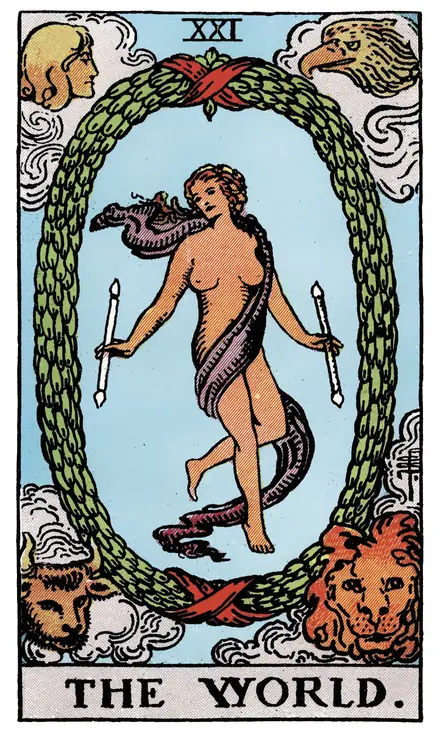
The World is the finished work and the journey home: a cycle that closes, gathers up everything lived and readies the next turn.
Draw this card · Its correspondences
- Arcana: Major, number XXI
- Hebrew letter: Tav (ת), “mark”
- Path on the Tree of Life: 32
- Attribution: Saturn
- Also: Earth
- In one sentence: The completed work
- Keywords: Completion, integration, accomplishment, travel
- Yes or no?: Yes
- Archetype: The Dancer at the End
What the card shows
In the deck Pamela Colman Smith drew for Arthur Edward Waite in 1909, the World takes the last place among the Major Arcana. In the centre, against a blue sky, floats an almost naked figure, wrapped only in a long violet sash that spirals across the body. The figure holds a wand in each hand and seems to dance, weight resting on one leg, the other crossed behind. Around it runs a great oval wreath of green leaves, tied at top and bottom with red ribbons crossed into a bow. In the four corners, among clouds, appear four heads: an angel, an eagle, a bull and a lion.
Every detail has its reading in the tradition. The laurel wreath is victory and, being closed, the completed cycle; the oval recalls an egg or a threshold, the passage from one life to another. The two wands, one in each hand, read as two forces held in balance, now mastered without effort. The crossed legs repeat the posture of The Hanged Man, now the right way up: what was sacrifice there is dance here. The four creatures are the tetramorph of Ezekiel and Revelation, the four Evangelists and the four fixed signs of the zodiac (Aquarius, Scorpio, Taurus and Leo). They also appear on the Wheel of Fortune, and here the wheel has stopped turning and become a garland.
In The Pictorial Key to the Tarot (1910), Waite presents the card as the perfection and end of the cosmos, the secret held within it, and notes that the figure is sometimes said to unite male and female. The Golden Dawn gave it Tav, the last letter of the Hebrew alphabet, meaning “mark”, the 32nd path and the planet Saturn, with Earth as a second attribution.
The World upright
Upright, the World reads as a complete achievement. Something long under way reaches its final form: a project delivered, a stage of life closed with meaning, a journey that ends in the right place. Tradition stresses that this fullness has been earned. The figure dances because she has passed through every card before her, and what she celebrates is the whole road.
In a spread, the World often signals integration. Loose pieces fit together, lessons learned at different times come together, and the person recognises themselves in what they have done. Waite adds a practical note: the card speaks of reward, of travel, of change of place and of emigration. The world, in this sense, is also the outside world, opening up.
The card bears the number XXI and the final letter of the Hebrew alphabet, and that position explains its double face. Every ending is a doorway. Beside The Fool, the unnumbered card, the World reads as the point where the journey ends and begins again on another level. Beside cards of effort, such as the Eight of Pentacles, it reads as the fruit of long and steady work.
As advice, the World asks you to acknowledge what you have achieved before rushing into the next thing. Close well, give thanks, gather what you learned. What is celebrated calmly becomes firm ground for the turn ahead.
The World reversed
Not every school reads reversed cards. Many readers work with upright cards only and let the neighbouring cards supply the nuance. Those who do read reversals tend to see the World reversed as a cycle that will not quite close.
Waite sums up its reversed meaning in four words: inertia, fixity, stagnation and permanence. You can recognise it in the project that is nearly finished and stalls on the last stretch, in the trip postponed again and again, in the stage of life that has run its course and that nobody says goodbye to. The work exists; it is missing its final stitch.
Another common reading ties it to Saturn, its planet: time weighing heavily, a structure that once held you up and now hems you in. Seen this way, the laurel wreath stops being a threshold and becomes a comfortable cage.
The advice is to work out what is missing for the cycle to close. Often it is very little: a conversation, a delivery, a small decision. Taking that step releases the energy the card holds upright.
In love
In love, the World reads as a relationship that has come into its fullness. In a couple it can point to a commitment made official, a shared home that finally works, a journey together, or the sense of having built something whole between two people. Tradition links it with mature love, in which each partner keeps their own shape and the two of them dance together.
For someone single, the World speaks of feeling complete before looking: a person who has closed their previous story and feels at ease in their own life. From there the card opens the horizon, and it is sometimes linked with meeting someone far from home or during a move.
Reversed, in love
Reversed in love, the World speaks of a story that will not quite end: a relationship kept going out of habit, a break-up without a goodbye, a step that keeps being postponed. As advice, it invites you to decide what shape you want the bond to take and to close what is already over.
Career and money
For career and money, the World reads as the culmination of long effort: a project delivered, a qualification earned, a promotion, a business that becomes established. It is also linked with international work, relocation and opportunities beyond your usual surroundings. It is a good moment to collect results and prepare the next stage.
Reversed, in career
Reversed, it points to delays in the final stretch, goals almost reached that get stuck, or a weight of routine. The advice is to find the detail blocking completion and finish it before opening new fronts.
Health and mood
For health and mood, the World is associated with the end of a process and with a sense of balance between body and mind. It reads as an invitation to consolidate good habits and to close each stage of care calmly. No card can diagnose anything: for any symptom or doubt, speak to a qualified health professional.
Yes or no? Yes
The World reads as one of the clearest “yes” answers in the tarot. What you are asking about has the shape of something reaching its end and becoming complete: the plan works, the trip happens, the stage closes well. The card adds one nuance. The result comes as the fruit of a road already travelled, so it asks you to finish what you have started.
Ask the card: a yes or no tarot reading with one card or three.
The archetype: The Dancer at the End
As an archetype, the World is the character who has arrived. It embodies the one who has passed every test and returns transformed, the traveller who comes home already knowing who they are. Its main trait is integration: inside the wreath there is room for every earlier version of the self, from the innocent of the opening to the one who fell and got up again. When it takes human form, it is the serene figure moving easily at the centre, with nothing left to prove.
In the structure of a story, the World is the resolution: the return with the elixir in the hero’s journey, the final scene that answers the first. Its dramatic force lies in resonance. The reader recognises in the ending the echoes of the beginning and feels the circle close. That is why the card calls for endings that integrate, that gather up the threads and show a changed character doing something they could never have done at the start.
The risk of this archetype in fiction is the picture-postcard ending, where everything fits at no cost. The World works when the fullness has been paid for. The dancer holds two wands, and those wands are heavy: the serenity of the ending convinces when the reader has seen the price. It also works very well as an open ending, because card XXI always looks toward the Fool setting out again. A good World ending closes one story and lets the next appear on the horizon.
There is a second way to use the archetype: the secondary character who is already complete and serves as a mirror for the protagonist. The teacher back from a journey of their own, the old woman who has lived several lives. Their mere presence shows the protagonist what the ending could look like.
In literature
- The Hobbit (J. R. R. Tolkien, 1937). Its subtitle, “There and Back Again”, is the World in four words. Bilbo leaves Bag End against his will, crosses the Wild, faces a dragon and comes home to the same round door. The village has not changed; he has. His neighbours find him odd, and he is content, a whole person at last.
- Orlando (Virginia Woolf, 1928). Orlando lives through four centuries and changes sex halfway through the book, like the figure on the card who unites male and female. The novel ends in its author’s own present, with an Orlando who gathers all her lives into one and finally finishes the poem she has been writing for centuries.
- Ulysses (James Joyce, 1922). Leopold Bloom crosses Dublin in a single day as Odysseus crossed the Mediterranean, and comes home in the small hours. The book closes with Molly’s monologue, which ends on a repeated “yes”. It is the World in an everyday key: a full voyage round the world that fits inside one city.
For writers
The conflict
The World sets up a conflict between fulfilment and the fear of finishing. The character is one step from completing something, and that last step costs more than all the others, because closing means ceasing to be the person they were along the way. It works well when identity is at stake: the traveller who dreads arriving, the artist who will not hand over the work, the family that cannot bring itself to sell the house.
The twist
As a plot twist, the World is the arrival that reveals the destination was the starting point all along. The character returns to the place where it began and sees it with new eyes. The four creatures in the corners suggest another route: gather in the final scene four characters who embody the four forces of the story, and let the protagonist move among them with ease.
Prompts
- Close the arc by having the character fold what they learned into one concrete action.
- Write the last scene of a story as an exact mirror of the first: the same place and the same gesture, with a new meaning.
- Have your protagonist finish a task they have put off for years, and tell only the ten minutes afterwards, when there is nothing left to do.
- Seat four characters who have accompanied your protagonist at different times of their life around one table, and let each of them remember a different person.
Its correspondences
- Letter and path: Tav. Source: Golden Dawn (tradition).
- Planet: Saturn. Source: Golden Dawn (tradition).
- Letter, alternative attribution: Tav. Source: Éliphas Lévi (tradition).
- Element: Earth. Source: Golden Dawn (tradition).
- Rune: Fehu. Source: Angelorum table (modern system).
- Rune: Othala. Source: Angelorum table (modern system).
- Archangel: Uriel. Source: Angelorum table (modern system).
- Archangel: Cassiel. Source: Angelorum table (modern system).
Combinations
The World and The Fool
The Fool and the World are the beginning and end of the same journey. Together they read as one cycle closing and another starting straight away, with the experience of the last round packed in the luggage.
The World and The Tower
With the Tower, the end of the cycle comes through a collapse. It reads as a whole stage of life closing abruptly, leaving the person ready to begin another with everything they have learned.
The World and Wheel of Fortune
The two cards share the four creatures in the corners. Together they read as a turn of fortune that reaches safe harbour: the change that looked like chance completes a long cycle.
The World and Judgement
Judgement and the World are the last two cards of the Major Arcana. They read as an inner call that is answered and leads to fulfilment: the awakening that finally finds its form.
The World and Ace of Swords
With the Ace of Swords, the closing comes with a clear idea. It reads as the understanding that gives meaning to a whole journey, or as a new project born from what has been completed.
The World and Ten of Cups
The World beside the Ten of Cups reads as emotional and family fulfilment: the home built, the bond that works, joy shared at the end of a long effort.
The World and Three of Wands
With the Three of Wands, the World underlines its sense of travel. It reads as widening horizons, work abroad, a move, or a project that crosses borders.
The World and Eight of Pentacles
Beside the Eight of Pentacles, the culmination reads as the fruit of craft: years of steady work that end in a piece of work done well and recognised.
Frequently asked questions
What does The World mean in tarot?
The World, card XXI and the last of the Major Arcana, stands for the completed work: a cycle that closes, lessons integrated and an achievement earned after a long road. Waite also links it with travel, reward and change of place.
What does The World mean in love?
In love it reads as a full, mature relationship: commitment, a shared home that works, or a joint project completed. For someone single, it speaks of feeling whole before looking, and of meetings tied to travel or a move.
Is The World a yes or no card?
It reads as a very clear “yes”. The card shows that what you are asking about reaches its final form and is completed. The nuance is that the result comes as the fruit of a journey, so it asks you to finish what you started.
What does The World reversed mean?
Readers who use reversals see it as a cycle that will not close: inertia, stagnation, a project stuck on the last stretch. Waite sums it up as fixity and permanence. The advice is to find what is missing and supply it.
What Hebrew letter and planet are linked to The World?
In the Golden Dawn system, The World corresponds to Tav, the last letter of the Hebrew alphabet, meaning “mark”, to the 32nd path of the Tree of Life and to the planet Saturn. The element of Earth is given as its second attribution.
What are the four animals on The World card?
They are the angel, the eagle, the bull and the lion, the tetramorph of Ezekiel’s vision and of Revelation. Tradition links them with the four Evangelists, the four elements and the four fixed signs of the zodiac. They also appear on the Wheel of Fortune.
Do your readingPrevious: Judgement · Next: Ace of Wands
The 22 Major Arcana
- The Fool
- The Magician
- The High Priestess
- The Empress
- The Emperor
- The Hierophant
- The Lovers
- The Chariot
- Strength
- The Hermit
- Wheel of Fortune
- Justice
- The Hanged Man
- Death
- Temperance
- The Devil
- The Tower
- The Star
- The Moon
- The Sun
- Judgement
- The World
By Style Optimizer · published November 22, 2026.