Tarot / The 78 cards / Major Arcana / The Moon
The Moon, Major Arcana XVIII: tarot card meaning, upright and reversed
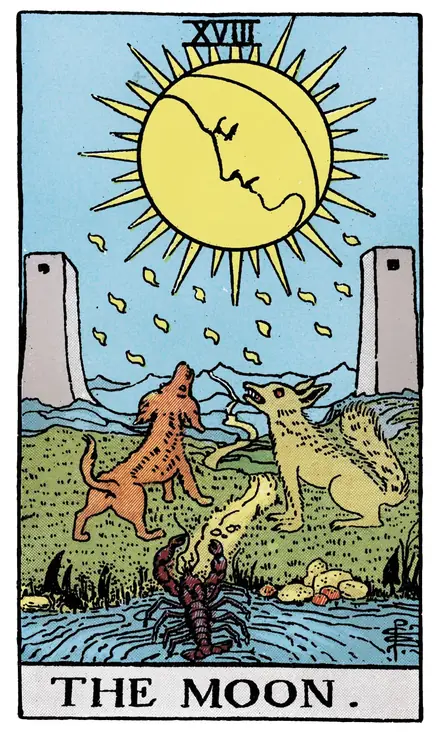
The Moon is the road walked by half-light, between fear and dream, at a time when what you see does not yet match what is really there.
Draw this card · Its correspondences
- Arcana: Major, number XVIII
- Hebrew letter: Qoph (ק), “back of the head”
- Path on the Tree of Life: 29
- Attribution: Pisces
- In one sentence: Fear and dreaming
- Keywords: Illusion, fear, anxiety, the subconscious, intuition
- Yes or no?: Not for now
- Archetype: The Shadow on the Path
What the card shows
In the deck Pamela Colman Smith drew for Arthur Edward Waite in 1909, the Moon hangs at the top of the card as a yellow disc with a face in profile, eyes half closed, ringed by long and short rays. Inside the disc a crescent is drawn. Drops shaped like yods fall from it, the Hebrew letter that was fire in the Tower and here looks more like dew. Below, on either side, stand two grey towers. Between them a narrow path begins, climbing and winding away through the hills toward distant mountains.
In the foreground lies a pool. A crayfish rises from its waters, trying to reach dry land. On the bank, a dog and a wolf lift their heads and howl at the moon. Waite reads them as the fears of the natural mind before a way out it knows only by rumour. The crayfish is the oldest and darkest part of human nature, something that climbs up from the depths and has no name. The towers mark a frontier: beyond them begins unmapped territory.
Waite insists that the light of this card is the light of imagination cut off from spirit. It illuminates, and it distorts. The tame dog and the wild wolf look at the same thing and react the same way. The path, meanwhile, keeps going straight ahead. The Golden Dawn assigned the card the Hebrew letter Qoph, meaning “back of the head”, the sign of Pisces and the 29th path of the Tree of Life, and gave it the title “Ruler of Flux and Reflux”. Éliphas Lévi, working with a different order of letters, had linked it to Tzaddi.
The Moon upright
Upright, the Moon reads as a time of uncertainty when things are not quite what they seem. Information is missing, shadows make problems look larger, and there is a vague feeling that something is slipping away. Tradition associates the card with illusion, fear, anxiety, dreams and intuition. All of these words share one idea: you perceive something real through a light that bends it.
In a spread, the card often suggests caution about first impressions. There may be a deception, your own or someone else’s. More often there is a misreading of the situation: a suspicion that feeds on itself, a fear that grows at night and shrinks by morning. The Moon asks you to separate what you know from what you imagine.
The card also has a fertile side. It is the card of dreams, imagination and the unconscious. For anyone who writes, paints or composes, the Moon reads as a season of powerful images that have yet to take shape. What crawls out of the pool is frightening, and it is also material.
As advice, the Moon suggests walking slowly along the path in the picture, without stopping to argue with every howl. Sleep, write down your dreams, wait for more facts before deciding. Beside cards of clarity, such as The Sun or the Ace of Swords, the confusion reads as temporary. Beside cards such as the Nine of Swords or the Seven of Cups, the emphasis falls on anxiety and on fantasies that distract.
The Moon reversed
Not every school reads reversed cards. Many readers work with upright cards only and let the neighbouring cards supply the nuance. Those who do read reversals tend to take the Moon reversed in two ways.
The first is the fog lifting. A deception comes to light, a fear loses its grip once it is named, a confusing situation starts to make sense. Read this way, the reversed Moon heralds the dawn and draws close to The Sun, which follows it in the sequence of the Major Arcana.
The second is confusion turning inward. The fear stops being projected onto other people and settles in the body: sleeplessness, restlessness with no clear cause, intuitions that get ignored. It can also point to a refusal to look at what is rising from the pool, at the price of feeling it anyway.
In both cases, the advice is to seek a second view: talk to someone you trust, check the facts, and give your emotions a place where they can be expressed.
In love
In love, the Moon reads as a relationship seen by half-light. In a couple it can point to doubts, jealousy, suspicions that never get confirmed, or things left unsaid. Sometimes there is a secret; sometimes there is only an insecurity that colours every gesture of the other person. The card advises asking before interpreting, and separating facts from phantoms.
For someone single, the Moon speaks of idealising: falling for an image, for someone you barely know, or for a story that exists mostly in your imagination. It can also point to an intense and slightly murky attraction, with more mystery than clarity. Give it time before you commit.
Reversed, in love
Reversed in love, the Moon reads as a doubt clearing up: a suspicion that turns out to be unfounded, or a truth finally spoken. It can also point to a fear of showing yourself as you are. The advice is to speak plainly.
Career and money
For career and money, the Moon reads as ground with poor visibility. There are rumours, incomplete information, agreements with small print, or a project whose direction nobody quite understands. This is a poor moment to sign without reading or to invest on a hunch. Tradition advises gathering facts, getting things in writing and distrusting whatever looks too good to be true. For creative work the card is kinder, and speaks of ideas born from dreams.
Reversed, in career
Reversed, it points to something hidden coming to light: an error in the accounts, an intention revealed, a misunderstanding resolved. The advice is to use the new clarity to put things in order.
Health and mood
For health and mood, the Moon is associated with disturbed sleep, anxiety and those vague discomforts that are hard to describe. It reads as an invitation to protect your rest and to pay attention to the feelings that weigh on you. No card can diagnose anything: for any symptom or worry, speak to a qualified health professional.
Yes or no? Not for now
The Moon reads as “no, not for now”. The situation is too dark to answer with any confidence: facts are missing, fears are distorting judgement, and some information may be hidden. The card advises waiting for more light before you decide. Once the fog lifts, the same question may get a different answer.
Ask the card: a yes or no tarot reading with one card or three.
The archetype: The Shadow on the Path
As an archetype, the Moon is the stretch of the story travelled at night. The protagonist has left the familiar behind, passed between the two towers, and now moves through a landscape where every sound could be a threat or a sign. When it takes human form, the Moon is the ambiguous figure: the guide who may be lying, the lover nobody knows anything about, the double, the ghost, the voice that speaks in dreams.
In the structure of a story, the Moon occupies the dark centre of the second act. The certainties of the opening no longer work and the truth of the ending has yet to arrive. This is the territory of suspicion, false clues and dreams that foreshadow. In the folk tale it is the forest; in the Gothic novel, the dark corridor; in the detective story, the moment when every suspect looks guilty.
The dramatic force of this archetype lies in making the reader share the character’s confusion. The dog and the wolf on the card are a good guide: the civilised and the wild react the same way to the unknown. The risk in fiction is getting lost in the fog with no direction. The Moon works when the path is still there, however hard it is to see, and when whatever rises from the pool ends up with a shape, a name and consequences.
In literature
- Life Is a Dream (Pedro Calderón de la Barca, 1635). Segismundo wakes in a palace after a lifetime locked in a tower and no longer knows what is real. Calderón turns that doubt into the engine of the drama: if everything might be a dream, how do you choose to act well? It is the Moon put on stage, complete with its tower and its awakening.
- The Turn of the Screw (Henry James, 1898). A governess sees ghosts at a country house and believes they are stalking the children in her care. James never settles whether they exist or are born of the narrator’s fear. The whole novella lives by moonlight, where perception and threat blur into each other.
- Pedro Páramo (Juan Rulfo, 1955). Juan Preciado comes to Comala to find his father and discovers a village of murmurs. Little by little, the reader realises that the living and the dead are speaking at once. Rulfo builds the novel as a night road among voices, where nothing ever comes fully into view.
For writers
The conflict
The Moon sets up a conflict between what the character perceives and what is really happening. It works best when the reader cannot be sure either: information arrives filtered through the protagonist’s fear, desire or exhaustion. To sustain it, scatter clues that allow two readings and let the character act on the wrong one. The conflict grows when that decision has real consequences.
The twist
As a plot twist, the Moon is the moment when the imagined and the real come apart. It might be the revelation that the enemy was innocent, that the ally was lying, or that the ghost was a memory. The crayfish crawling out of the water is a useful image: something ancient and buried surfaces, and it turns out stranger than anyone feared, or smaller.
Prompts
- Let a doubtful perception rule the scene until proof appears.
- Write a night scene in which your protagonist hears two different sounds and mistakes them for a single threat.
- Describe a dream your character has that the reader understands before they do, and have them remember it at the worst possible moment.
- Have two characters, one cautious and one wild, react in exactly the same way to the same thing, and let that coincidence frighten them more than the threat.
Its correspondences
- Letter and path: Qoph. Source: Golden Dawn (tradition).
- Sign: Pisces. Source: Golden Dawn (tradition).
- Letter, alternative attribution: Tzaddi. Source: Éliphas Lévi (tradition).
- I Ching trigram: Water. Source: Style Optimizer (our own proposal).
- Rune: Algiz. Source: Angelorum table (modern system).
- Archangel: Tzadkiel. Source: Angelorum table (modern system).
- Archangel: Asariel. Source: Angelorum table (modern system).
Combinations
The Moon and The Sun
The Moon followed by The Sun is the classic passage from night to day. It reads as confusion clearing, a fear dissolving and a truth that can at last be seen sharply.
The Moon and The Star
With The Star, the Moon gains a fixed point. Hope guides you through the uncertainty; it reads as walking in the dark with the confidence that the path leads somewhere.
The Moon and The High Priestess
The High Priestess beside the Moon strengthens intuition and the world of dreams. It reads as a time to listen to what you know without knowing how, taking care to tell intuition from fear.
The Moon and The Tower
The Tower and the Moon together speak of a crisis wrapped in confusion. The collapse uncovers something hidden, and it is wise to let the dust settle before drawing conclusions.
The Moon and Seven of Cups
With the Seven of Cups, the Moon heightens fantasy and illusory options. It reads as the risk of being carried away by attractive images with little ground beneath them.
The Moon and Nine of Swords
The Nine of Swords beside the Moon speaks of sleepless nights and fears that grow in the dark. It reads as an anxiety worth sharing and testing against the facts.
The Moon and The Devil
The Devil with the Moon points to a deception that binds: a dependence in disguise, a relationship that confuses. It reads as the need to see clearly what is holding you.
Frequently asked questions
What does The Moon mean in tarot?
The Moon, card XVIII of the Major Arcana, stands for uncertainty, fear and the world of dreams. Tradition reads it as a road walked by half-light, where things are not quite what they seem. It is also the card of intuition and creative imagination.
What does The Moon mean in love?
In love it reads as doubt, jealousy or idealisation. In a relationship it can point to things left unsaid or insecurities that distort how you see your partner; for someone single, falling for an image. The advice is to ask before you interpret.
Is The Moon a yes or no card?
It reads as “no, not for now”. The situation is too dark to answer with confidence, and the card advises waiting for more information before you decide.
What does The Moon reversed mean?
Readers who use reversals usually see it as the fog lifting: a deception uncovered or a fear losing its grip. It can also point to anxiety turning inward and asking for attention.
Is The Moon a bad card?
It is a difficult card because it speaks of fear and confusion, and tradition also links it with intuition, dreams and creativity. Its meaning depends a great deal on the surrounding cards and on the question asked.
What zodiac sign and Hebrew letter are linked to The Moon?
In the Golden Dawn system, The Moon corresponds to Pisces and to the Hebrew letter Qoph, meaning “back of the head”, on the 29th path of the Tree of Life. Éliphas Lévi, using a different order, had given it the letter Tzaddi.
Do your readingPrevious: The Star · Next: The Sun
The 22 Major Arcana
- The Fool
- The Magician
- The High Priestess
- The Empress
- The Emperor
- The Hierophant
- The Lovers
- The Chariot
- Strength
- The Hermit
- Wheel of Fortune
- Justice
- The Hanged Man
- Death
- Temperance
- The Devil
- The Tower
- The Star
- The Moon
- The Sun
- Judgement
- The World
By Style Optimizer · published November 22, 2026.