Tarot / The 78 cards / Major Arcana / The Sun
The Sun, Major Arcana XIX: tarot card meaning, upright and reversed
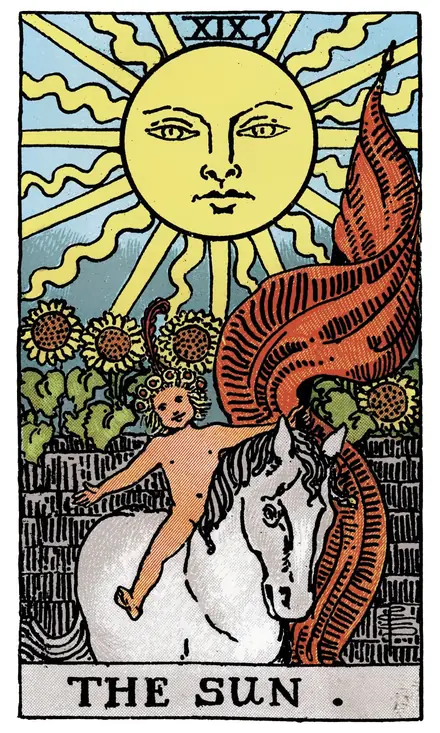
The Sun is the clarity that comes after the night: simple joy, success within reach and a truth that no longer needs to hide.
Draw this card · Its correspondences
- Arcana: Major, number XIX
- Hebrew letter: Resh (ר), “head”
- Path on the Tree of Life: 30
- Attribution: Sun
- In one sentence: Clarity without shadow
- Keywords: Positivity, fun, warmth, success, vitality
- Yes or no?: Yes
- Archetype: The Child on Horseback
What the card shows
In the deck Pamela Colman Smith drew for Arthur Edward Waite in 1909, the Sun fills the upper half of the card. It is a golden disc with a calm face looking straight out, surrounded by rays that alternate between straight and wavy lines. Below runs a grey brick wall, and above it rise open sunflowers turned toward the viewer. In front, a naked child rides a white horse bareback. The child wears a garland of flowers with a red feather, spreads both arms wide, and holds in one hand a large red banner that streams out behind.
Each element has its reading in the tradition. The child is innocence regained, life showing itself unclothed because it has nothing to hide. There is no saddle and no bridle: the white horse’s strength lets itself be guided without force. The red banner stands for vitality and victory. The wall marks the cultivated garden left behind; the child has already ridden out of it and moves in the open air. The sunflowers follow the sun, like nature turning toward the light.
In The Pictorial Key to the Tarot (1910), Waite replaced the two children of the older decks with this lone rider, and read the card as the passage from the light of this world to the light of understanding. The Golden Dawn assigned it to the Sun itself, to the Hebrew letter Resh, meaning “head”, and to the 30th path of the Tree of Life, with the title “Lord of the Fire of the World”. Éliphas Lévi had linked it to Qoph.
The Sun upright
Upright, the Sun is one of the most favourable cards in the tarot. Tradition associates it with joy, vitality, success, warmth and clarity. After the confusion of the Moon, everything is seen as it is: problems return to their real size, intentions are understood and energy comes back.
In a spread, the card often marks a good season. A project that succeeds, recognition, a reconciliation, a stretch of good health and good spirits. It also speaks of authenticity: showing yourself as you are, without masks, like the naked child in the picture. Things work because nothing needs hiding.
The Sun has a meaning closely tied to childhood. It can refer to a particular child, to a birth, or to the recovery of play and curiosity. For anyone who creates, it reads as a time of fluent work and of ideas expressed with simplicity.
As advice, the card invites you to enjoy what is good without distrusting it, and to share it. Sunlight falls on everyone alike. Beside cards such as the Tower or the Ten of Swords, the Sun reads as the way out of a crisis. Beside cards such as the Six of Wands or the Ten of Cups, it reinforces triumph and harmony. Its only possible shadow is excess: a confidence so dazzling that it stops seeing the details.
The Sun reversed
Not every school reads reversed cards. Many readers work with upright cards only and let the neighbouring cards supply the nuance. Those who do read reversals tend to take the Sun reversed in two ways.
The first is the clouded sun. The joy is there, and it arrives late, half-formed or muffled by tiredness. A success you cannot enjoy, an optimism that is hard to sustain, good news that is delayed. Read this way, the card keeps its favourable core and simply asks for patience.
The second is too much sun. Overconfidence, vanity, a wish to shine at other people’s expense, or a forced cheerfulness that hides something else. The child in the picture loses their innocence and starts to pose.
In both cases, the advice is to return to simple things: find out what truly gives you energy, and make sure your own light leaves room for other people’s.
In love
In love, the Sun reads as a radiant season. In a relationship it speaks of closeness, shared joy, trust and plans that come true. Traditionally it is also linked with the arrival of a child or with taking a visible step, such as meeting each other’s families. The relationship is lived in broad daylight.
For someone single, the Sun marks a good time to meet people and show yourself as you are. It speaks of easy encounters, frank attraction and relationships without games or hidden motives. The card favours naturalness over strategy.
Reversed, in love
Reversed in love, the Sun reads as a good relationship going through a dull patch: routine, tiredness, expectations set too high. It can also point to one partner shining while the other is left in the shade. The advice is to bring back a sense of play.
Career and money
For career and money, the Sun reads as success and recognition. A project that bears fruit, a promotion, a presentation that goes well, a stretch of steady income. The card favours everything done in the open: launching, publishing, putting yourself forward. Tradition also links it with clear accounts and with working enthusiastically, free of needless tension.
Reversed, in career
Reversed, it points to success that is delayed or barely enjoyed, or to overconfidence that leads you to neglect the details. The advice is to check the numbers before you celebrate.
Health and mood
For health and mood, the Sun is associated with vitality, good humour and renewed energy. It reads as an invitation to light, fresh air, movement and enough rest. No card can diagnose anything: for any symptom or worry, speak to a qualified health professional.
Yes or no? Yes
The Sun reads as one of the clearest “yes” answers in the tarot. The situation is out in the open, the energy is with you and things tend to go well. The card favours whatever is approached sincerely and without hidden motives. It only asks you not to take the outcome for granted too early, or to let overconfidence blind you to the details.
Ask the card: a yes or no tarot reading with one card or three.
The archetype: The Child on Horseback
As an archetype, the Sun is the light that returns after the night. When it takes human form, it is the child: the figure who sees things as they are, says what the adults keep quiet, and feels no fear because they have not yet learned to. It can also be the hero who comes home victorious, the loyal friend who never lies, or the person whose joy spreads through a whole community.
In the structure of a story, the Sun takes the place of the bright resolution. It arrives after the Moon, when suspicions scatter and the truth appears whole. It is the happy ending of a comedy, the wedding at the close, the reunion, the dawn after the longest night. In the folk tale it is the child’s return home with the treasure; in the coming-of-age novel, the instant the protagonist understands who they are.
The dramatic force of the archetype lies in contrast. The Sun moves us because the reader has been through the dark first. A story that begins in full daylight needs shadows for that light to carry weight. The risk in fiction is light without conflict, the comfortable ending that has not been earned. The Sun works when clarity costs something, and when it reveals what was hidden along with what is good. The wall in the picture is a reminder that the garden had limits, and that the child had to leave it in order to ride.
In literature
- The Secret Garden (Frances Hodgson Burnett, 1911). Mary Lennox, sour and neglected, finds the key to a walled garden locked for ten years. With Dickon and her cousin Colin, who has been kept in bed as an invalid, she brings it back to life. By the end Colin runs across the lawn in the sunlight: the wall, the flowers and the child of the card.
- To Kill a Mockingbird (Harper Lee, 1960). Scout tells, through a child’s eyes, the story of a trial that lays bare the racism of a small Alabama town. Her innocence lights up what the adults refuse to see. At the end Boo Radley, the feared neighbour, steps into the light and turns out to be her protector: a Moon that becomes a Sun.
- The Little Prince (Antoine de Saint-Exupéry, 1943). A pilot stranded in the desert meets a boy from an asteroid. With simple questions, the little prince dismantles the seriousness of grown-ups and gives the narrator back a way of seeing. He is the child of the Sun in its purest form: truth spoken with nothing to cover it.
For writers
The conflict
The Sun sets up a conflict between clarity and those who prefer the shade. It works well when the light threatens someone: the child who tells the truth in a family of secrets, the good news that exposes a lie, the success that stirs up envy. It can also be internal: a character who does not know how to be happy and distrusts every joy, because they have learned to live in the night.
The twist
As a plot twist, the Sun is the bright revelation that disarms fear. The monster turns out to be an ally, the lost letter surfaces and says the opposite of what everyone dreaded, the rival confesses their admiration. The twist gains force when clarity has a price: someone who lived comfortably in the half-dark is exposed and has to choose what to do in full daylight.
Prompts
- Expose to full light what only worked while it stayed hidden.
- Write the morning after your protagonist’s worst night, and let the daylight show them a detail they missed in the dark.
- Have a child say out loud, in the middle of a family meal, the sentence every adult at the table has spent years avoiding.
- Tell the story of a complete success for your character, and make the hardest part of the scene accepting it and sharing it.
Its correspondences
- Letter and path: Resh. Source: Golden Dawn (tradition).
- Planet: Sun. Source: Golden Dawn (tradition).
- Letter, alternative attribution: Qoph. Source: Éliphas Lévi (tradition).
- I Ching trigram: Fire. Source: Style Optimizer (our own proposal).
- Rune: Sowilo. Source: Angelorum table (modern system).
- Archangel: Michael. Source: Angelorum table (modern system).
Combinations
The Sun and The Moon
The Sun after the Moon is dawn after the night. It reads as confusion fully resolved, a fear revealed as groundless, and a situation that finally makes sense.
The Sun and The Tower
The Sun beside the Tower reads as light coming through the cracks. The crisis ends well: what collapsed let the clarity in, and the situation ends happier than it began.
The Sun and The Devil
The Devil beside the Sun reads as a bond brought into the light. What held you is recognised and named out loud, and letting it go brings relief and a new kind of joy.
The Sun and The Empress
With The Empress, the Sun reinforces growth and abundance. It reads as a fertile, happy season, very favourable for family, for a project or for anything that is taking shape.
The Sun and Ten of Cups
With the Ten of Cups, the Sun underlines happiness at home and in the family. It reads as a time of shared harmony, celebration and bonds that feel secure.
The Sun and Six of Wands
The Six of Wands with the Sun reads as a public, well-earned triumph. There is recognition, applause and the satisfaction of seeing your effort valued.
The Sun and Strength
Strength and the Sun share the fire of Leo. Together they read as full vitality, a quiet confidence in yourself and an energy that holds steady with no need to dominate.
The Sun and The Star
The Star and the Sun together are hope fulfilled. What was wished for in silence comes into the light and takes shape, with a feeling of calm and fullness.
Frequently asked questions
What does The Sun mean in tarot?
The Sun, card XIX of the Major Arcana, stands for clarity, joy, vitality and success. Tradition reads it as the light that comes after the night of the Moon: things are seen as they are and energy returns. It is one of the most favourable cards in the deck.
What does The Sun mean in love?
In love it reads as closeness, trust and shared joy. In a relationship it marks a good season or a visible step forward; for someone single, honest encounters without games. The card favours naturalness and showing yourself as you are.
Is The Sun a yes or no card?
It is one of the clearest “yes” cards in the tarot. The energy is with you and things tend to go well, especially when approached sincerely. It only asks you to avoid overconfidence and keep an eye on the details.
What does The Sun reversed mean?
Readers who use reversals usually see it as joy that is clouded or delayed, keeping its favourable core, or as overconfidence and a need to shine. The advice is to return to simple things.
What does the child on The Sun card mean?
The naked child on horseback reads as innocence regained and authenticity: there is nothing to hide. The child rides without reins, which tradition understands as strength guided without force.
What planet and Hebrew letter are linked to The Sun?
In the Golden Dawn system, The Sun corresponds to the Sun itself and to the Hebrew letter Resh, meaning “head”, on the 30th path of the Tree of Life. Éliphas Lévi, using a different order, had given it the letter Qoph.
Do your readingPrevious: The Moon · Next: Judgement
The 22 Major Arcana
- The Fool
- The Magician
- The High Priestess
- The Empress
- The Emperor
- The Hierophant
- The Lovers
- The Chariot
- Strength
- The Hermit
- Wheel of Fortune
- Justice
- The Hanged Man
- Death
- Temperance
- The Devil
- The Tower
- The Star
- The Moon
- The Sun
- Judgement
- The World
By Style Optimizer · published November 22, 2026.