Tarot / The 78 cards / Major Arcana / Judgement
Judgement, Major Arcana XX: tarot card meaning, upright and reversed
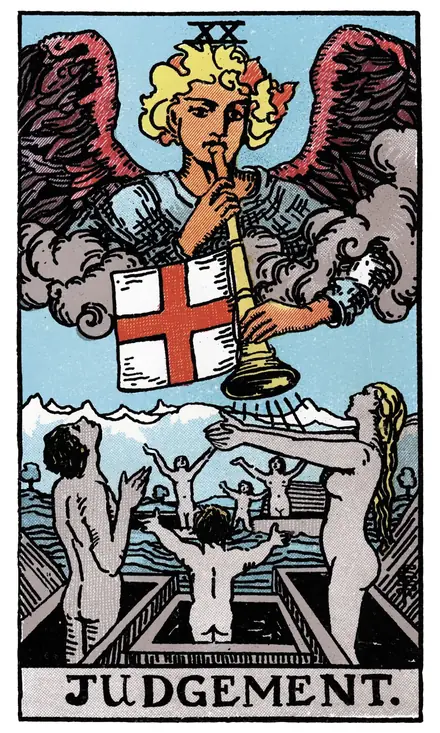
Judgement is the call that wakes you: a reckoning with the past, a voice that returns and the decision to rise and begin another life.
Draw this card · Its correspondences
- Arcana: Major, number XX
- Hebrew letter: Shin (ש), “tooth”
- Path on the Tree of Life: 31
- Attribution: Fire
- Also: Spirit
- In one sentence: The call that awakens
- Keywords: Judgement, rebirth, inner calling, absolution
- Yes or no?: Yes
- Archetype: The Awakened
What the card shows
In the deck Pamela Colman Smith drew for Arthur Edward Waite in 1909, Judgement shows a great red-winged angel leaning out of the clouds and blowing a trumpet. From the trumpet hangs a white banner with a red cross, and short strokes around the bell draw the sound itself. Below, on grey water, float open coffins. Naked figures with ashen skin rise from them, arms lifted toward the angel. In the foreground stand a man seen from behind, a woman, and a child between them; further back, another group repeats the gesture. In the distance rise white mountains, cold and high.
Each element has its reading in the tradition. The angel is usually identified as Gabriel, the messenger, and his trumpet is the call nobody can ignore. The cross on the banner joins two axes, the material and the spiritual, and reads as a sign of reconciliation. The coffins are what was considered finished: a stage of life, a part of oneself, a buried story. Floating on water, they suggest movement and emotion. The grey of the bodies speaks of what was asleep and is coming back to life. The family in the foreground brings the awakening close to home: the call reaches every age. The mountains are the abstract horizon that waits beyond.
In The Pictorial Key to the Tarot (1910), Waite reads the card as the completion of a great transformation, the answer of what is lowest in a person to a summons from on high. The Golden Dawn assigned it the Hebrew letter Shin, “tooth”, the element of Fire and also Spirit, on the 31st path of the Tree of Life. Many people know it as the Last Judgement; in the Marseille decks it is Le Jugement.
Judgement upright
Upright, Judgement reads as an awakening. Something calls to the person and makes them look at their life with new eyes: a piece of news, a reunion, a phrase that keeps echoing, a crisis that puts things in their proper place. Tradition associates the card with reckoning, forgiveness and the decision to begin again. Its image is the dead rising, so it speaks of rebirth and of accountability at once.
In a spread it often marks the moment when the past returns in order to be closed properly. Unfinished business, a person from another time, a vocation set aside long ago. The card invites you to hear that call and answer it. The Tower arrives as a blow; Judgement arrives as a voice. You can listen to it or drown it out, and what happens next depends on your response.
The name of the card sometimes frightens people, because it suggests a courtroom. Tradition reads it instead as an honest evaluation, in which you judge yourself clearly and also grant yourself pardon. Acknowledging what you did, accepting what cannot be mended, and keeping what you learned: these are the three movements of Judgement.
Beside The World, the card that follows it, Judgement reads as the end of a long cycle. Beside cards of grief, such as the Five of Cups, the emphasis falls on leaving an old sorrow behind. As advice, Judgement asks you to pay attention to whatever keeps coming back, because it usually carries the clue to what needs doing.
Judgement reversed
Not every school reads reversed cards. Many readers work with upright cards only and let the neighbouring cards supply the nuance. Those who do read reversals tend to take Judgement reversed in two ways.
The first is the ignored call. The person knows something has to change and stays exactly where they are: they postpone the decision, avoid a conversation, remain in the coffin out of comfort or fear. The reversed card then speaks of a chance for renewal that is slipping away.
The second is a judgement that is too harsh. The person examines themselves so severely that there is no way out: guilt, constant self-criticism, an inability to forgive themselves or others. Read this way, reversed Judgement points to a reckoning stuck at the sentence that never reaches the pardon.
In both cases, the advice is to listen to the trumpet again, more calmly: recognise what it is asking for and give yourself permission to answer.
In love
In love, Judgement reads as renewal. In a relationship it can point to a conversation that clears everything up, a forgiveness finally given, or a shared decision to start a new chapter with what you have learned. It also speaks of taking stock: seeing honestly what you have built together and what you want now.
For someone single, Judgement often appears alongside the return of someone from the past, or the final closing of an old story that left little room for a new one. Tradition links it with feeling desire again after a long pause.
Reversed, in love
Reversed in love, Judgement speaks of reproaches that keep repeating, a past relationship you cannot quite let go of, or guilt that stops you from starting over. As advice, it invites you to close what is pending before looking for something new.
Career and money
For career and money, Judgement reads as a calling or as an evaluation. It can point to an offer that brings back something you once left behind, a long-considered change of professional direction, or a moment of accountability, such as a review, an exam or an audit. Financially, it invites you to take stock and sort out whatever you have been carrying.
Reversed, in career
Reversed, it points to postponed decisions, a vocation kept quiet or an evaluation you dread. The advice is to prepare your reckoning honestly and take the step you have been putting off for a long time.
Health and mood
For health and mood, Judgement is associated with recovery and with the feeling of coming back to life after a dim period. It reads as an invitation to notice the signals your body keeps repeating and to take care of them. No card can diagnose anything: for any symptom or worry, speak to a qualified health professional.
Yes or no? Yes
Judgement reads as a “yes”, especially for questions about second chances, returns or new stages of life. The card shows that the call has already sounded and that the answer is in the hands of the person asking. It is a “yes” that asks you to act: listen to what returns, take stock and rise. If you wait without moving, the moment may pass.
Ask the card: a yes or no tarot reading with one card or three.
The archetype: The Awakened
As an archetype, Judgement has two faces. One is the messenger: the figure who brings the call, the old friend who reappears, the letter found in a drawer, the witness who finally speaks. The other is the awakened one: the character who hears that call and climbs out of the coffin, out of the half-life they had settled into. The card joins the two in a single scene.
In the structure of a story, Judgement belongs to the final stretch. It is the scene in which the protagonist looks back and sees their whole story, mistakes and successes alike, and decides who they want to be from then on. Many redemption novels are built on this card: the character must acknowledge what they did before they can be reborn. Its dramatic force lies in the past returning with all its weight and, even so, opening a door where one might expect it to close.
The danger of the archetype is the instant conversion, the change of heart that costs nothing and that the reader refuses to believe. Judgement works when the call has been prepared: the voice had sounded before, faintly, and the character had drowned it out. When they finally answer, the scene carries the weight of every time they did not. The open coffins on the card express this idea. What was buried was still there, waiting.
In literature
- A Christmas Carol (Charles Dickens, 1843). In a single night Scrooge is visited by his dead partner and by three spirits who show him his past, present and future. It is a complete trial, with its reckoning and its sentence, and it ends in a literal awakening: Scrooge opens his eyes in his own bed and decides to live differently.
- The Death of Ivan Ilyich (Leo Tolstoy, 1886). A respectable judge falls ill and, as he fades, reviews a life that was correct and empty. The man who judged others must now judge himself. In the final pages the light arrives that gives the card its name: acceptance, and a kind of release at the very end.
- Pedro Páramo (Juan Rulfo, 1955). Juan Preciado comes to Comala looking for his father and finds a village full of the voices of the dead, telling what happened. The graves speak, the past rises, and the story of Pedro Páramo is pieced together from those murmurs. It is Judgement told from inside the coffins.
For writers
The conflict
Judgement sets up a conflict between the character and their own past. Something returns and demands an answer: a debt, a promise, a person, an abandoned vocation. The character can respond or keep muffling the call, and both choices have a price. For the card to work, the past must have left visible traces in the story before it reappears: a name someone avoids, a scar, a photograph turned face down.
The twist
As a plot twist, Judgement is the return of what everyone believed was buried. It might be a character presumed dead, an old secret coming to light, or a second chance nobody expected. The most interesting moment comes with the response: who rises from the coffin and who prefers to stay inside. The family on the card suggests that the same call can reach several characters at once.
Prompts
- Bring back a voice, a debt or a calling the character thought was settled.
- Write the scene in which your protagonist receives a letter from someone they have not seen in twenty years, and end it before they open it.
- Have a character stand before an imaginary court and pronounce their own sentence out loud.
- Tell the story of a single call heard by three characters of different ages, like the family on the card, and show how each one answers.
Its correspondences
- Letter and path: Shin. Source: Golden Dawn (tradition).
- Element: Fire. Source: Golden Dawn (tradition).
- Letter, alternative attribution: Resh. Source: Éliphas Lévi (tradition).
- Element: Spirit. Source: Golden Dawn (tradition).
- Rune: Dagaz. Source: Angelorum table (modern system).
- Archangel: Michael. Source: Angelorum table (modern system).
- Archangel: Azrael. Source: Angelorum table (modern system).
Combinations
Judgement and The World
The World, which follows Judgement, closes the journey of the Major Arcana with it. Together they read as a cycle that ends well: the reckoning is done and the person is ready for a new, complete stage.
Judgement and Death
With Death, Judgement completes a movement of ending and return. Death closes; Judgement raises what remained. They read as a deep transformation that ends in rebirth.
Judgement and The Star
The Star beside Judgement reads as hope renewed after a hard season. The call arrives calmly and brings the confidence needed to answer without fear.
Judgement and Justice
With Justice, Judgement reads as a final reckoning. Justice weighs actions with care; Judgement calls you to answer for them. Together they point to a past being put in order and closed.
Judgement and The Hanged Man
The Hanged Man beside Judgement reads as the end of a wait. After the pause and the change of perspective comes the call that sets you moving again, with a new view of what you have lived.
Judgement and Six of Cups
The Six of Cups beside Judgement points to the return of someone or something from the past, often from childhood or youth. It reads as a reunion that helps close a chapter.
Judgement and Five of Cups
With the Five of Cups, Judgement invites you to leave an old sorrow behind. It reads as the moment to turn toward what is still standing and begin again.
Judgement and Strength
Judgement and Strength together read as a call that demands courage. The trumpet wakes you; Strength brings the calm and steadiness to change your life without being swept away.
Frequently asked questions
What does Judgement mean in tarot?
Judgement, card XX of the Major Arcana, stands for the call that wakes you: a reckoning with the past, forgiveness and the decision to begin again. Tradition links it with rebirth, second chances and buried things that return to be laid to rest properly.
What does Judgement mean in love?
In love it reads as renewal: a conversation that clears the air, an act of forgiveness, or the return of someone from the past. For someone single, it speaks of closing an old story and feeling desire again.
Is Judgement a yes or no card?
It reads as a “yes”, especially for second chances or new stages of life. It is a “yes” that asks you to act: the call has sounded, and the answer depends on the person asking.
What does Judgement reversed mean?
Readers who use reversals usually see it as an ignored call, with decisions put off, or as being far too hard on yourself. The advice is to listen to what keeps returning and allow yourself forgiveness.
Are Judgement and the Last Judgement the same card?
Yes. Card XX is known as Judgement and also as the Last Judgement, after its scene of an angel blowing a trumpet while the dead rise. In the Marseille decks it is Le Jugement, and in Crowley’s Thoth deck it becomes The Aeon.
What Hebrew letter and element are linked to Judgement?
In the Golden Dawn system, Judgement corresponds to the Hebrew letter Shin, meaning “tooth”, and to the element of Fire, as well as Spirit, on the 31st path of the Tree of Life. Éliphas Lévi assigned it the letter Resh.
Do your readingPrevious: The Sun · Next: The World
The 22 Major Arcana
- The Fool
- The Magician
- The High Priestess
- The Empress
- The Emperor
- The Hierophant
- The Lovers
- The Chariot
- Strength
- The Hermit
- Wheel of Fortune
- Justice
- The Hanged Man
- Death
- Temperance
- The Devil
- The Tower
- The Star
- The Moon
- The Sun
- Judgement
- The World
By Style Optimizer · published November 22, 2026.