Tarot / The 78 cards / Major Arcana / The Chariot
The Chariot, Major Arcana VII: tarot card meaning, upright and reversed
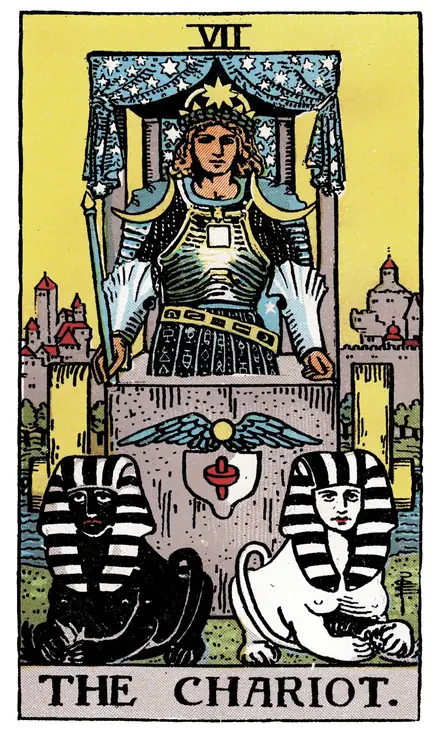
The Chariot is victory in motion: the will that harnesses opposing forces, steers without reins and drives towards a chosen goal.
Draw this card · Its correspondences
- Arcana: Major, number VII
- Hebrew letter: Cheth (ח), “fence”
- Path on the Tree of Life: 18
- Attribution: Cancer
- In one sentence: Victory in motion
- Keywords: Control, willpower, victory, assertion, determination
- Yes or no?: Yes
- Archetype: The self-governed conqueror
What the card shows
In the deck Pamela Colman Smith drew for Arthur Edward Waite in 1909, the Chariot shows a young man standing inside a cube-shaped chariot of stone. He wears armour, a crown set with an eight-pointed star and, on his shoulders, two crescent moons with faces. In his right hand he holds a wand that ends in a point. Above him stretches a blue canopy scattered with stars. In front of the chariot rest two sphinxes, one black and one white, looking in different directions. Behind lie a river and a walled city.
The most striking detail is what is missing: the charioteer holds no reins. He drives the sphinxes by will alone, and that is the key to the card. The two sphinxes are opposing forces, light and shadow, desire and duty, each of which would pull its own way if nothing held them together. The stone chariot is solid form, the body and discipline that carry the journey. The starry canopy places the undertaking under a celestial order. On the front of the chariot appear a winged disc and a shield with an emblem of opposites united.
In The Pictorial Key to the Tarot (1910), Waite sees in the Chariot triumph on every plane, and suggests that the moons on the shoulders are the Urim and Thummim, the oracular objects of the high priest. The Golden Dawn assigned the card the Hebrew letter Cheth, meaning “fence” or “enclosure”, the eighteenth path and the sign of Cancer, and Book T names it Lord of the Triumph of Light. The city left behind is a reminder that the victor has left home to conquer.
The Chariot upright
Upright, the Chariot reads as progress, determination and victory. This is the card of the moment someone decides where they are going and puts all their strength into getting there. The tradition links it with self-mastery, well-directed ambition and the ability to hold a course despite distractions. It speaks of journeys, moves, projects getting under way and goals reached through sheer persistence.
In a spread, it usually signals favourable momentum. Something that was stuck starts to move: a competition is won, a test is passed, a position is secured. The important nuance is in the drawing: the sphinxes face different ways. The Chariot’s victory demands holding together tendencies that contradict each other, and the charioteer’s merit is that he never lets them break loose.
As advice, the Chariot asks for a clear objective and self-control. The card favours the person who knows what they want and acts decisively, and also the one who knows themselves well enough to govern their impulses. The armour suggests protection: triumph comes from moving forward firmly without exposing yourself more than necessary.
Next to cards such as the Six of Wands or the Sun, the Chariot strengthens the sense of success and recognition. Next to cards such as the Eight of Swords, the movement slows, and the card reads as the need to take back the reins.
The Chariot reversed
Many readers never use reversals; they read every card upright and let the surrounding cards add the nuance. Those who do read reversed cards usually see the Chariot upside down in one of two ways.
The first is loss of control. The sphinxes pull in opposite directions, the chariot veers off course and the person feels dragged along by circumstances or by their own impulses. It is linked with projects that scatter, haste that loses the way and aggression standing in for real willpower.
The second is too much drive: someone who wants to win at any cost, rides roughshod over others or mistakes stubbornness for strength. Read this way, the reversed card asks you to stop, review the goal and ask whether the chosen road still leads where you meant to go. Sometimes braking in time is the wisest way to stay in command.
In love
In love, the Chariot reads as momentum and decision. In a relationship it speaks of a season of moving forward together: a move, a shared project, a trip, the resolve to overcome an obstacle as a team. It also asks both people to pull in the same direction, like the sphinxes under a single will.
For singles, the card is linked with taking the initiative and with an active phase of going out, meeting people and being on the move. It can point to someone determined and ambitious entering your life.
Reversed, in love
Reversed in love, the Chariot points to a battle of wills or a relationship in which each partner goes their own way. The advice is to stop competing and agree on a shared direction.
Career and money
For career and money, the Chariot is linked with promotion, competitions won and projects that move fast. It reads as a good time to sit an exam, launch an initiative or defend a position firmly. It can also point to business travel or a transfer to a new post.
Reversed, in career
Reversed, it points to scattered effort, unclear goals or conflict over who is in charge. It asks you to set priorities before speeding up and to keep impulse spending in check.
Health and mood
In health and mood, the Chariot is linked with energy, discipline and consistent habits, and also with the risk of pushing yourself too hard. It reads as an invitation to keep up steady routines without forcing the pace. No card can diagnose anything: for any symptom or concern, the person to see is a health professional.
Yes or no? Yes
The Chariot reads as a clear “yes”, especially when the question depends on your own effort and resolve. The card speaks of progress and victory, and favours anyone with a defined goal who pursues it steadily. The condition is staying in control: the result comes if you direct your energy towards the goal instead of scattering it.
Ask the card: a yes or no tarot reading with one card or three.
The archetype: The self-governed conqueror
As an archetype, the Chariot is the hero who leaves home with a goal and the will to reach it. The young warrior, the athlete training for the final, the entrepreneur leaving town, the traveller crossing a continent. Their essential trait is directed drive: they have strength and know where to aim it. The missing reins in the drawing sum it up: the Chariot character steers from within.
In story structure, the Chariot occupies the stretch of the first victory. It is the moment when the protagonist, having answered the call, shows what they are capable of: they win the first battle, pass the test, get what they were after. That triumph is real and thrills the reader, though it is usually provisional. The card is number VII, halfway along the road of the Major Arcana, and its victory opens the door to deeper trials.
The archetype’s dramatic richness lies in the two sphinxes. Every Chariot character carries forces pulling in opposite directions: ambition and loyalty, desire and discipline, what they want and what they owe. While they hold them together, they advance. When one breaks free, the story finds its crisis. A writer who understands this writes victories with tension running underneath, and the reader senses that the chariot could overturn at any bend.
Cancer, the card’s sign, adds a useful contrast. The crab carries its home on its back, and the charioteer rides inside a shell of stone and armour. Under all that protection there is often something tender: a homesickness, a family, a fear. Show that softness once, and the conqueror becomes a person.
In literature
- Phaedrus (Plato, 370 BC). Socrates compares the soul to a charioteer driving two winged horses: one noble and obedient, the other stubborn and unruly. The driver must tame the second without losing the first in order to rise towards the heights. It is the oldest image of the Chariot and its two sphinxes, the will that unites contrary impulses.
- Ben-Hur (Lew Wallace, 1880). Judah Ben-Hur, condemned to the galleys through a betrayal, rebuilds his life and returns to face his former friend Messala in the circus at Antioch. The chariot race is the card in its purest form: control, rivalry and victory. The novel places that triumph halfway along the road; other trials follow.
- Moby-Dick (Herman Melville, 1851). Captain Ahab has an iron will and a single goal: the white whale. He commands the Pequod and its crew with a force no one dares question. Melville shows the Chariot reversed, determination hardened into obsession that drags everyone on board towards shipwreck.
For writers
The conflict
The Chariot sets up a conflict between two forces the protagonist must keep together in order to advance. It works best when both are legitimate: career and family, revenge and the law, personal ambition and loyalty to the group. The character cannot let go of either without losing something important. The goal demands speed, and the sphinxes demand balance.
The twist
As a plot twist, the Chariot is the victory that binds. The character wins, and in the same moment becomes tied to a road they can no longer leave. The city behind the charioteer on the card is a good clue: every advance takes them further from home. An interesting twist comes when one of the sphinxes, which seemed tamed, rises up at the worst possible moment.
Prompts
- Give the character an immediate victory that commits them to a more dangerous path.
- Write a race, journey or chase scene in which the character has to make a moral decision without ever stopping.
- Give your protagonist two opposing desires and let both drive them forward, up to the scene where one of them stops obeying.
- Tell the victor’s return to the city they left behind, and what they find changed by their absence.
Its correspondences
- Letter and path: Cheth. Source: Golden Dawn (tradition).
- Sign: Cancer. Source: Golden Dawn (tradition).
- Letter, alternative attribution: Zayin. Source: Éliphas Lévi (tradition).
- Rune: Raidho. Source: Angelorum table (modern system).
- Archangel: Gabriel. Source: Angelorum table (modern system).
Combinations
The Chariot and Strength
The Chariot and Strength speak of two ways to master a force: the will that steers and the patience that tames. Together they read as complete control, firm on the outside and calm within.
The Chariot and Justice
With Justice, the Chariot’s victory is placed on the scales. Together they read as a legitimate triumph, won for good reasons, as long as haste does not bend the judgement.
The Chariot and Six of Wands
The Six of Wands beside the Chariot reinforces success and public recognition. It reads as a visible victory, celebrated by others, after sustained effort.
The Chariot and The Fool
With the Fool, the Chariot’s drive loses direction and gains freedom. Together they read as a journey begun with enthusiasm, where it pays to set a course before speeding up.
The Chariot and Eight of Swords
The Eight of Swords brakes the Chariot. It reads as feeling stuck despite the will to move forward; the way out lies in regaining command of yourself.
The Chariot and The Magician
With the Magician, the Chariot’s will finds its tools. Together they read as a project with initiative and resources, ready to get moving.
The Chariot and Knight of Wands
With the Knight of Wands, the movement speeds up: travel, moves or quick decisions. The pairing asks for enthusiasm with a measure of caution so that you stay in control.
Frequently asked questions
What does The Chariot mean in tarot?
The Chariot, card VII of the Major Arcana, stands for victory in motion: the will that harnesses opposing forces and drives towards a goal. The tradition links it with determination, self-control, travel and success won through effort and persistence.
What does The Chariot mean in love?
In love it reads as momentum and decision: a couple moving forward together towards a shared project, or an active phase for someone looking for a partner. Reversed, it points to a battle of wills and asks you to agree on a common direction.
Is The Chariot a yes or no card?
The Chariot reads as a clear “yes”, especially when the outcome depends on your own effort and determination. The condition is staying in control and directing your energy towards the goal.
What does The Chariot reversed mean?
Readers who use reversals usually see it as loss of control, scattered energy or forces pulling in opposite directions. It can also mean too much drive and a need to win at any cost. It asks you to slow down, review the goal and take back command.
Why does the charioteer in The Chariot have no reins?
In Pamela Colman Smith’s drawing, the young man guides the two sphinxes with no reins at all. The tradition reads this as mastery through will: the opposing forces obey the inner decision of the one who drives.
What zodiac sign and Hebrew letter correspond to The Chariot?
In the Golden Dawn system, the Chariot corresponds to Cancer and to the Hebrew letter Cheth, meaning “fence” or “enclosure”, on the eighteenth path of the Tree of Life. Éliphas Lévi had given it a different attribution, the letter Zain.
Do your readingPrevious: The Lovers · Next: Strength
The 22 Major Arcana
- The Fool
- The Magician
- The High Priestess
- The Empress
- The Emperor
- The Hierophant
- The Lovers
- The Chariot
- Strength
- The Hermit
- Wheel of Fortune
- Justice
- The Hanged Man
- Death
- Temperance
- The Devil
- The Tower
- The Star
- The Moon
- The Sun
- Judgement
- The World
By Style Optimizer · published November 22, 2026.