Tarot / The 78 cards / Major Arcana / The Tower
The Tower, Major Arcana XVI: tarot card meaning, upright and reversed
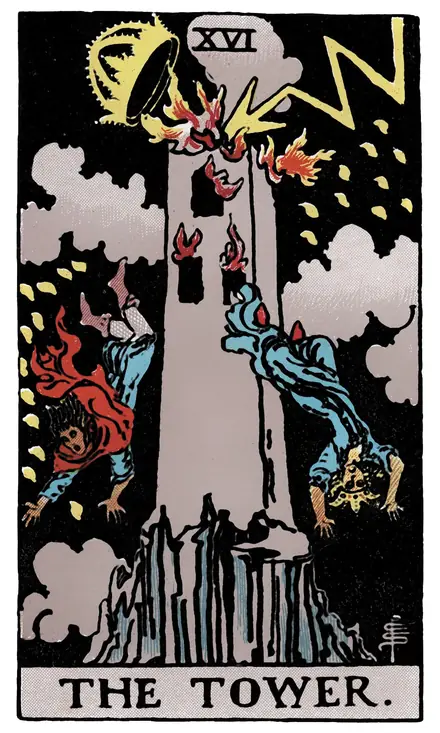
The Tower is the sudden collapse that exposes what the structure was hiding: a truth that forces you to rebuild from the foundations up.
Draw this card · Its correspondences
- Arcana: Major, number XVI
- Hebrew letter: Peh (פ), “mouth”
- Path on the Tree of Life: 27
- Attribution: Mars
- In one sentence: The lightning that strikes down
- Keywords: Sudden upheaval, revelation, release, chaos, awakening
- Yes or no?: No
- Archetype: The Revealing Collapse
What the card shows
In the deck Pamela Colman Smith drew for Arthur Edward Waite in 1909, the Tower rises from a lonely crag, so tall it seems to be reaching for the sky. A bolt of lightning strikes the top and knocks off the crown that capped it. Flames pour from its three windows. Two people fall headfirst into the void: one wears a crown and a red cloak, the other is dressed in blue. The background is black, and on either side of the tower falls a rain of fiery drops shaped like yods, the first letter of the divine name in Hebrew.
Each element has its reading in the tradition. The crown is the head of the structure: pride, the idea that seemed untouchable. The lightning comes from above and from outside, and nobody asked for it, which is why it is tied to revelation and to what cannot be bargained with. The two figures are often read as two halves of one person, the one who commands and the one who obeys, or as power and those who prop it up, falling together. The fiery drops are the part many people overlook. The same fire that destroys also falls like seed.
In The Pictorial Key to the Tarot (1910), Waite sets aside the Tower of Babel as the single key to the card and prefers to see in it the ruin of a house built on a lie. The Golden Dawn assigned it the Hebrew letter Peh, meaning “mouth”, and the planet Mars: the word that brings walls down and the force that asks no permission. In the Marseille decks the card is called La Maison Dieu, the House of God.
The Tower upright
Upright, the Tower reads as an abrupt change nobody would have chosen, which leaves things clearer than they were before. Something that looked solid comes down in a short time: a plan, a relationship, a belief about yourself, a way of working. Tradition insists on one nuance. What falls is what was badly built. That is why the card speaks of disaster and of liberation in the same image.
In a spread it often marks a moment of revelation. A fact comes out, a conversation puts everything on the table, someone finally says what everyone else kept quiet. The blow hurts because it forces you to see. Once the first shock passes, there is open ground, and the question becomes what to build in its place.
The Tower is one of the cards that most alarms beginners, and it rewards a calm reading. It rarely announces a literal catastrophe. In the tradition it is usually understood as the end of an illusion. Beside bright cards such as The Star or The Sun, the collapse reads as a necessary step toward something better. Beside hard cards such as the Ten of Swords, the emphasis falls on loss and on the time it will take to recover.
As advice, the card asks you to stop propping up what is already falling. Spending your strength on holding up a façade tends to drag out the damage. Better to step aside, look at what is still standing, and start again from the foundations.
The Tower reversed
Not every school reads reversed cards. Many readers work with upright cards only and let the neighbouring cards supply the nuance. Those who do read reversals tend to take the Tower reversed in two ways.
The first is the postponed collapse. You know something is failing, you can see the cracks, and you keep papering over them. The reversed card then speaks of fear of change and of pressure that keeps building. The blow is only delayed, and it may land harder when it comes.
The second is the inner collapse. The crisis happens inside, without any public drama: a person changes their mind about something central in their life and quietly rearranges everything. Read this way, the reversed Tower is gentler and more personal. It speaks of letting go of an old idea before life knocks it down by force.
In both cases the advice is the same as upright, with more urgency: face what you are avoiding and choose your own moment to take it apart.
In love
In love, the Tower reads as an upheaval. In a relationship it can point to an argument that changes everything, a secret coming to light, or the fall of an idealised image of your partner. It does not always mean the end. Some couples come out of a Tower more honest, because they have finally said what they think. What the card makes clear is that the relationship cannot go on as it was.
For someone single, the Tower often speaks of breaking a pattern: no longer chasing the same type of person, stepping out of a story that keeps repeating, or meeting someone who dismantles your ideas about love. It can also show up as a sudden, unexpected attraction that turns your life upside down.
Reversed, in love
Reversed in love, the Tower speaks of a crisis you can see coming and keep dodging: conversations put off, unease kept under wraps, a break-up that has already happened inside and not yet outside. As advice, it invites you to start the overdue conversation before it explodes by itself.
Career and money
For career and money, the Tower reads as a change that comes from outside and forces you to reorganise: a restructuring, a cancelled project, a client who leaves, an unexpected drop in income. It can also expose a deeper problem, such as accounts that never added up or a way of working that no longer holds. Tradition advises against big decisions made in the heat of the moment. Check the foundations and use the gap to rebuild on firmer ground.
Reversed, in career
Reversed, it points to known problems being covered up: a role that no longer fits, a company showing warning signs, an expense you keep ignoring. The advice is to get ahead of it and prepare an exit or a plan B before the change is imposed on you.
Health and mood
For health and mood, the Tower is associated with exhaustion that arrives all at once after pushing too hard, and with scares that force you to stop. It reads as a call to listen to your body and review habits you took for granted. No card can diagnose anything: for any symptom or worry, speak to a qualified health professional.
Yes or no? No
The Tower reads as a “no” to the question as it stands. What you want to keep or achieve rests on something that is about to change, and the card says the plan, as currently imagined, will not go ahead. It is a “no” that opens another door: what collapses often makes room for a more honest option. If the question is whether something will change suddenly, the answer is “yes”.
Ask the card: a yes or no tarot reading with one card or three.
The archetype: The Revealing Collapse
As an archetype, the Tower is the moment when the story can no longer pretend. It is less a character than an event: the news that changes everything, the fire, the confession, the evidence that surfaces at the worst possible time. When it takes human form, it is the figure who brings the truth without asking permission, the unexpected witness or the visitor who says out loud what nobody wanted to hear.
In the structure of a story, the Tower takes the place of the great turning point: the end of the second act, when the protagonist’s plan falls apart, or the climax of a tragedy, when the hero discovers who they really are. Its dramatic power lies in destroying and clarifying at once. What is lost is real, and so the reader feels it. What is discovered matters more than what is lost, and so the story moves forward.
The danger of this archetype in fiction is to use it as gratuitous punishment. The Tower works when the collapse has been prepared: there were cracks the reader could see before the character did, a crown too heavy to wear, a lie told once too often. Then the lightning feels inevitable and fair, however brutal it is.
In literature
- Oedipus Rex (Sophocles, 429 BC). The whole tragedy walks toward a Tower. Oedipus investigates who killed King Laius, and every answer brings him closer to the truth that destroys his life: he is the culprit himself. The crown falls quite literally, and what remains is a man who finally sees, at the very moment he chooses to stop seeing.
- The Fall of the House of Usher (Edgar Allan Poe, 1839). A house cracked from roof to ground, a family guarding a secret, and a stormy night when everything comes out. At the end the mansion splits along its fissure and sinks into the tarn. Poe builds the tale so that the collapse seems written from the first page.
- Rebecca (Daphne du Maurier, 1938). Manderley is the tower: a perfect house resting on everything nobody says about its first mistress. When the truth comes out, the house burns. The narrator loses the place she had tried so hard to fill and gains a more honest marriage, which is the card’s double edge.
For writers
The conflict
The Tower sets up a conflict between what has been built and the truth that contradicts it. It works best when the character has invested heavily in the structure: their reputation, their marriage, their faith, their company. The more it cost them to raise it, the harder the lightning strikes. To prepare the card, plant visible cracks: lines that do not fit, objects out of place, a question someone asks and nobody answers.
The twist
As a plot twist, the Tower is the revelation that changes everything and leaves the characters among the rubble. The most interesting moment comes right after the blow: who gets up first, who looks for someone to blame, who is secretly glad. The two falling figures on the card are a good clue. The collapse drags two people down at once, and each will live through it differently.
Prompts
- Bring down the lie that held the scene up and leave the characters among the ruins.
- Write the scene immediately after a revelation without narrating the revelation itself: only the wreckage and what the characters do with it.
- Have your protagonist try to shore up a lie one last time, and make that effort the thing that brings it down.
- Tell the same collapse from both falling figures: the one who wore the crown and the one who held the tower up while nobody noticed.
Its correspondences
- Letter and path: Peh. Source: Golden Dawn (tradition).
- Planet: Mars. Source: Golden Dawn (tradition).
- Letter, alternative attribution: Ayin. Source: Éliphas Lévi (tradition).
- I Ching trigram: Thunder. Source: Style Optimizer (our own proposal).
- Rune: Hagalaz. Source: Angelorum table (modern system).
- Archangel: Kamael. Source: Angelorum table (modern system).
Combinations
The Tower and Death
The Tower and Death together speak of an ending that is complete and swift. The Tower brings the blow; Death, the certainty that there is no going back. They read as a chapter closing fully so another can begin.
The Tower and The Star
This is the classic pairing of the tradition: after the lightning, the calm. The Star following the Tower reads as recovery, hope and a cleaner direction than the one before.
The Tower and The Devil
The Devil beside the Tower marks a bond that breaks: a dependence, a toxic tie or a controlling situation that shatters all at once. The collapse sets the person free.
The Tower and Wheel of Fortune
With the Wheel of Fortune, the change comes from outside and does not depend on the person asking. It reads as a turn of fate or circumstance that you can only adapt to.
The Tower and The Sun
The Tower followed by The Sun reads as a crisis that ends well: what falls lets the light in, and the situation ends clearer and happier than it began.
The Tower and Ace of Swords
With the Ace of Swords, the revelation arrives as an idea or a word: a truth spoken plainly that cuts straight through a confused situation.
The Tower and The Lovers
The Lovers beside the Tower speak of a choice forced by crisis. The upheaval makes you decide which bond or which value you keep.
The Tower and The World
With The World, the collapse closes a long cycle. It reads as the end of a whole stage of life, leaving the person ready to begin another with what they have learned.
Frequently asked questions
What does The Tower mean in tarot?
The Tower, card XVI of the Major Arcana, stands for sudden change that brings down what was badly built and reveals a hidden truth. Tradition reads it as crisis and as liberation at once: what falls leaves room to start again from the foundations.
What does The Tower mean in love?
In love it reads as an upheaval: a decisive argument, a secret coming out, or the fall of an idealised image. It does not always mean a break-up; sometimes the couple comes out more honest. What it shows is that the relationship cannot stay the same.
Is The Tower a bad card?
It is one of the hardest cards in the deck, and tradition still reads it as necessary. The collapse affects what was already cracked, which is why the card is also linked with liberation and truth. Its final meaning depends a great deal on the cards around it.
Is The Tower a yes or no card?
It reads as a “no” to the plan as it stands, because it announces sudden change. If the question is whether a quick change is coming, the answer is “yes”.
What does The Tower reversed mean?
Readers who use reversals usually see it as a postponed collapse, a crisis you can see coming and keep covering up, or as a quiet inner change. The advice is to deal with what is pending before it blows up by itself.
What planet and Hebrew letter are linked to The Tower?
In the Golden Dawn system, The Tower corresponds to Mars and to the Hebrew letter Peh, meaning “mouth”, on the 27th path of the Tree of Life. In the Marseille decks the card is called La Maison Dieu, the House of God.
Do your readingPrevious: The Devil · Next: The Star
The 22 Major Arcana
- The Fool
- The Magician
- The High Priestess
- The Empress
- The Emperor
- The Hierophant
- The Lovers
- The Chariot
- Strength
- The Hermit
- Wheel of Fortune
- Justice
- The Hanged Man
- Death
- Temperance
- The Devil
- The Tower
- The Star
- The Moon
- The Sun
- Judgement
- The World
By Style Optimizer · published November 22, 2026.