Tarot / The 78 cards / Pentacles / Eight of Pentacles
Eight of Pentacles (8 of Pentacles): tarot card meaning, upright and reversed
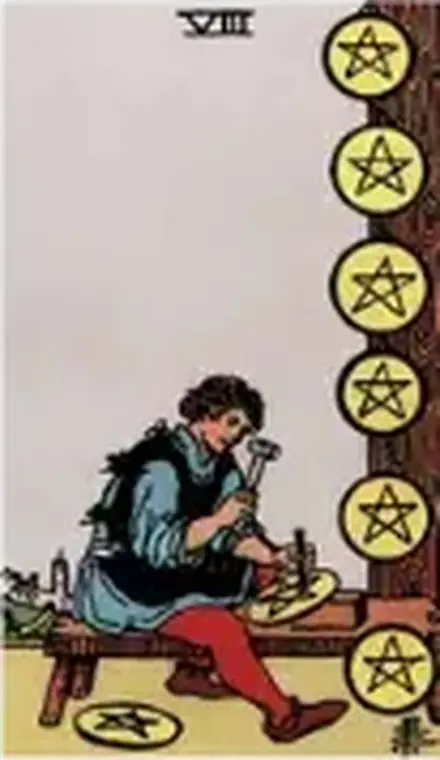
The Eight of Pentacles is a craft learned piece by piece: hours at the bench, attention to detail and a skill that grows with practice.
Draw this card · Its correspondences
- Arcana: Minor, number 8
- Suit and element: Pentacles, Earth
- Golden Dawn title: Lord of Prudence
- Sephirah: Hod
- Decan: Virgo I, Sun (0° to 10° Virgo)
- Keywords: Apprenticeship, mastery, detail, skill development
- Yes or no?: Yes, with conditions
- Archetype: The Apprentice Becoming Master
What the card shows
In the deck Pamela Colman Smith drew for Arthur Edward Waite in 1909, the Eight of Pentacles shows a young man seated at a workbench. He wears a blue tunic, red hose and a dark apron, the uniform of someone who gets their hands dirty. With hammer and chisel he engraves the five-pointed star on a disc resting on his knees. Beside him stands a wooden post with six finished pentacles hung one above another; another lies on the ground next to the bench. The eighth is the one in his hands. Far off in the background, a road leads to a town with its rooftops.
Each detail has its reading. The hanging pentacles are the workshop’s display: finished work shown off like a trophy and also as proof that the craftsman is improving. The one on the ground is usually read as the piece still pending, or the one that came out so-so and is waiting for another pass. The bowed head and fixed gaze speak of concentration. The young man works with his back to the town, which remains the place of trade and recognition, present but set apart.
Waite describes the card as an artist in stone at his work, and links it with work, employment, commission, and skill in craft and business, perhaps still at the preparatory stage. The Golden Dawn titled it the Lord of Prudence and placed it in Hod, the sefirah of method and practical intellect, in the first decan of Virgo, ruled by the Sun: light trained on the detail.
Eight of Pentacles upright
Upright, the Eight of Pentacles reads as steady, well-done work. It is the card of hands-on learning: someone repeating a movement until they master it, studying, correcting, starting again. Its pace is slow and its reward is sure. Tradition links it with mastery earned through hours, with the commission completed and with the pride of doing small things well.
In a spread it often points to a period of training or intense dedication to a specific task: a course, an internship, a new trade, a project that demands patience. It can also describe work you already know well that still leaves room to improve. After the Seven of Pentacles, which waits for the harvest, the Eight goes back to the workbench and starts producing.
The number eight, in Hod, gives the card a methodical character. Skill comes from putting effort in order: one step, then the next. That is why the Eight of Pentacles also reads as the value of a chosen routine, the one that keeps quality up when inspiration runs dry.
As advice, the card asks you to focus on the task and leave the shop window for later. The town in the background can wait. What matters now is the piece in your hands, and the next one, and the one after that.
Eight of Pentacles reversed
Many readers work only with upright cards and let the neighboring cards shade the meaning. Those who read reversals usually take the Eight of Pentacles reversed in three ways.
The first is careless work: haste, half-finished pieces, a task repeated without learning anything from it. The second is perfectionism that paralyzes, the craftsman who files the same piece again and again and never hands it over. The third comes from Waite, who saw in the reversed card voided ambition and an ingenious mind turned to cunning and intrigue: skill used to deceive or to get ahead.
The advice is to look at the purpose of the effort. Are you working to learn, to comply or to look good? The answer usually shows what needs to change.
In love
In love, the Eight of Pentacles reads as a relationship built day by day. For couples it speaks of consistency, small repeated gestures and learning to live together patiently, the way you learn a trade. It looks unromantic on the surface and runs very deep: the card of affection shown through actions.
If you are single, the card often points to a season of personal work. It can be a good moment to devote yourself to your own growth, a project or something you are learning. It is also linked with meeting someone through work or a class.
Reversed, in love
Reversed in love, it speaks of routine without attention: a couple running on autopilot, or one who gives all their time to work and leaves the relationship for later. As advice, it invites you to bring to the bond the same care you bring to the job.
Career and money
For career and money, the Eight of Pentacles is one of the most favorable cards in the suit for professional life. It reads as employment, commissions, training and sharpening your skills. It shows that effort comes through in quality, and that quality, in time, gets paid. Income grows little by little, at the pace of the work. Tradition advises investing in learning and taking care with every delivery.
Reversed, in career
Reversed, it points to work that does not motivate, mechanical tasks or a lack of training. It can also warn of the temptation to cut corners on quality in order to go faster. The advice is to rekindle your interest in the craft or find one where you can grow.
Health and mood
For health and wellbeing, the Eight of Pentacles is associated with habits built through consistency and with daily care of the body. It also points to the risk of spending too many hours hunched over the same task. No card can diagnose anything. For any symptom or concern, the person to see is a health professional.
Yes or no? Yes, with conditions
The Eight of Pentacles reads as a “yes” you have to work for. What you ask about can succeed as long as you give it time, effort and attention. The card rules out shortcuts: the result comes through accumulation. If the question is whether something will happen quickly or without your involvement, the emphasis shifts toward “not yet.”
Ask the card: a yes or no tarot reading with one card or three.
The archetype: The Apprentice Becoming Master
As an archetype, the Eight of Pentacles is the apprentice. It embodies the person who does not yet know everything, knows it, and turns that awareness into method. The character who gets up early to practice, who stays in the workshop after everyone else has gone, who watches the master work and imitates them until finding a hand of their own.
In story structure, the card covers the training stretch. It is the montage sequence in films, the chapter on the trade in a coming-of-age novel, the time when the protagonist acquires the tool they will need at the climax. Its dramatic force is quiet and cumulative. The reader watches the character improve piece by piece, and when the test arrives, trusts them because they have seen the hours.
The archetype has its shadow too. The apprentice may stay in the workshop forever, afraid to go out to the town in the distance and show their work. Or they may become obsessed with technical perfection and forget what the pieces were for. In fiction, the Eight of Pentacles works best when the craft says something about character. How a person works reveals how they live, and the detail they care for or neglect becomes a clue for the reader.
In literature
- The Karate Kid (John G. Avildsen, 1984). Daniel wants to learn to fight, and Mr. Miyagi sets him to waxing cars, sanding floors and painting fences. The boy fumes at the chores until he discovers that each repeated movement has been training his body. The film is the Eight of Pentacles as a story engine: skill built in silence that decides the climax.
- The Wrench (Primo Levi, 1978). Faussone, a rigger who erects cranes and bridges, tells the story of his jobs around the world to a narrator who is a chemist. The two discover they share something: the pleasure of work done well. Levi writes a tribute to craft that fits the card, with all its pride and patience.
- Great Expectations (Charles Dickens, 1861). Pip is apprenticed at Joe’s forge and soon grows ashamed of that humble trade. The whole novel serves to show him the worth of what he scorned: Joe, with his hammer and his honesty, is the true master. It is the Eight of Pentacles read from its reverse side.
For writers
The conflict
The Eight of Pentacles sets up a conflict between the patience of craft and the hurry for results. The character wants to arrive now, and the task demands years. It works well with an outside deadline, a demanding master or a rival with more talent and less discipline. To build the card into the story, show the work in concrete detail: the tools, the mistake that keeps recurring, the movement that finally comes out right.
The twist
As a plot twist, the Eight of Pentacles is the skill learned quietly that decides the story. Something the character practiced for chapters, barely registering with the reader, turns out to be the key at the critical moment. The twist can also run the other way: the apprentice discovers the master has been teaching them wrong on purpose, or that the piece they have spent years perfecting no longer interests anyone.
Prompts
- Write a scene in which a character works with their hands for a full hour and, without ever saying so, the reader understands what is worrying them.
- Tell an apprentice’s first day through the eyes of the master, who recognizes in them the mistakes of their own youth.
- Make your protagonist redo from scratch the piece that cost them the most, and narrate the second attempt.
Its correspondences
- Element: Earth. Source: Golden Dawn (tradition).
- Sephirah: Hod. Source: Golden Dawn (tradition).
- Decan: Virgo I. Source: Golden Dawn (tradition).
Combinations
Eight of Pentacles and Ace of Pentacles
With the Ace of Pentacles, opportunity turns into craft. It reads as a new job or project that will grow through daily practice, learning and care at every step.
Eight of Pentacles and Page of Pentacles
With the Page of Pentacles, learning moves from interest to practice. It reads as studies, an internship or a first job made the most of through discipline and hours at the bench.
Eight of Pentacles and King of Pentacles
Next to the King of Pentacles, the apprentice looks to the master. It reads as years of craft ending in a solid position, or as guidance from someone experienced who shows the way.
Eight of Pentacles and Page of Wands
With the Page of Wands, enthusiasm finds a trade. It reads as a new calling put to the test through steady effort: a course, an internship or a first commission.
Eight of Pentacles and The World
With the World, steady work reaches its culmination. It reads as a finished, recognized work, the end of a period of training or a craft that finally bears its full fruit.
Eight of Pentacles and Three of Pentacles
With the Three of Pentacles, individual work joins a team. It reads as a shared project where each person brings their skill and the quality of the whole depends on everyone.
Eight of Pentacles and The Magician
Next to the Magician, the skill is ready for use. It reads as the moment what you have learned becomes your own resource and the apprentice begins to create on their own initiative.
Eight of Pentacles and The Hermit
With the Hermit, the work calls for retreat and concentration. It reads as deep study, mastery cultivated far from the noise, or a task that demands solitude.
Frequently asked questions
What does the Eight of Pentacles mean in tarot?
The Eight of Pentacles represents steady work, hands-on learning and mastery earned through hours of practice. Tradition reads it as employment, training and attention to detail: skill that grows one piece at a time.
What does the Eight of Pentacles mean in love?
In love it reads as a relationship cared for daily, with consistency and small gestures. For singles, it points to a season of personal work or to meeting someone through work or a class.
Is the Eight of Pentacles a yes or no card?
It reads as a conditional “yes”: what you ask about can go well if you give it time and effort. The card rules out shortcuts and promises the kind of result that comes through accumulation.
What does the Eight of Pentacles reversed mean?
Readers who use reversals often see it as careless work, perfectionism that blocks progress, or skill turned to cunning. The advice is to ask what you are working for and recover the meaning of the craft.
What does the Eight of Pentacles mean for career?
It is one of the most favorable cards for professional life. It reads as employment, commissions, training and improving your skills. Income grows at the pace of the work, and quality ends up recognized.
What decan and sefirah correspond to the Eight of Pentacles?
In the Golden Dawn system, the Eight of Pentacles is titled the Lord of Prudence. It corresponds to the first decan of Virgo, ruled by the Sun (0° to 10°), and to Hod, the eighth sefirah of the Tree of Life.
Do your readingPrevious: Seven of Pentacles · Next: Nine of Pentacles
The 14 cards of Pentacles
- Ace of Pentacles
- Two of Pentacles
- Three of Pentacles
- Four of Pentacles
- Five of Pentacles
- Six of Pentacles
- Seven of Pentacles
- Eight of Pentacles
- Nine of Pentacles
- Ten of Pentacles
- Page of Pentacles
- Knight of Pentacles
- Queen of Pentacles
- King of Pentacles
By Style Optimizer · published November 22, 2026.