Tarot / The 78 cards / Major Arcana / Temperance
Temperance, Major Arcana XIV: tarot card meaning, upright and reversed
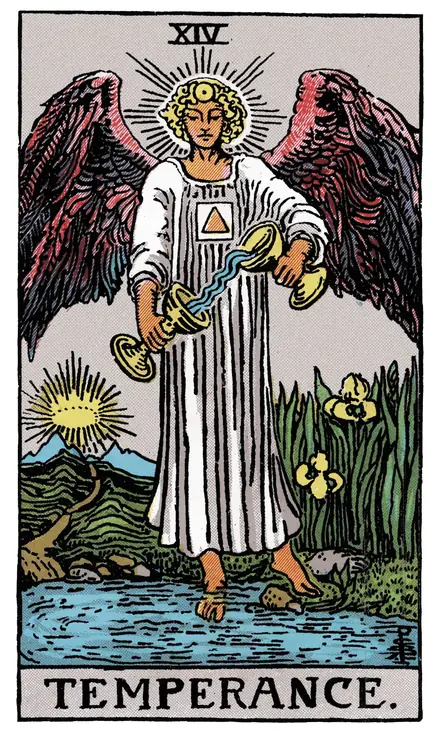
Temperance is the patient blend: joining what seemed opposed in just the right measure and giving the process all the time it needs.
Draw this card · Its correspondences
- Arcana: Major, number XIV
- Hebrew letter: Samekh (ס), “prop”
- Path on the Tree of Life: 25
- Attribution: Sagittarius
- In one sentence: The patient blending
- Keywords: Balance, moderation, patience, purpose, alchemy
- Yes or no?: Yes, with conditions
- Archetype: The patient alchemist
What the card shows
In the deck Pamela Colman Smith drew for Arthur Edward Waite in 1909, Temperance is an angel with red wings, dressed in a white robe. On the forehead is a circle with a dot, the sign of the Sun. On the breast is a square with a triangle inside it, and above it the letters of the divine name. The angel holds two golden cups and pours water from one to the other in a stream that seems to flow on a diagonal, as if the liquid were defying gravity. One foot rests in a pool, the other on dry land. On one side, by the water, grow yellow irises. Behind, a path rises out of the water and climbs between hills to two peaks, where a light shines in the shape of a crown.
Each detail has its reading in the tradition. The two cups are the two extremes being blended: conscious and unconscious, what you feel and what you think. The impossible stream shows that mixing is an art, and that it takes more than force. The foot in the water and the foot on the earth speak of living with a step in each world. The square and the triangle, four and three, add up to seven, the number of wholeness. The irises recall Iris, messenger of the rainbow, the bridge between heaven and earth. The path toward the light suggests that balance is a road you travel.
Waite describes the angel as a figure of indeterminate sex and calls it a genius of the Sun. The Golden Dawn titled the card “Daughter of the Reconcilers” and gave it the Hebrew letter Samekh and the sign of Sagittarius.
Temperance upright
Upright, Temperance reads as the art of finding the right measure. The card speaks of combining different forces, softening extremes and letting things settle at their own pace. It appears when a situation calls for patience and a steady hand at once: no rush and no neglect, only continuous attention that keeps adjusting the proportions until the blend works.
Above all, Temperance means integration. Two parts of a life that had been kept apart find a way to live together: work and rest, ambition and affection, an old habit and a new idea. Tradition also links it with slow healing, with reconciliation after a conflict, and with the person who builds a bridge between two sides.
The card comes after Death in the sequence of the Major Arcana, and that order helps explain it. After an ending, Temperance is the period in which what remains is put back together and you learn to live with the new shape. That is why its timescale is long. It rarely promises instant results; it describes a process that goes well when it is respected.
Its attribution to Sagittarius adds a further shade. The archer aims far, and Temperance reads as the composure of someone who has a clear purpose and can therefore afford to wait. Next to cards of action, such as the Chariot or the Eight of Wands, the card asks you to slow down a little and pace yourself. Next to cards of blockage, such as the Four of Cups, it invites you to move slowly instead of staying stuck.
As advice, Temperance asks you to try, measure and adjust. The perfect blend appears after several attempts.
Temperance reversed
Not every school reads reversals. Many readers work with upright cards only and let the neighbouring cards add nuance. Those who do read reversed cards usually see Temperance reversed as imbalance.
The most common form is excess: too much of one thing and too little of everything else. It might be work without rest, spending without limits, a passion that crowds out the rest of life, or a steady diet of news, screens or arguments that wears you down. The water spills outside the cups and the blend is spoiled.
Another reading speaks of impatience. You want results now and force a process that needed time, or combine elements that were not yet ready to come together. It can also point to a conflict between two parts of yourself that cannot reach agreement.
The advice of Temperance reversed is to return to measure: identify what is too much and what is missing, recover a sustainable rhythm, and accept that balance is rebuilt little by little.
In love
In love, Temperance reads as a relationship finding its rhythm. For a couple it signals harmony, good communication and the ability to compromise without losing yourself. It is the card of partners who complement each other, of calm reconciliations and of agreements built over time. If there was tension, it suggests patience can ease it.
If you are single, Temperance speaks of a love that arrives without hurry: a friendship that ripens, someone who fits in naturally. It also invites you to tend your own balance before looking outside for what is missing inside.
Reversed, in love
Reversed in a love reading, it signals a mismatch: one partner gives far more than the other, the timing never lines up, or the couple swings from euphoria to coldness with no middle ground. The advice is to talk about proportions and seek a fairer share.
Career and money
For career and money, Temperance reads as sensible management. It favours collaboration between very different teams or people, negotiation, and projects that grow slowly on solid foundations. In finances it advises steady saving, a balanced budget and patience with long-term investments. It can also mark a good moment to balance work and personal life.
Reversed, in career
Reversed, it warns of excess: overtime, impulse spending, a rush to close a deal that needed time to mature. Review how you divide your time and money before the imbalance takes its toll.
Health and mood
In matters of health and mood, Temperance is linked with moderation and with habits that last: eating, sleeping and moving regularly. It reads as an invitation to consistency and rest. No card can diagnose anything: for any symptom or doubt, see a qualified health professional.
Yes or no? Yes, with conditions
Temperance reads as a yes that asks for patience and measure. What you are asking about can turn out well, as long as you respect the pace of the process and seek balance between everyone involved. If the question demands an immediate answer or a drastic solution, the card advises waiting and pacing yourself. Its yes is built little by little.
Ask the card: a yes or no tarot reading with one card or three.
The archetype: The patient alchemist
As an archetype, Temperance is the figure who blends. In fiction it takes the form of the mediator, the healer, the teacher of few words, the friend who reconciles two feuding siblings, or the translator who lives between two languages. Its defining trait is active patience: it waits, observes and adjusts. It is rarely at the centre of the showy action, and yet without it the story never resolves.
In the structure of a story, Temperance occupies the time that follows the crisis. After the blow, the grief or the break, comes a quieter stretch in which the character rebuilds their life from old pieces and new. It is the stretch of apprenticeship, training and convalescence. Many writers skip it because it seems undramatic, and that is why so many endings feel rushed. The card is a reminder that transformation needs its time on the page.
Alchemy is the image that sums it up best. The alchemist combines opposing substances, heats them, cools them, repeats the operation, and obtains something none of them had on its own. In a character, that means integrating two sides in conflict: reason and desire, family inheritance and the life one has chosen, the past and what is coming.
The risk of this archetype in fiction is the figure who is too wise and flawless. Temperance works best when the character also struggles with their own balance, when the water spills now and then and they have to start again. A mediator who has never lost their temper is hard to believe; one who has, and chooses calm anyway, earns the reader’s trust.
In literature
- Siddhartha (Hermann Hesse, 1922). The young Siddhartha tries the extremes: the harshest asceticism, and then wealth and pleasure. Neither is enough. The answer comes beside a river, through the ferryman Vasudeva, who teaches him to listen to the water. The whole novel is a road toward measure and the union of opposites.
- Sense and Sensibility (Jane Austen, 1811). Elinor stands for restraint and Marianne for unchecked feeling. Both sisters suffer from too much of their own quality, and the novel leads each to learn something from the other. Austen writes Temperance in two characters: balance arrives when the contents of the two cups are finally mixed.
- The Tempest (William Shakespeare, 1611). Prospero has the men who betrayed him at his mercy on his island, and chooses forgiveness over revenge. The marriage of Miranda and Ferdinand joins the rival houses of Milan and Naples, and the magician gives up his art. The play resolves its conflict through measure, reconciliation and a blend of old enemies.
For writers
The conflict
Temperance sets two forces against each other that the character needs and that seem incompatible: vocation and family, loyalty to two people, origin and destiny. The interest lies in their inability to choose one and give up the other without losing themselves. To set up the card, show the character failing at their first attempts to blend: wrong doses, agreements that do not hold, relapses. Each failed attempt teaches something about proportion, and the reader learns alongside them.
The twist
As a plot twist, Temperance is the unexpected synthesis. Just when it seemed a choice had to be made, someone finds a third way that combines the best of both extremes. It works if the reader has already seen the two cups separately and the solution grows out of elements already present in the story. The angel with one foot in the water and one on land is the clue: the way out lies on the border.
Prompts
- Combine two elements that seemed incompatible until now.
- Write a scene in which two characters at odds must work together with their hands, mixing something, without being able to talk about their conflict.
- Have your protagonist solve a problem the slow way, and let the reader understand at the end why the quick way would have failed.
- Tell a reconciliation in three moments separated by time, none of which is decisive on its own.
Its correspondences
- Letter and path: Samekh. Source: Golden Dawn (tradition).
- Sign: Sagittarius. Source: Golden Dawn (tradition).
- Letter, alternative attribution: Nun. Source: Éliphas Lévi (tradition).
- Rune: Ehwaz. Source: Angelorum table (modern system).
- Archangel: Tzadkiel. Source: Angelorum table (modern system).
Combinations
Temperance and Death
Death followed by Temperance is the order of the sequence itself: after the ending, the rebuilding. Together they read as a period of grief or closure that gives way to slow, well-handled healing.
Temperance and The Magician
The Magician beside Temperance speaks of skill applied with patience. The talent and the tools are there; Temperance adds the measure and the time needed for the project to turn out well made.
Temperance and The Lovers
With the Lovers, Temperance reads as a balanced relationship and a choice made calmly. It is one of the most harmonious combinations for questions about love and partnership.
Temperance and The Star
The Star and Temperance share the gesture of pouring water. Together they speak of hope, healing and serene renewal, a period of recovery that moves forward without shocks or setbacks.
Temperance and The Devil
The Devil opposite Temperance sets excess against measure. It reads as the struggle with a dependency or a habit that overflows its bounds, and as the path toward regaining control little by little.
Temperance and Two of Cups
With the Two of Cups, Temperance strengthens the idea of union and agreement between two people. It reads as a reconciliation, or as a bond built between equals who meet each other halfway.
Temperance and Justice
Justice and Temperance share a love of measure. Together they read as an agreement that is fair and kind at once: a mediation that reconciles interests and a patient adjustment that leaves everyone at peace.
Temperance and Two of Pentacles
With the Two of Pentacles, the theme is how resources and time are divided. Together the two cards describe a financial juggling act that works out if you keep a flexible, steady rhythm.
Frequently asked questions
What does Temperance mean in tarot?
Temperance, card XIV of the Major Arcana, stands for balance, patience and the blending of opposites in the right measure. Tradition reads it as integration, slow healing and reconciliation: a process that goes well when it is given the time it needs.
What does Temperance mean in love?
In love it reads as a harmonious relationship, with good communication and a willingness to compromise. It favours reconciliations and bonds that ripen calmly. If you are single, it points to a love that arrives without hurry.
Is Temperance a yes or no card?
It reads as a conditional yes: what you are asking about can turn out well if you respect the pace of the process and seek balance. If you are hoping for a quick or drastic solution, the card advises patience.
What does Temperance reversed mean?
Readers who use reversals usually see it as imbalance: excess, impatience, or two parts of life that cannot reach agreement. The advice is to identify what is too much and what is missing, and to recover a sustainable rhythm.
What zodiac sign and Hebrew letter go with Temperance?
In the Golden Dawn system, Temperance corresponds to Sagittarius and to the Hebrew letter Samekh, meaning “prop” or “support,” on the 25th path of the Tree of Life. Éliphas Lévi attributed a different letter to it, Nun.
What does the angel on the Temperance card represent?
The angel pouring water between two cups represents the blending of opposites and the art of measure. One foot in the water and one on land reads as a life lived between two worlds, and the path toward the light as purpose.
Do your readingPrevious: Death · Next: The Devil
The 22 Major Arcana
- The Fool
- The Magician
- The High Priestess
- The Empress
- The Emperor
- The Hierophant
- The Lovers
- The Chariot
- Strength
- The Hermit
- Wheel of Fortune
- Justice
- The Hanged Man
- Death
- Temperance
- The Devil
- The Tower
- The Star
- The Moon
- The Sun
- Judgement
- The World
By Style Optimizer · published November 22, 2026.