Tarot / The 78 cards / Major Arcana / The Emperor
The Emperor, Major Arcana IV: tarot card meaning, upright and reversed
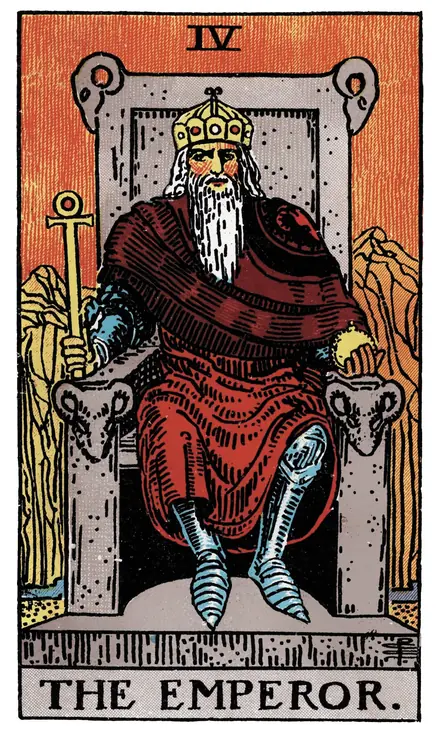
The Emperor is authority that brings order: the structure, law and steady will that turn open territory into a stable kingdom.
Draw this card · Its correspondences
- Arcana: Major, number IV
- Hebrew letter: Heh (ה), “window”
- Path on the Tree of Life: 15
- Attribution: Aries
- In one sentence: The authority that founds
- Keywords: Authority, structure, control, fatherhood, stability
- Yes or no?: Yes
- Archetype: The founding father
What the card shows
In the deck Pamela Colman Smith drew for Arthur Edward Waite in 1909, the Emperor fills almost the whole card, seated face-on upon a grey stone throne, massive and square. Rams’ heads jut from the back and arms of the throne. He is an older man with a long white beard and a golden crown. He wears a red cloak, and beneath it, at his legs, the metal of a suit of armour shows through.
In his right hand he holds a sceptre topped with an ankh, the Egyptian looped cross that symbolises life. In his left he holds a golden orb, the sphere of power over the world. Behind him rise bare orange mountains without a single tree, under a sky of the same warm tone. At their foot runs a thread of water you can barely see.
Each detail has its reading in the tradition. The rams point to Aries, the sign the Golden Dawn gave the card: the drive to begin, the fire that charges ahead. The armour under the cloak says this authority is ready to defend itself; the ceremony covers a warrior. The stone of the throne and its square shape speak of solidity and limits. The barren mountains are conquered ground and also the price of control: a landscape that is firm and not very fertile. The little river is a reminder that, even there, something living still flows.
In The Pictorial Key to the Tarot (1910), Waite describes him as executive power and realisation, the authority of this world. The Golden Dawn gave him the title Son of the Morning, Chief among the Mighty, and the Hebrew letter Heh, meaning “window”. In the sequence of the Major Arcana he is the Empress’s partner: she makes things grow, he sets their bounds.
The Emperor upright
Upright, the Emperor reads as the arrival of order. This is the card of structures that work: a plan with dates, a household with clear rules, a well-run company, a decision that is made and then upheld. The tradition links him with authority, discipline, stability and the responsibility of someone who protects others.
In a spread, the Emperor’s meaning usually points to the need to set boundaries or take charge. It can show that the time has come to stop improvising and build something that lasts. It can also point to a specific person: a father, a boss, a figure with power over the situation, or the querent’s own capacity to take control of their life.
The Emperor is a card of facts. He cares less about what is felt than about what is done, and he values a promise kept, consistency and methodical work. That is why he is linked with contracts, laws, institutions and everything that gives energy a stable shape.
His strength has an edge. The same firmness that protects can harden into rigidity. Next to gentle cards, such as the Empress or the Six of Cups, the Emperor reads as steady care, support that holds you up. Next to harsh cards, such as the Four of Pentacles or the Five of Swords, the emphasis falls on control, pride and an inability to give way.
As advice, the card suggests sorting your priorities, setting simple rules and keeping them. The authority it describes is born of example.
The Emperor reversed
Many readers never use reversals; they read every card upright and let the surrounding cards add the nuance. Those who do read reversed cards usually see the Emperor upside down in one of two ways.
The first is too much control. Authority turns into tyranny: rules that serve only the person who makes them, a figure who imposes instead of guiding, someone who cannot bear anything straying from the plan. Here the reversed Emperor speaks of rigidity, abuse of power and a discipline that has lost its purpose.
The second is a lack of structure. Nobody takes charge, decisions are put off, boundaries blur and everything hangs on the mood of the day. Read this way, the card points to disorder, insecurity or an absent authority that leaves everyone else without a point of reference.
In both cases, the advice is to find the middle ground: a firmness that protects and still leaves room, and rules designed to help life run well.
In love
In love, the Emperor reads as stability and commitment. In a relationship it can mark a solid bond, with shared plans, clear agreements and a partner who looks after and protects. It can also show that one person carries the weight of the decisions. The card values loyalty and deeds over words.
For singles, the Emperor’s love meaning points to an attraction to someone mature and self-assured, or to a time when you want a serious relationship. It also invites you to be clear about what you want and what you will not accept.
Reversed, in love
Reversed in love, the Emperor speaks of control and imbalance: possessive jealousy, a partner who decides for both of you, rules that suffocate. It can also point to someone who avoids commitment. As advice, it invites you to look at who holds the power in the relationship, and why.
Career and money
For career and money, the Emperor reads as favourable ground for organisation and leadership. It can mark a promotion, a position of responsibility, starting your own company or working under a firm boss. It favours contracts, long-term planning and orderly management of money. Financially, it counsels a budget, steady saving and well-considered decisions.
Reversed, in career
Reversed, it points to an authoritarian boss, power struggles or a project without direction. With money, it can show spending out of control or a rigidity that prevents adapting. The advice is to put the accounts in order and negotiate the boundaries.
Health and mood
In health and mood, the Emperor is linked with consistency: routines, schedules and habits that sustain the body. The tradition connects him with Aries, which rules the head, and reads the card as a call to keep endurance separate from harshness. No card can diagnose anything: for any symptom or concern, the person to see is a health professional.
Yes or no? Yes
The Emperor reads as a firm “yes”, especially when the question depends on effort, organisation or a decision in your own hands. It is a yes that asks for structure: the result comes with method, deadlines and the will to keep going with what you start. If the question is about escaping a rule, the answer turns harder.
Ask the card: a yes or no tarot reading with one card or three.
The archetype: The founding father
As an archetype, the Emperor is the character who builds the order everyone else lives in. The king, the patriarch, the headmistress, the general, the father who sets the house rules. In fiction he stands for visible law: the thing the protagonist collides with, or the thing the protagonist must one day become.
His dramatic function has two faces. As an outside figure, the Emperor is the structural obstacle: the father who forbids the marriage, the state that watches, the boss who decides who rises and who falls. As the hero’s destination, he is maturity: the moment the character stops reacting and starts governing their own life, shouldering responsibility and making decisions that affect others.
As a moment in the plot, the Emperor usually marks consolidation. The adventure is over, the kingdom stands, and now it has to be held together. Many sequels are born here: the hero turned king discovers that ruling is harder than conquering.
The risk with this archetype is shrinking him to a cardboard tyrant. The Emperor works in fiction when his authority has reasons: an old fear, a war he remembers, a child he wants to protect, an idea of order he truly believes in. The armour under the cloak is the clue. Behind every well-written figure of power is a warrior who learned to defend himself and cannot stop doing it, and that is the crack through which the reader gets inside the character.
In literature
- King Lear (William Shakespeare, 1606). Lear is the Emperor who wants to give up the crown and keep the power. He divides his kingdom among his daughters according to how much they claim to love him, and banishes the one who speaks honestly. The tragedy shows authority without judgement and the collapse of an order that rested on one man.
- The House of Bernarda Alba (Federico García Lorca, 1936). Bernarda is the Emperor reversed: an authority that turns the home into a prison. She imposes eight years of mourning, watches every move her daughters make and defends appearances above life itself. Lorca writes control as a whitewashed wall, and her final command, silence, closes the play.
- The Godfather (Mario Puzo, 1969). Vito Corleone rules an empire with its own laws, loyalties and punishments. The novel follows the passing of the sceptre to his youngest son, Michael, who never wanted to inherit it and ends up a colder Emperor than his father. It is the story of how a structure shapes the person who occupies it.
For writers
The conflict
The Emperor sets up a conflict between order and freedom. It works best when both sides are right: the rule protects something valuable and, at the same time, stops someone from living. You can set your character against authority, or inside it, forced to enforce a rule they have stopped believing in. To prepare the card, show what the structure gives before you show what it takes away.
The twist
As a plot twist, the Emperor is the moment the rebel inherits the throne. The character who fought the rules suddenly has the power to make them, and the reader watches to see whether they repeat what they hated. Another route is the reverse: the untouchable authority reveals a weakness, the stern father falls ill, the law shows its arbitrary origin, and the kingdom discovers how fragile its foundations were.
Prompts
- Set the character against the structure that keeps them safe and holds them back at the same time.
- Write a scene in which a character with power has to apply a rule that harms someone they love.
- Tell the first day of someone who inherits a post they never wanted, through the rules they decide to change and the ones they dare not touch.
- Narrate the fall of an authority figure through the eyes of someone who served them for years and knew the armour beneath the cloak.
Its correspondences
- Letter and path: Heh. Source: Golden Dawn (tradition).
- Sign: Aries. Source: Golden Dawn (tradition).
- Letter, alternative attribution: Daleth. Source: Éliphas Lévi (tradition).
- Letter, alternative attribution: Tzaddi. Source: Crowley, The Book of Thoth (tradition). Crowley swaps Heh and Tzaddi: the Emperor is still Aries.
- I Ching trigram: Heaven. Source: Style Optimizer (our own proposal).
- Rune: Ingwaz. Source: Angelorum table (modern system).
- Archangel: Kamael. Source: Angelorum table (modern system).
- alquimia: Sulphur. Source: Crowley, The Book of Thoth (tradition).
Combinations
The Emperor and The Empress
The Emperor and the Empress form the pairing of creation and order. Together they read as a project that grows and takes shape at the same time, a stable family or a business with both heart and method.
The Emperor and The High Priestess
With the High Priestess, authority listens to intuition. The pairing reads as a firm decision guided by discreet counsel, or as tension between the visible rule and what is known and left unsaid.
The Emperor and The Hierophant
The Emperor beside the Hierophant reinforces everything institutional: laws, traditions, organisations and hierarchies. Together they read as a time of clear rules and respect for established forms.
The Emperor and The Tower
With the Tower, order breaks. The pairing reads as the fall of an authority, the crisis of a structure that seemed solid, or the end of a control that could no longer hold.
The Emperor and The Fool
The Fool and the Emperor set total freedom against structure. Together they read as the need to give shape to a new impulse, or as an order that needs a little fresh air.
The Emperor and Justice
With Justice, the Emperor becomes a judge. The pairing speaks of contracts, legal proceedings and decisions made with sound judgement, where authority rests on fair rules.
The Emperor and Four of Pentacles
Beside the Four of Pentacles, control focuses on money and possessions. It reads as well-guarded financial security or, on its harsher side, as greed and a fear of letting go.
The Emperor and King of Wands
With the King of Wands, leadership fills with fire. Together they read as an authority with vision and charisma, able to carry others along towards an ambitious project.
Frequently asked questions
What does The Emperor mean in tarot?
The Emperor, card IV of the Major Arcana, stands for authority, structure and order. The tradition reads him as the steady will that turns an impulse into something stable: clear rules, responsibility and the ability to protect what has been built.
What does The Emperor mean in love?
In love he reads as stability, commitment and protection: a relationship with clear agreements and a partner who keeps their word. For singles, he points to the wish for something serious. His difficult side is control, and the card invites you to watch the balance.
Is The Emperor a yes or no card?
The Emperor reads as a firm “yes” when the outcome depends on effort, organisation and consistency. It is a yes that asks for method and deadlines; if the question is about bending a rule, the answer turns harder.
What does The Emperor reversed mean?
Readers who use reversals see him as excessive control, rigidity or abuse of power, or the opposite: a lack of structure and an absent authority. The advice is to find a firmness that protects without smothering.
What zodiac sign and Hebrew letter correspond to The Emperor?
In the Golden Dawn system he corresponds to Aries and to the Hebrew letter Heh, meaning “window”, on the fifteenth path of the Tree of Life. Aleister Crowley, in *The Book of Thoth*, gave him the letter Tzaddi, and Éliphas Lévi gave him Daleth.
Do your readingPrevious: The Empress · Next: The Hierophant
The 22 Major Arcana
- The Fool
- The Magician
- The High Priestess
- The Empress
- The Emperor
- The Hierophant
- The Lovers
- The Chariot
- Strength
- The Hermit
- Wheel of Fortune
- Justice
- The Hanged Man
- Death
- Temperance
- The Devil
- The Tower
- The Star
- The Moon
- The Sun
- Judgement
- The World
By Style Optimizer · published November 22, 2026.