Tarot / The 78 cards / Major Arcana / The Lovers
The Lovers, Major Arcana VI: tarot card meaning, upright and reversed
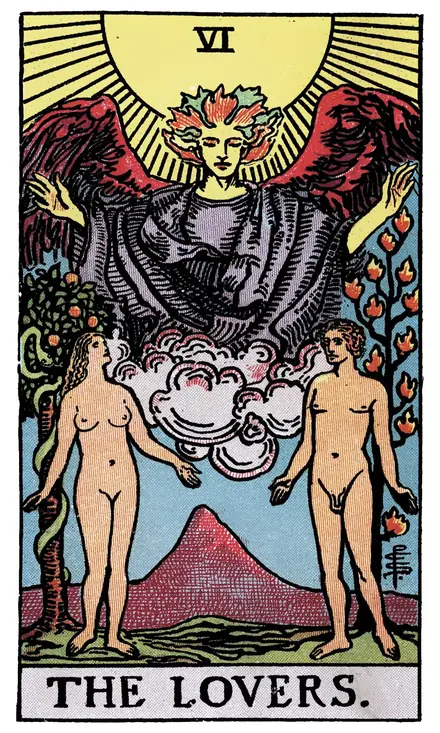
The Lovers is the choice that unites: love, attraction and the decision that brings what you desire into line with what you value.
Draw this card · Its correspondences
- Arcana: Major, number VI
- Hebrew letter: Zayin (ז), “sword”
- Path on the Tree of Life: 17
- Attribution: Gemini
- In one sentence: The choice that unites
- Keywords: Love, harmony, relationships, aligned values, choices
- Yes or no?: Yes, with conditions
- Archetype: Those who choose
What the card shows
In the deck Pamela Colman Smith drew for Arthur Edward Waite in 1909, the Lovers shows a naked man and woman standing in a garden, facing each other. Above them, among clouds, an angel with great red wings spreads his arms as if in blessing; behind the angel blazes an enormous sun. Behind the woman grows a tree heavy with fruit, a serpent coiled around its trunk. Behind the man, another tree bears flames instead of leaves. In the distance, between the two figures, rises a mountain.
The scene is Eden before the Fall. The tree with the serpent is the Tree of the Knowledge of Good and Evil, and it announces temptation and choice. The tree of flames is the Tree of Life, and Waite counts twelve fruits on it, often read as the twelve signs of the zodiac. The mountain is the shared goal, what the couple can reach together. Their gazes form a ladder: the man looks at the woman and the woman looks up at the angel. The tradition reads in this the passage from attraction to conscious love, and from conscious love to the sacred. Waite identifies the angel as Raphael, archangel of Air.
Waite changed the older image on purpose. In Marseille decks the card is called L’Amoureux, the Lover, and shows a young man standing between two women while Cupid aims his arrow from above: a choice between two paths. The Golden Dawn gave the card the Hebrew letter Zain, “sword”, the seventeenth path and the sign of Gemini. In Book T its title is Children of the Voice; in English it has kept one plain name, The Lovers.
The Lovers upright
Upright, the Lovers reads as love, attraction and union. This is the card of the bond born of deep affinity: two people, two ideas or two parts of yourself that fit together. Its meaning in love is the clearest in the whole tarot, and the card often points to an important relationship, falling in love or a commitment. Desire, closeness and harmony sit at its heart.
The tradition adds a second layer, just as important as the first: choice. The old card showed a young man between two paths, and that sense survives. The Lovers asks you to decide with your heart and your values at the same time. Choosing a person, a job, a city or a way of life means giving up others, and the card reminds you that a true choice is one made in keeping with who you are.
That is why the card also speaks of alignment. When what you desire matches what you value, the harmony of the image appears: two figures at peace under the same light. When the two pull apart, doubt sets in. The letter Zain, “sword”, and the sign of Gemini, the twins, point to that double nature: to unite you must also separate and tell things apart.
As advice, the Lovers invites you to listen to your own truth before you commit and to choose with full awareness. Once the choice is made, the card asks you to give yourself to it without looking back.
The Lovers reversed
Many readers never use reversals; they read every card upright and let the surrounding cards add the nuance. Those who do read reversed cards usually see the Lovers upside down in one of two ways.
The first is imbalance in a relationship: poor communication, desires that no longer match, an attraction cooling off or a bond kept going out of habit. It can also point to a temptation that threatens a commitment.
The second is the choice you avoid. An important decision sits in front of you and keeps being postponed, or it gets made under someone else’s pressure, against your own values. The reversed card then speaks of inconsistency: saying one thing and doing another, wanting two roads at once.
In both cases the advice is to ask yourself again what you truly value and act on the answer.
In love
The Lovers is the love card above all others. For couples, it reads as a strong and passionate relationship, with physical chemistry and shared values; sometimes it announces a big step, such as moving in together or making the commitment official. Its love meaning includes honesty: a couple who choose each other every day.
For singles, the card is usually read as the arrival of a powerful attraction or a meeting that leaves its mark. It can also show that a choice must be made between two people, or between two ways of understanding love.
Reversed, in love
Reversed in love, the card speaks of distance, clashing values or a love triangle that complicates things. It can point to a relationship in which one partner has stopped choosing the other. The advice is to talk frankly about what each of you wants.
Career and money
For career and money, the Lovers reads as an alliance that works: a like-minded partner, a good team, a project in tune with your values. It also points to an important career decision, such as choosing between two offers, best made by asking what will still make sense in the long run.
Reversed, in career
Reversed, it points to conflict with partners or colleagues, a job at odds with your principles or a decision left hanging too long. Be clear about what you are looking for before you sign anything.
Health and mood
In health and mood, the Lovers is linked with balance between body and mind and with the wellbeing that healthy relationships bring. It reads as an invitation to look after your bonds and choose habits that suit who you are. No card can diagnose anything: for any symptom or concern, the person to see is a health professional.
Yes or no? Yes, with conditions
The Lovers reads as a “yes” with one condition: the choice has to be sincere and true to what you value. If the question is about love, the card is very favourable. If the question means picking between two options, the answer depends on choosing one and letting the other go, with everything that follows.
Ask the card: a yes or no tarot reading with one card or three.
The archetype: Those who choose
As an archetype, the Lovers is both the couple and the crossroads. In fiction they appear as lovers who find each other against all odds, an engaged pair full of doubts, the young person who must choose between two suitors or two lives. The archetype centres on a bond more than on a single person: a Lovers story happens between two characters, in the space that separates them, and each one changes the other.
As a moment in the plot, the card marks the choice that defines the protagonist. It is the point where the character stops being swept along by events and makes a decision that reveals who they are. It might be a declaration of love, a wedding, an elopement or giving someone up out of loyalty to something else. That decision has consequences that fill the rest of the book, which is why the card often falls at the end of the first act or at the heart of the second.
Waite’s image, with Eden and the serpent, adds another reading: love as knowledge. Choosing someone means opening your eyes and leaving the paradise of innocence. The best Lovers stories know that love brings joy and loss together, and that every union leaves something outside. The card works when the reader feels the weight of what the character did not choose.
Gemini, the twins, gives writers one more key. Every Lovers character carries a double: the self who stays and the self who could have gone, the life lived and the life refused. Let that second figure haunt the page, and the choice keeps its full weight long after it is made.
In literature
- Romeo and Juliet (William Shakespeare, 1597). Two young people from feuding houses in Verona fall in love at first sight and marry in secret within days. Their passion sweeps up everyone around them, from the Nurse to Friar Laurence. The play shows the card’s dark face: a desire that chooses without counting the cost and ends in tragedy.
- Pride and Prejudice (Jane Austen, 1813). Elizabeth Bennet turns down two proposals of marriage before accepting a third. Each choice tests her values against the pressure of her family and her time. Austen writes the card of alignment: love becomes possible only once each of them corrects the judgement they had formed of the other.
- Love in the Time of Cholera (Gabriel García Márquez, 1985). Fermina Daza chooses to marry Dr Juvenal Urbino and leaves behind Florentino Ariza, who waits for her for more than fifty years. The novel turns on that choice and its consequences, and explores the many kinds of love: passionate love, married love and the love that arrives in old age.
For writers
The conflict
The Lovers sets up a conflict of choice between desires or loyalties that cannot live side by side. The classic form is the love triangle, though the card works just as well with a vocation set against a family, or a love set against a cause. What matters is that both options carry real weight and that the character loses something precious whichever way they decide. Prepare the choice by letting the reader see what each path offers.
The twist
As a plot twist, the card is the declaration or decision that changes the course of the story: someone confesses their love, breaks off an engagement or chooses the unexpected suitor. The twist gains force if the choice reveals something the reader did not know about the character. The reverse twist works too: discovering that the other person had already chosen, and that the protagonist’s doubts have come too late.
Prompts
- Force a choice between two loyalties that can’t both be kept.
- Write a scene in which two characters fall in love without ever saying so, only through what they look at and what they avoid looking at.
- Have your protagonist make a choice in love, and tell, in parallel, the life they would have had with the option they turned down.
- Narrate a conversation between two lovers in which each defends a different value, and neither of them is entirely right.
Its correspondences
- Letter and path: Zayin. Source: Golden Dawn (tradition).
- Sign: Gemini. Source: Golden Dawn (tradition).
- Letter, alternative attribution: Vav. Source: Éliphas Lévi (tradition).
- Rune: Gebo. Source: Angelorum table (modern system).
- Archangel: Raphael. Source: Angelorum table (modern system).
Combinations
The Lovers and The Tower
The Lovers with the Tower speaks of a choice forced by crisis. The upheaval makes you decide which bond, or which value, you will save from the rubble. What survives the shock shows what truly mattered.
The Lovers and The Empress
Beside the Empress, the Lovers reads as a love that bears fruit: a relationship freely chosen that becomes a home, a shared project or a family. It is one of the warmest pairings for questions of the heart.
The Lovers and The Hierophant
With the Hierophant, the union becomes formal: an engagement, a wedding or a bond that gains the recognition of family and community. Together they read as a private choice made public.
The Lovers and The Devil
The Lovers beside the Devil points to an intense attraction that can turn into dependence. Together they read as the temptation that puts the freedom to choose to the test.
The Lovers and Two of Cups
With the Two of Cups, the card’s romantic meaning grows stronger: a mutual connection, a balanced meeting, the start of a relationship where the feeling is returned.
The Lovers and Two of Swords
Beside the Two of Swords, the choice stalls. It reads as a decision put off for fear of losing one of the two options, and as an invitation to look honestly at what each one costs.
The Lovers and The Chariot
With the Chariot, the choice has been made and it is time to act. The chosen partner or project moves forward with determination, and both cards ask you to keep that direction.
The Lovers and Temperance
The Lovers and Temperance speak of lasting harmony: a balanced relationship built on patience and the ability to understand each other over time.
Frequently asked questions
What does The Lovers mean in tarot?
The Lovers, card VI of the Major Arcana, stands for love, attraction and choice. The tradition links it with the union of two people and with decisions that bring what you desire into line with what you value. It reads as a deep bond or as a crossroads that asks for an honest choice.
Why does the Marseille Lovers card show a young man between two women?
In Marseille decks the card is called L’Amoureux, the Lover, and shows a young man between two women with Cupid above: a choice between two paths. Waite replaced it with Adam and Eve in Eden, and the English name settled as The Lovers. The meaning keeps both layers, love and choice.
What does The Lovers mean in love?
It is the love card above all others. For couples, it reads as a strong relationship with chemistry and shared values, and sometimes as a step towards commitment. For singles, it announces a powerful attraction or the need to choose between two people or two ways of loving.
Is The Lovers a yes or no card?
The Lovers reads as a conditional “yes”: the answer is favourable if the choice is sincere and true to your values. In love questions the card is very positive; in dilemmas, it asks you to pick one option and accept letting the other go.
What does The Lovers reversed mean?
Readers who use reversals usually see it as imbalance in a relationship, poor communication or a temptation that threatens a commitment. It can also mean a choice avoided or made against your own values. The advice is to get clear about what you truly want.
What zodiac sign and Hebrew letter correspond to The Lovers?
In the Golden Dawn system, the Lovers corresponds to Gemini and to the Hebrew letter Zain, meaning “sword”, on the seventeenth path of the Tree of Life. Éliphas Lévi had earlier assigned the card the letter Vav.
Do your readingPrevious: The Hierophant · Next: The Chariot
The 22 Major Arcana
- The Fool
- The Magician
- The High Priestess
- The Empress
- The Emperor
- The Hierophant
- The Lovers
- The Chariot
- Strength
- The Hermit
- Wheel of Fortune
- Justice
- The Hanged Man
- Death
- Temperance
- The Devil
- The Tower
- The Star
- The Moon
- The Sun
- Judgement
- The World
By Style Optimizer · published November 22, 2026.