Tarot / The 78 cards / Major Arcana / The Hermit
The Hermit, Major Arcana IX: tarot card meaning, upright and reversed
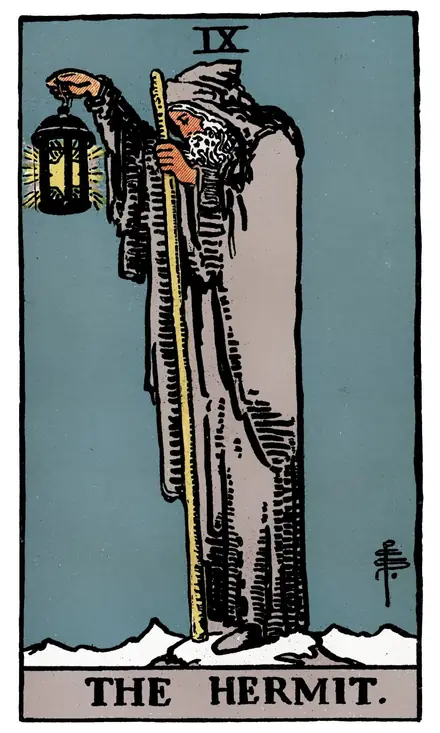
The Hermit is a chosen retreat to think clearly: an old man whose lantern lights only the next step of the path, never the whole road.
Draw this card · Its correspondences
- Arcana: Major, number IX
- Hebrew letter: Yod (י), “hand”
- Path on the Tree of Life: 20
- Attribution: Virgo
- In one sentence: Light in solitude
- Keywords: Soul-searching, introspection, solitude, inner guidance
- Yes or no?: Not for now
- Archetype: The sage who lights the way
What the card shows
In the deck Pamela Colman Smith drew for Arthur Edward Waite in 1909, the Hermit is an old man with a long white beard, wrapped in a grey hooded cloak. He stands alone on a snow-covered summit. He looks down, his eyes almost closed. In his right hand he raises a lantern, and inside it shines a six-pointed star. With his left hand he leans on a long yellow staff. The background is dark, the blue-grey of dusk, and there is no one else in the scene.
Every detail has its reading in the tradition. The summit is the place you reach after a long climb: the Hermit has already walked the path. The snow speaks of cold, of silence and of a purity that is hard to attain. The grey cloak is the colour of discretion, the choice of someone who prefers to pass unnoticed. The star in the lantern, made of two interlaced triangles, is associated with the Seal of Solomon and with the union of above and below. The staff is the support of experience. The lantern’s light falls short on purpose: it shows the next step, never the whole road.
In The Pictorial Key to the Tarot (1910), Waite sets aside the old reading of the card as Prudence and presents it as a card of attainment more than of seeking: the old man lifts his lamp to guide those who climb behind him. The Golden Dawn gave it the Hebrew letter Yod, meaning “hand,” and the sign of Virgo. In the Marseille deck it is called L’Hermite, and in some early Italian decks the old man carried an hourglass instead of a lantern.
The Hermit upright
Upright, the Hermit reads as a time of chosen retreat. You step away from the noise, slow down and stay alone with your questions. Tradition insists that this solitude is fertile: it yields the answers that conversation and hurry kept you from hearing. In short, the Hermit’s meaning in tarot is the light each of us finds once we stop looking for it outside.
In a spread it often marks a period of reflection before an important decision. It might be a journey, a few weeks of study, a break from social media, a move somewhere quieter, or simply the need to think without other people’s opinions. The card is also tied to the figure of the quiet teacher: someone experienced who never lectures, and who helps you see your next step when you ask.
The Hermit asks for patience. His lantern gives little light, and he accepts that. He moves slowly, one step at a time, with the confidence of someone who knows the mountain. Next to cards of movement, such as the Chariot or the Knight of Wands, the retreat reads as a short pause to get your bearings. Next to cards of withdrawal, such as the Four of Swords, the emphasis falls on rest and recovery.
As advice, the Hermit invites you to set aside time and space for yourself, to listen to your own intuition and to be wary of haste. The answers this card brings arrive in silence, and you recognise them because they bring order to what looked confused before.
The Hermit reversed
Not every school reads reversals. Many readers work with upright cards only and let the neighbouring cards add nuance. Those who do read reversed cards usually see the Hermit reversed in two ways.
The first is isolation that has stopped helping. The retreat that was fertile when upright drags on and turns into confinement. You withdraw from others out of fear, pride or exhaustion, and lose what their company could give you. The lantern goes out and the mountain turns cold.
The second is solitude refused. You need to stop and think, and you avoid it by filling your calendar, seeking out noise or asking everyone for advice so you never have to hear your own voice. Read this way, the Hermit reversed points to an overdue conversation with yourself.
In both cases the advice is about balance: come back down to the world with what you have learned, or finally grant yourself the quiet hour you keep putting off.
In love
In love, the Hermit reads as a time of introspection. In a relationship it may show that one partner needs space of their own, or that the bond is asking for deeper conversations and less noise around it. It is linked with mature, quiet love, the kind that builds without fanfare.
If you are single, the Hermit in a love reading usually describes a season for getting to know yourself before looking for someone else: understanding what you want, letting old wounds close, enjoying your own company. If someone does appear, tradition pictures them as reserved, wise or older, a person who approaches slowly.
Reversed, in love
Reversed in a love reading, the card speaks of distance that hurts: one partner shuts themselves away and the other feels alone, or intimacy is avoided out of fear. As advice, it asks you to say out loud what space you need and why.
Career and money
For career and money, the Hermit reads as a time of study, specialisation or review. It favours work that calls for focus and quiet: research, writing, programming, teaching, counselling. It may also suggest thinking a change of direction through calmly before announcing it. With money, tradition ties it to prudence, measured spending and letting go of the superfluous.
Reversed, in career
Reversed, it points to isolation within a team, working alone when you badly need help, or deliberation that drags on until it paralyses. The advice is to share your plan with someone you trust and set a date to decide.
Health and mood
In matters of health and mood, the Hermit is linked with the need for rest, silence and calmer routines, and with the attention to small things that Virgo brings: sleep, food, daily habits. It also reminds you to watch for isolation when it weighs on you. No card can diagnose anything: for any symptom or concern, see a qualified health professional.
Yes or no? Not for now
The Hermit reads as “not yet.” The card asks for time to think before acting, and suggests that a clear answer will come after a period of calm reflection. Forcing the decision now usually means choosing by very little light. If your question is whether to pause, study or step back for a while, the answer is yes.
Ask the card: a yes or no tarot reading with one card or three.
The archetype: The sage who lights the way
As an archetype, the Hermit is the sage set apart: the old man on the mountain, the monk, the retired master, the solitary detective who sees what everyone else overlooks. He has lived a great deal, climbed alone, and now knows something the others do not yet know. His dramatic trait is distance. He stands outside the main action, and from there he understands it better than anyone.
In the structure of a story, the Hermit can occupy two places. The first is the mentor the protagonist turns to when lost. You have to climb the mountain, enter the cave or find the library to reach him, and his help comes as a question, or as a small light that shows only the next step. The second place belongs to the protagonist during their passage through the desert: the moment they withdraw, by force or by choice, and return changed. That retreat is often the secret centre of the story.
The card teaches something useful about pacing. The Hermit brings slow scenes with few words, where the important things happen inside. They work when the reader feels that the silence is charged, that the character, without moving, is on the verge of understanding. The danger is decorative solitude, a retreat that changes nothing. A good Hermit comes down the mountain holding something he did not have before, and the plot can no longer go on as it was.
For a writer, the Hermit is also a reminder that wisdom in fiction is shown through restraint. The sage who explains everything flattens the story. The one who offers a single sentence, or a lantern, leaves the reader something to do.
In literature
- Thus Spoke Zarathustra (Friedrich Nietzsche, 1883). The book opens as Zarathustra, after ten years of solitude in the mountains, decides to go down and share what he has learned. On the way he meets an old saint in the forest, another hermit. The whole work moves between the summit and the world, which is exactly the card’s rhythm.
- Siddhartha (Hermann Hesse, 1922). Siddhartha leaves his father’s house, lives among ascetics, tries wealth and pleasure, and ends up beside a river, learning from the ferryman Vasudeva. The novel is an inner quest told step by step, with the slowness and the short reach of the Hermit’s lantern.
- Walden (Henry David Thoreau, 1854). Thoreau spent two years in a cabin by Walden Pond and wrote down what he learned living on very little. The book presents retreat as a lucid experiment, full of accounts, seasons and close observation, very near the Hermit’s Virgo-like attention to detail.
For writers
The conflict
The Hermit sets the world against retreat. Your character needs to step away to understand something, and everything around them pulls them back: obligations, people who love them, a plan that will not wait. The tension grows if the retreat has a visible cost and the reader suspects the answer is up there on the mountain, waiting for the character to be patient enough to see it.
The twist
As a plot twist, the Hermit is the return bearing light: the character comes back from retreat with a truth that rearranges everything we thought we knew. It also works the other way round, when the protagonist climbs up to find the sage and learns that the lantern lights only one step, and the rest of the road must be walked alone. The card itself holds the clue: the light is small, and that is why it forces you to walk.
Prompts
- Pull the character away from the noise and let them find a truth they didn’t want to hear.
- Write a scene in which your character spends a whole day without speaking to anyone and ends it understanding something they had failed to see for years.
- Have your protagonist climb in search of a master and receive, as the only help, a single question.
- Tell the return of someone who lived apart for a long time through the small details of the world that now strike them as strange.
Its correspondences
- Letter and path: Yod. Source: Golden Dawn (tradition).
- Sign: Virgo. Source: Golden Dawn (tradition).
- Letter, alternative attribution: Teth. Source: Éliphas Lévi (tradition).
- I Ching trigram: Mountain. Source: Style Optimizer (our own proposal).
- Rune: Kenaz. Source: Angelorum table (modern system).
- Rune: Isa. Source: Angelorum table (modern system).
- Archangel: Raphael. Source: Angelorum table (modern system).
Combinations
The Hermit and The High Priestess
The Hermit with the High Priestess deepens silence and intuition. Together they read as a time of inner study, of attentive dreams and of knowledge that arrives slowly, without asking anyone else for it.
The Hermit and The Hierophant
The Hermit beside the Hierophant sets personal wisdom against inherited wisdom. It reads as a teacher who passes on what he knows, or as someone testing what they were taught against what they have learned alone.
The Hermit and The Star
The Star after the Hermit reads as the hope that appears at the end of a retreat. The small star in the lantern grows large, and you recover faith in your own path and in where it leads.
The Hermit and Wheel of Fortune
With the Wheel of Fortune, reflection ends and movement begins. It reads as the close of a pause: what you thought through in solitude is set in motion as soon as circumstances start to change.
The Hermit and Eight of Cups
The Eight of Cups beside the Hermit speaks of leaving behind something that no longer fulfils you in search of deeper meaning. Both cards show a lone figure walking away by night.
The Hermit and Four of Swords
With the Four of Swords, the retreat reads as necessary rest: a pause to recover your strength, sleep well, think things over and come back with a much clearer head.
The Hermit and The Fool
The Fool and the Hermit are the beginning and the maturity of the same journey. Together they read as a fresh apprenticeship that starts again, with the old man’s experience and the young traveller’s lightness.
Frequently asked questions
What does The Hermit mean in tarot?
The Hermit, card IX of the Major Arcana, stands for a chosen retreat to think, the inner search and the wisdom that comes in silence. Tradition reads it as a time of introspection and as the figure of the quiet teacher who lights the next step of the way.
What does the Hermit mean in love?
In love it reads as a time of introspection. In a relationship it may ask for personal space or deeper conversations; if you are single, it invites you to know yourself before looking for someone else. It is also linked with mature, quiet love.
Is the Hermit a yes or no card?
It reads as “not yet”: the card asks for time to think before acting, and the clear answer comes after a period of calm. If your question is whether to pause or step back for a while, the answer is yes.
What does the Hermit reversed mean?
Readers who use reversals usually see it as isolation that no longer helps, solitude turned into confinement, or as the opposite: someone who needs to stop and avoids it by filling their life with noise. The advice is to look for balance.
What zodiac sign and Hebrew letter go with the Hermit?
In the Golden Dawn system, the Hermit corresponds to Virgo and to the Hebrew letter Yod, meaning “hand,” on the 20th path of the Tree of Life. Éliphas Lévi, working with a different order, assigned it the letter Teth.
What does the Hermit’s lantern represent?
The lantern holds a six-pointed star, associated with the Seal of Solomon. Tradition reads it as the light of experience: it shows only the next step, and it also serves as a guide for those climbing the mountain behind him.
Do your readingPrevious: Strength · Next: Wheel of Fortune
The 22 Major Arcana
- The Fool
- The Magician
- The High Priestess
- The Empress
- The Emperor
- The Hierophant
- The Lovers
- The Chariot
- Strength
- The Hermit
- Wheel of Fortune
- Justice
- The Hanged Man
- Death
- Temperance
- The Devil
- The Tower
- The Star
- The Moon
- The Sun
- Judgement
- The World
By Style Optimizer · published November 22, 2026.