Tarot / The 78 cards / Swords / Ace of Swords
Ace of Swords: tarot card meaning, upright and reversed
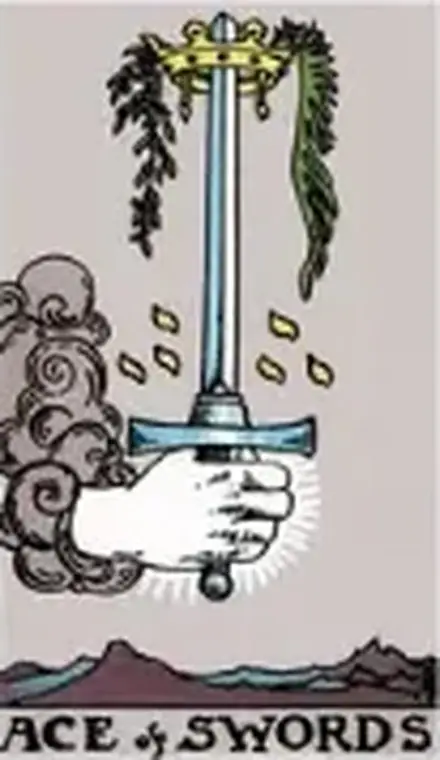
The Ace of Swords is the idea that cuts through the fog: a clear truth, a firm decision and the power of the mind at its sharpest.
Draw this card · Its correspondences
- Arcana: Minor, number 1
- Suit and element: Swords, Air
- Golden Dawn title: Root of the Powers of Air
- Sephirah: Kether
- Zodiac quadrant: Capricorn, Aquarius, Pisces
- Keywords: Clarity, a new idea, mental truth, success
- Yes or no?: Yes, with conditions
- Archetype: The Idea That Cuts
What the card shows
In the deck Pamela Colman Smith drew for Arthur Edward Waite in 1909, the Ace of Swords shows a hand reaching out of a glowing cloud. It grips a straight, double-edged sword held upright, point to the sky. The point pierces a golden crown. Two branches hang from the crown: olive on one side, palm on the other. Golden drops shaped like the letter yod fall around the blade. Yod is the first letter of the divine name in Hebrew. Far below lie bare, blue-grey mountains under a grey sky.
Each detail has its reading in the tradition. The hand from the cloud appears on all four Aces. It is the gift from above, a power offered before anyone has used it. The sword is air and intellect, the edge that separates true from false. It has two edges because thought cuts both ways. The crown stands for victory and also for Kether, the Crown at the top of the Tree of Life. Olive is linked with peace and palm with triumph, and the same sword can bring either. The yods are sparks of the divine falling on the earthly world. The cold, treeless mountains are the heights of pure thought: beautiful, and hard to live on.
In The Pictorial Key to the Tarot (1910), Waite calls it a card of triumph and of great force, in love as well as in hatred, and hints that the crown points to something higher than good luck. The Golden Dawn named it the Root of the Powers of Air, placed it in Kether and gave it the quarter of the heavens that holds Capricorn, Aquarius and Pisces.
Ace of Swords upright
Upright, the Ace of Swords reads as clarity arriving. A new idea lands all at once. A confusing situation finally makes sense. A decision you have been putting off gets made, cleanly. This is the seed of the suit of air, and here the mind is whole, still free of doubt and wounds.
In a reading it often marks the moment of truth. Someone names what is really going on. A conversation shows where everyone stands. A single fact ends the speculation. Waite links the card with conquest and the triumph of force, and the tradition adds that this is the force of reason and of the spoken word. That makes it the card of intellectual beginnings as well: a course of study, a writing project, a piece of research, a fresh way of framing a problem.
Like every Ace, it brings raw power with no fixed direction. The sword carries both olive and palm, and what you do with it decides which branch falls. Beside calm cards such as Temperance or The Star, the Ace reads as clarity that brings peace. Beside cards of conflict such as the Five of Swords, the edge turns against someone.
As advice, the Ace of Swords asks you to say things precisely and to act on what you now understand. A clear idea loses its edge if it sits in a drawer too long. It also asks for care. Truth cuts, so choose the moment and the manner in which you use it.
Ace of Swords reversed
Many readers never read reversals and let the surrounding cards supply the nuance instead. Those who do read them usually see the Ace of Swords reversed as mental force pointed the wrong way.
Waite notes that the reversed card keeps its strength while the results go badly. You can see it in words spoken with cruelty, in the argument that is won and leaves scars, in the brilliant idea that hardens into obsession. The blade still cuts. It just cuts badly.
Another common reading is confusion: the idea that never quite takes shape, the decision postponed again, the truth glimpsed only in part. The sword is still in the cloud and the hand has yet to emerge.
Waite also records an older tradition that gives the reversed Ace a sense of conception and multiplication, of something growing. Read that way, it is an idea still ripening on the inside.
In every case the advice is to get clear before you act. Sort your thoughts, write them down and check your intentions before you speak.
In love
In love, the Ace of Swords reads as an honest conversation that clears the air. In a relationship it can mark the moment someone finally says what they think, a firm decision about a shared future or a new agreement that puts things in order. It is a cerebral card more than a tender one. The bond improves because each person understands the other better.
If you are single, the Ace of Swords speaks of seeing clearly what you want and what you will no longer accept. It can also point to meeting someone whose mind or way of talking draws you in, a connection that starts with ideas.
Reversed, in love
Reversed in love, the Ace of Swords points to hurtful words, misunderstandings and arguments where winning matters more than understanding. It can also show a decision that keeps being dodged. The advice is to speak calmly and to listen before you answer.
Career and money
For career and money, the Ace of Swords reads as an idea with real force behind it: a new project, the fix for a technical problem, a pitch that convinces. It favours work built on words and analysis, study, negotiation and clear contracts. It can also mark a firm decision about your career path. A good moment to put things in writing and to go over the numbers carefully.
Reversed, in career
Reversed, it shows muddled plans, tense communication with colleagues or clients and decisions made in the heat of the moment. Gather the facts, clarify agreements and wait for a cool head before you sign anything.
Health and mood
For health and mood, the Ace of Swords is linked with mental clarity and the urge to understand what is happening to you. It reads as an invitation to get good information and to make decisions about your habits with a clear head. No card can diagnose anything: for any symptom or worry, the right person to see is a health professional.
Yes or no? Yes, with conditions
The Ace of Swords reads as a yes that demands clarity. The card carries the force of a beginning and a triumph, and it backs what you are asking about as long as you act honestly and with your thoughts in order. If everything hinges on a truth nobody dares to say, the yes arrives once it is said.
Ask the card: a yes or no tarot reading with one card or three.
The archetype: The Idea That Cuts
As an archetype, the Ace of Swords is the flash of insight. It is less a character than a mental event: the deduction that cracks the case, the line that dismantles a lie, the choice the protagonist finally makes after a hundred pages of doubt. When it takes human form, it is the figure who thinks precisely and speaks plainly: the detective, the judge, the reporter, the witness who says what she saw.
In the structure of a story, the Ace of Swords holds the place of intellectual revelation. It can open the book, with the idea that sets the plot moving, or close it, with the understanding that makes everything fall into place. Its dramatic power lies in sharpness. The reader feels the relief of understanding and, at the same moment, the tension of knowing that this truth will have consequences. The sword always cuts something.
The double edge is the richest part of the archetype for fiction. One truth frees one character and sinks another. One idea can be the olive of peace or the palm of a victory won at someone else’s cost. So the Ace works best when the author lets both edges show: what is gained by understanding and what is lost.
The danger is using it as a magic fix, the idea that drops from the sky and solves everything for free. The hand on the card comes out of a cloud, yet the sword has weight. Insight convinces when the character has earned it, when the reader has seen the loose pieces and almost put them together first.
In literature
- The Name of the Rose (Umberto Eco, 1980). William of Baskerville arrives at an abbey where monks are dying one after another and works it all out by reason, in the spirit of his master Ockham and his famous razor. The whole novel is an Ace of Swords: the mind cutting through superstition. Yet the truth he uncovers costs the library.
- Twelve Angry Men (Reginald Rose, 1954). One juror refuses to rush a guilty verdict and, step by patient step, takes the case apart in a sweltering jury room. Each argument he raises cuts away a prejudice. Rose’s drama shows the Ace at its most hopeful: a single clear mind turning eleven votes and saving a life.
- An Enemy of the People (Henrik Ibsen, 1882). Dr Stockmann discovers that the spa waters his town lives on are contaminated and insists on saying so. His truth is clear and exact, and it costs him his job, his friends and his good name. Ibsen shows the card’s full edge: insight as triumph and as wound.
For writers
The conflict
The Ace of Swords sets up a conflict between a clear truth and the cost of speaking it. Your character understands something the others cannot or will not see, and has to decide what to do with that knowledge. It works best when the truth touches someone the character loves. The closer the person about to be exposed, the heavier the sword feels in the hand.
The twist
As a plot twist, the Ace of Swords is the moment a piece clicks into place and everything changes meaning. A sentence, a document, a memory that returns. The richest version comes when the idea that seemed to save the protagonist turns out to have a second edge: it solves the visible problem and opens a deeper one that drives the rest of the story.
Prompts
- Write the scene in which your protagonist suddenly understands what they have failed to see for months, and describe only what their hands do while it sinks in.
- Have a character say one true sentence out loud in the middle of a family dinner, then narrate the silence that follows.
- Tell the same decision twice: once as the peace it brings to the person who makes it, once as the wound it opens in the person who receives it.
Its correspondences
- Element: Air. Source: Golden Dawn (tradition).
- Sephirah: Kether. Source: Golden Dawn (tradition).
- Sign: Capricorn. Source: Golden Dawn (tradition).
- Sign: Aquarius. Source: Golden Dawn (tradition).
- Sign: Pisces. Source: Golden Dawn (tradition).
Combinations
Ace of Swords and The Tower
With The Tower, revelation arrives as an idea or a spoken word. Together they read as a truth said plainly that cuts a confused situation short and brings down whatever rested on a lie.
Ace of Swords and Justice
Justice also holds a sword aloft. Together they read as a fair, reasoned decision, a clear judgement or an agreement that puts everything in its proper place.
Ace of Swords and The Magician
The Magician beside the Ace of Swords points to an idea with the power to become real. Together they read as the talent for turning a thought into words, then a plan, then finished work.
Ace of Swords and The World
With The World, a clear idea gives meaning to a whole journey. The pair reads as the understanding that closes a cycle, or as a new project born from what has just been completed.
Ace of Swords and Two of Swords
The Two of Swords is the blocked decision and the Ace is the cut that settles it. Together they read as the end of indecision thanks to one fact or one frank conversation.
Ace of Swords and Ten of Swords
The beginning and the end of the suit of air. Together they read as one way of thinking running out and another being born, sharper, from what was learned in the fall.
Ace of Swords and Ace of Cups
With the Ace of Cups, head and heart begin together. The pair reads as a new emotional beginning spoken about honestly, or as an idea born from a sincere feeling.
Ace of Swords and Ace of Wands
Two Aces side by side read as a strong creative surge: the idea of air and the energy of fire. They favour launching a project with a clear vision behind it.
Frequently asked questions
What does the Ace of Swords mean in tarot?
The Ace of Swords is the first card of the suit of air and stands for mental clarity: a new idea, a truth spoken aloud, a firm decision. Waite links it with triumph and conquest, and the tradition reminds us that its double edge can bring peace or victory.
What does the Ace of Swords mean in love?
In love it reads as an honest conversation that clarifies the relationship: saying what you think, deciding about the future or making a new agreement. If you are single, it speaks of knowing clearly what you want and of connections that begin with ideas.
Is the Ace of Swords a yes or no card?
It reads as a conditional yes. The card has the force of a beginning and supports your question as long as you act honestly and think clearly. When a truth still needs saying, the yes arrives once you say it.
What does the Ace of Swords mean reversed?
Readers who use reversals usually see it as misdirected mental force: hurtful words, arguments, obsessive thinking or confusion. Waite adds an older sense of conception and growth. The advice is to put your thoughts in order before you act.
What element and sephirah correspond to the Ace of Swords?
In the Golden Dawn system the Ace of Swords is the Root of the Powers of Air. It belongs to the element of air and sits in Kether, the Crown of the Tree of Life. It rules the quarter of the zodiac formed by Capricorn, Aquarius and Pisces.
Do your readingPrevious: King of Cups · Next: Two of Swords
The 14 cards of Swords
- Ace of Swords
- Two of Swords
- Three of Swords
- Four of Swords
- Five of Swords
- Six of Swords
- Seven of Swords
- Eight of Swords
- Nine of Swords
- Ten of Swords
- Page of Swords
- Knight of Swords
- Queen of Swords
- King of Swords
By Style Optimizer · published November 22, 2026.