Tarot / The 78 cards / Wands / Three of Wands
Three of Wands (3 of Wands): tarot card meaning, upright and reversed
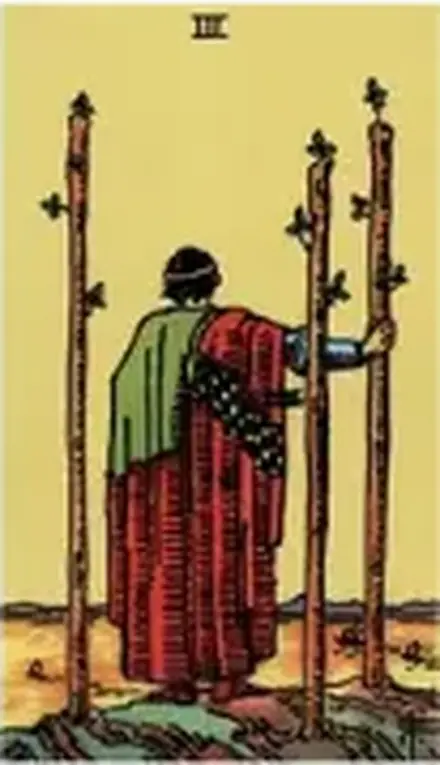
The Three of Wands is an enterprise under way: someone who has sent out their ships and waits on high, gazing far, for them to come home laden.
Draw this card · Its correspondences
- Arcana: Minor, number 3
- Suit and element: Wands, Fire
- Golden Dawn title: Lord of Established Strength
- Sephirah: Binah
- Decan: Aries II, Sun (10° to 20° Aries)
- Keywords: Preparation, foresight, expansion, distant horizons
- Yes or no?: Yes
- Archetype: The Merchant on the Cliff
What the card shows
In the deck Pamela Colman Smith drew for Arthur Edward Waite in 1909, the Three of Wands shows a man seen from behind, calm and still, at the edge of a cliff. He wears a red cloak over a green tunic, with a sash across one shoulder. His right hand rests on one of three wands planted in the ground around him. Below lies an inlet of golden water where small ships are sailing, and in the distance mountains rise under a yellow sky.
Each piece has a reading. The cliff is a high vantage point, the place of someone who has climbed and can now take in the whole landscape. Because the figure has his back to us, the viewer stands where he stands and sees what he sees. The ships are what he has set in motion: goods, projects or people that have gone out and not yet returned. The three wands planted firmly in the earth speak of a solid base that supports the wait. The gold of the water and sky belongs to the suit’s fire and to the promise of profit.
In The Pictorial Key to the Tarot (1910), Waite sees in the card established strength, enterprise, commerce and discovery, and says the ships are the figure’s own, carrying his merchandise. He adds a curious touch: the card may point to a successful person looking toward the querent to offer help. The Golden Dawn named it the Lord of Established Strength and gave it the second decan of Aries, ruled by the Sun, and Binah, the third sefirah of the Tree of Life.
Three of Wands upright
Upright, the Three of Wands reads as expansion that has already begun. Where the Two of Wands looked at the world from the castle and hesitated, the Three has made up its mind: the ships have sailed. Tradition links the card with preparation, foresight, distant horizons and the confidence of someone who knows they have done their part well.
In a spread it often points to a project in progress that has not yet borne visible fruit. The work is done, the investment made, the contacts in place, and now comes a wait with your eyes on the distance. The waiting in the Three of Wands is calm and active. The figure watches, calculates and prepares the next move. That is why the card also speaks of strategic vision, long-term thinking and seeing before anyone else what is coming over the horizon.
The decan gives the card its brightness. The Sun in Aries is the energy of a clear start, with a healthy pride in it. There is leadership here: the person who organised the expedition and answers for it. The card also covers travel, foreign trade, study abroad and long-distance relationships. Next to The World or the Six of Swords it reads as a real journey. Next to Pentacles cards, such as the Eight or the Ten, the stress falls on business and profit.
As advice, the card invites you to trust what you have already set moving and to use the wait to look further ahead. The ships return in their own time. Meanwhile the person on the cliff can prepare the harbour and plan the next voyage.
Three of Wands reversed
Not every school reads reversals. Many readers work with upright cards only and let the surrounding cards add nuance. Those who do read the Three of Wands reversed usually take it in one of two ways.
The first comes from Waite, and it surprises beginners: the end of troubles, a pause in adversity, the close of hard toil and of disappointment. Read this way, the reversed card brings relief.
The second, more common today, is delay. The ships are late, the answer does not come, the project meets obstacles nobody foresaw. It can point to short-sighted planning or to expansion that happened too fast.
In both cases the advice is to review the route and keep the enterprise standing. Check where the forecast went wrong, adjust the timeline and keep the base firm while you wait.
In love
In love, the Three of Wands reads as a relationship with a horizon. For couples it can point to future plans, a shared project, or a stretch of distance held together by trust. It also speaks of giving each other room: each person makes their own journey and the relationship is the harbour they return to.
If you are single, it speaks of opening up to what comes from far away. It might be someone from another city or country, a person met while travelling, or simply a time to widen your circle. The Three of Wands as feelings is hopeful and forward-looking, with an eye on what the two of you could build.
Reversed, in love
Reversed in love, the Three of Wands speaks of long waits and distance that weighs: slow replies, postponed plans, a relationship that lives more in the future than the present. As advice, it suggests setting real dates and looking after everyday life together.
Career and money
For career and money, the Three of Wands reads as expansion. It is one of the clearest cards for trade, exports, overseas clients and projects that cross borders. It says the investment has been made and the results will come with time. It also favours partnerships: Waite links it with cooperation in business. With money, it speaks of profits on the way and the wisdom of planning ahead.
Reversed, in career
Reversed, it points to delays in shipments, payments or replies, or to a miscalculated expansion. The advice is to review deadlines and risks and to hold off on new fronts until the current ones are secure.
Health and mood
For health and mood, the Three of Wands is linked with gradual recovery and patience: the care is already under way and results come with time. It also reads as an invitation to look ahead and stay consistent. No card can diagnose anything. For any symptom or worry, speak to a health professional.
Yes or no? Yes
The Three of Wands reads as a yes. What you are asking about is already on its way and stands on a solid base; the card shows the ships sailing toward their destination. The nuance is time. The result arrives, though not at once, and it calls for patience and foresight. If the question is whether something will happen this very week, the card advises waiting.
Ask the card: a yes or no tarot reading with one card or three.
The archetype: The Merchant on the Cliff
As an archetype, the Three of Wands is the person who has placed their bet and is now waiting. They have fitted out the expedition, sent the ships, signed the contract, and from on high they watch the horizon. This is the merchant awaiting a fleet, the explorer funding a voyage, the father seeing off a son who emigrates, the author who has sent out a manuscript and checks the post every morning.
In story structure, the card sits at the start of the second act, when the decision has been made and the world is answering. The intriguing thing is that the main action happens far away, out of the character’s sight. That creates a very particular tension. The reader knows something is happening at sea, and the character can only imagine it. The waiting fills up with calculations, fears and hopes.
The archetype has a clear shadow. Someone who always looks at the horizon can neglect what lies behind them: the house, the people close by, the present. They can also come to depend too much on something they cannot control. If the ships sink, all the confidence on the cliff collapses with them.
In fiction, the card works when the waiting carries weight. The reader needs to know what is aboard those ships, what has been risked on them and what will happen if they never return. A figure with their back to us, looking out to sea, only appears to be at rest. Inside, the Three of Wands is all foresight and nerve.
In literature
- The Merchant of Venice (William Shakespeare, 1600). Antonio’s fortune is spread across ships bound for Tripoli, the Indies and Mexico. On the strength of that confidence he signs Shylock’s bond, with a pound of his flesh as surety. The whole play rests on the ships of the Three of Wands, and on what happens when word comes that they have been lost.
- One Hundred Years of Solitude (Gabriel García Márquez, 1967). José Arcadio Buendía founds Macondo and immediately looks beyond it. He leads an expedition to find the sea and stumbles on a Spanish galleon stranded in the middle of the jungle. It is the Three of Wands’ impulse, established strength that needs to expand, with the bitter twist of a horizon that lies somewhere else entirely.
- Nostromo (Joseph Conrad, 1904). Charles Gould revives the San Tomé silver mine in the imaginary republic of Costaguana and turns it into an enterprise that moves ships, ports and governments. The novel shows the Three of Wands on a grand scale: trade as power, and silver shipped out by sea with everything it drags along behind it.
For writers
The conflict
The Three of Wands sets up a conflict of waiting and distant risk. The character has staked something valuable on an enterprise they no longer fully control: money, reputation, a person they love. The decisive events happen offstage. To prepare the card, make clear what is on board the ships and what the character stands to lose if they never return. The tension grows with every piece of news that arrives, or fails to.
The twist
As a plot twist, the Three of Wands is the message that comes in from the horizon. It may be word that the ships are back and laden, or that they have been lost. The richest twist comes when what returns is different from what was expected: other cargo, another person, an unexpected ally. The figure seen from behind also allows a twist of viewpoint, when we learn that someone has been watching him.
Prompts
- Write a scene of someone waiting for news of a ship, a train or a letter, without the text ever saying exactly what they are waiting for.
- Have your protagonist spot a sign on the horizon that nobody else has seen, and let them decide their next move in that instant.
- Tell the ships’ arrival from the crew’s point of view as they bring back something different from what their owner awaits on the cliff.
Its correspondences
- Element: Fire. Source: Golden Dawn (tradition).
- Sephirah: Binah. Source: Golden Dawn (tradition).
- Decan: Aries II. Source: Golden Dawn (tradition).
Combinations
Three of Wands and Two of Wands
The Two and Three of Wands form a natural sequence: the plan drawn up in the castle and the enterprise already under sail. Together they read as a decision starting to pay off.
Three of Wands and The World
With The World, the Three of Wands leans hard into travel. The pair reads as open horizons, work abroad, a relocation or a project that crosses borders and reaches safe harbour.
Three of Wands and King of Wands
The King of Wands beside the Three reads as long-range vision and leadership. Someone in authority launches an expansion and knows how to wait for the fruit of what they have sown.
Three of Wands and Six of Swords
With the Six of Swords, the journey becomes literal. The pair reads as a move, a relocation or a crossing toward calmer waters, prepared well ahead and with a clear head.
Three of Wands and Eight of Pentacles
The Eight of Pentacles brings the steady work that sustains expansion. The pairing speaks of a business that grows on the strength of quality and daily dedication.
Three of Wands and Eight of Cups
With the Eight of Cups, looking far also means leaving something behind. The pair reads as a necessary departure toward something more meaningful, even when the goodbye is hard.
Three of Wands and The Hermit
The Hermit beside the Three of Wands stresses solitary foresight. It reads as someone who plans alone, looks far ahead and prefers to wait until all the information is in.
Frequently asked questions
What does the Three of Wands mean in tarot?
The Three of Wands stands for an enterprise already under way and eyes fixed on the horizon. Tradition reads it as expansion, foresight, trade and travel: someone who has done their part and is waiting, with confidence, for the results to arrive.
What does the Three of Wands mean in love?
In love it reads as a relationship with a future and with room to breathe. For couples it can point to shared plans or a long-distance stretch that holds. For singles, it invites openness to people from other places and a wider circle than usual.
Is the Three of Wands a yes or no card?
It reads as a yes, with a note about timing. What you are asking about is already on its way and has a firm base, but the result calls for patience: the ships come in at their own pace.
What does the Three of Wands reversed mean?
Readers who use reversals usually see it as delays, miscalculated plans or a wait that drags on. Waite gave it the opposite sense, the end of troubles and a pause in toil, and many modern readings blend the two ideas.
What is the Three of Wands’ decan and Golden Dawn title?
In the Golden Dawn’s Book T, the Three of Wands is called the Lord of Established Strength. It corresponds to the second decan of Aries, 10° to 20°, ruled by the Sun, and to Binah, the third sefirah of the Tree of Life.
Does the Three of Wands mean travel?
It is one of the cards tradition most links with travel and foreign places, because of the ships sailing below the cliff. Depending on the cards around it, it can read as a real trip, a relocation, study abroad or a business with distant clients.
Do your readingPrevious: Two of Wands · Next: Four of Wands
The 14 cards of Wands
- Ace of Wands
- Two of Wands
- Three of Wands
- Four of Wands
- Five of Wands
- Six of Wands
- Seven of Wands
- Eight of Wands
- Nine of Wands
- Ten of Wands
- Page of Wands
- Knight of Wands
- Queen of Wands
- King of Wands
By Style Optimizer · published November 22, 2026.