Tarot / The 78 cards / Wands / Ace of Wands
Ace of Wands: tarot card meaning, upright and reversed
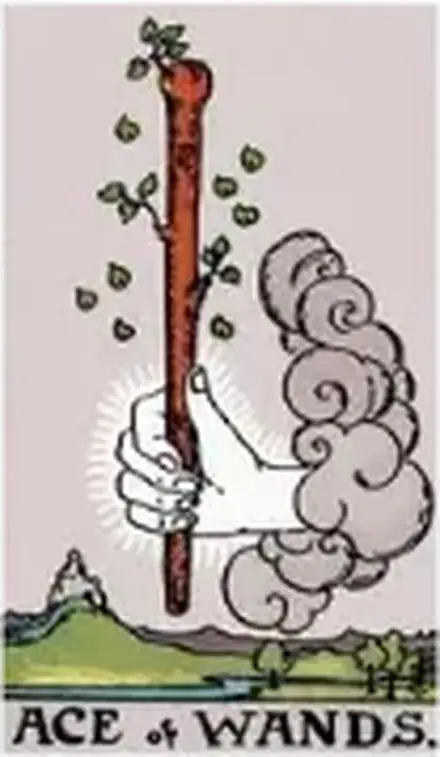
The Ace of Wands is the spark of a beginning: an idea with its own momentum, the urge to create and the energy to take the first step.
Draw this card · Its correspondences
- Arcana: Minor, number 1
- Suit and element: Wands, Fire
- Golden Dawn title: Root of the Powers of Fire
- Sephirah: Kether
- Zodiac quadrant: Cancer, Leo, Virgo
- Keywords: Inspiration, new opportunity, growth, potential
- Yes or no?: Yes
- Archetype: The First Spark
What the card shows
In the deck Pamela Colman Smith drew for Arthur Edward Waite in 1909, the Ace of Wands shows a hand reaching out of a cloud on the right side of the card. The cloud is grey, edged with a faint glow. The hand grips a thick, straight staff of living wood. Green leaves sprout along its length, and a few have come loose and are falling through the air. Below lies a quiet landscape: a river winding through meadows, a stand of trees on the left and, on a hill to the right, a castle.
Each element carries a traditional reading. The hand from the cloud is the gift that arrives from outside, the idea that turns up from nowhere. It appears on all four Aces and marks the whole suit held in seed form. The sprouting wand is wood that is still growing: raw energy, will, the desire to make something. The falling leaves are often read as small yods, the Hebrew letter that stands for the divine spark, and they suggest an impulse that spreads and quickens whatever it touches. The castle on the hill is the possible goal, what could be built if the spark catches. The river is time, and the road still to be travelled.
In The Pictorial Key to the Tarot (1910), Waite sums up the card with words such as creation, invention, enterprise, principle, source and birth. The Golden Dawn calls it the Root of the Powers of Fire, places it in Kether, the first sefirah of the Tree of Life, and gives it the quadrant of the heavens held by Cancer, Leo and Virgo.
Ace of Wands upright
Upright, the Ace of Wands reads as the start of something that runs on its own energy. It is the idea that excites you, the project that wants to begin today, the calling that wakes up. Tradition links it with creation in the broadest sense: a piece of work, a business, a journey, a relationship, a child. What all these readings share is the first push, the feeling that something is trying to be born.
In a spread it usually points to an opportunity still in seed. The Ace supplies the force and the desire. Shape, planning and staying power come later, with the cards that follow it in the suit. That is why it reads best as an invitation to act while the spark is alive. Fiery ideas cool quickly when they sit in a drawer.
The suit of Wands belongs to fire, and fire speaks of will, passion, ambition and creativity. The Ace is the root of all of it: the moment when the will is still fresh and unspent. Next to cards of structure, such as The Emperor or the Three of Pentacles, the impulse finds a channel. Next to scattered cards, such as the Seven of Cups, the risk is lighting many fires and feeding none.
As advice, the card asks you to say yes to the first step. Something concrete is enough: write the first page, make the call, sign up for the class, show someone the sketch. The Ace of Wands reads as permission to begin before everything is clear.
Ace of Wands reversed
Not every school reads reversals. Many readers use only upright cards and let the neighbouring cards add nuance. Those who do read the Ace of Wands reversed tend to take it in one of two ways.
The first is the spark that will not catch. The idea is there and so is the wish, yet something holds back the start: fear, tiredness, lack of time, or the sense that the moment has not come. For the reversed card Waite speaks of fall and of clouded joy, and modern readers take it as a beginning that is delayed or that fizzles out too soon.
The second is fire with no direction. Plenty of energy and no channel for it: projects started and dropped, enthusiasm that burns out in a day, impatience. Read this way, the card asks you to choose one fire and tend it.
Either way, the advice points to the same place. Find the smallest possible way to begin, and repeat it until the impulse puts down roots.
In love
In love, the Ace of Wands reads as attraction, desire and the start of something with real spark. In a relationship it can point to a season of renewed passion, a shared project that thrills you both, or the wish to surprise each other again. Tradition ties it to physical energy and the joy of being alive, so it also speaks of play and easy closeness.
If you are single, the Ace of Wands often describes a meeting that sparks instant interest, an attraction that is obvious from the first moment, or simply the urge to go out and meet people. The Ace of Wands as feelings is warm and eager. Much depends on the cards that follow: the spark is there, and the card leaves open whether there will be fuel to keep it going.
Reversed, in love
Reversed in love, the Ace of Wands speaks of desire cooling, attraction that goes unanswered, or a relationship where nobody takes the initiative. It can also point to haste, a wish to move far too fast. As advice, it suggests bringing back the playfulness before asking for results.
Career and money
For career and money, the Ace of Wands reads as a new project, an offer, a business idea or a vocation coming into focus. It favours creative work, entrepreneurship and any task that calls for initiative. Tradition advises using the momentum for a first concrete move: pitch the proposal, open the project, find the person who might fund it. Financially it speaks of potential more than cash in hand.
Reversed, in career
Reversed, it points to a delayed launch, ideas that find no backing, or a loss of appetite for your current job. The advice is to get specific: shrink the plan to one first task you can do this week.
Health and mood
For health and mood, the Ace of Wands is linked with vitality, the urge to move and energy returning after a tired stretch. It reads as a good moment to start a habit, at a pace the body can keep up. No card can diagnose anything. For any symptom or worry, speak to a health professional.
Yes or no? Yes
The Ace of Wands reads as a clear yes, especially when the question is about starting something: a project, a trip, a relationship, a change of direction. The card brings drive and appetite and encourages the first step. The nuance is timing. This yes depends on acting soon, because fire’s opportunities are taken while they are hot and slip away if you wait too long.
Ask the card: a yes or no tarot reading with one card or three.
The archetype: The First Spark
As an archetype, the Ace of Wands is the instant a story starts to move. It embodies an event more than a character: the call, the bright idea, the desire that bursts in and changes the course of a life. When it does take human form, it is the figure who spreads enthusiasm, the stranger who proposes an adventure, the teacher who lights a vocation with a single sentence.
In story structure, the Ace of Wands sits where the inciting incident sits. It is the card of the protagonist who discovers what they want. Its dramatic force lies in the energy it releases. From that moment the character has an engine and the reader has a question. Will they reach the castle on the hill?
The Ace’s fire cuts both ways, and fiction can make good use of that. The spark that creates can also burn. A character possessed by an idea may build something great or flatten everything around them, and the tension between those two outcomes carries many novels. The Ace also works well seen from outside: one character’s drive that nobody else understands and that only makes sense at the end.
For the archetype to work, the spark has to cost something. A desire that meets no resistance stays an anecdote. Once it collides with fear, family, money or time, it becomes a story.
In literature
- Frankenstein; or, The Modern Prometheus (Mary Shelley, 1818). Victor Frankenstein lives the Ace of Wands in its most dangerous form: the idea that becomes an obsession, the literal spark that brings the creature to life. The subtitle already points to fire stolen from the gods. The novel asks what happens when the creative drive races ahead and never stops to weigh the consequences.
- Fahrenheit 451 (Ray Bradbury, 1953). Guy Montag is a fireman who burns books, until a conversation with a young neighbour lights a curiosity in him that will not go out. That moment is the Ace of Wands. The same fire that used to destroy becomes a hunger to know, and it pushes him out of his entire life.
- Fuenteovejuna (Lope de Vega, 1619). The village endures the Commander’s abuses until Laurencia’s speech sets off the revolt. The play shows a collective Ace of Wands: one spark, spoken aloud, turns silent outrage into shared action. Lope builds the scene so that the uprising feels inevitable, and the whole town answers as one voice.
For writers
The conflict
The Ace of Wands sets up a conflict between the urge to begin and everything that stands against that beginning. It works best when the character has a lot to lose by following the impulse: a safe job, a family expecting something else, an image of who they are. To prepare the card, show the character’s dimmed life first, so the reader feels the difference when the spark arrives.
The twist
As a plot twist, the Ace of Wands is the unexpected call that opens a new story inside the story: a letter, an offer, an idea that comes to the person least likely to have it. The richest moment comes when the character decides whether to follow it or put it out. The falling leaves are a useful clue: one person’s impulse ends up catching fire in others.
Prompts
- Write the exact minute your character has an idea that will change their life, before they know what it will cost them.
- Tell the first night of a new project from the point of view of someone watching the protagonist and wondering why they glow.
- Let a spark of enthusiasm pass from one character to another like a contagion until it lands with the person who least expected it.
Its correspondences
- Element: Fire. Source: Golden Dawn (tradition).
- Sephirah: Kether. Source: Golden Dawn (tradition).
- Sign: Cancer. Source: Golden Dawn (tradition).
- Sign: Leo. Source: Golden Dawn (tradition).
- Sign: Virgo. Source: Golden Dawn (tradition).
Combinations
Ace of Wands and The Fool
The Ace of Wands with The Fool doubles the energy of a beginning. Together they read as a leap into something new with great enthusiasm and little foresight: perfect for starting, a little risky if nobody watches the road.
Ace of Wands and The Magician
With The Magician, the spark finds its tools. The pair reads as an idea that already has the means and the skill to become real, a strong start for a personal project or a creative craft.
Ace of Wands and Death
Death beside the Ace of Wands speaks of an ending that releases energy. What closes makes room for a new impulse, and the beginning arrives almost on the heels of the previous chapter.
Ace of Wands and Ace of Swords
The two Aces together join the clear idea of air with the drive of fire. They read as a beginning with both vision and force, very good for launching a project that has already been thought through.
Ace of Wands and The Emperor
With The Emperor, fire finds structure. The pair reads as a project that starts with order, leadership and a plan, which gives it a much better chance of lasting.
Ace of Wands and Seven of Cups
The Ace of Wands with the Seven of Cups warns about scattering: too many ideas and too much appetite at once. Choose one fire and leave the rest for later.
Ace of Wands and The Sun
With The Sun, the Ace of Wands reads as a joyful, vital beginning. It is one of the brightest pairings for a project, a birth or a fresh chapter of life.
Frequently asked questions
What does the Ace of Wands mean in tarot?
The Ace of Wands stands for the spark of a beginning: an idea with force behind it, the urge to create and the energy to take the first step. Tradition links it with creation, initiative and vocation. It is the root of the suit of Wands, which belongs to the element of fire.
What does the Ace of Wands mean in love?
In love it reads as attraction, desire and the start of something with real spark. In a relationship it speaks of renewed passion or a shared project; for singles, of a meeting that sparks instant interest. How long it lasts depends on whether that energy is looked after.
Is the Ace of Wands a yes or no card?
It reads as a yes, especially for questions about starting something. The card brings momentum and encourages action. The nuance is speed: fire’s yes asks you to move soon, and it weakens if you let too much time pass.
What does the Ace of Wands reversed mean?
Readers who use reversals usually see it as a spark that will not catch, a beginning delayed by fear or fatigue, or as energy with no direction that scatters across too many projects. The advice is to shrink the plan to one concrete first step.
What are the Ace of Wands correspondences?
In the Golden Dawn system, the Ace of Wands is called the Root of the Powers of Fire and sits in Kether, the first sefirah of the Tree of Life. It rules the quadrant of the heavens held by Cancer, Leo and Virgo.
Can the Ace of Wands mean pregnancy?
Tradition links the Ace of Wands with birth and origin, so some readers connect it with fertility. It reads as a symbol of something beginning. No card can confirm a pregnancy: for that, the answer lies in a test and a health professional.
Do your readingPrevious: The World · Next: Two of Wands
The 14 cards of Wands
- Ace of Wands
- Two of Wands
- Three of Wands
- Four of Wands
- Five of Wands
- Six of Wands
- Seven of Wands
- Eight of Wands
- Nine of Wands
- Ten of Wands
- Page of Wands
- Knight of Wands
- Queen of Wands
- King of Wands
By Style Optimizer · published November 22, 2026.