Tarot / The 78 cards / Major Arcana / Justice
Justice, Major Arcana XI: tarot card meaning, upright and reversed
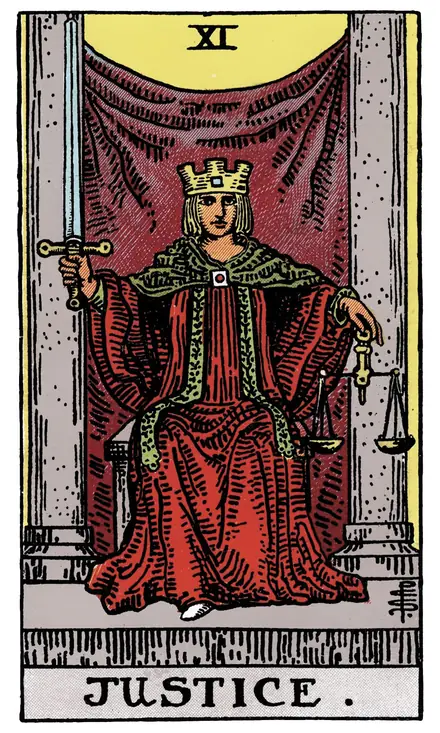
Justice is the balance between what was done and what comes back: the truth weighed on the scales and a decision that accepts its price.
Draw this card · Its correspondences
- Arcana: Major, number XI
- Hebrew letter: Lamed (ל), “ox-goad”
- Path on the Tree of Life: 22
- Attribution: Libra
- In one sentence: Exact balance
- Keywords: Justice, truth, cause and effect, law, clarity
- Yes or no?: Yes, with conditions
- Archetype: The one who weighs and decides
What the card shows
In the deck Pamela Colman Smith drew for Arthur Edward Waite in 1909, Justice sits facing us on a stone throne between two grey pillars. She wears a red robe and a green cloak fastened with a clasp, and a crown with a square jewel at its centre. In her right hand she holds a double-edged sword, straight and pointing upward. In her left she holds a pair of golden scales, at rest. Behind the pillars hangs a purple veil, and a white shoe peeps out from beneath her robe.
Each detail carries a meaning. The raised sword is decision: it cuts, separates true from false, and has two edges because every verdict touches both parties. The scales are the judgement that weighs before acting. Her eyes are open and look straight ahead, departing from the blindfolded Justice of the courthouse: this figure sees, and wants to see. The two pillars recall those of the High Priestess and mark a threshold. The veil behind them suggests that human justice has a limit, and that a deeper law lies beyond it. The foot stepping forward reads as readiness to act once the decision is made.
Waite changed the order of two cards. In the Marseille tarot Justice is VIII and Strength XI; in his deck Justice becomes XI. In this he followed the Golden Dawn, which assigned the card to the Hebrew letter Lamed, “ox-goad,” and to Libra, the scales of the zodiac. Book T calls it the Daughter of the Lords of Truth.
Justice upright
Upright, Justice reads as the moment the accounts balance. What was sown bears fruit, for better or worse, and the card asks you to look at it clearly. Tradition links it with truth, with cause and effect, with contracts and agreements, and with decisions made with a cool head. It is a grown-up card: it speaks of responsibility and of accepting your share of what happened.
In a spread it often signals a resolution. A pending matter closes, an answer arrives, papers get signed, someone receives what they deserved. It may also point to legal proceedings, a court case or a negotiation. In that case it reads as favourable to whoever has right on their side and has acted honestly.
The Justice card has little to do with revenge. Her scales seek balance, and her sword cuts away what is excess without cruelty. So, as advice, she asks for honesty with yourself: work out which part of the situation is your own responsibility before looking for someone to blame. She also asks you to decide. The figure sits calmly, sword raised: she has already weighed the arguments, and the time to act has come.
Next to cards such as Judgement or the World, Justice reinforces the idea of closure and reckoning. Next to cards of conflict, such as the Five of Swords, the emphasis falls on the need for fair dealing and on the consequences of having broken it.
Justice reversed
Not every school reads reversals. Many readers work with upright cards only and let the neighbouring cards add nuance. Those who do read reversed cards usually see Justice reversed in two ways.
The first is imbalance: unfair treatment, a decision coloured by prejudice, scales tipped toward whoever holds more power. In legal matters the reversed card is associated with delays, paperwork that gets complicated, or an outcome that does not match the facts.
The second looks inward. It is the person who dodges their share of responsibility, tells themselves a comfortable version of events, or avoids a decision because they fear its consequences. Read this way, Justice reversed asks for an honest self-examination. Admitting your own mistake is usually the first step toward restoring balance.
In love
In love, Justice reads as balance and sincerity. In a relationship it describes a bond in which each partner gives and receives in similar measure, or the need to reach that point: sharing the load more fairly, telling the truth, renegotiating agreements. It may also point to formal commitments, such as moving in together or a wedding, and to decisions made with maturity.
If you are single, the card invites you to look clearly at what you are looking for and what you are offering. It is linked with relationships built on mutual respect and with leaving lopsided stories behind.
Reversed, in love
Reversed in a love reading, Justice signals an imbalance: one person giving far more than the other, piled-up resentments, or a truth kept hidden. The advice is to put your cards on the table and seek a fairer arrangement.
Career and money
For career and money, Justice is associated with contracts, agreements, audits and anything where the rules matter. It reads as fair recognition for your effort, a balanced negotiation, or a favourable outcome to formal proceedings when your paperwork is in order. It advises reading the small print and deciding on the basis of facts.
Reversed, in career
Reversed, it points to unequal deals, confusing clauses or a legal dispute that drags on. It asks you to review documents, get proper advice and avoid shortcuts.
Health and mood
In matters of health and mood, Justice is linked with the balance between rest and effort and with the consequences of everyday habits. It reads as an invitation to put your routines in order and to listen honestly to your body. No card can diagnose anything: for any symptom or doubt, see a qualified health professional.
Yes or no? Yes, with conditions
Justice reads as a yes when what you are asking for is fair and you have acted honestly. The card gives back to each person what their actions have earned, so the outcome depends on what sits in the scales. If a shortcut was taken or something is being hidden, the answer leans toward no. Before expecting a result, review your own part.
Ask the card: a yes or no tarot reading with one card or three.
The archetype: The one who weighs and decides
As an archetype, Justice is the character who brings order to the story. She can take the form of the judge, the investigator, the referee or the friend who tells the truth without softening it. Her essential trait is a clear gaze: she sees the facts as they are and is ready to act on them, even when it costs her something. She carries sword and scales together, and that double role is where her dramatic interest lies. She has to weigh, and then she has to cut.
In the structure of a story, Justice occupies the moment of reckoning. It is the trial scene, the unmasking of the culprit, the final settling of accounts in which every earlier act receives its answer. Many novels are built toward this card: the reader gathers evidence and waits for the scales to move. When the author delivers, the story feels complete. When the author withholds it on purpose, the reader feels the injustice with a force that is literary too.
The risk of this archetype is coldness. A judge without doubts falls flat. Justice gains depth when the character knows her scales are human and that behind the pillars hangs a veil: a truth that escapes her. The fact that the card’s own number has moved around in the history of tarot says something similar. Even the order of the law is open to debate.
For a writer, the most useful question this card asks is simple: what does the verdict cost the one who delivers it? Answer that, and the trial scene stops being a formality.
In literature
- The Eumenides (Aeschylus, 458 BC). It closes the *Oresteia* with a trial. Orestes has avenged his father by killing his mother, and the Furies demand blood for blood. Athena then founds a jury of citizens to weigh the arguments of both sides. Vengeance gives way to law, and the scales replace the endless chain of killings.
- The Merchant of Venice (William Shakespeare, 1600). Shylock comes to court with his bond, his knife and his scales, ready to weigh out a pound of Antonio’s flesh. Portia, disguised as a young lawyer, pleads for mercy and then turns the letter of the law against him. The trial scene stages both edges of the card’s sword: strict justice and its limits.
- To Kill a Mockingbird (Harper Lee, 1960). Atticus Finch defends a Black man accused without evidence in a small Alabama town. The evidence is on his side, prejudice has rigged the scales, and the jury convicts anyway. Told by his daughter Scout, the novel shows Justice reversed, and a man who keeps holding her upright against everyone.
For writers
The conflict
Justice sets what is legal against what is fair, or what a character knows against what they are willing to admit. It works best when the person who must judge is involved: a judge who knows the accused, a mother who discovers her son’s wrongdoing, a journalist holding evidence that harms her own people. The scales weigh heaviest when the character is standing in one of the pans.
The twist
As a plot twist, Justice is the consequence that returns. A decision from the first act, one the reader had almost forgotten, comes back with its exact bill. The effect is strongest when the answer is proportionate and precise, neither more nor less than what was done. The double-edged sword is a good clue: the verdict can also strike the one who pronounces it.
Prompts
- Make the exact consequence of an earlier decision visible.
- Write a scene in which a character must judge someone they love, with the evidence on the table and nobody to decide for them.
- Tell the same event twice, once from each pan of the scales, and let the reader weigh the two versions.
- Have your protagonist receive a fair sentence and discover, as they accept it, a truth that was hidden behind the veil.
Its correspondences
- Letter and path: Lamed. Source: Golden Dawn (tradition).
- Sign: Libra. Source: Golden Dawn (tradition).
- Letter, alternative attribution: Cheth. Source: Éliphas Lévi (tradition).
- Rune: Tiwaz. Source: Angelorum table (modern system).
- Archangel: Haniel. Source: Angelorum table (modern system).
Combinations
Justice and Judgement
Justice and Judgement together speak of a final reckoning. Justice weighs the deeds; Judgement calls you to answer for them. Together they read as a closure in which the past is finally set in order.
Justice and Strength
This is the pair Waite swapped. Strength brings patience and Justice brings discernment. Together they read as serene firmness: the ability to decide calmly and then stand by the decision once it has been made.
Justice and The Chariot
The Chariot with Justice reads as a victory won for good reasons. The will moves forward and the scales give it legitimacy, as long as haste does not bend the judgement along the way.
Justice and The Lovers
With the Lovers, Justice asks you to choose with a clear head. It reads as a decision of the heart that must take into account what is fair to both people involved.
Justice and Two of Swords
The Two of Swords beside Justice signals a postponed decision. The scales are still because someone refuses to look; Justice asks you to take off the blindfold and finally decide.
Justice and Temperance
With Temperance, balance becomes gentler. Together they read as an agreement that reconciles competing interests, a mediation that works, and a patient adjustment that leaves both sides at peace.
Justice and Four of Pentacles
With the Four of Pentacles, the scales turn to money and property: inheritances, divisions of assets, debts or contracts that are worth reviewing carefully and with a sense of fairness.
Frequently asked questions
What does Justice mean in tarot?
Justice, card XI in the Rider–Waite–Smith deck, stands for the balance between actions and their consequences. Tradition links it with truth, law, agreements and decisions made with clarity. Its sword cuts away what is excess, and its scales weigh everything before acting.
What does Justice mean in love?
In love it reads as a balanced, honest relationship in which each partner gives and receives in similar measure. It can also point to formal commitments. Reversed, it signals an unequal arrangement or a truth left unspoken, and asks you to speak plainly.
Is Justice a yes or no card?
It reads as a conditional yes: favourable if what you are asking for is fair and you have acted honestly. If there was a shortcut or something is hidden, it leans toward no. The card returns what your actions have earned.
What does Justice reversed mean?
Readers who use reversals usually see it as unfair treatment, a prejudiced decision or formal proceedings that get complicated. It can also describe a tendency to dodge your own responsibility. It asks for honest self-examination before looking for someone to blame.
Why is Justice XI and not VIII?
In the Marseille tarot Justice is VIII and Strength XI. Waite swapped them in his 1909 deck, following the Golden Dawn, so that the cards would line up with the order of the Hebrew letters and the signs: Strength with Leo and Justice with Libra.
What zodiac sign and Hebrew letter go with Justice?
In the Golden Dawn system, Justice corresponds to Libra, the scales, and to the Hebrew letter Lamed, meaning “ox-goad,” on the 22nd path of the Tree of Life. Éliphas Lévi had given it a different attribution, the letter Cheth.
Do your readingPrevious: Wheel of Fortune · Next: The Hanged Man
The 22 Major Arcana
- The Fool
- The Magician
- The High Priestess
- The Empress
- The Emperor
- The Hierophant
- The Lovers
- The Chariot
- Strength
- The Hermit
- Wheel of Fortune
- Justice
- The Hanged Man
- Death
- Temperance
- The Devil
- The Tower
- The Star
- The Moon
- The Sun
- Judgement
- The World
By Style Optimizer · published November 22, 2026.