Tarot / The 78 cards / Major Arcana / The High Priestess
The High Priestess, Major Arcana II: tarot card meaning, upright and reversed
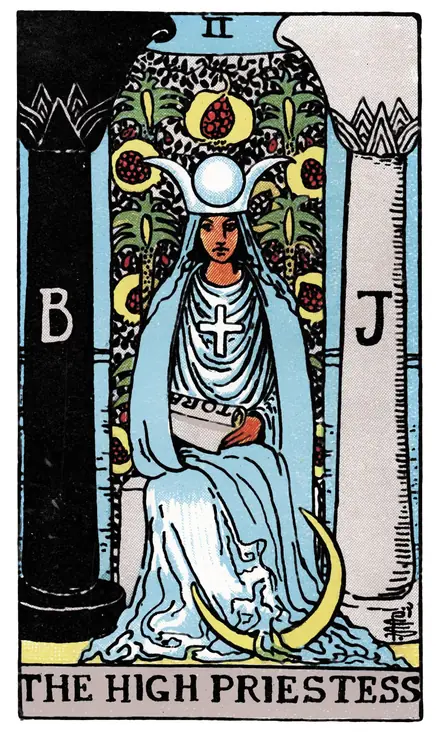
The High Priestess is knowledge that keeps its silence: intuition, secrets and the patience to wait until the truth chooses to show itself.
Draw this card · Its correspondences
- Arcana: Major, number II
- Hebrew letter: Gimel (ג), “camel”
- Path on the Tree of Life: 13
- Attribution: Moon
- In one sentence: The veil and what it keeps silent
- Keywords: Intuition, mystery, the subconscious, inner wisdom
- Yes or no?: It depends
- Archetype: The keeper of secrets
What the card shows
In the deck Pamela Colman Smith drew for Arthur Edward Waite in 1909, the High Priestess sits still and upright, facing us, between two pillars. The one on the left is black and bears the letter B; the one on the right is white and bears the letter J. They are Boaz and Jachin, the pillars that, in the biblical account, stood at the entrance to Solomon’s Temple. Behind her hangs a veil embroidered with palms and pomegranates that hides most of the background; through the gaps a strip of water shows.
Her blue mantle falls to the ground like a current. On her head she wears a horned crown with a disc at its centre, the waxing, full and waning moon in a single headdress. A solar cross with equal arms lies on her breast. In her lap she holds a scroll marked TORA, half hidden in the folds of her robe: the law is present, though never fully in view. A crescent moon rests at her feet.
Each element has its reading. The two pillars are the opposites, light and shadow, and she sits between them, at the point where neither rules. The veil separates what is visible from what lies behind it; the pomegranates, packed with seeds, speak of fertility and of knowledge that ripens within. The water in the background is the inner life, flowing without a sound.
In The Pictorial Key to the Tarot (1910), Waite describes her as the secret tradition and the hidden law, a queen of borrowed light, like the moon. The Golden Dawn named her the Priestess of the Silver Star and gave her the Hebrew letter Gimel, “camel”, and the Moon. In Marseille decks she appears as La Papesse, the Papess or Female Pope.
The High Priestess upright
Upright, the High Priestess reads as the moment to listen before you act. This is the card of things known before they can be explained: a hunch, a dream you remember, the sense that something was missing from a conversation. The tradition links her with intuition, inner knowledge and secrets, both the ones you keep and the ones nobody has told you yet.
In a spread, the High Priestess meaning usually points to incomplete information. There is something behind the veil, and the card advises against tearing the curtain open. The answer will come in its own time; pushing now would only give you part of the picture. That is why she is associated with patience, observation and quiet study.
She can also be read as a person: a woman, or anyone, who knows more than they say. She may be an adviser, a teacher, a discreet friend or the querent’s own inner voice. Her strength is reserve. She stands to one side, watches and remembers.
The Magician comes before her in the sequence of the Major Arcana and works outward; the High Priestess works inward. He speaks, she listens; he begins, she keeps. Beside active cards such as the Wands, she asks for a little calm before the leap. Beside water cards such as the Cups or the Moon, she strengthens everything to do with dreams, memory and feeling.
As advice, the card suggests trusting what you already sense, writing it down and waiting for events to confirm or correct it. Here, silence is a form of attention.
The High Priestess reversed
Many readers never use reversals; they read every card upright and let the surrounding cards add the nuance. Those who do read reversed cards usually see the High Priestess upside down in one of two ways.
The first is intuition ignored. The person senses that something is wrong and talks themselves out of it, because reason or haste carries more weight. The reversed card then speaks of noise: too many outside opinions, too many screens, too little room to hear yourself.
The second is the secret that festers. What is kept quiet stops protecting and starts to divide: a subject no one in the family will touch, information someone holds back to keep power, a truth about yourself you refuse to face. In this reading, the veil becomes a wall.
In both cases, the advice is to recover a useful silence: step away for a while, turn the volume down and ask yourself what you already know and have been avoiding.
In love
In love, the High Priestess reads as a bond with a hidden side. In a relationship it can mark a calm and deep season, an understanding beyond words, or a relationship in which one partner keeps something back. The card asks for patience and listening ahead of grand declarations.
For singles, her love meaning points to a quiet attraction, someone intriguing about whom you know very little, or to a time of retreat in which it pays to get to know yourself better before looking for anyone.
Reversed, in love
Reversed in love, the High Priestess speaks of heavy silences: unspoken suspicions, jealousy nobody names, an emotional distance that keeps growing. It can also show that a clear intuition about the other person is being ignored. As advice, it invites you to ask, calmly, the question you are afraid to ask.
Career and money
For career and money, the High Priestess reads as a time to gather information before deciding. It can point to negotiations with hidden details, a project not yet public or an opportunity best studied discreetly. It favours research, writing, teaching and professions built on listening. Financially, it counsels caution: read the small print and never sign in a hurry.
Reversed, in career
Reversed, it points to information that slips away or gets twisted: rumours, office secrets, a key fact someone refuses to share. The advice is to ask questions, get things in writing and trust your first impression.
Health and mood
In health and mood, the High Priestess is linked with rest, sleep and the body’s rhythms, which the tradition connects with the Moon. She reads as an invitation to notice small signals before they grow. No card can diagnose anything: for any symptom or concern, the person to see is a health professional.
Yes or no? It depends
The High Priestess reads as an answer still behind the veil. Information is missing, and the card advises waiting until you have it before you decide. If the question concerns something you already sense clearly, the tradition reads her as a “yes” to that intuition. If the question demands quick action, she leans closer to “not yet”.
Ask the card: a yes or no tarot reading with one card or three.
The archetype: The keeper of secrets
As an archetype, the High Priestess is the character who knows and stays silent. She occupies a threshold, between two pillars and two worlds, and from there she sees what others miss. In fiction she takes many shapes: the oracle, the grandmother who knows the family history, the librarian guarding a forbidden book, the witness who never testified, the woman everyone consults and nobody really knows.
Her dramatic function is withheld knowledge. As long as she says nothing, the plot rests on an open question. That is why she often appears early in a story, dropping a line the protagonist fails to understand, and returns at the end, when that line finally makes sense. She is an engine of suspense that works without moving.
As a moment in the plot, the High Priestess is the pause before the revelation: the sleepless night, the prophetic dream, the letter the character holds and has not yet opened. It is the instant when the information exists and has changed nothing yet.
The risk with this archetype is turning her into decoration: the mysterious woman who exists only to be decoded. The High Priestess works when her silence has reasons of its own. She keeps quiet out of loyalty, fear or strategy, or because she knows a truth told too soon is useless. Once the reader understands why she is silent, the character gains weight and becomes someone with her own story behind the veil.
In literature
- Rebecca (Daphne du Maurier, 1938). At Manderley, everyone seems to know something about the first Mrs de Winter except the young narrator. Mrs Danvers guards Rebecca’s rooms like a shrine and her memory like a law. The truth stays behind the veil until Maxim confesses it, and the whole novel turns on what is withheld.
- One Hundred Years of Solitude (Gabriel García Márquez, 1967). Melquíades’ parchments are this card’s Torah scroll: written knowledge present throughout the novel that nobody manages to read. Generation after generation, the Buendías have them in front of their eyes without understanding them. When at last they are deciphered, text and life coincide, and the revelation arrives in the final instant.
- The Name of the Rose (Umberto Eco, 1980). An abbey, a labyrinthine library and a book someone protects at any cost. Jorge of Burgos embodies the High Priestess’s dark face: the guardian who decides which knowledge may circulate and which must stay behind the veil. The novel sets secrecy against the curiosity of William of Baskerville, the investigator.
For writers
The conflict
The High Priestess sets up a conflict between what a character knows and what they can or will say. The interest lies in the cost of silence: what it protects, whom it harms, how long it can last. To prepare the card, let the reader suspect that someone knows more, through gestures, glances or answers that are a little too short. The later the silence breaks, the heavier the thing behind it must be.
The twist
As a plot twist, the High Priestess is the revelation that the information was there all along. The document was in the drawer, the grandmother knew, the answer was in chapter one. The strongest effect comes when the reader mentally rereads the story and discovers they had the clues. The card’s two pillars suggest another route: a character who knows both versions of an event and chooses which one to tell.
Prompts
- Keep a crucial piece of information out of the dialogue and let it work from the silence.
- Write a scene in which a character answers every question with exact truths and never once reveals the only thing that matters.
- Tell a family’s story through an object a woman keeps and nobody else has ever seen open.
- Narrate a dream your protagonist forgets on waking and, several scenes later, suddenly recognises in something they are living through.
Its correspondences
- Letter and path: Gimel. Source: Golden Dawn (tradition).
- Planet: Moon. Source: Golden Dawn (tradition).
- Letter, alternative attribution: Beth. Source: Éliphas Lévi (tradition).
- Rune: Perthro. Source: Angelorum table (modern system).
- Archangel: Gabriel. Source: Angelorum table (modern system).
Combinations
The High Priestess and The Magician
The Magician and the High Priestess are the opening pair of the Major Arcana: action and listening. Together they read as a balance between what you do and what you sense, a plan that works because it was first thought through in silence.
The High Priestess and The Moon
With the Moon, the ground is all water: vivid dreams, strong intuitions and some confusion too. Together they read as a period in which it pays to separate, calmly, what you sense from what you fear.
The High Priestess and The Empress
The High Priestess and the Empress join the two faces of the feminine in tarot: what is kept and what blossoms. Together they read as an idea ripening within and about to bear fruit.
The High Priestess and The Emperor
With the Emperor, intuition meets the rulebook. The pairing reads as tension between what you sense and what the structure dictates, or as discreet counsel guiding the person in charge.
The High Priestess and The Hermit
The Hermit beside the High Priestess deepens the retreat. It is a pairing of study, withdrawal and inner searching: a time to learn alone before returning to other people.
The High Priestess and The Tower
With the Tower, the veil tears all at once. What was kept quiet comes to light without warning, and the pairing reads as a secret revealed that overturns the existing order.
The High Priestess and Two of Swords
With the Two of Swords, the decision hangs in suspense. It reads as someone refusing to look at information they already hold; the High Priestess invites you to trust your intuition to break the deadlock.
The High Priestess and Seven of Cups
Beside the Seven of Cups, imagination overflows. The pairing asks you to separate true intuition from fantasy and to choose with a cool head among dazzling options.
Frequently asked questions
What does The High Priestess mean in tarot?
The High Priestess, card II of the Major Arcana, stands for intuition, inner knowledge and secrets. The tradition reads her as the moment to listen before acting: something lies behind the veil, and the card advises patience until the truth comes into view.
Is The High Priestess the same card as the Papess?
Yes, they are names for the same card, number II. Waite called her the High Priestess, and that is the standard English name today. In Marseille decks and older Italian packs she appears as La Papesse, the Papess or Female Pope.
What does The High Priestess mean in love?
In love she reads as a bond with a hidden side: a deep and quiet relationship, or a person who keeps something to themselves. For singles, she points to a discreet attraction or a time of retreat. She asks for patience and careful listening.
Is The High Priestess a yes or no card?
She reads as an answer that depends on information still missing. If the question confirms a clear intuition, she leans towards “yes”; if it calls for hasty action, the tradition places her closer to “not yet”.
What does The High Priestess reversed mean?
Readers who use reversals see her as an ignored intuition, or as a secret that stops protecting and starts to divide. The advice is to find some silence, listen to yourself and face what you already know and keep avoiding.
What Hebrew letter and planet correspond to The High Priestess?
In the Golden Dawn system she corresponds to the Hebrew letter Gimel, meaning “camel”, and to the Moon, on the thirteenth path of the Tree of Life. Éliphas Lévi had earlier assigned the card the letter Beth.
Do your readingPrevious: The Magician · Next: The Empress
The 22 Major Arcana
- The Fool
- The Magician
- The High Priestess
- The Empress
- The Emperor
- The Hierophant
- The Lovers
- The Chariot
- Strength
- The Hermit
- Wheel of Fortune
- Justice
- The Hanged Man
- Death
- Temperance
- The Devil
- The Tower
- The Star
- The Moon
- The Sun
- Judgement
- The World
By Style Optimizer · published November 22, 2026.