Tarot / The 78 cards / Major Arcana / The Fool
The Fool, Major Arcana 0: tarot card meaning, upright and reversed
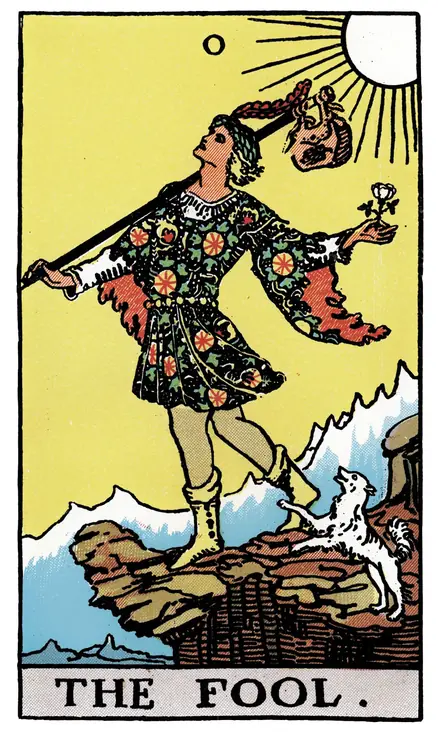
The Fool is the first step into the unknown: the trust of someone who sets out with a light pack and everything still to discover.
Draw this card · Its correspondences
- Arcana: Major, number 0
- Hebrew letter: Aleph (א), “ox”
- Path on the Tree of Life: 11
- Attribution: Air
- In one sentence: The leap before knowing
- Keywords: Beginnings, innocence, spontaneity, a free spirit
- Yes or no?: Yes, with conditions
- Archetype: The innocent traveller
What the card shows
In the deck Pamela Colman Smith drew for Arthur Edward Waite in 1909, the Fool is a young man walking along a mountain ridge, one step from the edge of a cliff. His head is raised to the sky and he seems unaware of the drop. He wears a dark tunic patterned with circles and lined in red, yellow boots and a wreath of leaves with a red feather. In his left hand he holds a white rose; over his right shoulder rests a staff with a small bundle tied to the end. A white dog leaps at his feet. Behind him a white sun shines in a yellow sky, and snowy peaks rise in the distance.
Every detail carries a reading in the tradition. The cliff is the unknown: the next step has no ground beneath it yet. The white rose speaks of pure intention, a desire free of calculation. The bundle holds only the essentials, and is often read as the bare minimum of experience, or as a memory the traveller has yet to open. The dog can be the instinct that keeps him company, a warning, or the joy that urges him on. The sun at his back shows that the journey begins under a good light. The snowy mountains are the heights still to be climbed.
In The Pictorial Key to the Tarot (1910), Waite describes the Fool as a prince of the other world on his travels through this one, pausing for a moment in mid-stride. The Golden Dawn gave him the Hebrew letter Aleph, meaning “ox”, the element of Air and the eleventh path on the Tree of Life, between Kether and Chokmah. His number is zero, which is why he can stand at the beginning or the end of the Major Arcana.
The Fool upright
Upright, the Fool reads as a beginning. It marks the moment someone takes a step without having all the answers: a journey, a project, a move, a new relationship, a different way of living. The tradition links the card with innocence, spontaneity and a free spirit, and with a kind of trust that runs ahead of the evidence.
In a spread, the Fool usually points to an open door and a person who wants to walk through it. It asks for curiosity and a light touch. What fits in the bundle is enough to start; the rest is learned on the road. That is why the card favours decisions born of enthusiasm, and seasons of life when trying something out works better than planning every detail.
The Fool also has a cautionary side, and it is worth reading in balance. The cliff is right there. The tradition sees in it the recklessness of leaping without looking, a reluctance to commit, or the habit of starting things and never finishing them. Next to cards of structure, such as the Emperor or the Four of Pentacles, the emphasis falls on putting some order in place before the leap. Next to bright cards, such as the Sun or the Ace of Wands, the leap reads as an adventure with a promising story ahead.
As advice, the Fool asks you to dare something new and keep your eyes open. The key is to walk with joy while still watching the ground beneath your feet.
The Fool reversed
Many readers never use reversals; they read every card upright and let the surrounding cards add the nuance. Those who do read reversed cards usually see the Fool upside down in one of two ways.
The first is recklessness. The leap happens without a look, out of impulse or to escape something, and the person takes on needless risks: spending without limits, promises that will never be kept, decisions made in the heat of the moment. Here the dog barks and nobody listens.
The second is the fear of beginning. The reversed Fool stays at the edge of the cliff and never steps off. The wish for change is real, the door stands open, and still the person waits for a guarantee that never comes. Read this way, the card speaks of missed chances and a life kept on hold.
In both cases the advice looks for the middle ground: recover the traveller’s trust and add a little care. Look at the path, pack what you truly need, and then walk.
In love
In love, the Fool reads as freshness and adventure. In a relationship it can mark a new chapter: a trip together, a move, a freer and more playful way of being a couple. It also asks whether the relationship leaves each person room to be themselves, because this card needs air.
For singles, the Fool’s love meaning is about unexpected encounters and openness. It invites you to meet people without rigid expectations and to let yourself be surprised. The tradition links it with a light-hearted crush and with stories that begin without a plan.
Reversed, in love
Reversed in love, the Fool speaks of fickleness or fear of commitment: relationships that never get past the first weeks, someone who runs when things turn serious, or someone too shy to make the first move. As advice, it asks for honesty about what you really want.
Career and money
For career and money, the Fool reads as a risky but promising start: a different job, a venture of your own, a change of field or an idea launched without prior experience. It favours learning and initiative. With finances, the tradition counsels lightness with prudence: invest in what helps you grow and watch the impulse buys, because the Fool’s bundle is small.
Reversed, in career
Reversed, it points to rushed decisions or, at the other extreme, paralysis before a necessary change. It can mean money spent without thought or an opportunity lost to fear. The advice is to run the numbers before you jump.
Health and mood
In health and mood, the Fool is linked with the energy of beginnings and the urge to move, travel or try new habits. It also reads as a warning against carelessness and needless risks. No card can diagnose anything: for any symptom or concern, the person to see is a health professional.
Yes or no? Yes, with conditions
The Fool reads as a “yes” to starting, trying and leaping into something new. The condition lies in the cliff on the card: the yes holds for someone who steps forward with eyes open. If the question involves a serious risk, a signature or a lot of money, the card asks you to study the ground first and decide afterwards.
Ask the card: a yes or no tarot reading with one card or three.
The archetype: The innocent traveller
As an archetype, the Fool is the character who leaves home with no idea what lies ahead. The beginner, the stranger, the youngster who leaves the village, the person who does not know the rules and so puts them to the test. Innocence is the Fool’s strength: they see the world without prejudice and ask the questions everyone else has stopped asking.
In story structure, the Fool takes the place of the call to adventure and the crossing of the first threshold. It is the instant the protagonist leaves the familiar behind. Zero has a curious property, though: it can sit at the start or at the end. So the Fool also appears at the close of many stories, when the character has learned so much that they look at the world with new eyes again, wiser and lighter.
In fiction, the Fool also works as a foil. The court jester, the child who says the emperor has no clothes, the idealist colliding with a cynical world: each of them, through clumsiness or candour, exposes the absurdity around them. The risk with this archetype is turning the character into a simpleton with no depth. The Fool becomes interesting when their naivety costs them something and still lets them see what the clever people miss.
The letter Aleph helps explain the role. It is the first letter of the Hebrew alphabet and has almost no sound of its own: it carries the others without imposing itself. That is how the Fool works in an ensemble novel. This is the character who passes through every scene, crosses every social world and connects people who would never otherwise have met. Their lightness, tied to Air, lets them move where others get stuck.
In literature
- Don Quixote (Miguel de Cervantes, 1605). Alonso Quijano rides out of his village in rusty armour on a scrawny horse, his head full of chivalric romances. He is literature’s great Fool: everyone takes him for a madman, and his way of seeing the world ends up exposing the meanness of the sane. The dog on the card takes the shape of Sancho Panza.
- The Idiot (Fyodor Dostoevsky, 1869). Prince Myshkin returns to Russia after years in Switzerland, carrying a goodness that St Petersburg society cannot place. They call him an idiot for his frankness. The novel shows the Fool’s double edge: his innocence lights up the people around him and, at the same time, leaves him exposed at the edge of the abyss.
- The Hobbit (J. R. R. Tolkien, 1937). Bilbo Baggins rushes out of his hobbit-hole without a pocket handkerchief, with little idea where he is going. It is the Fool’s journey in its purest form: an inexperienced hero accepts the adventure, learns on the road and comes home transformed, his bundle full of stories.
For writers
The conflict
The Fool sets up a conflict between the urge to leap and the fear of the unknown, or between the character’s innocence and a world that punishes it. It works best when the reader sees the cliff before the protagonist does. To prepare the card, give your character something to leave behind, a clear reason to go and a bundle with very few things in it, each chosen with intent.
The twist
As a plot twist, the Fool is the impulsive decision that changes the course of the story: the character who boards a train without a ticket, says yes without thinking or abandons a safe path. Another possible twist is the zero at the end: the protagonist who, after everything, gives up what they have won to start again with empty hands and clear eyes.
Prompts
- Introduce a decision that looks reckless but opens up a new world.
- Write the scene in which your character packs to leave and chooses three objects to take; let each one reveal a piece of their past.
- Tell a journey from the point of view of the dog who travels with the wanderer and sees the dangers he ignores.
- Have a character who has achieved everything give it all away and set out on the road again, and let the reader understand why.
Its correspondences
- Letter and path: Aleph. Source: Golden Dawn (tradition).
- Element: Air. Source: Golden Dawn (tradition).
- Letter, alternative attribution: Shin. Source: Éliphas Lévi (tradition).
- I Ching trigram: Wind. Source: Style Optimizer (our own proposal).
- Rune: Mannaz. Source: Angelorum table (modern system).
- Archangel: Raphael. Source: Angelorum table (modern system).
- Archangel: Uriel. Source: Angelorum table (modern system).
Combinations
The Fool and The Magician
The Fool and the Magician together speak of a beginning with resources: the urge to start finds the tools to do it. They read as an idea moving from enthusiasm to concrete action, the leap that finally has a plan.
The Fool and The World
With the World, the Fool closes and reopens the cycle of the Major Arcana. Together they read as the end of a complete chapter and the immediate start of another, the traveller who reaches the goal and is already eyeing the next road.
The Fool and The Tower
The Fool beside the Tower speaks of a beginning forced by crisis. Something collapses and pushes you onto the road with no luggage. The pairing asks you to accept the leap and make use of the freedom the collapse leaves behind.
The Fool and The Hermit
With the Hermit, the Fool’s journey turns inward. Together they read as a personal quest, a chosen time of solitude in order to learn. The urge to set out finds a lantern that lights the next step.
The Fool and Ace of Wands
The Fool with the Ace of Wands doubles the energy of beginnings. It reads as a new project full of drive, a creative spark that wants to launch right now. Channel all that fire so it lasts beyond the first day.
The Fool and Ace of Cups
With the Ace of Cups, the Fool speaks of an emotional beginning: a new love, a friendship, a hope that arrives unannounced. The pairing reads as an opening of the heart and a willingness to be surprised.
The Fool and Eight of Swords
With the Eight of Swords, the Fool stays at the edge. It reads as paralysis before a change: the person feels bound by fears that, seen up close, are weaker than they look. The advice is to find the way out and take the step.
Frequently asked questions
What does The Fool mean in tarot?
The Fool, card 0 of the Major Arcana, stands for beginnings, innocence and the leap into the unknown. The tradition reads it as the trust of someone starting something new with little luggage and plenty of curiosity, and also as a warning against walking without watching the ground.
What does The Fool mean in love?
In love, the Fool reads as freshness, adventure and unexpected meetings. In a relationship, it invites you to renew things and give each partner room to breathe. For singles, it speaks of openness and stories that start without a plan. Reversed, it points to fickleness or fear of commitment.
Is The Fool a yes or no card?
The Fool reads as a conditional “yes”: yes to starting, trying and taking the leap, as long as you do it with your eyes open. If the question involves a serious risk or a lot of money, the card asks you to study the ground carefully before deciding.
What does The Fool reversed mean?
Readers who use reversals usually see in the upside-down Fool either recklessness, the leap without looking or a flight from something, or the opposite: the fear of beginning and the chances let slip. Either way, the advice is to pair trust with attention.
What Hebrew letter and element correspond to The Fool?
In the Golden Dawn system, the Fool corresponds to the Hebrew letter Aleph, meaning “ox”, to the element of Air and to the eleventh path on the Tree of Life, between Kether and Chokmah. Éliphas Lévi had earlier assigned the card the letter Shin.
Do your readingPrevious: King of Pentacles · Next: The Magician
The 22 Major Arcana
- The Fool
- The Magician
- The High Priestess
- The Empress
- The Emperor
- The Hierophant
- The Lovers
- The Chariot
- Strength
- The Hermit
- Wheel of Fortune
- Justice
- The Hanged Man
- Death
- Temperance
- The Devil
- The Tower
- The Star
- The Moon
- The Sun
- Judgement
- The World
By Style Optimizer · published November 22, 2026.