Tarot / The 78 cards / Major Arcana / Wheel of Fortune
Wheel of Fortune, Major Arcana X: tarot card meaning, upright and reversed
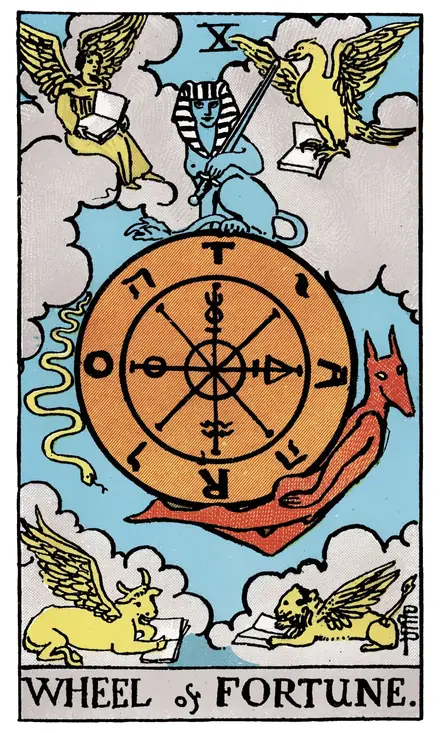
The Wheel of Fortune is the cycle that turns on its own: a change of circumstances that lifts some, lowers others and makes everyone adjust.
Draw this card · Its correspondences
- Arcana: Major, number X
- Hebrew letter: Kaph (כ), “palm of the hand”
- Path on the Tree of Life: 21
- Attribution: Jupiter
- In one sentence: The turning of the cycles
- Keywords: Change, cycles, inescapable fate, turning points
- Yes or no?: Yes
- Archetype: The turn of fortune
What the card shows
In the deck by Pamela Colman Smith and Arthur Edward Waite (1909), the Wheel of Fortune floats in a blue sky, with no ground and no people. It is a great orange disc made of three concentric circles. On the outer ring are the letters T, A, R, O, which can be read as TARO, ROTA (Latin for “wheel”) or TORA (the law), and between them the four Hebrew letters of the divine name, Yod, Heh, Vav and Heh. The inner ring carries the alchemical signs for mercury, sulphur, salt and water, the ingredients alchemy used to explain matter.
Three figures ride the turning. At the top sits a blue sphinx holding a sword: the balance that stays put while everything else moves. Down the left side slides a yellow serpent, which Waite identifies with Typhon, the force that drags things down. Up the right side climbs a red figure with a jackal’s head, Hermanubis, the force that raises them. In the four corners, on clouds, an angel, an eagle, a lion and a bull read open books. These are the four living creatures of Ezekiel and Revelation, which tradition connects with the Evangelists and with the four fixed signs of the zodiac: Aquarius, Scorpio, Leo and Taurus.
Waite took much of this design from Éliphas Lévi and presented it as an image of the perpetual motion of the universe and the flux of human life. The Golden Dawn titled the card “Lord of the Forces of Life” and gave it the Hebrew letter Kaph, “palm of the hand,” and the planet Jupiter, ruler of expansion and good fortune.
Wheel of Fortune upright
Upright, the Wheel of Fortune reads as a change of cycle. Circumstances shift for reasons beyond the control of whoever is asking: an offer arrives, a door opens, one run of luck ends and another begins. Tradition links the card with fortune, and nearly always with good fortune, because its planet is Jupiter. Even so, the image reminds you that the wheel keeps turning. What is at the top today will come down tomorrow.
In a spread it usually marks a turning point. Something that had been stuck for a long time suddenly starts to move, and what looked like coincidences begin to fit together. That is why it is also called the card of good timing. There are periods when things come with less effort, and the Wheel points to one of them.
The sphinx at the top holds the key to the card’s advice. She stays still while the wheel spins. The card invites you to ride the momentum without mistaking it for your own merit or for something permanent, and to keep your centre when the turn changes direction. Next to cards of effort, such as the Eight of Pentacles, luck reads as the reward for steady work. Next to unstable cards, such as the Five of Wands, the emphasis falls on the unpredictable.
Writers may find it useful to think of the Wheel as weather. Nobody controls it, everyone lives under it, and what matters is how each person dresses for the day.
Wheel of Fortune reversed
Not every school reads reversals. Many readers work with upright cards only and let the neighbouring cards add nuance. Those who do read reversed cards usually see the Wheel of Fortune reversed in two ways.
The first is a bad run: the wheel turns downward, plans are delayed and things cost more than expected. Tradition reminds you that the downturn belongs to the same cycle, and that it will not last forever either.
The second is resistance to change. You cling to a chapter that has already ended, or repeat the same pattern over and over, like someone going round and round on the wheel without ever stepping off. Read this way, the reversed card asks you to notice what keeps repeating and how much of that repetition depends on you.
In love
In love, the Wheel of Fortune reads as a favourable turn. In a relationship it may mark a new chapter: a move, a shared project, a change that shakes up routine and refreshes it. If you are single, tradition links it with meetings that seem to happen by chance, the person who appears at exactly the right moment, or a reunion with someone from the past. The card asks you to stay open and let things move.
Reversed, in love
Reversed in a love reading, it speaks of cycles that repeat: the same argument, the same type of partner, the relationship that keeps coming back without ever changing. It may also point to a passing rough patch. As advice, it invites you to break the pattern yourself instead of waiting for luck to break it.
Career and money
For career and money, the Wheel of Fortune reads as an opportunity that arrives through outside circumstances: a promotion, a new client, a market turning in your favour. Tradition advises riding the momentum and, since Jupiter is the planet of abundance, putting something aside for when the wheel turns again.
Reversed, in career
Reversed, it points to a lean spell: falling income, stalled projects, changes at work that do you no favours. The advice is to trim expenses, avoid taking it personally and prepare for the next turn.
Health and mood
In matters of health and mood, the Wheel of Fortune is linked with the body’s cycles and with seasons of higher and lower energy. It reads as an invitation to respect your own rhythms. No card can diagnose anything: for any symptom or concern, see a qualified health professional.
Yes or no? Yes
The Wheel of Fortune reads as a yes, especially if your question is whether something will change or get moving. It is a yes tied to timing: the moment is good now, and it is worth seizing before the wheel turns again. Reversed, it comes closer to “not yet,” and asks you to wait for the next turn.
Ask the card: a yes or no tarot reading with one card or three.
The archetype: The turn of fortune
As an archetype, the Wheel of Fortune stands for the force that moves the story without belonging to any character. It is chance, the unexpected inheritance, the war that breaks out, the letter that arrives twenty years late. When it takes human form, it appears as the goddess Fortuna of the ancients, blind and capricious, or as the gambler who lives for the next hand.
In the structure of a story, the Wheel occupies the place of the inciting incident and of the reversals of fortune that Aristotle saw at the heart of tragedy. The protagonist rises and falls, and the interest lies in what they do on each turn. Coming-of-age novels, picaresque tales and family sagas thrive on this archetype, because they follow several full turns of the wheel within a single life.
The card’s three figures offer three possible roles. The serpent is the character who falls, Hermanubis the one who rises, and the sphinx the one who watches without moving, the only one who understands the mechanism. A good story can share those roles among several characters and then make them swap places.
The risk of this archetype in fiction is gratuitous coincidence. The Wheel works when chance tests a character and reveals who they are. It fails when chance solves their problem for them. Readers forgive a coincidence that makes things worse far more readily than one that makes them better, so let luck open the trouble and let the character close it.
In literature
- The Consolation of Philosophy (Boethius, 524). Written in prison by a man who had once had everything, the book gives a voice to Fortune herself, who defends her right to turn the wheel. Boethius learns to seek a centre that luck cannot touch. It is the great medieval source of the image on the card.
- Life Is a Dream (Pedro Calderón de la Barca, 1635). Segismundo goes from the tower where he lives in chains to the throne, from the throne back to prison, and then to power once more. Each turn teaches him something. In the end he learns to act rightly without trusting to luck, which is the lesson of the sphinx at the top of the wheel.
- A Confederacy of Dunces (John Kennedy Toole, 1980). Ignatius J. Reilly invokes Boethius and the goddess Fortuna every time something goes wrong, which is almost always. The novel turns the wheel into a comic engine: a chain of chance events in New Orleans that sinks and rescues its characters without asking their permission.
For writers
The conflict
The Wheel of Fortune sets a character against circumstance. Your protagonist has a plan, and the world changes: the economy, the family, someone’s health, politics. The dramatic interest lies in the reaction. Some characters cling to what they had, some adapt, and some exploit the turn at others’ expense. The card works best when the change hits several people at once.
The twist
As a plot twist, the Wheel is the reversal of positions: whoever was on top falls and whoever was at the bottom rises. The richest moment comes when two characters cross paths halfway round, one climbing and one falling, and have to deal with each other in exchanged roles. So it does not feel like a trick, plant the fragility of the top position early.
Prompts
- Change an outside condition and force everyone to reposition with no time to prepare.
- Write two scenes in the same place ten years apart, with the same characters and the balance of power reversed.
- Tell the story of a stroke of good luck that ends up causing your character more trouble than any misfortune.
- Narrate a single turn of fortune from the sphinx’s point of view: someone who sees it coming, understands the mechanism and decides not to intervene.
Its correspondences
- Letter and path: Kaph. Source: Golden Dawn (tradition).
- Planet: Jupiter. Source: Golden Dawn (tradition).
- Letter, alternative attribution: Yod. Source: Éliphas Lévi (tradition).
- Rune: Jera. Source: Angelorum table (modern system).
- Archangel: Tzadkiel. Source: Angelorum table (modern system).
Combinations
Wheel of Fortune and The Tower
With the Tower, the wheel turns abruptly and the push comes from outside. It reads as a change of circumstances that knocks down what was standing, one you can only adapt to as quickly as possible.
Wheel of Fortune and The Magician
The Wheel and the Magician together describe an opportunity that gets used. Luck opens the door, and the Magician brings the skill to turn that opening into something concrete and lasting.
Wheel of Fortune and The Hermit
With the Hermit, which comes just before it in the sequence, change arrives after a period of retreat. It reads as the end of a pause and a return to movement with clearer ideas.
Wheel of Fortune and Justice
The Wheel beside Justice reads as cause and effect: the turn of fortune gives back what was sown earlier. What looks like pure chance turns out to follow a logic of its own.
Wheel of Fortune and Death
With Death, the cycle closes completely. The Wheel signals the change, and Death confirms that the previous chapter has ended for good and will not be coming back.
Wheel of Fortune and The World
The Wheel and the World share the four creatures in the corners. Together they read as a cycle completed successfully, one that clears the way for the next to begin.
Wheel of Fortune and Ten of Pentacles
With the Ten of Pentacles, good fortune reaches the material and the familial: an inheritance, a growing estate, or a prosperity that touches several generations of the same household.
Wheel of Fortune and Ten of Swords
Beside the Ten of Swords, the wheel sits at its lowest point. It reads as the worst moment of a bad run, and for that very reason as the point from which the only way left is up.
Frequently asked questions
What does Wheel of Fortune mean in tarot?
The Wheel of Fortune, card X of the Major Arcana, stands for cycles and for changes of circumstance beyond anyone’s control. Tradition reads it as a turning point, usually a favourable one, and as a reminder that nothing stays still for long.
What does the Wheel of Fortune mean in love?
In love it reads as a favourable turn: a new chapter for a couple, or a meeting that seems to happen by chance. Reversed, it speaks of patterns that keep repeating and of the need to break them yourself.
Is the Wheel of Fortune a yes or no card?
It reads as a yes, especially if you are asking about change or about something getting under way. It is a yes tied to timing: seize the moment now. Reversed, it comes closer to “not yet.”
What does the Wheel of Fortune reversed mean?
Readers who use reversals usually see it as a passing bad run or as resistance to a change that has already arrived. It can also describe a cycle that repeats because nobody interrupts it. The advice is to look at what depends on you.
What do the four creatures on the Wheel of Fortune represent?
The angel, eagle, lion and bull are the four living creatures of Ezekiel and Revelation. Tradition links them with the four Evangelists and with the fixed signs: Aquarius, Scorpio, Leo and Taurus. They appear again on the World card.
What planet and Hebrew letter go with the Wheel of Fortune?
In the Golden Dawn system, the Wheel corresponds to Jupiter and to the Hebrew letter Kaph, meaning “palm,” on the 21st path of the Tree of Life. Éliphas Lévi had earlier assigned it the letter Yod, following the older order.
Do your readingPrevious: The Hermit · Next: Justice
The 22 Major Arcana
- The Fool
- The Magician
- The High Priestess
- The Empress
- The Emperor
- The Hierophant
- The Lovers
- The Chariot
- Strength
- The Hermit
- Wheel of Fortune
- Justice
- The Hanged Man
- Death
- Temperance
- The Devil
- The Tower
- The Star
- The Moon
- The Sun
- Judgement
- The World
By Style Optimizer · published November 22, 2026.