Tarot / The 78 cards / Cups / Ten of Cups
Ten of Cups (10 of Cups): tarot card meaning, upright and reversed
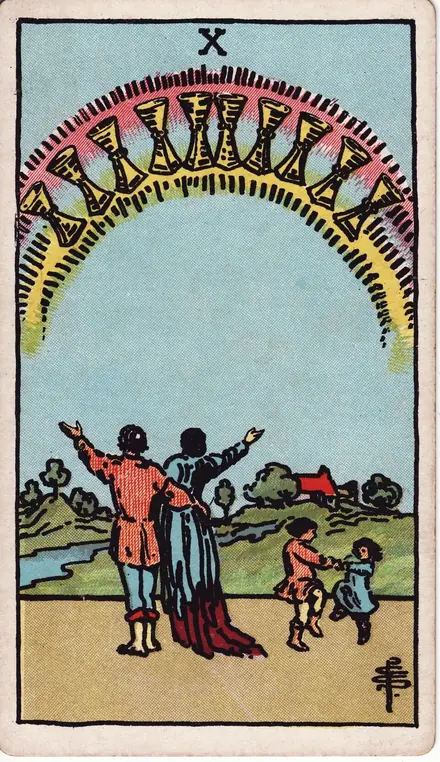
The Ten of Cups is shared happiness that becomes a home: love, family and friendship reaching their complete form and choosing to stay.
Draw this card · Its correspondences
- Arcana: Minor, number 10
- Suit and element: Cups, Water
- Golden Dawn title: Lord of Perfected Success
- Sephirah: Malkuth
- Decan: Pisces III, Mars (20° to 30° Pisces)
- Keywords: Divine harmony, happiness, alignment
- Yes or no?: Yes
- Archetype: The House at the End of the Road
What the card shows
In the deck Pamela Colman Smith drew for Arthur Edward Waite in 1909, the Ten of Cups shows a rainbow arching across the sky with ten golden cups set along its curve. Below, a man and a woman, their backs to the viewer, take in the scene in an embrace: he has one arm around her waist and raises the other to the sky; she lifts her free arm too. Beside them, two children dance hand in hand without looking up. In the distance, on a green rise, a red-roofed house stands among trees, and a river winds through the meadow.
Each detail has its reading in the tradition. The rainbow is the sign of the covenant in the biblical story of the Flood: the promise after the storm, a pact that holds. The ten cups along the arc are the water of the suit brought to fullness and set in the sky for all to see. The couple’s open arms express gratitude and wonder. The children, playing without noticing the marvel, are read as happiness lived without thinking about it, the most natural kind of all. The house and the river are home and flowing life: joy takes shape in a real place.
In The Pictorial Key to the Tarot (1910), Waite gives the card the meanings of contentment, repose of the entire heart and the perfection of human love and friendship, and adds the town, village or country where the querent lives. The Golden Dawn titled it the Lord of Perfected Success and gave it the third decan of Pisces, ruled by Mars, in the sefirah Malkuth.
Ten of Cups upright
Upright, the Ten of Cups reads as emotional fulfilment. It is the card that closes the water suit, and in it the feelings born in the Ace reach their complete form: a home, a family, a community, a bond that endures over time. If the Nine was the satisfaction of one person alone, the Ten is joy shared out.
In a spread it usually points to harmony at home, a family celebration, a wedding, a move to a place where you finally feel at ease, a reconciliation or a new arrival in the family. It also speaks of solid friendships and a sense of belonging somewhere. That is why the meaning of the Ten of Cups in love is among the most searched for: few tarot cards are so clear about matters of the heart.
The Golden Dawn tradition adds interesting nuances. The title, Lord of Perfected Success, stresses that the work is complete. The sefirah Malkuth, the kingdom, is the last on the Tree of Life, where everything becomes earth: feelings come down from the sky into the house and the meadow. The decan, Mars in Pisces, adds an energy read as the need to tend that happiness so it stays alive, because all fulfilment asks for daily work.
As advice, the card invites you to recognise what is close at hand, to celebrate it with others and to look up at the rainbow now and then, like the couple, while remembering that the children are already enjoying it through play.
Ten of Cups reversed
Many readers never use reversals. They read every card upright and let the neighbouring cards shade the meaning. Those who do read reversed cards tend to see the Ten of Cups reversed in one of two ways.
The first is the shop-window family. Everything looks in order, and inside there are tensions, silences or disagreements no one names. Waite gives the reversed card the meanings of repose of the false heart, indignation and violence: a pretended harmony that breaks.
The second is distance. The happiness exists and is lived far away, or one member of the family feels outside the circle. The advice is to notice who is missing from the embrace and open the conversation still waiting to happen.
In love
In love, the Ten of Cups is one of the most longed-for cards. For a couple, it reads as a solid commitment, happy life together, a shared wish to start a family, or the maturity of a relationship that has weathered storms. For someone single, it speaks of a meeting with a future in it, a person with whom you can picture a home, or the love of family and friends that holds you up while romance is on its way.
The card puts the emphasis on what is shared: the couple look in the same direction.
Reversed, in love
Reversed, in love, the Ten of Cups speaks of idealised expectations, differences over a shared future, or family conflicts weighing on the relationship. The advice is to talk frankly about the life you want to build.
Career and money
For career and money, the Ten of Cups reads as a harmonious workplace, a team that works like a family, a family business that thrives, or enough stability to take care of your own. It favours projects linked to the home, education and care. The tradition advises valuing the balance between work and life.
Reversed, in career
Reversed, it points to tension in a family business, a team that only looks united, or work that steals time from home. Review your priorities.
Health and mood
For health and mood, the Ten of Cups is linked with the wellbeing of feeling accompanied and loved, and with the calm of a peaceful home. It reads as an invitation to lean on others. A tarot card cannot diagnose anything: for any symptom or worry, the person to see is a qualified health professional.
Yes or no? Yes
The Ten of Cups reads as a resounding “yes”, especially for questions about love, family, home and friendship. It is the card of perfected success in the realm of feeling. If the question involves other people, the “yes” comes through more strongly when they all share the wish.
Ask the card: a yes or no tarot reading with one card or three.
The archetype: The House at the End of the Road
As an archetype, the Ten of Cups is less a character than a place and a group: the family gathered, the community that welcomes, the house you come back to. When it takes human form, it is the couple who have reached safe harbour, or the patriarch and matriarch watching their children play. Its symbolic power lies in the sum: no one is happy alone on this card.
In the structure of a story, the Ten of Cups holds the place of the happy ending. It is the wedding feast of comedy, the hero’s homecoming, the epilogue showing the protagonists years later surrounded by their loved ones. It can also appear at the beginning, as the paradise about to be lost: the happy family of the first page that the plot will put to the test.
The challenge for a writer is that complete happiness is hard to narrate. The Ten of Cups works in fiction when it has been earned through pain and when it keeps some living detail, like the children on the card who dance without looking at the rainbow. That small gesture gives the scene its truth. Fulfilment becomes believable when it shows in everyday life, and moving when the reader knows what it cost to get there.
In literature
- War and Peace (Leo Tolstoy, 1869). After the war, the burning of Moscow and so many deaths, the epilogue shows Natasha and Pierre, and Nikolai and Marya, in their country houses surrounded by children. Tolstoy turns domestic peace into the rainbow after the storm, with the energy of Mars still pulsing through the conversations.
- Jane Eyre (Charlotte Brontë, 1847). “Reader, I married him.” After the fire, the flight across the moors and long years apart, Jane returns to Rochester, and the final chapter shows ten years of marriage, a son, and sight partly restored. Brontë earns her Ten of Cups through suffering, which is why the quiet happiness rings true.
- Our Town (Thornton Wilder, 1938). In a small New Hampshire town, two families live their ordinary days: breakfasts, weddings, homework. In the last act, Emily returns to one day of her childhood and discovers the happiness no one was looking at. Wilder puts on stage the children of the card, dancing without seeing the rainbow.
For writers
The conflict
The Ten of Cups sets up a conflict around what you have and could lose. Family, home or community are such great goods that any threat weighs twice as much. It also serves the opposite conflict: someone watching other people’s happiness from outside and longing to join the circle. To prepare it, build the harmony with concrete details, rituals and private jokes the reader learns to love.
The twist
As a plot twist, the Ten of Cups is the homecoming after the storm: the reconciliation, the wedding, the family reunited. It works as a resolution if the road has been hard. It works as a starting point if the story is going to test it. The richest twist comes from the image itself: the rainbow is a promise, and a promise can always be broken or kept.
Prompts
- Write a scene of complete family happiness narrated by a child who has no idea they are happy, and let the reader notice it on their behalf.
- Tell your protagonist’s return to a house where people are waiting, and make the most moving moment an everyday gesture in place of an embrace.
- Describe the same celebration dinner from inside the circle and through the eyes of someone looking in through the window, longing to come in.
Its correspondences
- Element: Water. Source: Golden Dawn (tradition).
- Sephirah: Malkuth. Source: Golden Dawn (tradition).
- Decan: Pisces III. Source: Golden Dawn (tradition).
Combinations
Ten of Cups and The Sun
With The Sun, the Ten of Cups underlines happiness in the family and at home. It reads as a season of shared harmony, celebration and bonds that feel secure, one of the brightest pairings in the deck.
Ten of Cups and The World
The World beside the Ten of Cups reads as emotional and family fulfilment: the house built, the bond that works, joy shared at the end of a long effort. A whole cycle comes to completion.
Ten of Cups and Ten of Pentacles
With the Ten of Pentacles, fulfilment is emotional and material at once. It reads as a prosperous family, an inheritance passed down and a stable home for several generations.
Ten of Cups and The Lovers
The Lovers beside the Ten of Cups speak of a romantic choice leading to a shared life. They read as commitment, marriage or the decision to start a family.
Ten of Cups and Two of Cups
The Two of Cups with the Ten traces the whole journey of a relationship: the meeting of two people that ends up becoming a home and a family.
Ten of Cups and Four of Wands
With the Four of Wands, the Ten of Cups reads as a party at home: a wedding, a housewarming, a joyful family gathering full of the people you love.
Ten of Cups and The Tower
The Tower beside the Ten of Cups calls for attention: a shock to the home or family that forces a look behind the apparent harmony. It reads as a test from which a more honest bond can emerge.
Ten of Cups and Nine of Cups
The Nine and Ten of Cups together trace the move from personal satisfaction to shared happiness. Your own wish comes true and opens out to family or group.
Frequently asked questions
What does the Ten of Cups mean in tarot?
The Ten of Cups stands for shared happiness: love, family and friendship reaching their complete form. In the tradition it reads as harmony at home, emotional peace and belonging. Waite linked it with the repose of the entire heart and the perfection of human love.
What does the Ten of Cups mean in love?
In love it is one of the most favourable cards. For couples, it reads as commitment, happy life together or the wish to start a family; for singles, as a meeting with a future or the loving support of those close to you. The couple on the card look the same way.
Is the Ten of Cups a yes or no?
It reads as a resounding yes, especially for questions about love, family, home and friendship. When the question involves other people, the tradition holds that the yes comes through more strongly when everyone shares the same wish.
What does the Ten of Cups reversed mean?
Readers who use reversals usually see it as a shop-window family with silent tensions, or as happiness lived at a distance. Waite gave the reversal the meanings of the false heart, indignation and violence. The advice is to notice who is missing from the embrace.
What is the Ten of Cups decan and sefirah?
In the Golden Dawn’s Book T, the Ten of Cups is titled the Lord of Perfected Success. It corresponds to the third decan of Pisces, from 20° to 30°, ruled by Mars, and sits in Malkuth, the kingdom, the tenth and final sefirah of the Tree of Life.
What does the rainbow on the Ten of Cups mean?
In Pamela Colman Smith’s drawing, the rainbow bearing ten cups recalls the covenant in the story of the Flood: the promise after the storm. It reads as a pact that holds and as emotional fulfilment placed in plain sight for everyone.
Do your readingPrevious: Nine of Cups · Next: Page of Cups
The 14 cards of Cups
- Ace of Cups
- Two of Cups
- Three of Cups
- Four of Cups
- Five of Cups
- Six of Cups
- Seven of Cups
- Eight of Cups
- Nine of Cups
- Ten of Cups
- Page of Cups
- Knight of Cups
- Queen of Cups
- King of Cups
By Style Optimizer · published November 22, 2026.