Tarot / The 78 cards / Major Arcana / The Hanged Man
The Hanged Man, Major Arcana XII: tarot card meaning, upright and reversed
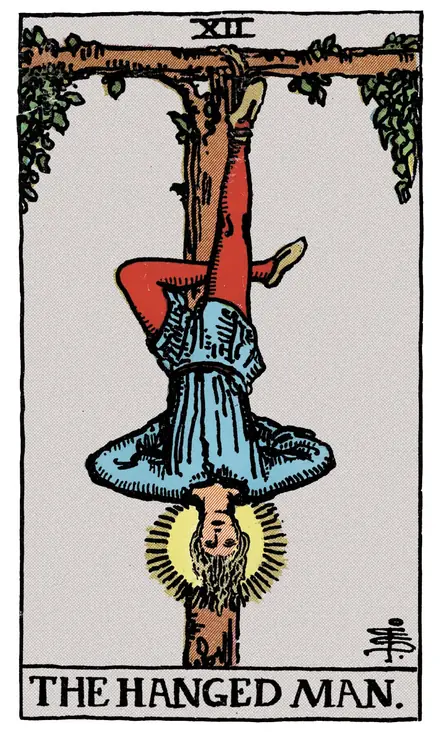
The Hanged Man is a chosen pause that turns your view upside down: letting go of control, waiting in suspension and seeing the other side.
Draw this card · Its correspondences
- Arcana: Major, number XII
- Hebrew letter: Mem (מ), “water”
- Path on the Tree of Life: 23
- Attribution: Water
- In one sentence: The surrender that turns the world upside down
- Keywords: Pause, surrender, letting go, new perspectives
- Yes or no?: Not for now
- Archetype: The suspended seer
What the card shows
In the deck Pamela Colman Smith drew for Arthur Edward Waite in 1909, the Hanged Man hangs head down from a T-shaped beam. The wood is alive: leaves sprout from it. A rope holds his right foot, while his left leg bends behind the knee to form a cross with the other, rather like the figure four. His hands are behind his back, so that his arms and head make a triangle. He wears a blue tunic, red hose and yellow shoes. A golden halo shines around his head. His face is calm, almost rapt, with no trace of pain.
Each element has its reading in the tradition. The T shape is the tau, one of the oldest forms of the cross, and the leaves show that what holds him up belongs to life and growth. The inverted body is the reversed gaze: whoever hangs this way sees the world from the other side. The crossed leg and the triangle of the arms read as an ordered, peaceful figure, someone who has accepted the posture. The halo is the decisive detail: suspension brings illumination. The colours repeat an old dialogue between the red of passion, the blue of knowledge and the yellow of an awakened mind.
Waite insists that the face expresses trance, and rejects readings that reduce the card to martyrdom or mere prudence. He speaks of a life in suspension that hides a profound meaning. The Golden Dawn titled the card “Spirit of the Mighty Waters” and gave it the Hebrew letter Mem and the element of Water. Early Italian decks sometimes called it the Traitor, after the old custom of hanging traitors upside down by one foot.
The Hanged Man upright
Upright, the Hanged Man reads as a necessary pause. Action stops, sometimes by your own choice and sometimes because circumstances impose it, and in that still time a different way of seeing appears. Tradition links the card with surrender, with the voluntary sacrifice of something small for the sake of something greater, and with the patience of someone who knows that forcing movement only tangles things further.
Above all, the Hanged Man’s meaning in tarot is a change of perspective. The problem is still there; what changes is the place you look at it from. An idea that seemed impossible becomes obvious once you turn it upside down. An apparent defeat reveals itself as a lesson. That is why the card speaks of waiting and of discovery in equal measure.
Its attribution to Water, through the letter Mem, strengthens this reading. Water yields, takes the shape of any vessel, and still carves canyons through rock. The Hanged Man reads as the strength of someone who lets go of control and allows themselves to be carried for a while, trusting that the current knows where it is going.
The card also asks what you are willing to release. Very often the blockage comes from clinging to a plan, a self-image or an expectation. Next to cards of movement, such as the Eight of Wands, the Hanged Man warns of a delay. Next to cards of introspection, such as the Hermit, it marks a fertile period of reflection.
As advice, the card suggests you stop pushing, accept the wait and use it to observe. The answer usually comes once you stop hunting for it in a hurry.
The Hanged Man reversed
Not every school reads reversals. Many readers work with upright cards only and let the neighbouring cards add nuance. Those who do read reversed cards usually see the Hanged Man reversed in two ways.
The first is the barren pause. You are stuck, and the stillness teaches you nothing: you circle the same thought, postpone decisions out of fear, or sacrifice yourself for something that no longer deserves it. Suspension turns into stagnation and the halo never lights up.
The second is resistance to the pause. Someone refuses to stop when everything is asking them to, keeps pushing a blocked project, or crams their schedule to avoid looking at what hurts. Curiously, when the card is reversed the figure stands upright again, and this reads as a return to the usual way of seeing before anything has been learned.
The advice of the Hanged Man reversed is to ask what the waiting is for, and what you are avoiding letting go of.
In love
In love, the Hanged Man reads as a relationship on hold. For a couple it may mark a period of waiting, a postponed decision, or the need to see your partner from a new angle. It also speaks of yielding for love, provided the surrender is chosen and balanced. A pause lived well can renew the bond.
If you are single, the Hanged Man invites you to rethink the way you search: drop fixed expectations, let some time pass without hurry, and look with fresh eyes at someone who was already close by.
Reversed, in love
Reversed in a love reading, it signals a sacrifice that has become one-sided, or a wait that drags on without purpose: someone holding out for a change that never comes. The advice is to name what you are waiting for and decide how much longer it is worth it.
Career and money
For career and money, the Hanged Man reads as a project on hold, a delayed promotion or a stalled negotiation. Tradition advises using that time to rethink your approach, learn something new or review your priorities. With money, it favours caution: wait before investing and avoid decisions driven by impatience.
Reversed, in career
Reversed, it warns of stagnation: tasks that go nowhere, a job you stay in out of inertia, expenses you keep postponing without resolving. Decide what to let go of so you can move again.
Health and mood
In matters of health and mood, the Hanged Man is linked with the need to stop and rest, with convalescence, and with periods when the body asks for a slower pace. It reads as an invitation to listen to yourself. No card can diagnose anything: for any symptom or concern, see a qualified health professional.
Yes or no? Not for now
The Hanged Man reads as “no for now.” The situation is on hold and the answer has not yet ripened. The card advises waiting, observing and perhaps rephrasing the question, because what you want may look very different from another angle. If you are asking whether to stop and reflect before acting, the answer is yes.
Ask the card: a yes or no tarot reading with one card or three.
The archetype: The suspended seer
As an archetype, the Hanged Man is the figure who stops the world in order to understand it. In fiction he takes the form of the prisoner who thinks, the invalid who reorders his life from a sickbed, the mystic, the man who refuses to play along, or the character trapped somewhere they cannot leave. His defining trait is stillness with a purpose: what he loses in movement he gains in vision.
In the structure of a story, the Hanged Man sits at the centre, in the stretch of suspension between the fall and the way out. It is the moment when the protagonist can no longer act as before and does not yet know how to act next. Many myths stage it: Odin hanging nine nights from the world tree to win the runes, the prophet swallowed by the whale, the hero who descends into the underworld. In all of them, stillness has a price and a reward.
Its dramatic power lies in inversion. The character leaves the scene holding the opposite idea to the one they came in with: what they took for defeat was a test, what they took for their desire was a trap. The reader feels the turn because they have shared the wait.
The risk of this archetype in fiction is a passivity that bores. The Hanged Man works when stillness is full of inner tension: memories, the urge to escape, voices begging him to come down. The scene is held up by what the character sees while he hangs, and the reader has to see it with him. Give the suspended character something to look at, and the stillest chapter can become the one that changes everything.
In literature
- The Magic Mountain (Thomas Mann, 1924). Hans Castorp travels up to a sanatorium in the Alps for a three-week visit and stays seven years. Up there time is suspended, and the young engineer completely changes the way he understands life, death and love. It is an entire novel written from the Hanged Man’s position.
- The Rime of the Ancient Mariner (Samuel Taylor Coleridge, 1798). After shooting the albatross, the Mariner is left becalmed on a rotting sea, the dead bird hung around his neck. Release comes only when, motionless and alone, he looks at the water-snakes and blesses them without meaning to. The albatross falls into the sea: suspension, Water and a sudden change of sight.
- Bartleby, the Scrivener (Herman Melville, 1853). A Wall Street copyist answers every request with a polite “I would prefer not to” and stays motionless in the office. His stillness turns the narrator’s view upside down, until the lawyer sees his own world of work with different eyes. It is the most unsettling version of the Hanged Man.
For writers
The conflict
The Hanged Man sets the need to act against the impossibility of acting. Your character is tied down, by illness, a prison, a promise or a wait, and everything in them wants to move. The tension is born of that contradiction. To set up the card, show early on what the character takes for granted about their life, so the reader feels the reversal when it is seen upside down. The clearer the old view, the greater the impact of the new one.
The twist
As a plot twist, the Hanged Man is the revelation that arrives by inversion. The character stops struggling, accepts the pause, and in that surrender discovers what they could not see: the enemy was an ally, the plan was the problem, the way out lay in the opposite direction. The halo on the card is the clue: the scene gains force when clarity appears at its stillest moment.
Prompts
- Stop the action and shift the point of view from which the problem is understood.
- Write a scene in which your protagonist cannot move from one spot and yet completely changes how they understand their situation.
- Describe the same place twice: before and after your character accepts the wait that has been forced on them.
- Have a character give up something everyone expected them to defend, and make that renunciation their bravest act.
Its correspondences
- Letter and path: Mem. Source: Golden Dawn (tradition).
- Element: Water. Source: Golden Dawn (tradition).
- Letter, alternative attribution: Lamed. Source: Éliphas Lévi (tradition).
- Rune: Laguz. Source: Angelorum table (modern system).
- Archangel: Gabriel. Source: Angelorum table (modern system).
- Archangel: Asariel. Source: Angelorum table (modern system).
Combinations
The Hanged Man and Death
The Hanged Man followed by Death is the order of the sequence itself: the pause prepares the ending. Together they read as letting go of something completely after a time of waiting and acceptance.
The Hanged Man and The Fool
The Fool and the Hanged Man share a surrender to the unknown. Together they describe a leap of faith that begins with letting go of control and trusting the path, even before it can be seen.
The Hanged Man and The Hermit
With the Hermit, the Hanged Man deepens introspection. Together they read as a voluntary retreat, a period of silence and study from which a deeper, more lasting understanding emerges.
The Hanged Man and Judgement
Judgement beside the Hanged Man marks the end of suspension. After the wait comes the awakening: a clear decision, or a call that brings the pause to an end with a new vision.
The Hanged Man and Four of Swords
With the Four of Swords, the pause becomes rest. Together the two cards advise stopping completely, recovering your strength and letting the mind lie fallow before you decide anything again.
The Hanged Man and Four of Cups
The Four of Cups beside the Hanged Man signals an apathy that calls for a new outlook. It reads as an offer ignored while you look inward, and as an invitation to turn your head and notice it.
The Hanged Man and Four of Pentacles
With the Four of Pentacles, the conflict is about letting go. The Hanged Man asks you to release and the Four of Pentacles clings; together they describe a deadlock that only giving something up can resolve.
The Hanged Man and Eight of Wands
The Eight of Wands is speed and the Hanged Man is stillness. Together they read as a change of pace: a pause that ends abruptly, or a rapid movement that is worth halting for a moment.
Frequently asked questions
What does The Hanged Man mean in tarot?
The Hanged Man, card XII of the Major Arcana, stands for pause, surrender and a change of perspective. Tradition reads it as a time of waiting, chosen or imposed, in which letting go of control opens up a new way of seeing the situation.
What does the Hanged Man mean in love?
In love it reads as a relationship on hold: a wait, a postponed decision, or the need to see your partner from a new angle. It also speaks of yielding for love, provided the surrender is freely chosen and balanced on both sides.
Is the Hanged Man a yes or no card?
It reads as “no for now”: the situation is on hold and the answer has not yet ripened. If you are asking whether to stop and reflect before you act, the answer is yes, and the pause itself may change the question.
What does the Hanged Man reversed mean?
Readers who use reversals usually see it as a barren pause, a wait that teaches nothing, or as resistance to stopping when everything calls for it. The advice is to ask what the waiting is for and what you are avoiding letting go of.
Why is the Hanged Man upside down?
The inverted body is the card’s central image: a reversed point of view. Waite saw trance in his calm face, and the halo around his head shows that the suspension brings insight. He hangs from a living tree, which ties the pause to growth.
What element and Hebrew letter go with the Hanged Man?
In the Golden Dawn system, the Hanged Man corresponds to the element of Water and to the Hebrew letter Mem, meaning “water,” on the 23rd path of the Tree of Life. Éliphas Lévi had attributed a different letter to it, Lamed.
Do your readingPrevious: Justice · Next: Death
The 22 Major Arcana
- The Fool
- The Magician
- The High Priestess
- The Empress
- The Emperor
- The Hierophant
- The Lovers
- The Chariot
- Strength
- The Hermit
- Wheel of Fortune
- Justice
- The Hanged Man
- Death
- Temperance
- The Devil
- The Tower
- The Star
- The Moon
- The Sun
- Judgement
- The World
By Style Optimizer · published November 22, 2026.