Tarot / The 78 cards / Major Arcana / The Magician
The Magician, Major Arcana I: tarot card meaning, upright and reversed
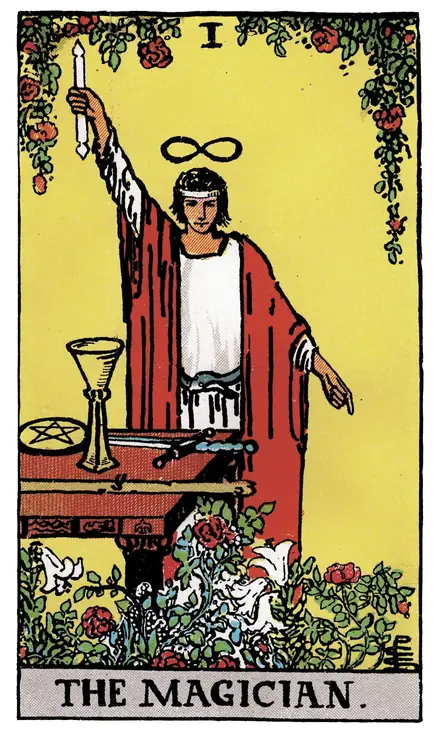
The Magician is will turned into action: the moment someone gathers their tools and makes an idea real, here, with what is at hand.
Draw this card · Its correspondences
- Arcana: Major, number I
- Hebrew letter: Beth (ב), “house”
- Path on the Tree of Life: 12
- Attribution: Mercury
- In one sentence: Will, with its tools
- Keywords: Manifestation, resourcefulness, power, inspired action
- Yes or no?: Yes
- Archetype: The maker
What the card shows
In the deck Pamela Colman Smith drew for Arthur Edward Waite in 1909, the Magician is a young man standing behind a table, facing the viewer. He wears a white robe and a red cloak. With his right hand he raises a white wand towards the sky; with his left he points down at the ground. Above his head floats the infinity sign, a figure eight lying on its side. His belt is a serpent swallowing its own tail. On the table lie the emblems of the four suits: a cup, a sword, a pentacle and a wand. A garland of red roses hangs overhead, and roses and lilies grow at his feet. The background is yellow.
Each symbol has its reading in the tradition. The gesture of the two hands sums up the card: what is received from above is brought down to earth, and the idea becomes a fact. It is the Hermetic formula “as above, so below”. The infinity sign speaks of an energy that never runs dry and a mind in full command of its craft. The serpent biting its tail is the completed cycle, eternity. The four objects on the table are the four elements, fire, water, air and earth, laid out for whoever knows how to use them. The red roses are usually read as desire and passion; the white lilies, as purity of intention.
In The Pictorial Key to the Tarot (1910), Waite sees in the Magician the human will at its highest, joined to the divine. The Golden Dawn gave the card the Hebrew letter Beth, meaning “house”, the planet Mercury and the twelfth path on the Tree of Life, between Kether and Binah. In Marseille decks the card is called Le Bateleur, the juggler or street conjurer, and shows a fairground performer at a table of tricks.
The Magician upright
Upright, the Magician reads as the passage from intention to action. It is the moment a person realises they already have what they need to begin: talent, knowledge, contacts, a clear idea. The tradition links the card with manifestation, ingenuity, skill and initiative, and with communication too, through its tie to Mercury.
In a spread, the Magician usually signals a good time to act. The tools are on the table; what remains is deciding what to do with them. It favours projects that rely on your own skill, negotiations, presentations, study and any task where word and hand have to work together. The card speaks of focus: the Magician gathers all his forces into a single point.
The card also has a shadow side that the tradition keeps in view, especially through its Marseille form, the fairground performer. Skill can serve to deceive. Next to cards like the Seven of Swords or the Devil, the emphasis falls on manipulation, sleight of hand, or the person who promises more than they deliver. Next to cards like the Sun, the Ace of Pentacles or the Emperor, the Magician reads as a talent that finds its place and bears fruit.
As advice, the Magician asks you to trust your own resources and use them now. Waiting for more tools is often a way of putting things off. What lies on the table is enough to start, if you use it with intent and with craft.
The Magician reversed
Many readers never use reversals; they read every card upright and let the surrounding cards add the nuance. Those who do read reversed cards usually see the Magician upside down in one of two ways.
The first is blocked talent. The tools lie on the table and nobody picks them up: self-doubt, scattered energy, too many projects at once and none of them finished. The person can do a great deal and does very little, or doubts a craft they have long since mastered.
The second is the misuse of power. The reversed Magician drifts towards the trickster: someone who manipulates, sells smoke and mirrors, or uses charm to get what they want at others’ expense. In a reading, it may point to someone nearby or to a temptation of your own.
In both cases, the advice is to return to the table. Choose one tool and one goal, and act with honesty and focus.
In love
In love, the Magician reads as initiative and charm. In a relationship it can mark a season of good communication, shared plans and a wish to make decisions together. The card invites you to say clearly what you want and to take the first step towards building it.
For singles, the Magician’s love meaning is about attraction and self-confidence. It favours the first move: sending the message, making the offer, introducing yourself. It can also describe someone brilliant and very persuasive who makes a striking entrance.
Reversed, in love
Reversed in love, the Magician speaks of words that are never kept, calculated seduction or someone presenting an image far from the truth. It can also point to shyness and a fear of making a move. As advice, it asks for consistency between what is said and what is done.
Career and money
For career and money, the Magician reads as a moment of initiative: launching a project, pitching a proposal, negotiating a contract or turning a skill of your own into income. It favours freelancers and anyone who sells, teaches or communicates. Financially, the tradition links it with resources put to good use and with earnings that depend on your own ingenuity.
Reversed, in career
Reversed, it points to projects that never get off the ground, scattered effort or a lack of faith in your abilities. It can also warn of murky deals or someone who promises too much. The advice is to read the small print and focus on a single goal.
Health and mood
In health and mood, the Magician is linked with mental energy, concentration and the ability to change habits through willpower. Through its tie to Mercury, it can also point to overactivity and nervous strain. No card can diagnose anything: for any symptom or concern, the person to see is a health professional.
Yes or no? Yes
The Magician reads as a clear “yes”, especially when the question depends on your own action. The card says the tools are available and the time is right to use them. The yes comes with a task: act with focus and intention. If what you are asking depends entirely on other people, the Magician invites you to look at which part lies in your own hands.
Ask the card: a yes or no tarot reading with one card or three.
The archetype: The maker
As an archetype, the Magician is the character who knows how to make things happen. The inventor, the craftsman, the orator, the strategist, the illusionist, the alchemist in the laboratory. Their essential trait is the power to transform: they take scattered materials and turn them into something new. Their mastery is admired by others and, at times, feared.
In story structure, the Magician appears in two ways. It can be the mentor who hands the hero their tools, the sage who teaches the craft and shows what the hero might become. Or it can be the protagonist at the moment they discover their gift and decide to use it: the instant they move from watching to acting. If the Fool is the decision to set out, the Magician is the first time the traveller opens the bundle and finds inside exactly what is needed.
In fiction the Magician has a richly double face. The same character who creates can deceive, and the border between artist and con man is one of the most fertile in literature. The rogue, the fairground charlatan, the stage magician and the political manipulator all share the Magician’s skill. The risk with this archetype is making the character all-powerful. It works when their power has limits and a price, and when the reader sees the trick and the wonder at the same time.
The letter Beth, “house”, and the planet Mercury complete the portrait. The house is the workshop where the Magician keeps the instruments, and also the structure built with them. Mercury is the messenger, god of orators, merchants and thieves. That is why the Magician shines in scenes of speech: the negotiation, the address, the well-told lie, the letter that persuades.
In literature
- The Tempest (William Shakespeare, 1611). Prospero, an exiled duke, rules an island with his book and his staff. He raises the storm, moves the other characters like chess pieces and stages his reckoning with the art he has studied for years. At the end he breaks his staff and gives up his magic: the Magician who knows when to lay down his tools.
- The Wonderful Wizard of Oz (L. Frank Baum, 1900). The great and terrible Oz turns out to be a showman from Omaha working illusions behind a screen. Baum gives us the Magician’s trickster face, close to the Marseille conjurer: power built from spectacle and other people’s belief. Yet the humbug still hands his visitors real gifts, because their brains, heart and courage were theirs all along.
- The Prestige (Christopher Priest, 1995). Two stage magicians in Victorian London wage a years-long feud over an illusion of human transportation. The novel explores obsession with craft, the cost of secrecy and the line between illusion and science. Each man is the Magician to his audience and a broken figure behind the curtain.
For writers
The conflict
The Magician sets up a conflict between ability and its use: what the character does with the power they hold, whom it serves and what they will sacrifice to master it. It works best when the talent carries a visible price. To prepare the card, set four different resources on your character’s table and make clear from the start which one costs them most to use.
The twist
As a plot twist, the Magician is the revelation of a hidden skill or the exposure of the trick. It can be the quiet character who, at the decisive moment, shows what they can do. Or the great performer whose act falls apart in front of the crowd and lays bare the mechanism. Both twists change how the reader has understood everything before.
Prompts
- Have the character finally use the resource that was in front of them all along.
- Describe your character’s workbench with four objects and let each one reveal a different side of their personality.
- Write a scene in which a con artist convinces a whole town of something false, told by the only person who sees through the trick.
- Have a mentor hand the protagonist a tool, and let the protagonist discover later that the real power lay in something else they received that day.
Its correspondences
- Letter and path: Beth. Source: Golden Dawn (tradition).
- Planet: Mercury. Source: Golden Dawn (tradition).
- Letter, alternative attribution: Aleph. Source: Éliphas Lévi (tradition).
- Rune: Ansuz. Source: Angelorum table (modern system).
- Archangel: Raphael. Source: Angelorum table (modern system).
- alquimia: Philosophical Mercury. Source: Crowley, The Book of Thoth (tradition).
Combinations
The Magician and The Fool
The Magician and the Fool together speak of a beginning with everything in its favour: the urge to start and the tools to do it. They read as a new project moving from enthusiasm to action, an adventure that already knows where to begin.
The Magician and The High Priestess
With the High Priestess, the Magician balances action and intuition. Together they read as what is known and what is sensed, the visible and the hidden. The pairing invites you to act after listening to what has not yet been said.
The Magician and The Chariot
The Magician beside the Chariot strengthens the will. Together they read as a clear goal pursued with determination and the means to reach it. It is one of the pairings most associated with self-made success and command of the situation.
The Magician and The Devil
With the Devil, the Magician shows his shadow. The pairing reads as manipulation, power used to bind others, or skill placed in the service of ambition. It can also warn of a seductive and unreliable person.
The Magician and Ace of Wands
The Magician with the Ace of Wands speaks of a creative spark finding its form: a new idea, a venture of your own or an artistic impulse with the means to get going from day one.
The Magician and Ace of Pentacles
With the Ace of Pentacles, the Magician lands in the material world. The pair points to a concrete opportunity for work or income that depends on your own skill: a talent starting to turn into money.
The Magician and Ace of Swords
With the Ace of Swords, the Magician gains mental clarity. Together they read as a brilliant idea, a decisive argument or a message that persuades. It is a pairing strongly linked with speech, writing and study.
Frequently asked questions
What does The Magician mean in tarot?
The Magician, card I of the Major Arcana, stands for will turned into action: the moment someone gathers their tools and makes an idea real. The tradition links it with ingenuity, skill and communication, and it also reminds us that talent can be used to deceive.
What does The Magician mean in love?
In love, the Magician reads as initiative, charm and good communication. In a relationship it favours shared plans and honest conversations. For singles, it invites you to make the first move with confidence. Reversed, it warns of empty promises or calculated seduction.
Is The Magician a yes or no card?
The Magician reads as a “yes”, especially when the answer depends on your own action. The card says the resources are available and the time is right to use them, always with focus and clear intention.
What does The Magician reversed mean?
Readers who use reversals usually see in the upside-down Magician either talent blocked by self-doubt and scattered energy, or skill put to bad use: manipulation, deceit, promises that go unkept. The advice is to return to a single goal and act honestly.
What planet and Hebrew letter correspond to The Magician?
In the Golden Dawn system, the Magician corresponds to Mercury and to the Hebrew letter Beth, meaning “house”, on the twelfth path of the Tree of Life, between Kether and Binah. Éliphas Lévi had earlier assigned the card the letter Aleph.
Do your readingPrevious: The Fool · Next: The High Priestess
The 22 Major Arcana
- The Fool
- The Magician
- The High Priestess
- The Empress
- The Emperor
- The Hierophant
- The Lovers
- The Chariot
- Strength
- The Hermit
- Wheel of Fortune
- Justice
- The Hanged Man
- Death
- Temperance
- The Devil
- The Tower
- The Star
- The Moon
- The Sun
- Judgement
- The World
By Style Optimizer · published November 22, 2026.