Tarot / The 78 cards / Major Arcana / Death
Death, Major Arcana XIII: tarot card meaning, upright and reversed
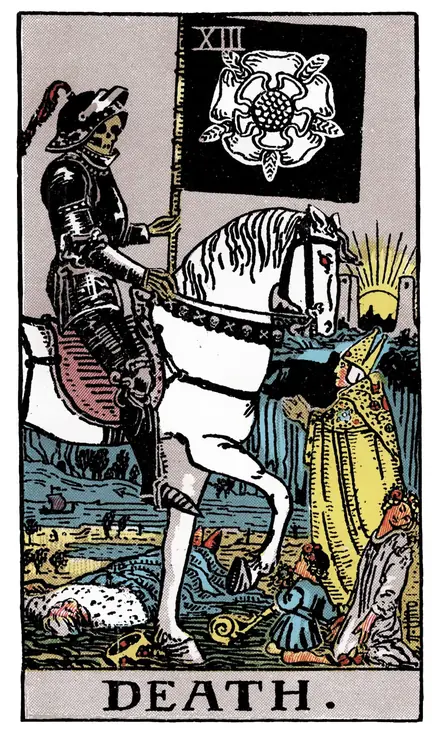
Death is the ending that transforms: a chapter that closes for good and clears the ground so that something different can grow in its place.
Draw this card · Its correspondences
- Arcana: Major, number XIII
- Hebrew letter: Nun (נ), “fish”
- Path on the Tree of Life: 24
- Attribution: Scorpio
- In one sentence: The ending that transforms
- Keywords: Endings, transformation, transition, deep change
- Yes or no?: No
- Archetype: The point of no return
What the card shows
In the deck Pamela Colman Smith drew for Arthur Edward Waite in 1909, Death comes on horseback. It is a skeleton in black armour, its helmet topped with a red plume, riding a white horse at a slow walk. In its hand it carries a black banner bearing a white five-petalled rose. Before the horse are four figures: a king fallen to the ground, his crown beside him; a mitred bishop standing with his hands joined; a young woman kneeling and turning her face away; and a child who looks up at the rider without fear. In the background a river flows with a boat on it, and on the horizon the sun rises between two towers.
Each detail has its reading. The fallen king shows that power cannot halt the rider. The bishop, the young woman and the child show three ways of meeting an ending: with faith, with refusal, and with the ease of someone who has not yet learned to fear it. The white rose is associated with purity and with life renewing itself, and the white horse carries the same idea. The river and the boat recall the crossing from one shore to the other, and the sun between the towers is the dawn that follows the night.
In The Pictorial Key to the Tarot (1910), Waite reads the card as change and as the passage from one state to a higher one, and notes that the sun in the background speaks of what endures. The Golden Dawn assigned it the Hebrew letter Nun, “fish,” and Scorpio, and called it the “Child of the Great Transformers.” In the Marseille decks card XIII often appears without a name, showing a skeleton mowing down heads and hands in a black field.
Death upright
Upright, Death reads as a true ending. Something finishes and will not come back as it was: a stage of life, a relationship, a job, a way of seeing yourself. Tradition almost never takes it as physical death. Its theme is transformation. For something new to grow, what came before has to end completely.
In a spread it often points to a closure already under way. Sometimes you have sensed it for a while and the card confirms it; at other times it arrives with the clarity of a decision made. The rider moves slowly, so the card speaks less of sudden blows than of processes: grief, a move, the end of a habit, the passage from one age to another. Death asks you to let go of what has completed its cycle.
It frightens beginners more than any other card, and deserves a calm explanation. The sun rising in the background is part of the picture. Next to cards of beginning, such as the Ace of Wands or the Star, the ending reads as a doorway into a more vivid chapter. Next to cards of loss, such as the Five of Cups, the emphasis falls on grief and the time it needs.
As advice, Death invites you to close things consciously. Say goodbye well, put in order what remains, be grateful for what was lived, and accept that what has ended leaves room. Delaying an ending that has arrived usually prolongs the discomfort.
Death reversed
Not every school reads reversals. Many readers work with upright cards only and let the neighbouring cards add nuance. Those who do read reversed cards usually see Death reversed as an ending that resists.
The most common image is the door left ajar: you know something is over, and you keep it standing out of habit, fear or comfort. Waite associated the reversed card with inertia, lethargy and sleep, and the idea fits. Life goes on without moving forward: the relationship nobody ends, the job that no longer makes sense, the project that drags on.
Another reading speaks of slow change, happening inside before it shows outside. The transformation is real; it simply takes longer to appear.
In both cases the advice is to look at what you are holding up out of fear of the empty space, and to take the step that is still missing.
In love
In love, Death reads as the end of a stage. For a couple it can point to a breakup, though very often it speaks of something else: the end of the honeymoon phase, of a way of living together, or of an agreement that no longer works. Some couples pass through this card and come out transformed, with new rules and more truth between them.
If you are single, the Death card in a love reading means finishing the grief for a past story. While that bond still takes up space, it is hard for someone new to come in. The card invites you to say a full goodbye to what was.
Reversed, in love
Reversed in a love reading, Death speaks of a relationship that has already ended inside and carries on out of inertia, or of a farewell that never quite gets said. As advice, it invites you to name the ending out loud so that something else can begin.
Career and money
For career and money, Death reads as the close of a professional chapter: a contract that ends, a project that is dropped, a change of industry, or a way of earning a living that has run its course. It may also signal restructuring finances that were no longer working. Tradition advises closing well, with clear accounts and no burned bridges, and treating the ending as preparation for what comes next.
Reversed, in career
Reversed, it points to stagnation: staying in a role that no longer gives you anything, keeping a business with no future, or postponing a change you can see is necessary. The advice is to put a date on the ending.
Health and mood
In matters of health and mood, Death is linked with the end of a habit and a change of life stage: giving up a harmful routine, adjusting to a new age, going through grief. It reads as an invitation to respect your rhythms and give processes time. No card can diagnose anything, and no card foretells anyone’s death: for any symptom or concern, see a qualified health professional.
Yes or no? No
Death reads as a no to the question as it stands, especially if it is about keeping or getting something back. What you are asking about belongs to a chapter that is closing. If your question is whether to end something, change direction or turn the page, the card reads as a clear yes, on condition that you close the old chapter well.
Ask the card: a yes or no tarot reading with one card or three.
The archetype: The point of no return
As an archetype, Death is the step that cannot be undone. In a story it appears as the moment the character’s world stops existing as it was: someone dies, a city falls, an era ends, a secret stops being one. When it takes human form, it is the messenger who cannot be bribed, the old man who announces the end of an age, or the figure who walks the protagonist to the other side.
In the structure of a story, Death occupies the threshold. In the hero’s journey it is the instant the protagonist crosses into unknown territory and can no longer return home unchanged. It is also the symbolic death of the second act, when the character loses who they thought they were and is reborn with a different outlook. Its dramatic force lies in irreversibility: the reader knows that what is lost will not return, and so every scene afterwards weighs more.
The four figures on the card offer a complete cast of reactions. The falling king is the character who believed himself untouchable. The bishop is the one who accepts. The young woman is the one who refuses to look. The child is the one who understands without words. A strong chapter ending can share those four attitudes among the characters and let them collide.
The danger of this archetype in fiction is using death as a shortcut to emotion. The card works when the ending transforms those who remain, and when the story takes the time to show the dawn, however small.
In literature
- The Death of Ivan Ilyich (Leo Tolstoy, 1886). A respectable judge falls ill and, as the end approaches, discovers that he has lived according to what was expected of him. The novella moves through fear, denial and, at last, a luminous acceptance. It holds the whole card: the king who falls, the young woman’s dread, and the sun rising behind.
- A Christmas Carol (Charles Dickens, 1843). The last spirit is a silent hooded figure who shows Scrooge a death nobody mourns and, finally, his own neglected grave. Scrooge wakes on Christmas morning a different man. Dickens writes the card’s true lesson: the old self dies so that a new life can begin with the sunrise.
- Orlando (Virginia Woolf, 1928). Orlando lives through several centuries and, after a long sleep, wakes as a woman. Each era that ends leaves behind a version of the character without destroying her. Woolf writes transformation as continuity, which is Waite’s reading: a change of state that keeps the essence and sheds the rest like an old skin.
For writers
The conflict
Death sets what is ending against the person who will not let it go. It works when the character has a powerful reason to cling: love, guilt, identity, fear of emptiness. The ending comes anyway, at a slow pace, like the horse on the card. The tension grows from how long the character takes to accept it, and from what they destroy while resisting. Plant signs of closure early so the reader sees it coming.
The twist
As a plot twist, Death is the ending that turns out to be a beginning. A character loses their place, their name or their former life, and the story discovers that the loss opens a path that was impossible before. It also works the other way: an ending that looked small changes everyone else’s world. The sun between the towers is the clue. After the closure, the story needs to show the first dawn, even in a single line.
Prompts
- Close off one possibility for good so that another can begin.
- Write the last time your character does something ordinary without knowing it is the last time, and let the reader know it.
- Give four characters the card’s four reactions to the same loss: the one who falls, the one who accepts, the one who looks away and the child who asks questions.
- Tell a farewell through the objects left in an empty room the morning after.
Its correspondences
- Letter and path: Nun. Source: Golden Dawn (tradition).
- Sign: Scorpio. Source: Golden Dawn (tradition).
- Letter, alternative attribution: Mem. Source: Éliphas Lévi (tradition).
- Rune: Eihwaz. Source: Angelorum table (modern system).
- Archangel: Azrael. Source: Angelorum table (modern system).
- Archangel: Kamael. Source: Angelorum table (modern system).
Combinations
Death and The Tower
Death and the Tower together speak of a swift, complete ending. The Tower delivers the blow and Death the certainty that there is no way back. They read as a chapter closed at the root, with no half-measures.
Death and The Star
Death followed by the Star is one of the most hopeful sequences in tarot: after the closure comes renewal. It reads as grief that gives way to hope and to a new sense of direction.
Death and The Hanged Man
With the Hanged Man, the ending first passes through a pause. It reads as a time of waiting and necessary surrender before the transformation is complete and you can look at the change from another angle.
Death and Judgement
Death and Judgement together speak of rebirth. What ends returns in another form, and you receive a clear call to begin a different life, carrying everything you have learned along the way.
Death and The Fool
With the Fool, the ending opens a leap into the void. It reads as a closure that leaves you free to start from scratch, lightly, curiously and without a map, trusting the road to appear as you walk.
Death and Five of Cups
Beside the Five of Cups, the emphasis falls on grief. It reads as a loss that needs time and tears, even though two cups still stand behind the figure, waiting for someone to turn around.
Death and Ace of Wands
With the Ace of Wands, the ending becomes a spark. It reads as a closure that releases energy for a new project, one that starts almost at the very moment the old one ends.
Death and Ten of Swords
With the Ten of Swords, the ending is clear and painful. Together they read as the lowest point of a situation, from which the only way is up; that card, too, shows the sky brightening behind.
Frequently asked questions
What does Death mean in tarot?
Death, card XIII of the Major Arcana, stands for the ending that transforms: a chapter that closes completely so another can begin. Tradition reads it as deep change and as the passage from one state to another, with a rising sun in the background.
Does the Death card mean someone will die?
Tradition almost never reads it that way. Waite interpreted it as change and transformation, and most schools see it as the symbolic end of a stage, a relationship or a habit. No card can announce anyone’s death.
What does the Death card mean in love?
In love it reads as the end of a stage: a breakup, or a shift into a new way of being together. If you are single, it speaks of fully finishing the grief for a past relationship so there is room for someone new.
Is Death a yes or no card?
It reads as a no to keeping or recovering what you are asking about, because it belongs to a chapter that is ending. If you are asking whether to close something, change direction or turn the page, the answer is yes, provided the ending is handled calmly.
What does Death reversed mean?
Readers who use reversals usually see it as an ending that resists: a situation that is already over and carries on out of inertia, or a slow change that has not yet surfaced. Waite linked it with lethargy. The advice is to see what fear is holding up and take the missing step.
What zodiac sign and Hebrew letter go with Death?
In the Golden Dawn system, Death corresponds to Scorpio and to the Hebrew letter Nun, meaning “fish,” on the 24th path of the Tree of Life. Éliphas Lévi had earlier given it the letter Mem, and some decks still follow his attribution.
Do your readingPrevious: The Hanged Man · Next: Temperance
The 22 Major Arcana
- The Fool
- The Magician
- The High Priestess
- The Empress
- The Emperor
- The Hierophant
- The Lovers
- The Chariot
- Strength
- The Hermit
- Wheel of Fortune
- Justice
- The Hanged Man
- Death
- Temperance
- The Devil
- The Tower
- The Star
- The Moon
- The Sun
- Judgement
- The World
By Style Optimizer · published November 22, 2026.