Tarot / The 78 cards / Major Arcana / The Devil
The Devil, Major Arcana XV: tarot card meaning, upright and reversed
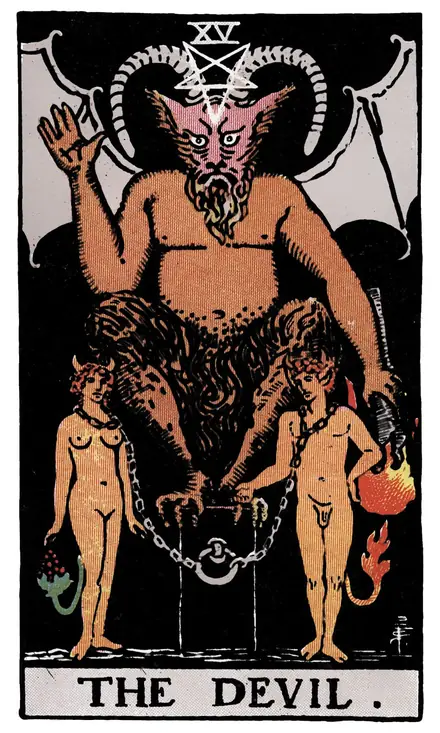
The Devil is the bondage we consent to: a desire, fear or habit that binds us with chains so loose they could be lifted off at any time.
Draw this card · Its correspondences
- Arcana: Major, number XV
- Hebrew letter: Ayin (ע), “eye”
- Path on the Tree of Life: 26
- Attribution: Capricorn
- In one sentence: Bondage and matter
- Keywords: Shadow, addiction, restriction, sexuality, materialism
- Yes or no?: No
- Archetype: The Tempter
What the card shows
In the deck Pamela Colman Smith drew for Arthur Edward Waite in 1909, the Devil fills almost the whole card against a black ground. He has a goat’s horns, a bat’s wings, the ears of an animal and the clawed feet of a bird of prey. An inverted pentagram, point down, sits on his brow. His right hand is raised with the palm open; his left holds a burning torch pointed at the earth. He squats on a black half-cube, an altar cut in two, and from it hangs an iron ring.
Two chains run from that ring to the necks of a naked man and woman. Both have small horns and tails: hers ends in a bunch of grapes, his in a flame. The chains hang slack. Either of them could raise their hands and slip the loop over their head.
Every detail carries a reading. The inverted pentagram is matter set above spirit. The lowered torch is a fire that lights only what lies below. The raised hand mimics a blessing turned upside down. The couple echoes The Lovers, card VI, now fallen: Waite connects them with Adam and Eve after Eden, and the tails of grape and fire with pleasure and desire. The loose chains are the key to the whole card. The bond holds because it is accepted.
The Golden Dawn titled the card “Lord of the Gates of Matter, Child of the Forces of Time”, assigned it the Hebrew letter Ayin, “eye”, and gave it Capricorn, the sign ruled by Saturn. Smith’s figure owes a great deal to the Baphomet drawn by Éliphas Lévi.
The Devil upright
Upright, the Devil reads as bondage. Something holds the person and takes away their freedom: a desire that has hardened into need, an addiction, a controlling relationship, a debt, a job they hate and still keep. Tradition draws attention to one detail of the image. The chains are loose. The card speaks of what binds us and, in the same breath, of the part we play in keeping the chain on.
In a spread it often points to the shadow, the side of ourselves we would rather leave unexamined: envy, ambition, appetite, the fear of losing what we have. It is also linked with sexuality and the pleasures of the senses, and here the reading turns warmer. The Devil stands for the force of instinct, and that force can become creative energy once it is looked at squarely.
Capricorn and Saturn add another shade: attachment to material things, to money, security and status. Beside cards of plenty, such as the Nine of Pentacles, the Devil warns that possessions can end up possessing their owner. Beside cards of departure, such as the Six of Swords, the bond is starting to loosen.
As advice, the card asks you to name the chain. What we recognise we can let go of. What we deny keeps giving orders in silence.
The Devil reversed
Not every school reads reversed cards. Many readers work with upright cards only and let the neighbouring cards supply the nuance. Those who do read reversals tend to take the Devil reversed in two ways.
The first, and the most common, is release. The person sees what was holding them and starts to let it go: they break a habit, leave a relationship that was erasing them, take back control of their time or their money. The chain is lifted over the head.
The second reading is subtler: a shadow that hides itself even deeper. The bond is denied or disguised, and so it weighs more. Read this way, the reversed card invites you to check whether what feels like freedom might be another kind of dependence.
In love
In love, the Devil reads as intense passion and as entanglement. In a relationship it can point to a powerful physical attraction, jealousy, possessiveness, or a bond kept alive by habit, fear or need. For someone single, tradition links it with a desire that is hard to rein in, or with a person whose appeal lies precisely in being wrong for you. The card asks you to tell desire apart from connection, and to ask who is holding the chain.
Reversed, in love
Reversed in love, the Devil speaks of breaking free: leaving a relationship that was suffocating, ending a pattern of jealousy, or no longer chasing the kind of person who hurts you. It can also mark the end of an obsession. As advice, it invites you to reclaim your own space.
Career and money
For career and money, the Devil reads as material bondage: a salary that keeps you in a role you dislike, debt, runaway ambition, or a workplace run on pressure and control. It can also flag temptation, such as easy money from a doubtful source. The advice is to look at the price you are paying for security.
Reversed, in career
Reversed, it marks the way out: paying off a debt, leaving a job that was stifling you, or setting limits on unreasonable demands. This is the card of someone who decides that the security is no longer worth the cost.
Health and mood
For health and mood, the Devil is associated with habits that are hard to drop and with tension that builds up through excess or stress. It reads as an invitation to look honestly at your routines. No card can diagnose anything: for any symptom, dependence or worry, speak to a qualified health professional.
Yes or no? No
The Devil reads as a “no”, or as a “yes” that comes at a high price. You may get what you want, in exchange for a bond: more dependence, more control by someone else, or a bill that arrives later. The card asks you to look at why you are asking. If the question is whether something is holding you back, the answer is “yes”.
Ask the card: a yes or no tarot reading with one card or three.
The archetype: The Tempter
As an archetype, the Devil is the character who offers the protagonist exactly what they want, in exchange for something they do not yet know they will miss. He is Mephistopheles with his contract, the serpent in the garden, the partner with an easy deal, the lover who demands to be the only one. His power lies in persuasion. The tempter convinces, and the other signs.
In the structure of a story, the Devil marks the bargain and its consequences. He tends to appear in the first act as an irresistible offer and collect his fee in the third. In between, the character enjoys the prize while the chain tightens little by little, unnoticed. The tension comes from the reader seeing the chain before the character does.
The archetype can also live inside the protagonist. Then it is the shadow Jung wrote about: the part of the self we refuse to accept, which goes on acting by itself. Stories of doubles, vices and obsessions run on this inner version of the Devil.
The chained couple on the card holds the dramatic key. The way out is there from the start, because the chains are loose. The story is about how long the character takes to see it, and how much it costs them to step free.
In literature
- Paradise Lost (John Milton, 1667). Milton gives the tempter his most eloquent voice. Satan, fallen and defiant, slips into Eden as a serpent and persuades Eve with flattery and argument. Adam follows her out of love. The poem ends with the couple of the card, cast out of the garden, hand in hand, bound now by what they chose.
- Strange Case of Dr Jekyll and Mr Hyde (Robert Louis Stevenson, 1886). A respected doctor frees his shadow with a potion and finds that he enjoys it. At first Jekyll controls the change; later Hyde arrives uninvited. This is the inner Devil in its purest form: a bond we forge ourselves while believing we are in charge of it.
- The Picture of Dorian Gray (Oscar Wilde, 1890). Dorian wishes that his portrait would age in his place, and the wish comes true. Free of any visible consequence, he gives himself to every pleasure while the painting keeps each stain. The novel shows a pact with no devil in sight: the tempter is a phrase of Lord Henry’s and Dorian’s own vanity.
For writers
The conflict
The Devil sets up a conflict between desire and freedom. The character wants something badly: money, pleasure, power, someone’s approval. To get it, they accept a condition that looks small. The card works best when the desire is understandable and the reader, in the same position, would sign too. To build the bond, show how the character justifies each concession, and how each one costs a little more than the last.
The twist
As a plot twist, the Devil is the discovery of the chain: the moment the character realises that what they thought they were choosing had been choosing them. The richest twist comes when they also discover that the chains were loose all along. Then the question changes. Now it is whether they are willing to give up what the bond was giving them.
Prompts
- Name the desire or dependency that keeps the character trapped.
- Write the scene in which someone accepts a deal that looks fair, and let the reader see the small print before the character does.
- Tell the story of a dependence from the point of view of the thing desired: the bottle, the phone, the money or the person.
- Have your character discover that the door was open the whole time, and show why they still take so long to walk through it.
Its correspondences
- Letter and path: Ayin. Source: Golden Dawn (tradition).
- Sign: Capricorn. Source: Golden Dawn (tradition).
- Letter, alternative attribution: Samekh. Source: Éliphas Lévi (tradition).
- Rune: Thurisaz. Source: Angelorum table (modern system).
- Archangel: Cassiel. Source: Angelorum table (modern system).
Combinations
The Devil and The Tower
The Devil with the Tower points to a bond that snaps all at once. The dependence or the controlling situation collapses, and although it hurts, the collapse sets the person free.
The Devil and The Lovers
With The Lovers, of which the Devil is the dark reflection, a choice in love is coloured by desire and dependence. It reads as a bond where passion weighs more than freedom.
The Devil and Temperance
Temperance, which comes just before it in the sequence, sets balance against excess. Together they read as the need to moderate an appetite before it turns into a chain.
The Devil and The Fool
With The Fool, freedom and bondage meet. It reads as an urge to break with everything to escape what binds you, or as an adventure that ends up tying you down.
The Devil and Eight of Swords
Beside the Eight of Swords, the bondage is mostly in the mind. Blindfold and chains reinforce each other: the person believes they are more trapped than they really are.
The Devil and Four of Pentacles
With the Four of Pentacles, the attachment is material. It reads as greed, fear of losing what you have, or financial security that ends up locking in the one who guards it.
The Devil and Seven of Cups
The Devil and the Seven of Cups speak of temptation and illusion. Many shining options, one or two of them dangerous: desire confuses what attracts with what helps.
The Devil and The Sun
With The Sun, the shadow comes into the light. It reads as recognising what held you, saying it out loud, and the joy of letting it go.
Frequently asked questions
What does The Devil mean in tarot?
The Devil, card XV of the Major Arcana, stands for bondage: desire, dependence or material attachment that takes away freedom. Tradition also reads it as the shadow and the force of instinct, and its loose chains are a reminder that the way out exists.
What does The Devil mean in love?
In love it reads as intense passion and entanglement: physical attraction, jealousy, possessiveness, or a relationship held together by need. Reversed, it speaks of breaking free from a bond that was suffocating you.
Is The Devil a yes or no card?
It reads as a “no”, or as a “yes” with a steep price: what you want arrives in exchange for a bond. If the question is whether something is holding you back, the answer is “yes”.
What does The Devil reversed mean?
Readers who use reversals usually see it as release: recognising what bound you and beginning to let it go. It can also point to a shadow that hides even deeper. Either way, the advice is to name the chain.
Is The Devil a bad card?
It is a demanding card, because it shows what binds you. Tradition also reads it as energy, desire and vital force, and as an invitation to face your own shadow. Its meaning depends a great deal on the cards around it.
What zodiac sign and Hebrew letter are linked to The Devil?
In the Golden Dawn system, The Devil corresponds to Capricorn and to the Hebrew letter Ayin, meaning “eye”, on the 26th path of the Tree of Life. Éliphas Lévi had earlier given it the letter Samekh.
Do your readingPrevious: Temperance · Next: The Tower
The 22 Major Arcana
- The Fool
- The Magician
- The High Priestess
- The Empress
- The Emperor
- The Hierophant
- The Lovers
- The Chariot
- Strength
- The Hermit
- Wheel of Fortune
- Justice
- The Hanged Man
- Death
- Temperance
- The Devil
- The Tower
- The Star
- The Moon
- The Sun
- Judgement
- The World
By Style Optimizer · published November 22, 2026.