Tarot / The 78 cards / Major Arcana / The Empress
The Empress, Major Arcana III: tarot card meaning, upright and reversed
The Empress is abundance that gives life: fertile ground, care and the pleasure of the senses that help whatever is sown to grow.
Draw this card · Its correspondences
- Arcana: Major, number III
- Hebrew letter: Daleth (ד), “door”
- Path on the Tree of Life: 14
- Attribution: Venus
- In one sentence: The abundance that gives birth
- Keywords: Fertility, femininity, beauty, nature, abundance
- Yes or no?: Yes
- Archetype: The fruitful mother
What the card shows
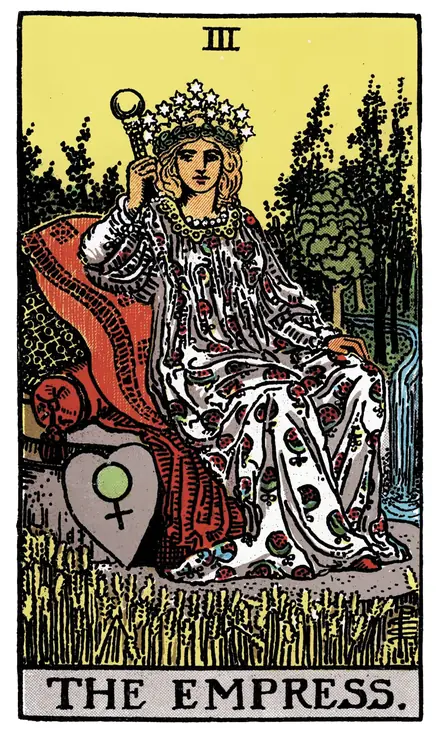
In the deck Pamela Colman Smith drew for Arthur Edward Waite in 1909, the Empress sits on a cushioned throne out in the open, surrounded by nature. She wears a white gown printed with pomegranates, a pearl necklace and a crown of twelve stars over a wreath of leaves. In her right hand she holds a sceptre topped with a globe. A field of ripe wheat grows at her feet; behind her rises a forest of tall trees, and a waterfall tumbles down to become a river. Resting against the throne is a heart-shaped shield bearing the sign of Venus.
Every detail reinforces the same idea. The wheat is the harvest, the fruit of working the land. The pomegranates, full of seeds, are fertility in every sense: children, works, projects. The twelve stars are usually read as the twelve signs of the zodiac or the twelve months, the full cycle of the year over which she presides. The falling water that feeds the field is life flowing without effort. The Venus shield makes the planetary attribution plain: love, beauty, pleasure, harmony.
In The Pictorial Key to the Tarot (1910), Waite calls her the earthly paradise and the door by which we enter it, and describes a stately figure in rich vestments. The Golden Dawn gave her the Hebrew letter Daleth, meaning “door”, and the fourteenth path on the Tree of Life, which joins the two highest spheres below the Crown. In Book T her title is Daughter of the Mighty Ones.
The Empress upright
Upright, the Empress reads as abundance, fertility and nurture. She is one of the most generous cards in the tarot: she speaks of something growing, a fruitful season in which what was sown begins to bear fruit. That fruit may be a child, a creative work, a business, a home or a relationship coming into its own. The tradition links her with nature, the body and the senses, and so she also reads as pleasure: eating well, resting, enjoying beauty without guilt.
In a spread, the Empress usually signals a time of creativity and expansion. Ideas flow, projects find support and there is energy to spare for looking after others. She can also stand for a particular person: someone who welcomes, feeds and makes you feel at home. Many readings see her as the mother figure, though her meaning extends to anyone who cultivates and protects.
The High Priestess keeps and stays silent; the Empress gives and shows. The Emperor orders through rules; she makes things grow through patience. Her rhythm is the rhythm of the seasons: a time to sow, a time to wait and a time to harvest, and none of them can be skipped. That is why the card asks for trust in slow processes.
As advice, the Empress invites you to nourish whatever you have in hand, to give it time and attention, and to look after your own body too. What is watered steadily ends up growing.
The Empress reversed
Many readers never use reversals; they read every card upright and let the surrounding cards add the nuance. Those who do read reversed cards usually see the Empress upside down in one of three ways.
The first is creative block: the soil is there and yields nothing. Projects that never start, ideas left in a drawer, a feeling of inner drought. The second is care taken too far, until it becomes control: protection that smothers, a person so devoted to others that they forget themselves, or who will not let the people in their care grow up. The third is neglect of the body and of pleasure: working without rest, eating badly, living without beauty.
In every case, the advice points towards balance: return to nature and to your own rhythm, care without possessing, and let yourself be cared for.
In love
In love, the Empress is one of the most favourable cards in the deck. For couples, she reads as a relationship in full bloom: tenderness, desire, closeness and a shared wish to build something. She is often linked with moving in together, making a home and, at times, the wish to have children. Her love meaning is affection expressed through the body and through everyday gestures.
For singles, the Empress reads as a time of magnetism and self-assurance. Feeling at ease in your own skin is often what draws other people in, and the card invites you to look after yourself and enjoy life without waiting for anyone to arrive.
Reversed, in love
Reversed in love, the Empress can point to an unbalanced relationship: one partner gives and the other only takes, or care turns into dependence and jealousy. She can also reflect a lack of self-love that leads you to accept less than you deserve. The advice is to share the caring more evenly.
Career and money
For career and money, the Empress reads as prosperity and growth. Projects bear fruit, effort is rewarded and there are resources to invest. She is especially good news for creative work, for anything involving caring for people, cooking, design or the land, and for businesses that need time to mature.
Reversed, in career
Reversed, she points to stagnation or runaway spending: projects that stop growing for lack of attention, or money lost to whims. She can also speak of exhaustion from carrying everyone else’s workload. Set priorities and learn to delegate.
Health and mood
In health and mood, the Empress is linked with vitality and care of the body: sleep, good food, time outdoors. She reads as an invitation to listen to your own physical needs. No card can diagnose anything, nor say anything about pregnancy: for any question or symptom, the person to see is a health professional.
Yes or no? Yes
The Empress reads as a clear “yes”. She is a card of growth and fruit, and usually shows that what you are asking about has fertile ground to flourish in. The nuance lies in timing: hers is the yes of the harvest, which arrives in its season. If the question needs something immediate, the card counsels patience and steady care.
Ask the card: a yes or no tarot reading with one card or three.
The archetype: The fruitful mother
As an archetype, the Empress is the figure who makes things grow. In fiction she appears as the mother, the nurse, the hostess, the gardener, the matriarch of a house full of people, or any character whose presence feeds everyone else. Her power works through abundance: she reigns because she gives, because her table is always laid and because everyone comes back to her. She is a character of the body, of smells, kitchens and seasons.
As a moment in the plot, the Empress is the time of gestation. It arrives when something that was sown begins to grow: a love affair, a pregnancy, a business, a rebellion. These are chapters of apparent calm, with a slower rhythm, in which the story gathers life before the conflict arrives. She can also be the paradise the protagonist loses, the childhood home they long to return to.
The archetype has a shadow, and that is where the richest material lies for a writer. The mother who gives can be the mother who holds on; abundance can turn suffocating; fertile ground can refuse to yield. The best Empress characters carry that tension: they love so fiercely that they cannot let go, or they long to bear fruit and cannot. The card comes alive in a story when her generosity has a price that someone has to pay.
Her letter, Daleth, “door”, adds one more layer. The Empress is a threshold into life: the house where children are born, the garden gate, the kitchen door that always stands open. A character who embodies her controls who comes in, and who is allowed to leave.
In literature
- One Hundred Years of Solitude (Gabriel García Márquez, 1967). Úrsula Iguarán is an Empress who holds up the Buendía house for more than a century. She cooks, enlarges the house, raises several generations and makes a thriving business of her little candy animals. Her energy keeps the family alive, and when she fades, the house begins to sink.
- Yerma (Federico García Lorca, 1934). Lorca’s tragedy is the Empress seen through her absence. Yerma longs for a child with all the force of the earth, and the earth gives no answer. The fields, the water and the songs of the washerwomen speak of fertility all around her, and her thwarted desire ends in a terrible act.
- Like Water for Chocolate (Laura Esquivel, 1989). Tita pours into her cooking everything she is forbidden to live: love, desire, grief. Her dishes pass on what she feels to whoever eats them. The novel turns the Empress’s abundance into a recipe book, and sets the mother who nourishes against the mother who represses, Mama Elena.
For writers
The conflict
The Empress sets up a conflict around care and growth. It can be external, such as a family that depends on a single character to survive, or internal, such as someone who longs to create and cannot make anything take root. It works especially well when the carer’s love turns into a form of control. To prepare it, show the character’s generosity first through physical details: the food, the house, the hands.
The twist
As a plot twist, the Empress is the news that something is about to be born and changes everything: an unexpected pregnancy, an inheritance, a record harvest, an idea that grows faster than anyone planned. The twist gets interesting when the fruit is different from what was hoped for, or when the person who tended it must learn to let it go. Growth always demands space, and someone will have to give it up.
Prompts
- Make something grow: an alliance, a threat or a responsibility impossible to ignore.
- Write a meal scene in which the character who cooks expresses, purely through the dishes they serve, something they dare not say.
- Describe a garden or vegetable plot across a whole year, and let each season coincide with a change in the life of the person who tends it.
- Tell the story of a house everyone keeps returning to, from the point of view of the one character who wants to leave.
Its correspondences
- Letter and path: Daleth. Source: Golden Dawn (tradition).
- Planet: Venus. Source: Golden Dawn (tradition).
- Letter, alternative attribution: Gimel. Source: Éliphas Lévi (tradition).
- I Ching trigram: Earth. Source: Style Optimizer (our own proposal).
- Rune: Berkano. Source: Angelorum table (modern system).
- Archangel: Haniel. Source: Angelorum table (modern system).
- alquimia: Salt. Source: Crowley, The Book of Thoth (tradition).
Combinations
The Empress and The Emperor
The Empress and the Emperor are the parents of the tarot. Together they read as a balance between care and structure: a project that grows in good order, a home with clear boundaries.
The Empress and The High Priestess
With the High Priestess, abundance turns inward. Both cards speak of intuition and creativity, of something taking shape in silence before it shows itself to the world.
The Empress and The Lovers
The Empress with the Lovers reads as a love that bears fruit: a relationship freely chosen that becomes a home, a shared project or a family.
The Empress and The Sun
Beside the Sun, the Empress amplifies joy and growth. It is one of the brightest pairings in the deck: success, vitality and a happy season for a family or a project.
The Empress and Ten of Pentacles
With the Ten of Pentacles, abundance becomes legacy: the family home, the inheritance, prosperity handed down from one generation to the next.
The Empress and Three of Cups
The Three of Cups beside the Empress speaks of celebration: a birth, a wedding or a harvest toasted with friends. Joy that is shared.
The Empress and Death
The Empress with Death recalls the cycle of nature: something ends so that the earth can bear fruit again. Together they read as a deep transformation preparing the ground for a new sowing.
Frequently asked questions
What does The Empress mean in tarot?
The Empress, card III of the Major Arcana, stands for abundance, fertility and nurture. The tradition links her with Venus, nature and the senses. She reads as a season of growth in which what has been sown starts to bear fruit, whether a project, a relationship or a family.
What does The Empress mean in love?
She is one of the most favourable cards for love. For couples, she reads as tenderness, desire and the wish to build a home together. For singles, she speaks of a time of magnetism and self-assurance, when caring for yourself and enjoying life opens the door to others.
Is The Empress a yes or no card?
The Empress reads as a “yes”. The card shows fertile ground for what you are asking about and good prospects for growth. The nuance is timing: her yes arrives like the harvest, in its season, and asks for patience and steady attention.
What does The Empress reversed mean?
Readers who use reversals usually see her as creative block, as care that turns into control or dependence, or as neglect of your own body. The advice is to restore the balance between giving and receiving and return to your own rhythm.
What planet and Hebrew letter correspond to The Empress?
In the Golden Dawn system, the Empress corresponds to Venus and to the Hebrew letter Daleth, meaning “door”, on the fourteenth path of the Tree of Life. Éliphas Lévi had earlier assigned the card the letter Gimel. That is why she carries the sign of Venus on her shield.
Does The Empress represent a mother?
Many readings see her as the mother figure of the tarot, though her meaning is broader. She can stand for anyone who cares, feeds and helps others grow, whatever their gender, and also for a season of your own creativity and abundance.
Do your readingPrevious: The High Priestess · Next: The Emperor
The 22 Major Arcana
- The Fool
- The Magician
- The High Priestess
- The Empress
- The Emperor
- The Hierophant
- The Lovers
- The Chariot
- Strength
- The Hermit
- Wheel of Fortune
- Justice
- The Hanged Man
- Death
- Temperance
- The Devil
- The Tower
- The Star
- The Moon
- The Sun
- Judgement
- The World
By Style Optimizer · published November 22, 2026.