Tarot / The 78 cards / Major Arcana / Strength
Strength, Major Arcana VIII: tarot card meaning, upright and reversed
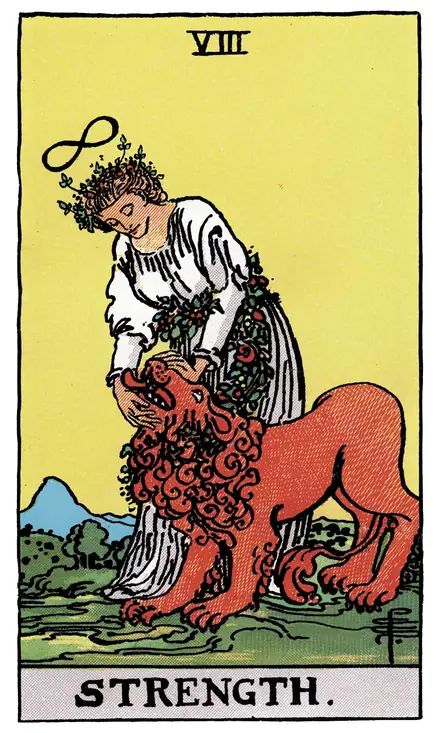
Strength is quiet courage that tames the wild with patience: self-mastery, steady compassion and a will that persuades rather than forces.
Draw this card · Its correspondences
- Arcana: Major, number VIII
- Hebrew letter: Teth (ט), “serpent”
- Path on the Tree of Life: 19
- Attribution: Leo
- In one sentence: The beast tamed
- Keywords: Courage, persuasion, influence, compassion, inner strength
- Yes or no?: Yes
- Archetype: The compassionate tamer
What the card shows
In the deck Pamela Colman Smith drew for Arthur Edward Waite in 1909, Strength shows a woman standing in a green meadow, with a blue mountain behind her and a bright yellow sky overhead. She wears a white robe and a crown of flowers in her hair, and a garland of roses circles her waist and runs on to the lion’s neck. With both hands she holds the animal’s mouth. The lion is tawny red, its tail tucked between its legs. It lowers its head and lets its tongue hang out. It is letting her do it. Above the woman’s head floats the figure of eight lying on its side, the lemniscate or infinity sign, the same one that hovers over the Magician.
Each detail carries a meaning in the tradition. The white robe speaks of pure intention: the woman acts without malice. The lion is instinct, passion, anger and desire, everything in a person that has claws. The chain of flowers is the key to the image, because it binds with something fragile what no rope could hold. The lemniscate suggests that her calm comes from a strength that renews itself and never runs out. The yellow sky and the open landscape give the scene air and light, far from any arena.
In The Pictorial Key to the Tarot (1910) Waite writes that the woman is closing the lion’s jaws, and links the card to innocence that tames by its presence alone. In the Marseille decks Strength is card XI and Justice card VIII. Waite swapped the numbers so that Strength, attributed to Leo, would come before Justice, attributed to Libra, as the signs do in the zodiac. The Golden Dawn gave the card the Hebrew letter Teth, “serpent,” and the 19th path on the Tree of Life.
Strength upright
Upright, Strength reads as quiet courage. It describes the ability to stay calm when something inside or outside you is pushing toward a violent reaction: anger, fear, an impulse, a difficult person. Tradition links it with moral fortitude, with patience and with a kind of influence that wins people over instead of overpowering them. The woman on the card prevails because the lion trusts her.
In a spread it often marks a moment when a tension has to be held without letting it snap. The card asks for firmness and gentleness at once: say what needs saying without shouting, set a boundary without humiliating anyone, get through a hard stretch without hardening. It also points to inner resources. You have more stamina than you think, and it works best the less you show it off.
The lion never disappears. That is the most interesting part of the card. Passion, desire and anger are still there, with all their energy, and Strength proposes bringing them over to your side. This is why the card is also tied to vitality, enthusiasm and physical courage, everything the sign of Leo offers when it is channelled well.
Next to active cards such as the Chariot or the King of Wands, Strength reads as leadership that inspires. Next to cards of conflict, such as the Five of Swords, the emphasis falls on the restraint needed to stay out of the fight. As advice, it invites you to handle what is wild with warmth and consistency, and to trust that patience is a form of power too.
Strength reversed
Not every school reads reversals. Many readers work with upright cards only and let the surrounding cards add nuance. Those who do read reversed cards tend to see Strength reversed in two ways.
The first is the lion off its leash. Instinct takes over: flashes of temper, impatience, decisions made in the heat of the moment, desires that drag a person along instead of keeping them company. Read this way, the reversed card points to a loss of self-control and the need to steady yourself before acting.
The second is the woman who doubts. The strength is there, and the person does not trust it: insecurity, fear of conflict, a sense of not being up to the task. Here Strength reversed speaks of low self-esteem and of energy that lies dormant for want of permission.
In both cases the advice points the same way: back to the chain of flowers, to the small, repeated gestures that bring back calm and confidence.
In love
In love, Strength reads as a bond that lasts because there is patience and respect in it. In a relationship it shows the ability to get through a difficult season without wounding each other, to talk about what hurts with tenderness, and to accept the other person’s temperament, lion and all. It also describes passion handled well: intense desire and deep trust at the same time.
If you are single, Strength usually suggests a good moment to show yourself as you are, with confidence and without hurry. Tradition links it with a calm magnetism that comes from being at ease in your own skin, and with the patience to let something grow at its own pace.
Reversed, in love
Reversed in a love reading, Strength speaks of jealousy, arguments that get out of hand, or someone who always gives in for fear of losing the other. As advice, it asks you to restore the balance: neither dominate nor be dominated.
Career and money
For career and money, Strength reads as persistence and good manners. It favours tough negotiations, teams under strain and projects that demand stamina. You persuade through steadiness more than volume. With money, it suggests patience: hold your course, resist the impulse purchase and let steady effort pay off.
Reversed, in career
Reversed, it points to friction with a boss or colleagues, a flash of temper that damages a working relationship, or a lack of confidence to ask for what you deserve. The advice is to cool down before replying and to prepare your arguments well.
Health and mood
In matters of health and mood, Strength is linked with vitality and resilience, and also with the tension that builds up when you endure too much for too long. It reads as an invitation to look after your body steadily and to let it rest. No card can diagnose anything: for any symptom or concern, see a qualified health professional.
Yes or no? Yes
Strength reads as a yes. It says you have the resources to achieve what you are asking about, especially if you act calmly and keep at it. It is a yes that asks for patience: the result comes through self-mastery and persuasion. Rushing or applying pressure makes things harder. Quiet firmness brings the outcome closer.
Ask the card: a yes or no tarot reading with one card or three.
The archetype: The compassionate tamer
As an archetype, Strength is the figure who wins without striking a blow. She can be a heroine, a mentor, a mother, even a child: someone whose power lies in calm, in the right word, and in the ability to look the beast in the eye without fear. Her most recognisable trait is patience. Where other characters attack, she waits. Where others run, she comes slowly closer.
In the structure of a story, Strength tends to appear in the scene of the inner trial. The protagonist faces something that cannot be beaten with weapons: their own rage, an addiction, an enemy who is wounded underneath, a creature that only needs trust. The resolution comes when the character changes tactics and stops fighting. That moment carries real dramatic force, because the reader expects a battle and receives something harder and more memorable.
The archetype has a shadow as well. Patience can curdle into resignation, and gentleness into a form of control. Some tamers are really manipulators. Strength works best in fiction when the cost is visible: the character trembles, makes mistakes, doubts that the chain of flowers will hold, and still keeps a hand in the lion’s mouth. That is where the scene lives, and it is often the image readers remember long after the plot has faded.
In literature
- Beauty and the Beast (Jeanne-Marie Leprince de Beaumont, 1756). Beauty enters the castle of a fearsome creature and, instead of fleeing or fighting, treats him with kindness day after day. The Beast is transformed by that patience. It is almost a literal reading of the card: the woman, the beast, and a fragile bond that proves stronger than fear.
- The Little Prince (Antoine de Saint-Exupéry, 1943). The fox asks the little prince to tame him and explains how: sit a little closer every day, in silence, at the same hour. The scene turns taming into an apprenticeship in mutual trust, which is exactly what Strength shows with its chain of flowers.
- To Kill a Mockingbird (Harper Lee, 1960). Atticus Finch defends an innocent man in a hostile town and does it without violence, absorbing insults and threats with a calm his children take years to understand. His courage is the card’s own: firm, serene, and more concerned with dignity than with winning the fight.
For writers
The conflict
Strength sets impulse against self-command. Your character faces something that provokes them: an insult, a temptation, a dangerous creature, a child who defies them. Answering with equal violence would be easy and even justified. The tension of the scene lies in their choosing another way without knowing whether it will work. For the card to carry weight, the reader has to feel the claws. The risk must be real.
The twist
As a plot twist, Strength is the moment the enemy turns out to be someone who can be gentled, or the protagonist discovers that their most powerful weapon is calm. It works beautifully against expectation: the character who looks weakest solves what the strong could not. Another possible twist is the lion that changes sides and comes to protect the one who tamed it.
Prompts
- Resolve the scene through inner mastery, without a greater force stepping in.
- Write a scene in which your protagonist has every reason to explode and chooses to speak softly; show what each sentence costs them.
- Create a character with a dangerous reputation and have someone win their trust through one small gesture repeated over several days.
- Tell the same confrontation twice, first with brute force and then with the chain of flowers, and let the reader weigh the costs.
Its correspondences
- Letter and path: Teth. Source: Golden Dawn (tradition).
- Sign: Leo. Source: Golden Dawn (tradition).
- Letter, alternative attribution: Kaph. Source: Éliphas Lévi (tradition).
- Rune: Nauthiz. Source: Angelorum table (modern system).
- Archangel: Michael. Source: Angelorum table (modern system).
Combinations
Strength and The Magician
The Magician and Strength share the infinity sign above their heads. Together they read as will and self-mastery serving a single aim: the ability to make things happen and the composure to sustain what has been made.
Strength and The Chariot
With the Chariot, Strength adds direction to restraint. The Chariot moves forward by holding opposing forces in check through willpower; Strength soothes them through affection. Together they read as steady progress that tramples no one along the way.
Strength and Justice
Justice beside Strength recalls the swap of numbers between the Marseille deck and the Rider–Waite–Smith. Together they read as a balance between the mind that weighs and the heart that holds steady: fair decisions taken calmly.
Strength and The Devil
The Devil next to Strength points to a struggle with instinct: a dependency, a craving or an anger that keeps you bound. Strength says you have what it takes to loosen that chain, through patience and steady effort.
Strength and The Sun
With the Sun, Strength reads as full vitality and self-confidence. The two cards share the fiery energy of Leo and point to a time of joy, good health and a calm, settled kind of security.
Strength and King of Wands
The King of Wands and Strength read as charismatic leadership. The fire of the suit brings initiative; the Major Arcana card brings the composure that makes other people want to follow, and keeps that fire from burning anyone.
Strength and Five of Swords
With the Five of Swords, Strength advises stepping back from a fight that leaves only losers. It reads as the victory of someone who refuses the bait and walks away with their dignity intact.
Strength and Judgement
Strength and Judgement together read as a call that demands courage. Judgement wakes you up; Strength gives you the calm to answer it and to change without being swept away by impulse or by fear.
Frequently asked questions
What does Strength mean in tarot?
Strength, card VIII in the Rider–Waite–Smith deck, stands for quiet courage that tames what is wild without violence. Tradition links it with patience, compassion, persuasion and self-mastery, all summed up in the image of a woman holding a lion with a chain of flowers.
What does Strength mean in love?
In love it reads as a bond that is patient and passionate at once, able to weather hard seasons without wounding either partner. If you are single, it speaks of calm confidence and of letting something grow at its own pace.
Is Strength a yes or no card?
Strength reads as a yes, with one condition: that you act calmly and consistently. The outcome arrives through patience and persuasion. Rushing or pushing too hard makes it harder to reach, while quiet firmness brings it closer.
What does Strength reversed mean?
Readers who use reversals usually see it as instinct running wild, with outbursts and impatience, or as a lack of faith in your own strength. The advice is to recover your calm through small, repeated gestures before you act on anything.
Why is Strength VIII in the Rider–Waite–Smith deck and XI in the Marseille tarot?
Waite swapped Strength and Justice so that the order of the trumps would follow the zodiac: Strength corresponds to Leo and Justice to Libra, which comes after it. In the Marseille decks Strength is XI and Justice is VIII, and some modern decks still keep that order.
What zodiac sign and Hebrew letter go with Strength?
In the Golden Dawn system, Strength corresponds to Leo and to the Hebrew letter Teth, meaning “serpent,” on the 19th path of the Tree of Life. Éliphas Lévi had assigned it a different letter, Kaph, following the older order of the cards.
Do your readingPrevious: The Chariot · Next: The Hermit
The 22 Major Arcana
- The Fool
- The Magician
- The High Priestess
- The Empress
- The Emperor
- The Hierophant
- The Lovers
- The Chariot
- Strength
- The Hermit
- Wheel of Fortune
- Justice
- The Hanged Man
- Death
- Temperance
- The Devil
- The Tower
- The Star
- The Moon
- The Sun
- Judgement
- The World
By Style Optimizer · published November 22, 2026.