Tarot / The 78 cards / Major Arcana / The Star
The Star, Major Arcana XVII: tarot card meaning, upright and reversed
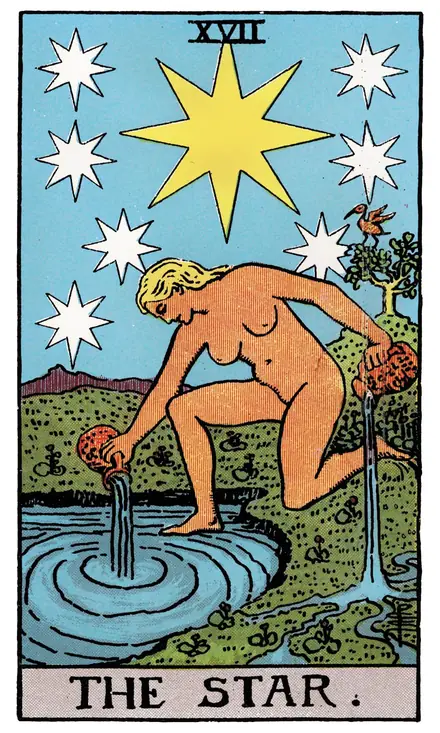
The Star is hope returning after the storm: a quiet calm and a small, steady light that shows you which way to go next.
Draw this card · Its correspondences
- Arcana: Major, number XVII
- Hebrew letter: Tzaddi (צ), “fish-hook”
- Path on the Tree of Life: 28
- Attribution: Aquarius
- In one sentence: Hope poured out
- Keywords: Hope, faith, purpose, renewal, spirituality
- Yes or no?: Yes
- Archetype: The Guide in the Night
What the card shows
In the deck Pamela Colman Smith drew for Arthur Edward Waite in 1909, the Star shows a young naked woman kneeling at the edge of a pool. One knee rests on the earth and the other foot on the water. She holds two jugs: from one she pours water back into the pool, from the other she spills it onto the land, where it divides into five small streams. Above her shines a great yellow eight-pointed star, surrounded by seven smaller white stars, each with eight points as well. Behind her rise a green hill and a tree with a bird perched on a branch.
Each element has its reading in the tradition. Her nakedness is linked with sincerity, with what no longer needs protecting: after the Tower, there is nothing left to hide. The foot on the water and the knee on the land join the world of feeling with the practical world. The water returning to the pool speaks of what renews itself without running dry. The water on the land, split into five channels, is often read as nourishment for the five senses. The eight stars stand for guidance and orientation, and the bird in the tree, often identified as an ibis, is associated with thought taking flight.
In The Pictorial Key to the Tarot (1910), Waite sees in the figure eternal youth and beauty, and in the great star a guiding light. The Golden Dawn assigned the card the Hebrew letter Tzaddi, “fish-hook”, and the sign of Aquarius, and titled it “Daughter of the Firmament, Dweller between the Waters”. In The Book of Thoth, Crowley gives it the letter Heh instead.
The Star upright
Upright, the Star reads as hope regained. It arrives after a hard season and brings something quieter than joy: the feeling that you can breathe again. The worst is over, the noise has gone, and a clear calm settles in which things begin to come into focus.
In a spread it often marks a time of renewal. Motivation returns, an idea appears that gives direction, someone offers help without asking anything back, or you recover your trust in yourself. Tradition ties the card to faith in a broad sense: trusting that the path makes sense even before you can see all of it. A star guides at night, before the sun has risen, so this card is about orientation more than arrival.
It also reads as generosity. The woman pours without measuring; she gives back to the pool and waters the earth. This is a card of inspiration and creativity, much loved by artists and writers, because it shows the moment the spring starts to run again.
Beside cards of crisis, such as the Tower or Death, the Star marks the way out of the tunnel. Beside bright cards, such as The Sun or the Ace of Cups, it confirms a happy, open season.
As advice, the Star asks you to tend your hope with concrete gestures: rest, sort out your priorities, return to what gives life meaning, and trust the process without forcing it or rushing it.
The Star reversed
Not every school reads reversed cards. Many readers work with upright cards only and let the neighbouring cards supply the nuance. Those who do read reversals tend to see the Star reversed as hope that dims or goes into hiding.
The first reading is discouragement. After a crisis, the person cannot bring themselves to believe things will improve. The spring is still there; they have simply stopped looking up. Waite gave the reversed card qualities such as arrogance and impotence, which can be understood as misplaced confidence or an inability to act.
The second reading is hope cut off from reality: illusions with no ground beneath them, the foot resting on the water without the knee planted firmly on the land.
In both cases, the advice is to look for one small, verifiable sign of improvement and lean on it before thinking about big goals.
In love
In love, the Star carries a meaning of calm and sincerity. In a relationship it reads as a time of reconciliation or renewal after a difficult stretch: trust returns, you speak openly, and the two of you share a horizon again. This is a card of healthy, generous bonds.
For someone single, the Star speaks of hope and openness. After a break-up, it suggests the wound is starting to close and that trusting again is possible. In the traditional reading it can also point to meeting someone who inspires you and brings you peace.
Reversed, in love
Reversed in love, the Star speaks of disillusion: idealising someone, expecting too much, or doubting that you deserve a good relationship. As advice, it invites you to rebuild trust in yourself before placing it in someone else.
Career and money
For career and money, the Star reads as recovery and vocation. After a bad run, things improve little by little and opportunities appear that fit what you truly want to do. It is very favourable for creative projects, meaningful work and picking up an abandoned idea. Financially it suggests stability returning slowly, without spectacular strokes of luck, and advises investing in what makes sense over the long term.
Reversed, in career
Reversed, it points to low motivation or projects that fail to take off for lack of confidence. The advice is to set one small, reachable goal to get the momentum back.
Health and mood
For health and mood, the Star is associated with recovery, rest and serenity after a period of fatigue. It reads as an invitation to look after your sleep, your calm and the habits that restore your energy. No card can diagnose anything: for any symptom or worry, speak to a qualified health professional.
Yes or no? Yes
The Star reads as a serene “yes”. What you are asking about has a good horizon, although the card describes a road travelled with patience rather than an instant result. It is a “yes” that asks for trust and consistency, and it grows firmer the more it rests on concrete steps. Reversed, the answer becomes “not yet”.
Ask the card: a yes or no tarot reading with one card or three.
The archetype: The Guide in the Night
As an archetype, the Star is the light that appears when everything seemed lost. In a story it arrives after the catastrophe: the character has lost almost everything and, in the silence, finds a reason to go on. When it takes human form, it is the figure who heals without fuss: the healer, the stranger who offers water, the child who reminds the protagonist who they used to be, the voice singing among the ruins.
In the structure of a story, the Star is the breathing space after the great blow. If the Tower is the end of the second act, the Star is the start of the third: the moment the protagonist, stripped of old certainties, discovers what truly matters and finds the direction for the final stretch. Its dramatic force is delicate, and it works by contrast. The darker the night, the more a single light counts.
The risk of this archetype in fiction is turning it into easy comfort. The Star works when hope has a price and a concrete shape: a letter found, a promise kept, a small gesture the reader can see. The woman on the card works with her hands and pours the water jug by jug. Hope in a story is built the same way, through actions.
There is also an underused trait here. The woman is alone and nobody is watching her. The Star is hope worked on in private, before anyone else notices, and that gives a character an intimate scene of great power.
In literature
- The Road (Cormac McCarthy, 2006). A father and his son cross a ruined world, telling each other that they are carrying the fire. In the middle of the ash, that phrase is the Star: a tiny, stubborn hope that gives the journey meaning. The ending offers a small and verifiable light, exactly what the card asks for after catastrophe.
- Les Misérables (Victor Hugo, 1862). Jean Valjean leaves prison a bitter man, and a bishop restores his faith with one generous act. From then on the novel follows someone who pours out on others what he was given. He is the woman on the card, returning water to the earth with both hands.
- The Tempest (William Shakespeare, 1611). After the shipwreck Prospero has raised, the play moves toward forgiveness and reconciliation. Miranda looks at the newcomers and sees a brave new world. Shakespeare closes on the calm that follows the storm, which is precisely the passage from the Tower to the Star.
For writers
The conflict
The Star sets up a conflict between hope and mistrust. The character has just come through a crisis and has every reason never to believe in anything again. A chance of renewal appears, and accepting it means risking another loss. The tension grows from that doubt: trust or stay guarded. It works best when the earlier wound is clear to the reader and the sign of hope is small, fragile and easy to miss.
The twist
As a plot twist, the Star is the unexpected help that arrives at the worst moment. A minor character reveals their generosity, a forgotten object regains its value, a memory restores the protagonist’s bearings. The twist works when the hope was planted earlier and nobody noticed it. The card offers another clue: the woman gives without expecting anything, so the turn can come from someone who helps without asking for explanations or reward.
Prompts
- After the loss, show a small but tangible sign of renewal.
- Write a scene of calm right after a catastrophe, in which your character makes a small gesture of care without mentioning what happened.
- Have a character who has lost everything share the little they have left with a stranger, and let that gesture change the course of both their lives.
- Tell the story of a night when someone finds their way by a single light, and let that light mean something different by the end.
Its correspondences
- Letter and path: Tzaddi. Source: Golden Dawn (tradition).
- Sign: Aquarius. Source: Golden Dawn (tradition).
- Letter, alternative attribution: Peh. Source: Éliphas Lévi (tradition).
- Letter, alternative attribution: Heh. Source: Crowley, The Book of Thoth (tradition). Crowley swaps Heh and Tzaddi: the Star is still Aquarius.
- I Ching trigram: Lake. Source: Style Optimizer (our own proposal).
- Rune: Wunjo. Source: Angelorum table (modern system).
- Archangel: Cassiel. Source: Angelorum table (modern system).
- Archangel: Uriel. Source: Angelorum table (modern system).
Combinations
The Star and The Tower
This is the classic pairing of the tradition: after the lightning, the calm. The Star following the Tower reads as recovery, hope and a cleaner direction than the one lost in the collapse.
The Star and Death
The Star beside Death reads as renewal after an ending. Mourning draws to a close and a quiet hope appears, with the sense that what ended has made room for something better and truer.
The Star and The Moon
With The Moon, hope lives alongside confusion. It reads as guidance that exists even on a dark road: trust the star’s bearing and be wary of the fears that grow at night.
The Star and The Sun
The Star followed by The Sun announces, in the traditional reading, a bright and open season. Hope turns into joy, and what was only sensed begins to show itself in full daylight.
The Star and The Hermit
With The Hermit, the guidance comes from within. It reads as a time of peaceful solitude in which the person finds their own light, recovers their sense of purpose and learns to steer by themselves.
The Star and Ace of Cups
Beside the Ace of Cups, the Star strengthens emotional renewal. It reads as a love or friendship beginning in sincerity, or as tenderness returning after a dry and difficult time.
The Star and Four of Swords
With the Four of Swords, the emphasis falls on rest. Together they read as a restoring pause that brings back strength and clarity after a long struggle, before you set off again.
The Star and Ten of Pentacles
With the Ten of Pentacles, hope rests on solid ground. It reads as a lasting improvement in family, home or inheritance, built with patience and meant to endure for generations.
Frequently asked questions
What does The Star mean in tarot?
The Star, card XVII of the Major Arcana, stands for hope returning after a crisis: calm, renewal, faith and inspiration. Tradition reads it as a guide in the night, a small sign that shows which way to go once the worst has passed.
What does The Star mean in love?
In love it reads as reconciliation, sincerity and renewed trust. In a relationship it speaks of a calmer time after a hard stretch; for someone single, of a wound that is closing and an openness to someone who brings peace.
Is The Star a yes or no card?
It reads as a serene “yes”: what you are asking about has a good horizon. The card describes a road that calls for patience and consistency, so the result comes step by step. Reversed, the yes waits until trust returns.
What does The Star reversed mean?
Readers who use reversals usually see it as discouragement, a loss of faith that things will improve, or as unrealistic hopes with no ground beneath them. The advice is to find one small, verifiable sign of improvement and build from there.
What does The Star mean after The Tower?
It is one of the best-known sequences in tarot. After the Tower’s collapse, the Star reads as recovery and hope: what fell has cleared the ground, and a new, more honest direction appears, with the calm of someone who has nothing left to hide.
What zodiac sign and Hebrew letter are linked to The Star?
In the Golden Dawn system, The Star corresponds to Aquarius and to the Hebrew letter Tzaddi, meaning “fish-hook”, on the 28th path of the Tree of Life. In *The Book of Thoth*, Crowley assigned it the letter Heh.
Do your readingPrevious: The Tower · Next: The Moon
The 22 Major Arcana
- The Fool
- The Magician
- The High Priestess
- The Empress
- The Emperor
- The Hierophant
- The Lovers
- The Chariot
- Strength
- The Hermit
- Wheel of Fortune
- Justice
- The Hanged Man
- Death
- Temperance
- The Devil
- The Tower
- The Star
- The Moon
- The Sun
- Judgement
- The World
By Style Optimizer · published November 22, 2026.