Tarot / The 78 cards / Major Arcana / The Hierophant
The Hierophant, Major Arcana V: tarot card meaning, upright and reversed
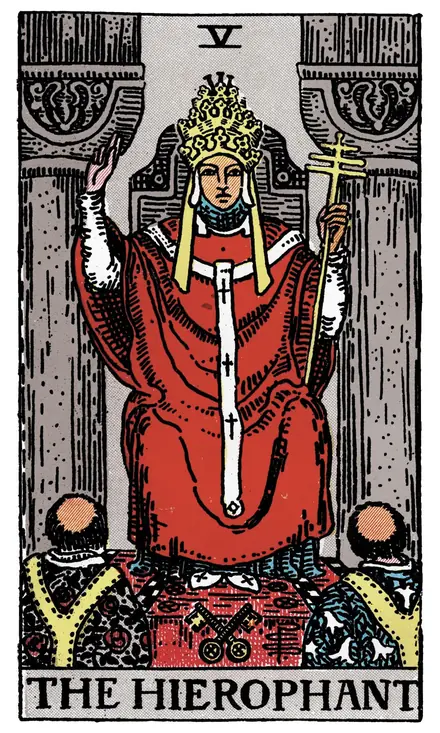
The Hierophant is tradition taught and handed down: the teacher, the institution and the shared rule that give a community its shape.
Draw this card · Its correspondences
- Arcana: Major, number V
- Hebrew letter: Vav (ו), “nail”
- Path on the Tree of Life: 16
- Attribution: Taurus
- In one sentence: The teaching handed down
- Keywords: Tradition, conformity, morality, ethics, education
- Yes or no?: Yes, with conditions
- Archetype: The keeper of tradition
What the card shows
In the deck Pamela Colman Smith drew for Arthur Edward Waite in 1909, the Hierophant is a pontiff seated on a stone throne between two grey pillars. He wears a three-tiered crown, the papal tiara, and a red mantle over blue and white robes. His right hand is raised in blessing, two fingers up and two folded. In his left he holds a staff topped with a triple cross. Two crossed keys lie at his feet, and in front of him, with their backs to the viewer, kneel two tonsured ministers: one robe is embroidered with red roses, the other with white lilies.
Each detail has its reading in the tradition. The triple crown and the triple cross are linked with a power that reaches across several planes at once, from body to spirit. The hand of blessing is the gesture of transmission: teaching passes from above to below, from master to disciple. The two keys, one gold and one silver, open and close, bind and loose; they are the authority to grant access. The roses and lilies repeat the flowers of the Magician’s garden, desire and purity, now set in order inside an institution.
In The Pictorial Key to the Tarot (1910), Waite presents him as the head of outward religion and of recognised order, the channel of grace in the world of institutions, in contrast to the High Priestess, keeper of the secret doctrine. The Golden Dawn gave the card the Hebrew letter Vav, meaning “nail”, and the sign of Taurus. Some modern decks call him the High Priest, and in the Marseille deck the card is Le Pape, the Pope.
The Hierophant upright
Upright, the Hierophant reads as the power of tradition: what we learn from others, what a community passes on and the rules that hold it together. The tradition links him with teaching, mentors, institutions and the rites that mark life’s important moments. In a few words, the Hierophant’s meaning in tarot is the value of what we inherit and the sense of belonging to a group.
In a spread, he usually signals a time when it pays to follow the established path. That might mean formal study, training with someone who knows more, paperwork, a public commitment such as a wedding, or joining an organisation. He is also linked with the figure of the counsellor: someone with moral authority, a mentor, a family doctor, a teacher or a priest, depending on each person’s life.
The card values structure. Taurus, his sign, is fixed earth: patience, constancy and loyalty to what works. Next to cards of stability, such as the Emperor or the Four of Pentacles, the Hierophant reads as order and security. Next to rebellious cards, such as the Fool, the spread speaks of a clash between the rule and personal freedom.
As advice, the Hierophant invites you to learn from those who have already walked the road, to respect forms when they serve a purpose and to look for the right community. The wisdom this card brings is shared and handed on, and so it grows with time.
The Hierophant reversed
Many readers never use reversals; they read every card upright and let the surrounding cards add the nuance. Those who do read reversed cards usually see the Hierophant upside down in one of two ways.
The first is the rule turned into a cage. Rules are applied out of habit, without asking what they are for; the institution weighs more than the people it was meant to serve. The reversed card then speaks of dogmatism, peer pressure and authorities that have lost their reason for being.
The second is a break with what was inherited. The person stops believing in what they were taught and seeks a path of their own: they change course, leave a family tradition, reject a rite or found something new. Read this way, the reversed Hierophant is the card of heterodoxy and of the personal quest.
In both cases, the advice is to separate what is still valuable from what has become mere habit, and to choose freely what to keep.
In love
In love, the Hierophant reads as commitment and formality. In a relationship it can mark the move to something serious: meeting the family, moving in together, getting married or sharing a ceremony. He is linked with common values and with fidelity.
For singles, the Hierophant’s love meaning usually speaks of meeting someone through familiar circles, such as family, school, work or a community. The person who appears is drawn as someone with settled habits, firm values and a wish for something stable.
Reversed, in love
Reversed in love, the card speaks of relationships that leave the expected script, of family or social pressure, or of a commitment kept up purely out of habit. As advice, it invites you to decide what kind of relationship you truly want.
Career and money
For career and money, the Hierophant reads as structure and learning. He favours large organisations, administration, teaching, law, healthcare and any trade learned under a master. He also points to certifications, entrance exams, formal contracts and the help of a mentor. With money, the tradition links him with the prudence of Taurus: saving, conservative investments and expert advice.
Reversed, in career
Reversed, he points to clashes with hierarchy, absurd rules or the feeling that the official path leads nowhere. The advice is to find your own way of working without burning bridges too soon.
Health and mood
In health and mood, the Hierophant is linked with stable routines, tried-and-tested care and, above all, the figure of the expert: this is the card that asks you to listen to someone who knows. Taurus adds a love of good food and a steady pace. No card can diagnose anything: for any symptom or concern, the person to see is a health professional.
Yes or no? Yes, with conditions
The Hierophant reads as a “yes” if you follow the proper channels: ask for advice, meet the requirements, do things in the right order. The card favours what is done patiently and within the rules. If the question involves breaking a rule or going it alone, the answer leans towards “no”.
Ask the card: a yes or no tarot reading with one card or three.
The archetype: The keeper of tradition
As an archetype, the Hierophant is the teacher who passes things on and the guardian who keeps them: the priest, the abbot, the professor, the head of the clan, the village judge. He knows the rules, knows where they come from and has the authority to teach them. His dramatic trait is mediation. He stands between high and low, between doctrine and people, and everything that reaches the others passes through his hands. The letter Vav, the nail, says it well: he is the piece that joins.
In story structure, the Hierophant appears in two ways. As an ally he is the institutional mentor, who initiates the protagonist into a trade, an order or a community and hands over the keys to enter. As an antagonist he is the authority defending the rule against the hero: the inquisitor, the boarding-school headmaster, the father who demands that tradition be honoured. Many coming-of-age stories tell exactly the passage from one figure to the other, when the disciple discovers that the master has limits too.
The card brings the weight of the collective into fiction. The Hierophant stages the rules of a world: what may be said, who marries whom, what is forbidden. He works when those rules have real consequences and the reader understands them. The danger is the cardboard villain, the institution that is simply bad. A good Hierophant believes in what he defends, and his richest conflict is the one he has with himself when the rule and the person collide.
In literature
- The Scarlet Letter (Nathaniel Hawthorne, 1850). In Puritan Boston, the community’s law brands Hester Prynne with a scarlet A, and the young minister Arthur Dimmesdale preaches to the town while hiding that he is the father of her child. Hawthorne writes the Hierophant from both sides: the institution that judges and the shepherd eaten away by his own secret.
- Saint Manuel Bueno, Martyr (Miguel de Unamuno, 1931). Don Manuel is the perfect parish priest of Valverde de Lucerna, the shepherd who sustains his village’s faith. His secret is that he has lost that faith himself and keeps preaching so the others can keep their comfort. Unamuno writes the most anguished Hierophant: the one who serves his office against himself.
- The Brothers Karamazov (Fyodor Dostoevsky, 1880). In the chapter of the Grand Inquisitor, Ivan imagines an aged cardinal in Seville who imprisons Christ to protect the institution that speaks in his name. It is the Hierophant’s dark side: the authority that holds the keys and fears the very message it was meant to pass on.
For writers
The conflict
The Hierophant sets up a conflict between the rule and the person. The character belongs to a community with clear rules, and something in their life does not fit: a love, a doubt, a different calling. The tension grows if the community has given them a great deal, if the rule makes sense and if breaking it means losing their place. To prepare the card, let the reader first see what is valuable in that tradition.
The twist
As a plot twist, the Hierophant is the revelation about the teacher: the mentor turns out to be human, weak or complicit, and the disciple must decide what to do with what they learned. It also works the other way round, when the rebel discovers that the old rule was protecting something important. The clue lies in the card’s two keys: one opens and one locks, and the character has to choose which to use.
Prompts
- Test an inherited rule: obeying it must cost something, and breaking it must cost something else.
- Write the scene in which a master passes on to a disciple the most important rule of the trade, and let the reader sense that the master no longer keeps it.
- Narrate a collective rite, a wedding, a funeral or an initiation, through the eyes of the only person there who does not believe in it.
- Have your protagonist receive a set of keys, real or symbolic, and make the first door they choose to open the one they were forbidden.
Its correspondences
- Letter and path: Vav. Source: Golden Dawn (tradition).
- Sign: Taurus. Source: Golden Dawn (tradition).
- Letter, alternative attribution: Heh. Source: Éliphas Lévi (tradition).
- Rune: Uruz. Source: Angelorum table (modern system).
- Archangel: Haniel. Source: Angelorum table (modern system).
Combinations
The Hierophant and The High Priestess
The Hierophant with the High Priestess joins outer and inner knowledge. Together they read as a complete education: what is learned from books and community, and what can only be understood in silence.
The Hierophant and The Emperor
With the Emperor, authority doubles: civil law and moral law. The pair speaks of strong structure, institutions, hierarchies and a time when it pays to respect the rules.
The Hierophant and The Lovers
The Lovers beside the Hierophant read as formal commitment: a union made public, a wedding or a romantic decision taken with the family’s values in view.
The Hierophant and The Hermit
The Hierophant beside the Hermit sets inherited wisdom against wisdom of one’s own. It reads as a teacher at work, or as someone testing what they were taught against what they have learned alone.
The Hierophant and The Devil
The Devil echoes the Hierophant’s composition, with two figures at its feet, only now they are chained. Together they read as a tradition turned into bondage and a dependence disguised as duty.
The Hierophant and Three of Pentacles
With the Three of Pentacles, teaching becomes craft: an apprenticeship under a master, good work done within an institution and recognition from people who know.
The Hierophant and The Fool
The Fool and the Hierophant set freedom against the rule. Together they read as the urge to leave the marked path, or as the need to learn the rules before breaking them.
Frequently asked questions
What does The Hierophant mean in tarot?
The Hierophant, card V of the Major Arcana, stands for tradition, teaching and the institutions that pass on shared knowledge. The tradition reads him as the teacher and moral guide, and as the value of belonging to a community with clear rules.
What does The Hierophant mean in love?
In love he reads as commitment and formality: a serious relationship, meeting the family, a wedding or shared values. For singles, he points to meeting someone through family, work or a familiar community.
Is The Hierophant a yes or no card?
The Hierophant reads as a conditional “yes”: the answer is favourable if you follow the proper channels, seek advice and meet the requirements. If the question involves breaking the rules, it leans towards “no”.
What does The Hierophant reversed mean?
Readers who use reversals usually see him as the rule turned into a cage, with dogmatism and group pressure, or as a break with what was inherited and the search for a path of one’s own. The advice is to separate what is valuable from mere habit.
Are The Hierophant, the High Priest and the Pope the same card?
Yes. They are card V under different names: the Marseille deck calls it Le Pape, the Pope; the Rider–Waite–Smith deck calls it the Hierophant; and some modern decks title it the High Priest. The core meaning is the same: authority that teaches and hands on.
What zodiac sign and Hebrew letter correspond to The Hierophant?
In the Golden Dawn system, the Hierophant corresponds to Taurus and to the Hebrew letter Vav, meaning “nail”, on the sixteenth path of the Tree of Life. Éliphas Lévi, using a different order, assigned it the letter Heh.
Do your readingPrevious: The Emperor · Next: The Lovers
The 22 Major Arcana
- The Fool
- The Magician
- The High Priestess
- The Empress
- The Emperor
- The Hierophant
- The Lovers
- The Chariot
- Strength
- The Hermit
- Wheel of Fortune
- Justice
- The Hanged Man
- Death
- Temperance
- The Devil
- The Tower
- The Star
- The Moon
- The Sun
- Judgement
- The World
By Style Optimizer · published November 22, 2026.