Tarot / The 78 cards / Cups / Four of Cups
Four of Cups (4 of Cups): tarot card meaning, upright and reversed
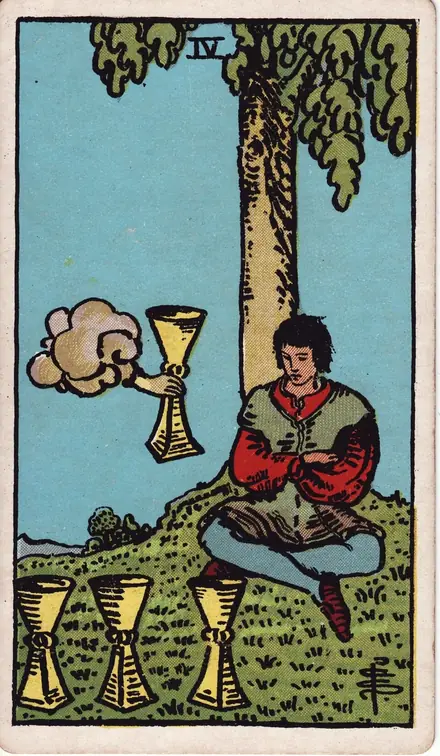
The Four of Cups is the weariness of someone who has enough: a pause to look inward while, close by, a hand offers something new.
Draw this card · Its correspondences
- Arcana: Minor, number 4
- Suit and element: Cups, Water
- Golden Dawn title: Lord of Blended Pleasure
- Sephirah: Chesed
- Decan: Cancer III, Moon (20° to 30° Cancer)
- Keywords: Meditation, contemplation, apathy, reevaluation
- Yes or no?: Not for now
- Archetype: The One Who Won’t Look at the Cup
What the card shows
In the deck Pamela Colman Smith drew for Arthur Edward Waite in 1909, a young man sits on the grass at the foot of a tree, legs crossed and arms folded over his chest. His back rests against the trunk and his head is slightly bowed. In front of him, in a row on the ground, stand three cups. To one side, a hand emerges from a cloud, just as on the Ace of the suit, and offers him a fourth cup. He does not look at it, or looks at it without interest. Behind him rise a hill and a clear sky.
Each detail has its reading in the tradition. The three cups in a row are what he already has: affections, experiences, familiar pleasures that no longer move him. The folded arms are the gesture of someone closing off, out of fatigue or mistrust. The tree gives shade and support; it is linked with retreat and meditation, and some readers recall the Buddha seated beneath his fig tree. The hand from the cloud is a gift, a new opportunity or a spiritual invitation, and the card leaves open whether the young man will ever notice it.
In The Pictorial Key to the Tarot (1910), Waite describes a young man contemplating three cups while an arm offers him another, and notes that his expression is one of discontent with his surroundings. He speaks of weariness, imaginary vexations, and a gift offered like a fairy favour in which the wanderer finds no consolation. The Golden Dawn called it the Lord of Blended Pleasure, placed it in the sefirah Chesed and gave it the third decan of Cancer, ruled by the Moon.
Four of Cups upright
Upright, the Four of Cups reads as an emotional pause. It is the card of boredom, apathy and dissatisfaction with things that once brought joy. The person has enough, even plenty, and still feels something is missing. In tarot it marks the moment when a familiar pleasure runs dry and a new desire has yet to appear.
The tradition gives it two faces. The first is self-absorption: someone so focused on what they dislike that they let an offer slip past. The hand from the cloud is right there, and the gaze drifts elsewhere. The second face is kinder: a necessary retreat. After a great deal of activity or emotion, the card speaks of stopping to think about what you truly want. Read this way, it is a card of meditation and reassessment.
The Golden Dawn title, Lord of Blended Pleasure, captures that double reading. The pleasure is there, mixed with tiredness, doubt or nostalgia. The decan of the Moon in Cancer underlines shifting moods and a rich inner life.
In a spread, beside bright cards, it reads as an opportunity worth a careful look before you turn it down. Beside harder cards, the emphasis falls on disconnection and the need to recover your spirits. As advice, the card asks two things at once: honour the pause, and lift your eyes from time to time.
Four of Cups reversed
Many tarot readers work with upright cards only and let the surrounding cards shade the meaning. Those who do read reversals tend to see the Four of Cups reversed as the end of self-absorption.
Waite gives the reversed card a sense of novelty: presentiment, new instruction, new relationships. The young man stands, unfolds his arms and at last sees the cup being offered. It reads as returning motivation, an opportunity accepted, or the way out of a period of apathy.
Some schools offer a second reading: apathy taken further, isolation becoming a habit, every offer of help refused. In that case the reversed card asks you to pay attention to your own sadness and to seek company.
Modern practice usually favours the first reading: the moment the pause ends and you find yourself wanting something again.
In love
In love, the Four of Cups reads as routine and indifference. For a couple, it can point to a stretch of boredom, flagging enthusiasm or emotional distance, with one partner withdrawn into themselves. The card invites you to notice what the other person is offering that you may be overlooking.
For someone single, it speaks of little interest in meeting anyone, or of turning down invitations out of habit. It can also point to an interesting person close by who is getting no attention.
Reversed, in love
Reversed, in love, the Four of Cups speaks of rediscovered enthusiasm: wanting to go out again, to open up to someone new or to rekindle the relationship. It reads as finally accepting the cup that was being offered.
Career and money
For career and money, the Four of Cups reads as low motivation: a stable job that no longer excites you, repetitive tasks, a sense of standing still. It also points to an offer or an idea that is being overlooked. Review recent proposals with fresh eyes.
Reversed, in career
Reversed, it shows interest returning: a new opportunity accepted, a change of role, a project that rekindles your drive. It is a good moment to say yes to what you once refused.
Health and mood
For health and mood, the Four of Cups is linked with emotional fatigue, low spirits and the need for rest. It reads as an invitation to look after your mood and to stay connected with others. A tarot card cannot diagnose anything: if apathy or sadness lingers, the person to see is a qualified health professional.
Yes or no? Not for now
The Four of Cups reads as a “not for now”. The person is not in a position to make the most of what is on offer, or the situation does not yet spark enough interest. The answer can change as soon as you look up: the fourth cup is still there. Ask the question again once the weariness has passed.
Ask the card: a yes or no tarot reading with one card or three.
The archetype: The One Who Won’t Look at the Cup
As an archetype, the Four of Cups is the jaded character. They have everything, or nearly everything, and nothing is enough. When the card takes human form, it is the rich young man bored on his estate, the weary hero who refuses to return to the quest, the person who has stopped hoping and turns down every offer out of habit. Their gesture is the folded arms.
In the structure of a story, the card occupies a very precise place: the refusal of the call. Before setting out, many protagonists say no. The messenger arrives, the opportunity appears, and the hero stays under the tree. That refusal is valuable because it shows who the character is before the change, and how much it will cost them to move. It also appears at the end of an arc, when the character has won what they wanted and discovers it leaves them empty.
The hand from the cloud is the narrative key to the card. The reader sees it; the character does not. That gap in knowledge creates a very fertile tension: the reader knows the way out is there and waits, impatiently, for the protagonist to turn their head.
The risk of this archetype is contagious apathy. A character who wants nothing can bore the reader. It works when the weariness has a cause the reader can sense, a wound or a loss, and when the cup on offer is tempting enough that refusing it hurts.
In literature
- Oblomov (Ivan Goncharov, 1859). Ilya Oblomov spends much of the novel lying on his sofa, unable to get up. He is offered love, business and friendship, and every proposal stalls halfway. Goncharov drew that apathy so precisely that Russian coined a word for it: oblomovism.
- Bartleby, the Scrivener (Herman Melville, 1853). A Wall Street copyist answers every request with the same phrase: he would prefer not to. His employer offers him work, help and even a home, and Bartleby refuses every cup. The story takes the Four of Cups to its most unsettling extreme.
- The Stranger (Albert Camus, 1942). Meursault meets every offer with the same flat calm. His employer proposes a post in Paris and he shrugs; Marie asks if he will marry her and he says it makes no difference. Camus builds a whole novel around a man sitting under the tree, deaf to the hand from the cloud.
For writers
The conflict
The Four of Cups sets up an inner conflict: the character has closed off while the world keeps offering them things. The tension lies between the comfort of retreat and the opportunity knocking at the door. It works well with characters who have suffered a disappointment and decided never to want anything again. For the card to carry weight, show in detail the three cups your character already owns and why they no longer suffice.
The twist
As a plot twist, the Four of Cups is the missed opportunity, or the one that arrives at the last moment. You can tell the story of the refused cup and what it costs afterwards, or of the instant the character finally unfolds their arms. One effective device is to have another character accept the cup the protagonist turned down.
Prompts
- Write a scene in which your protagonist declines an invitation while the narrator describes, in detail, everything they are missing.
- Tell the afternoon on which a jaded character realises that the offer they have ignored for weeks has been withdrawn.
- Describe a character sitting under a tree from the point of view of the one holding out the fourth cup and waiting.
Its correspondences
- Element: Water. Source: Golden Dawn (tradition).
- Sephirah: Chesed. Source: Golden Dawn (tradition).
- Decan: Cancer III. Source: Golden Dawn (tradition).
Combinations
Four of Cups and The Hanged Man
Beside The Hanged Man, the Four of Cups points to an apathy that calls for a new perspective. It reads as a long pause and an offer ignored while you look inward, with an invitation to turn your head.
Four of Cups and Ace of Cups
With the Ace of Cups, the hand from the cloud becomes easier to see. It reads as a clear emotional opportunity, a new affection or a fresh inspiration worth accepting.
Four of Cups and The Hermit
With The Hermit, the retreat becomes a choice. The pairing speaks of deep introspection and an inner search that needs silence and time.
Four of Cups and Four of Swords
With the Four of Swords, the pause is one of rest and recovery. It reads as the need to stop completely before deciding anything again.
Four of Cups and Eight of Cups
With the Eight of Cups, weariness leads to walking away. It reads as the decision to leave behind something that no longer fulfils you and go in search of a different meaning.
Four of Cups and Seven of Cups
With the Seven of Cups, apathy blends with fantasy. It reads as wavering among many imagined options without choosing any of them.
Four of Cups and The Fool
With The Fool, the cup on offer is an adventure. The pairing invites you to break the routine and say yes to the unknown.
Frequently asked questions
What does the Four of Cups mean in tarot?
The Four of Cups stands for weariness and an emotional pause: someone who has enough yet feels unsatisfied, and who fails to see the opportunity being offered. The tradition also reads it as meditation, retreat and a reassessment of what you really want.
What does the Four of Cups mean in love?
In love it reads as routine, indifference or emotional distance in a couple, and as little interest in meeting anyone for someone single. The card invites you to notice what the other person offers that you may be overlooking.
Is the Four of Cups a yes or no?
It reads as a “not for now”. The person is not yet in a position to make the most of what is offered. The answer can change once the weariness passes and you look up at the new cup.
What does the Four of Cups reversed mean?
Readers who use reversals usually see it as the end of apathy: motivation returns, an opportunity is accepted or new relationships begin, which is the sense Waite gave it. Some schools read it as isolation that drags on.
What does the hand from the cloud mean in the Four of Cups?
It is the same hand as on the Ace of Cups, and tradition reads it as a gift or opportunity arriving from outside. The young man does not look at it: the card shows the distance between what is offered and what you are ready to see.
What is the Four of Cups decan and Golden Dawn title?
In the Golden Dawn system, the Four of Cups is called the Lord of Blended Pleasure and corresponds to the third decan of Cancer, ruled by the Moon, from 20° to 30° of the sign. On the Tree of Life it sits in Chesed, mercy.
Do your readingPrevious: Three of Cups · Next: Five of Cups
The 14 cards of Cups
- Ace of Cups
- Two of Cups
- Three of Cups
- Four of Cups
- Five of Cups
- Six of Cups
- Seven of Cups
- Eight of Cups
- Nine of Cups
- Ten of Cups
- Page of Cups
- Knight of Cups
- Queen of Cups
- King of Cups
By Style Optimizer · published November 22, 2026.