Tarot / The 78 cards / Wands / Eight of Wands
Eight of Wands (8 of Wands): tarot card meaning, upright and reversed
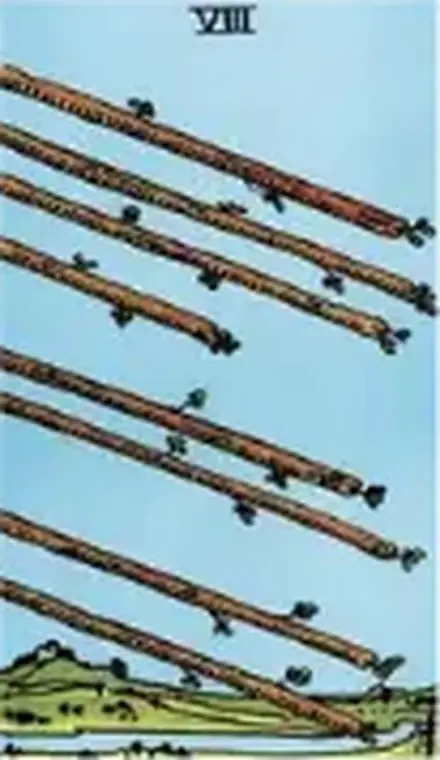
The Eight of Wands is pure speed: news, journeys and affairs rushing toward their end after a long wait, all arriving at once.
Draw this card · Its correspondences
- Arcana: Minor, number 8
- Suit and element: Wands, Fire
- Golden Dawn title: Lord of Swiftness
- Sephirah: Hod
- Decan: Sagittarius I, Mercury (0° to 10° Sagittarius)
- Keywords: Movement, speed, action, rapid change
- Yes or no?: Yes
- Archetype: The Messenger
What the card shows
In the deck Pamela Colman Smith drew for Arthur Edward Waite in 1909, the Eight of Wands is one of the few Minor Arcana cards with no human figure at all. Eight long staves, all parallel, cross the sky on a diagonal from upper left to lower right. Each one carries small green shoots, like every wand in the deck. Beneath them opens a wide stretch of country, with a river winding between low hills and, on a rise, a house or small castle. The sky is clean and cloudless.
The composition tells the card on its own. The staves fly together and at the same angle: an ordered movement with a direction, which is why tradition reads it as speed with purpose, far from chaos. It matters a great deal that they are already tilting toward the ground. They are about to land. Waite insists on this in The Pictorial Key to the Tarot (1910), describing motion that is reaching the end of its course; what the card announces is near, perhaps already on the threshold. The shoots recall that the fire of Wands is living, growing force. The river is the road running below, and the house on the hill is the place where the news arrives.
In Book T, the Golden Dawn named this card the Lord of Swiftness and placed it in Hod, the sefirah of intellect and the word. Its decan is the first of Sagittarius, ruled by Mercury, messenger of the gods. The archer’s arrow and Mercury’s wings explain why the Eight of Wands is, above all, the card of messages.
Eight of Wands upright
Upright, the Eight of Wands reads as the moment everything starts moving at once. After a stretch of waiting or preparation, matters speed up: answers arrive, papers get signed, a trip is confirmed, someone finally replies. Tradition links it with the speed of an urgent messenger and with the hope that rides along with that haste. Waite speaks of activity in undertakings, of swiftness and of a rush toward a happy end.
In a spread it often points to news. It might be a letter, a call, an email or a decisive conversation, and it almost always comes sooner than expected. It is also linked with travel, especially short trips or ones decided overnight, and with movement in general: house moves, a change of city, work journeys.
The Eight of Wands meaning carries one nuance worth underlining. The staves are already coming down. What was launched some time ago is about to land. That is why the card also speaks of outcomes, of projects reaching their goal and processes that wrap up quickly.
As advice, it asks you to ride the momentum. This is a good time to act without overthinking, reply quickly and go with the current. The risk, when it appears beside impulsive cards, is confusing speed with haste. Know where the staves are flying before you chase after them.
Eight of Wands reversed
Not every school reads reversals. Many readers use only upright cards and let the neighbouring cards add nuance. Those who do read the Eight of Wands reversed tend to take it in one of three ways.
The first is delay. What should have arrived gets stuck, messages are lost or misread, the trip is postponed. The energy is still there, and it has hit an obstacle.
The second comes from Waite, who gives the reversed card the arrows of jealousy, internal dispute, stings of conscience and domestic quarrels. The same staves that upright are messages and arrows of love become, reversed, reproaches flung from one end of the house to the other.
The third is haste badly handled: decisions made in the heat of the moment, messages sent without thinking, speed slipping out of your hands. In every case the advice is to slow down just enough to find your direction again.
In love
In love, the Eight of Wands reads as feelings moving fast. Waite goes so far as to call its staves “arrows of love,” and tradition keeps that reading. For couples it can point to a period of lively communication, a trip together, or a step taken sooner than planned, such as moving in. The relationship gains pace and excitement.
If you are single, the card speaks of love at first sight, messages flying back and forth, or someone who appears out of nowhere. It can also point to long-distance love, since the staves cross the sky to join two faraway places. The Eight of Wands as feelings is eager, impatient and in a hurry to say so.
Reversed, in love
Reversed in love, the Eight of Wands speaks of jealousy, unanswered messages or misunderstandings that keep growing. It can describe a relationship that went too fast and is now braking. As advice, it asks for slow, unhurried talk without reproach.
Career and money
For career and money, the Eight of Wands reads as a busy stretch: projects moving at a good clip, answers coming in, one interview after another, payments finally clearing. It is a favourable card for launching something, closing deals and getting moving. It can also point to work travel or a promotion that arrives all at once.
Reversed, in career
Reversed, it points to late payments, lost emails, deadlines that stretch, or the opposite, a workload so fast it causes mistakes. Check everything before you hit send.
Health and mood
For health and mood, the Eight of Wands is linked with high energy and a fast pace of life that sometimes leaves little room for rest. Tradition reads it as an invitation to channel that force into movement and exercise, without going faster than the body allows. No card can diagnose anything. For any symptom or worry, speak to a health professional.
Yes or no? Yes
The Eight of Wands reads as a clear yes, and a quick one. The card speaks of things that get moving and reach their destination, so tradition takes it as a favourable answer, especially for questions about news, travel and deadlines. Its only nuance is timing: it usually signals that the answer will come sooner than you expect.
Ask the card: a yes or no tarot reading with one card or three.
The archetype: The Messenger
As an archetype, the Eight of Wands is the messenger, even though the card shows nobody at all. It is the figure who carries news from one place to another: the rider with the post, the telegram, the letter crossing the ocean, the servant running down palace corridors. It is also the news itself, the force that enters a scene and makes everyone move. Its element is fire and its ruler is Mercury: pure communication in a hurry.
In story structure, the Eight of Wands sits where the story accelerates. It is the stretch where events chain together without a breather, when chapters get shorter and each scene shoves the next one forward. It often appears in the third act, when everything that was sown starts falling at once, like the staves dropping toward the ground. It can also be the trigger: the letter that arrives on the first page and sets the protagonist running.
The archetype’s dramatic appeal lies in timing. A message that arrives late, one that comes early, one that goes astray: tragedy and comedy both live in those margins. Speed creates tension because it leaves characters no room to think. Used well, the Eight of Wands gives the reader the feeling that the story has caught its momentum and nothing can stop it now. Used badly, it becomes a shortcut, news that solves everything without anyone having done anything. It works best when each falling staff is the consequence of something thrown earlier.
In literature
- Michael Strogoff (Jules Verne, 1876). The Tsar’s courier must cross Siberia to deliver a message before Irkutsk falls. The whole novel is an Eight of Wands: a race against the clock, a messenger who cannot stop and news on which a city depends. Verne turns distance itself into the real enemy.
- Chronicle of a Death Foretold (Gabriel García Márquez, 1981). Word that the Vicario brothers are going to kill Santiago Nasar spreads through the town faster than anyone is able to act. Everyone knows except him. It is the card’s dark side: messages flying in every direction that somehow never reach the one person who needs them.
- Romeo and Juliet (William Shakespeare, 1597). The young lovers move at dizzying speed: they meet, marry and die within a few days. Waite’s arrows of love are in every scene. And the tragedy hinges on a message that fails to arrive in time, Friar Laurence’s letter that never reaches Romeo.
For writers
The conflict
The Eight of Wands sets up a conflict with time. Something has to reach its destination before it is too late: news, a person, a piece of evidence, a pardon. The clock is the antagonist. For the card to work, the reader needs to know what happens if the message fails to arrive, and to feel each obstacle eating up minutes. Distance, weather, a closed road or a dead phone battery are enough to build tension.
The twist
As a plot twist, the Eight of Wands is the news that arrives all at once and speeds everything up. It might be good news that comes too soon, before anyone is ready, or news that comes too late and changes everything in hindsight. Another variation is the misdirected message: the letter sent to the wrong person, the mix-up of names. The eight parallel staves also suggest an ensemble plot in which several threads converge at the same moment.
Prompts
- Write a scene in which three different pieces of news reach your protagonist within an hour, and let the third change the meaning of the first two.
- Tell the journey of a letter from the moment someone writes it to the moment another person opens it, through every pair of hands that touches it.
- Narrate someone falling in love in a single day, with sentences growing shorter as the afternoon goes on.
Its correspondences
- Element: Fire. Source: Golden Dawn (tradition).
- Sephirah: Hod. Source: Golden Dawn (tradition).
- Decan: Sagittarius I. Source: Golden Dawn (tradition).
Combinations
Eight of Wands and Knight of Wands
With the Knight of Wands, the speed doubles. The pair reads as trips decided overnight, urgent messages and projects moving at full tilt, with the risk of not watching where you step.
Eight of Wands and The Hanged Man
The Hanged Man is stillness and the Eight of Wands is speed. Together they read as a change of pace: a long pause that suddenly ends, or a fast impulse worth halting for a moment to see things from another angle.
Eight of Wands and The Chariot
With The Chariot, the movement has a clear destination. The pair reads as an important journey, a victory that comes quickly or a determined advance toward a specific goal, with willpower at the reins.
Eight of Wands and The Magician
With The Magician, word and action come together. The pair reads as an idea communicated brilliantly and put into motion at once: a good moment to pitch a project, negotiate or write.
Eight of Wands and Two of Cups
With the Two of Cups, Waite’s arrows of love hit their mark. The pair reads as love at first sight, a relationship moving quickly or a declaration that comes as a surprise.
Eight of Wands and Four of Swords
The Four of Swords asks for rest and the Eight of Wands for action. Together they read as the end of a pause: after recovering your strength, matters spring back to life all at once.
Eight of Wands and Ten of Wands
With the Ten of Wands, speed turns into overload. The pair reads as too many tasks arriving at once and a pace that ends up weighing on your shoulders.
Frequently asked questions
What does the Eight of Wands mean in tarot?
The Eight of Wands stands for speed, movement and news. Tradition reads it as the moment matters accelerate and reach their destination: messages, journeys, answers and projects that resolve sooner than expected.
What does the Eight of Wands mean in love?
In love it reads as feelings moving fast: love at first sight, messages flying back and forth, a big step taken early or a long-distance romance. Waite called its staves “arrows of love.” Reversed, tradition links it with jealousy and misunderstandings.
Is the Eight of Wands a yes or no card?
It reads as a clear, quick yes. The card speaks of things that get moving and reach their goal, so tradition takes it as a favourable answer, especially when the question concerns news, travel or deadlines.
What does the Eight of Wands reversed mean?
Readers who use reversals link it with delays, lost messages and postponed trips. Waite added jealousy, internal dispute and domestic quarrels. It can also point to haste badly handled: decisions made in the heat of the moment.
What is the Eight of Wands’ decan and Golden Dawn title?
In the Golden Dawn’s Book T, the Eight of Wands is called the Lord of Swiftness. It corresponds to the first decan of Sagittarius, 0° to 10°, ruled by Mercury, and to the sefirah Hod. Mercury, the messenger, explains its tie to news.
Why are there no people on the Eight of Wands?
It is one of the few Rider–Waite–Smith minor cards without figures. Pamela Colman Smith drew only the eight staves in flight so that the card would speak of movement itself: what matters is what travels and where it lands.
Do your readingPrevious: Seven of Wands · Next: Nine of Wands
The 14 cards of Wands
- Ace of Wands
- Two of Wands
- Three of Wands
- Four of Wands
- Five of Wands
- Six of Wands
- Seven of Wands
- Eight of Wands
- Nine of Wands
- Ten of Wands
- Page of Wands
- Knight of Wands
- Queen of Wands
- King of Wands
By Style Optimizer · published November 22, 2026.