Tarot / The 78 cards / Swords / Four of Swords
Four of Swords (4 of Swords): tarot card meaning, upright and reversed
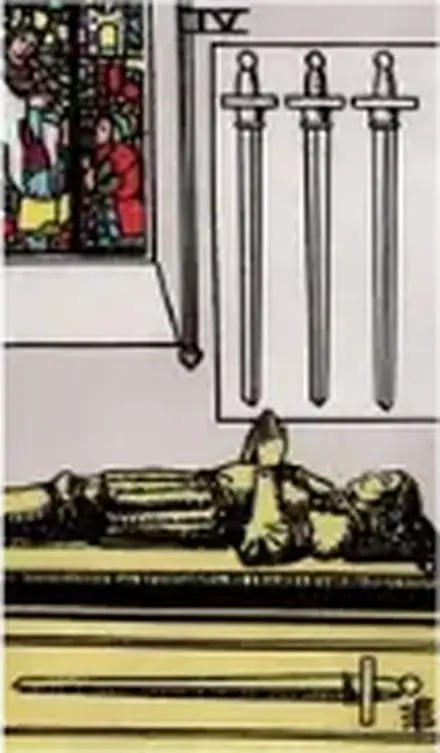
The Four of Swords is the truce after the battle: a retreat to rest, think in silence and gather strength before going back out.
Draw this card · Its correspondences
- Arcana: Minor, number 4
- Suit and element: Swords, Air
- Golden Dawn title: Lord of Rest from Strife
- Sephirah: Chesed
- Decan: Libra III, Jupiter (20° to 30° Libra)
- Keywords: Rest, recovery, contemplation, passivity
- Yes or no?: Not for now
- Archetype: The Knight Keeping Vigil
What the card shows
In the deck Pamela Colman Smith drew for Arthur Edward Waite in 1909, the Four of Swords shows the inside of a church or chapel. On a stone tomb lies the effigy of a knight in armour, stretched out full length, eyes closed, hands pressed together on his chest in prayer. On the wall above him three swords hang point down. The fourth lies horizontally along the side of the tomb, as if carved into the stone. At the top left, a stained-glass window shows one figure blessing another who kneels before it.
Each element has its reading. The effigy is the body at rest, the person who has withdrawn from combat. The three hanging swords are the struggles and thoughts that are still there, motionless, harmless as long as nobody takes them down. The fourth, lying flat, is the knight’s own weapon, set aside. The window brings in the spiritual note: rest comes with consolation, prayer or meditation. The dim church marks a place apart, sheltered from noise.
In The Pictorial Key to the Tarot (1910), Waite describes the effigy of a knight in the attitude of prayer, at full length upon his tomb, and gives as meanings vigilance, retreat, solitude and hermit’s repose. He adds that the tomb and coffin suggested the design. The Golden Dawn titled the card Lord of Rest from Strife, placed it in Chesed, the sephirah of mercy, and gave it the third decan of Libra, ruled by Jupiter, from 20° to 30° of the sign: the scales settling back into balance after the fight.
Four of Swords upright
Upright, the Four of Swords reads as a necessary pause. After a conflict, an illness, a loss or a long stretch of hard effort, the time comes to withdraw, close your eyes and lay your weapons down. The card speaks of rest for the body and above all for the mind. Swords are the suit of thought, and what most needs to rest here is your head.
The tradition gives it several shades. It is the chosen retreat, solitude sought to put your ideas in order, meditation or prayer. It is also convalescence, the time taken to recover before returning to ordinary life. The Golden Dawn title, Lord of Rest from Strife, makes the point plainly. The battle is still there, swords hanging on the wall, and for now there is a truce.
In a spread, the Four of Swords usually advises against forcing anything. It can mean the answer will come in its own time, that it is wise to wait before deciding, or that you need time alone. Beside active cards such as The Chariot or the Knight of Wands, the pause reads as brief, a preparation for the next move. Beside cards of exhaustion such as the Ten of Wands, the emphasis falls on a weariness that is already demanding a stop.
As advice, the card asks you to take rest seriously. Sleep, step away from the noise, hang your worries on the wall for a while. Clarity tends to arrive once the mind stops fighting.
Four of Swords reversed
Many readers never read reversals and let the surrounding cards supply the nuance instead. Those who do usually read the Four of Swords reversed in one of two ways.
The first is the end of the retreat. You get up, recover your energy and return to activity, sometimes before you are fully ready. It can be a healthy return or a hasty one, depending on the cards around it.
The second is rest that never comes. The mind keeps spinning, the body asks to stop and goes unheard, or the retreat has turned into isolation and a passivity that no longer heals. For the reversed card Waite offers a more practical reading: wise administration, circumspection, economy, precaution and testament. Read this way, the Four of Swords reversed speaks of putting your affairs in order, saving strength and resources, and planning with care.
Either way, the advice is to find the balance between resting and returning.
In love
In love, the Four of Swords reads as a time-out. With a partner it can point to a truce after an argument, a quiet phase where each of you needs space, or a temporary distance to think things over. The usual reading is the silence that lets both people recover.
If you are single, the Four of Swords in love describes a chosen retreat: healing a wound before opening up to someone, enjoying your own company or pausing the search for a while. The meaning is clear. The heart is convalescing, and that is good for it.
Reversed, in love
Reversed in love, the card points to coming back after a break, or to a distance that has lasted too long and begun to cool things. The advice is to talk about how much time each of you needs, and to keep rest and abandonment clearly apart.
Career and money
For career and money, the Four of Swords reads as a pause: a holiday, sick leave, a quiet period or a project on hold. It also advises stopping before burnout and reviewing your strategy calmly. Financially, it is a good time to consolidate and avoid risk. The tradition recommends planning, resting and coming back with a clearer head.
Reversed, in career
Reversed, it points to a return to work after a break, or to exhaustion from failing to stop in time. Following Waite, it also counsels prudence with money and putting paperwork and forecasts in order.
Health and mood
For health and mood, the Four of Swords is linked with rest, convalescence and the need to rebuild strength after long effort. It reads as an invitation to sleep more, slow down and look after your mind. No card can diagnose anything: for any symptom or worry, the right person to see is a health professional.
Yes or no? Not for now
The Four of Swords reads as “not yet”. The card shows someone who has laid down their weapons to rest: the moment calls for waiting, and what you are asking about needs time to ripen. Forcing an answer now usually turns out worse than holding on. Once the pause is over, the situation will look clearer and you can ask again.
Ask the card: a yes or no tarot reading with one card or three.
The archetype: The Knight Keeping Vigil
As an archetype, the Four of Swords is the warrior who has left the fight for a while. It can be the soldier back from the front who shuts himself away at home, the convalescent in her sickroom, the monk in his cell, the writer who retreats to the country to finish a book, or the squire keeping vigil over his arms the night before he is knighted. Its strength is stillness. Its risk is that the stillness becomes a tomb.
In the structure of a story, the card holds the pause between two stretches of action. It is the recovery scene after defeat, the chapter where the protagonist hides, heals and thinks, or the sleepless night before the decisive battle. Its dramatic value is contrast. After the noise, silence lets us hear what the character could never hear in the middle of combat.
As a person, the Four of Swords is reserved and reflective, someone who needs solitude to think and who protects themselves by withdrawing. They may seem distant or absent, and are usually processing something inside. The natural arc is the return: the scene where they rise from the tomb, pick up the sword and walk back into the world with a clearer idea of what they want.
For the archetype to work in fiction, the pause has to change something. The character who comes out of the retreat must differ from the one who went in. If they come out the same, the rest chapter reads as padding. If they come out transformed, the reader understands the real battle was being fought in silence.
In literature
- Don Quixote (Miguel de Cervantes, 1605). In chapter three, Alonso Quixano keeps vigil over his armour all night in the yard of an inn, beside a well, before the innkeeper dubs him a knight. It is the card’s image played for comedy: watchful repose before the adventure, weapons in sight and the mind ablaze.
- The Magic Mountain (Thomas Mann, 1924). Hans Castorp travels up to an Alpine sanatorium for a three-week visit and stays seven years. Convalescence becomes a way of life cut off from the world, given over to endless thought and debate. Mann shows both faces of the Four: the retreat that teaches and the retreat that lulls to sleep.
- Rip Van Winkle (Washington Irving, 1819). Rip falls asleep in the Catskill Mountains and wakes twenty years later, long-bearded, in a changed country. The tale pushes the card’s rest to the extreme: a pause so long that life goes on without the sleeper, and coming back means starting over.
For writers
The conflict
The Four of Swords sets up a conflict between the need to stop and the pressure to return. It works best when the character withdraws with something unfinished: a battle half fought, a fresh wound, someone waiting outside. Build tension with the three swords on the wall: unopened letters, ignored calls, the shadow of what they will have to face once they get up.
The twist
As a plot twist, the Four of Swords lets the pause reveal something. In the silence the character grasps a truth the noise had hidden, or discovers the enemy has used their absence to advance. It also works in reverse: the one everybody had written off, lying still as an effigy, was only keeping watch, and rises at exactly the right moment to change the ending.
Prompts
- Write a character’s last night before a decisive test, alone and without action: only what they think while waiting for dawn.
- Tell the return of someone after a long retreat, and make the world they find more changed than they expected.
- Narrate a convalescence from the patient’s bed, letting visitors, sounds and the objects in the room tell what is happening outside.
Its correspondences
- Element: Air. Source: Golden Dawn (tradition).
- Sephirah: Chesed. Source: Golden Dawn (tradition).
- Decan: Libra III. Source: Golden Dawn (tradition).
Combinations
Four of Swords and The Hanged Man
With The Hanged Man, the pause doubles. Together they advise stopping completely, rebuilding strength and looking at the situation from a different angle before deciding again. The waiting has a purpose.
Four of Swords and The Star
The Star beside the Four of Swords reads as rest that restores. After a long struggle, the pause returns strength, hope and clarity, and prepares you to set out again in a different spirit.
Four of Swords and The Hermit
With The Hermit, the retreat goes deeper. Together they read as solitude sought in order to think, sleep and understand, a pause that sends you back into life with a clearer head.
Four of Swords and Three of Swords
The Three of Swords before the Four reads as a wound that asks for rest. The pair advises withdrawing after a sorrow, letting the heart recover and making no big decision until your strength returns.
Four of Swords and Temperance
With Temperance, rest becomes slow healing. Together they read as a patient recovery, gentle in pace, balancing repose with a gradual return to activity.
Four of Swords and Ten of Wands
The Ten of Wands beside the Four of Swords says the load is already too heavy. Together they read as exhaustion that needs you to stop soon and put down part of the weight so you can truly rest.
Four of Swords and Four of Cups
With the Four of Cups, the pause risks sliding into apathy. Together they warn of a retreat that drags on without healing, and ask you to notice what is being offered from outside.
Frequently asked questions
What does the Four of Swords mean in tarot?
The Four of Swords stands for the truce after a struggle: rest, retreat, convalescence and quiet reflection. The tradition reads it as a necessary pause to recover strength, mental strength above all, before returning to action.
What does the Four of Swords mean in love?
In love it reads as a pause: a truce after an argument, some distance to think, or, if you are single, a retreat to heal before opening up to someone. The Four of Swords in love speaks of rest, and only rarely of an ending.
Is the Four of Swords a yes or no card?
It reads as “not yet”. The card asks for patience and rest, and suggests the situation needs time to ripen. Forcing an answer now usually goes worse than waiting for the pause to end.
What does the Four of Swords mean reversed?
Readers who use reversals see it as a return after a pause, sometimes a hasty one, or as rest that never arrives. Waite adds a practical reading: prudence, economy, precaution and putting your affairs in order, including your will.
What is the decan and Golden Dawn title of the Four of Swords?
In the Golden Dawn’s Book T, the Four of Swords is titled Lord of Rest from Strife. It corresponds to the third decan of Libra, 20° to 30°, ruled by Jupiter, and to the sephirah Chesed, the sphere of mercy. Its element is air.
Is the knight on the Four of Swords dead?
The figure is a funeral effigy, and Waite admits the tomb suggested the design. The tradition reads it as rest and vigil rather than as a death: the hands joined in prayer and the sword laid aside speak of truce and recollection.
Do your readingPrevious: Three of Swords · Next: Five of Swords
The 14 cards of Swords
- Ace of Swords
- Two of Swords
- Three of Swords
- Four of Swords
- Five of Swords
- Six of Swords
- Seven of Swords
- Eight of Swords
- Nine of Swords
- Ten of Swords
- Page of Swords
- Knight of Swords
- Queen of Swords
- King of Swords
By Style Optimizer · published November 22, 2026.