Tarot / The 78 cards / Pentacles / Four of Pentacles
Four of Pentacles (4 of Pentacles): tarot card meaning, upright and reversed
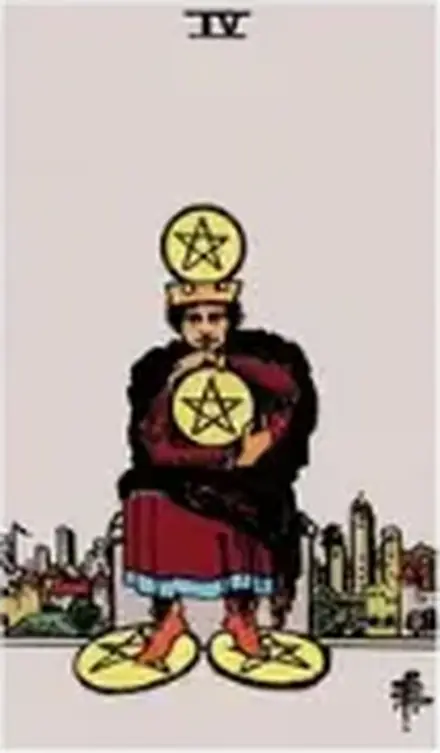
The Four of Pentacles is the hand that holds on: material security, savings and control, and the fear of loss that locks in the keeper.
Draw this card · Its correspondences
- Arcana: Minor, number 4
- Suit and element: Pentacles, Earth
- Golden Dawn title: Lord of Earthly Power
- Sephirah: Chesed
- Decan: Capricorn III, Sun (20° to 30° Capricorn)
- Keywords: Security, conservation, scarcity, control
- Yes or no?: Not for now
- Archetype: The Keeper of the Hoard
What the card shows
In the deck Pamela Colman Smith drew for Arthur Edward Waite in 1909, the Four of Pentacles shows a crowned man seated on a block of stone. He is dressed in red under a dark cloak. With both arms and hands he presses a pentacle against his chest. Another pentacle rests on top of his crown, balanced there, and the remaining two lie under his feet, held down firmly. Behind him, in the distance, rise the towers and roofs of a city.
Each detail has its reading. The pentacle he hugs is the center of the card: what he owns is gripped with his whole body, as if someone might snatch it away. The pentacle on his crown says that his head, too, is full of money, that his thoughts circle around what he possesses. The two pentacles under his feet are firm ground, a material base, and at the same time a posture that keeps him from standing up and walking. The stone block repeats the idea of something square and immovable. The city at his back is the world of exchange, which he has left behind in order to guard what is his.
In The Pictorial Key to the Tarot (1910), Waite sums up the scene in one idea: the man clings to what he has. He gives the meanings of the surety of possessions, cleaving to what one has, gift, legacy and inheritance. The Golden Dawn called it the Lord of Earthly Power and placed it in the third decan of Capricorn, ruled by the Sun, in the sefirah Chesed, the abundance that is ordered and preserved.
Four of Pentacles upright
Upright, the Four of Pentacles reads as material security achieved and well kept. There is a foundation: savings, a house, a steady position, assets worth protecting. It is the card of financial order, of the budget that holds, of the person who knows how to manage. Tradition also links it with inheritances, legacies and gifts, everything that arrives to be kept.
In a spread it often points to a time of consolidation. After a stretch of hard work, it makes sense to protect what you have gained and keep it out of risky bets. Read this way, the card has plenty of good sense. Its Golden Dawn title, Lord of Earthly Power, speaks of real mastery over material things, the kind of control that brings stability.
The card has a second, well-known edge. The man in the image grips so tightly that he cannot move. So the Four of Pentacles also reads as attachment, greed, fear of spending, fear of loss and difficulty sharing. It can refer to money, and equally to emotions, ideas or people: someone who holds back, controls and will not let go. Beside generous cards, such as the Six of Pentacles, the emphasis falls on the need to open your hand. Beside cards of hardship, such as the Five of Pentacles, it falls on the fear of scarcity that drives the man to shut himself in.
As advice, the Four of Pentacles asks you to look after what you have without letting it rule you. Security is there to live by, and the city is still back there, waiting.
Four of Pentacles reversed
Many readers work only with upright cards and let the neighboring cards shade the meaning. Those who read reversals usually take the Four of Pentacles reversed in two opposite ways.
The first is the hand that suddenly opens. What was hoarded gets spent, given away or lost: a large outlay, generosity that comes late, control that snaps. It can be a release, when someone finally stops living just to preserve, or carelessness, when the spending has no limit.
The second deepens the block. For the reversed card Waite gives suspense, delay and opposition: material matters that stall, paperwork that goes nowhere, someone who refuses to release what they hold.
Either way, the advice is to look for the middle ground between keeping and giving, and to ask what fear keeps the hand closed.
In love
In love, the Four of Pentacles reads as a stable relationship that offers security, and as the risk of turning that security into possession. For couples it can describe a solid bond with shared material plans, or jealousy, control and fear of losing the other. The card asks whether you are caring for your partner or holding on to them.
If you are single, it often points to too much self-protection: fear of opening up, of depending on someone, of being hurt again. The heart is guarded like the pentacle in the image, pressed against the chest, safe and also shut.
Reversed, in love
Reversed in love, it speaks of releasing control: easing jealousy, giving space, accepting that your partner has a life of their own. It can also point to a relationship that breaks under too much rigidity. The advice is to open your hand before the bond suffocates.
Career and money
For career and money, the Four of Pentacles reads as financial stability, saving and sound management. It favors consolidating, paying off debt or protecting assets. Its warning appears when caution stunts growth: not investing out of fear, refusing to delegate, clinging to a job that has nothing left to give. Tradition advises saving with judgment and spending when the spending builds something.
Reversed, in career
Reversed, it points to unexpected expenses, losses or control that spins out of control. It can also mean delays in payments, inheritances or paperwork. The advice is to go over the accounts calmly and separate necessary caution from fear.
Health and mood
For health and wellbeing, the Four of Pentacles is associated with the tension of holding on: stiffness, worry about money, trouble relaxing. It reads as an invitation to set down the load and protect your rest. No card can diagnose anything. For any symptom or concern, the person to see is a health professional.
Yes or no? Not for now
The Four of Pentacles reads as “not for now” when the question concerns a change, an investment or a move. The card favors keeping what you have and waiting for things to settle. If the question is whether something will stay stable, the answer leans toward “yes.” Waite links the card with delay, and it asks for patience.
Ask the card: a yes or no tarot reading with one card or three.
The archetype: The Keeper of the Hoard
As an archetype, the Four of Pentacles is the character who has turned what they own into who they are. The miser of comedy, the father who will not release the inheritance, the matriarch who counts the family silver, the dragon asleep on its gold. In its kinder form it is the saver, the prudent steward, the one who carries the family through the lean years thanks to what they had the sense to keep.
In story structure, the Four of Pentacles is often the immovable obstacle. It is the figure who holds what everyone else needs: the money for the wedding, the land, the permission, the secret. The protagonist has to persuade them, trick them or wait for them to die. Classic comedies use this figure to set the plot in motion, and tragedies use it to show how attachment destroys the one who practices it.
The archetype also offers a rich inner portrait. The keeper of the hoard is almost always afraid, and that fear usually has a history: past poverty, a loss, a betrayal. When the story uncovers it, the miser stops being a caricature and becomes human. This character’s great scene is the moment they must choose between the gold and a person.
The risk with this archetype is the flat caricature. It works when the reader understands why the character grips so hard, and nearly feels the same vertigo at the thought of letting go.
In literature
- The Miser (Molière, 1668). Harpagon buries a cash box in his garden and lives in constant watch over it while his children suffer his stinginess. When the box is stolen, his frantic monologue is the fall of the Four of Pentacles: a man who has mistaken his life for his treasure and no longer knows who he is without it.
- A Christmas Carol (Charles Dickens, 1843). Ebenezer Scrooge hoards every coin in a freezing counting-house and scorns anyone who asks for help. The ghosts show him where his isolation came from and where it leads. The story runs through the whole card, from the clenched fist of the upright to the opening hand of the reversed, on the morning Scrooge decides to share.
- Silas Marner (George Eliot, 1861). The weaver Silas lives alone in Raveloe, counting his gold each night as the only warmth in his life. When it is stolen, a golden-haired child wanders into his cottage instead. Eliot stages the card’s great choice between treasure and a person, and lets love take the place the hoard once filled.
For writers
The conflict
The Four of Pentacles sets up a conflict between what is kept and what is needed. It works best when the character who holds on has understandable reasons, and so does the one who asks. To raise the tension, make the hoard essential to someone else: the money for an operation, the family home, a letter that would prove something. The reader should be unsure who is right.
The twist
As a plot twist, the Four of Pentacles is the moment the treasure is lost or turns out to be worthless. The miser discovers the money has lost its value, the inheritance was a debt, or what they guarded so fiercely no longer means anything. Another option is the generous twist: the character who seemed stingy was saving for someone, and that someone finds out too late.
Prompts
- Write a scene in which a character counts their money alone and, while doing it, remembers the one time they went hungry.
- Make your protagonist ask a favor of the stingiest person they know, and let the whole conversation turn on what neither of them says.
- Tell the story of an object a family keeps for three generations without anyone daring to use it.
Its correspondences
- Element: Earth. Source: Golden Dawn (tradition).
- Sephirah: Chesed. Source: Golden Dawn (tradition).
- Decan: Capricorn III. Source: Golden Dawn (tradition).
Combinations
Four of Pentacles and The Emperor
With the Emperor, control centers on money and possessions. It reads as well-protected wealth or, on its hard side, as rigidity and a fear of giving up command.
Four of Pentacles and Justice
Next to Justice, the scales settle on material matters: inheritances, divisions, debts or contracts that need a fair review with the paperwork in order.
Four of Pentacles and The Hanged Man
With the Hanged Man, attachment is put on hold. It reads as a need to look at what you are holding from another angle and accept that letting go may be a gain.
Four of Pentacles and The Devil
The Devil beside the Four of Pentacles points to a material attachment that enslaves: greed, fear of loss or a financial security that ends up imprisoning its keeper.
Four of Pentacles and King of Pentacles
With the King of Pentacles, wealth has an owner who may also have fears. Together they read as solid assets and an invitation to loosen control over them a little.
Four of Pentacles and Knight of Pentacles
Next to the Knight of Pentacles, caution hardens into rigidity. Together they read as too much control over money or a fear of change that holds back growth.
Four of Pentacles and Five of Pentacles
With the Five of Pentacles, the root of the attachment appears: the fear of scarcity. It reads as someone who hoards because they remember or dread want.
Four of Pentacles and Six of Pentacles
The Six of Pentacles is the hand that gives. Together they read as the shift from holding back to sharing, or as a tension between saving and generosity that calls for balance.
Frequently asked questions
What does the Four of Pentacles mean in tarot?
The Four of Pentacles represents material security, saving and control over what you own. Tradition reads it as stability well kept and, on its other edge, as attachment, greed and fear of loss. Waite sums it up as a man clinging to what is his.
What does the Four of Pentacles mean in love?
In love it reads as a stable relationship that offers security, with the risk of turning it into possessiveness, jealousy or control. For singles, it often points to a fear of opening up and a heavily guarded heart. Reversed, it invites you to let go and give space.
Is the Four of Pentacles a yes or no card?
It reads as “not for now” if the question is about changing, investing or moving, because the card favors keeping things as they are. If you are asking whether something will stay stable, the answer leans toward “yes.”
What does the Four of Pentacles reversed mean?
Readers who use reversals often see it as the hand suddenly opening, with spending or losses, or as a deeper block. Waite gives it the meanings of suspense, delay and opposition. The advice is to find the middle ground between keeping and giving.
What decan and Golden Dawn title belong to the Four of Pentacles?
In the Golden Dawn’s Book T, the Four of Pentacles is the Lord of Earthly Power. It corresponds to the third decan of Capricorn, 20° to 30°, ruled by the Sun, and to the sefirah Chesed on the Tree of Life.
Is the Four of Pentacles a card of greed?
It can be, though tradition also reads it as prudence, saving and inheritance. The meaning depends on the cards around it. Beside generous cards it asks you to open your hand, and beside cards of hard work it honors security fairly earned.
Do your readingPrevious: Three of Pentacles · Next: Five of Pentacles
The 14 cards of Pentacles
- Ace of Pentacles
- Two of Pentacles
- Three of Pentacles
- Four of Pentacles
- Five of Pentacles
- Six of Pentacles
- Seven of Pentacles
- Eight of Pentacles
- Nine of Pentacles
- Ten of Pentacles
- Page of Pentacles
- Knight of Pentacles
- Queen of Pentacles
- King of Pentacles
By Style Optimizer · published November 22, 2026.