Tarot / The 78 cards / Cups / Ace of Cups
Ace of Cups: tarot card meaning, upright and reversed
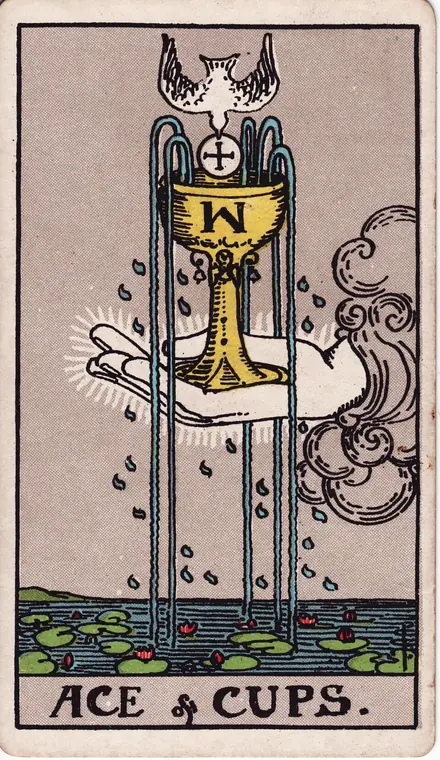
The Ace of Cups is the heart filled to overflowing: a love, a kindness or an inspiration that arrives as a gift and asks to be shared.
Draw this card · Its correspondences
- Arcana: Minor, number 1
- Suit and element: Cups, Water
- Golden Dawn title: Root of the Powers of Water
- Sephirah: Kether
- Zodiac quadrant: Libra, Scorpio, Sagittarius
- Keywords: Love, a new relationship, compassion, creativity
- Yes or no?: Yes
- Archetype: The Overflowing Gift
What the card shows
In the deck Pamela Colman Smith drew for Arthur Edward Waite in 1909, a hand emerges from a cloud and holds a golden, chalice-shaped cup on its open palm. Streams of water spill over the rim and fall into a pond covered with water lilies; five of them can be counted in the drawing. From above, a white dove descends head first, carrying a wafer marked with a cross in its beak. Loose drops fall all around like dew, and on the cup there is a letter that some read as a W and others as an upside-down M.
Each detail carries a meaning. The hand from the cloud belongs to every Ace: a gift that comes from outside and is offered openly, with nothing asked in return. The cup is the heart and, in the Christian imagery Waite had in mind, the Grail. The dove with the wafer points to the Holy Spirit and to communion: what fills the cup comes down from above. The spilling streams are often linked to the five senses, the channels through which feeling flows out into the world. Water lilies grow in still water and open to the light, so they are read as emotion that blossoms once it finds calm.
In The Pictorial Key to the Tarot (1910), Waite calls this card the house of the true heart and gives it the meanings of joy, contentment, nourishment, abundance and fertility. The Golden Dawn titled it the Root of the Powers of Water: water at its source, before it is shared out among the ten numbered cards of the suit. The order placed it in Kether, the crown of the Tree of Life, and gave it rule over a quarter of the heavens spanning Libra, Scorpio and Sagittarius.
Ace of Cups upright
Upright, the Ace of Cups reads as the beginning of something you feel before you understand it. A new affection, a friendship that starts strong, a reconciliation, the joy of a birth, or tenderness returning after a dry season. Every Ace is a seed, and this one is the seed of the water suit: emotions, bonds, intuition and imagination.
The tradition stresses two ideas. The first is the gift. The cup arrives in a hand from the cloud, and the person receives it without quite having gone looking for it. The second is the overflow. The water runs over the rim because the cup holds more than it can contain. That is why the Ace of Cups speaks as much about giving as about receiving. A true feeling wants to reach other people.
In a spread it usually marks an opening of the heart. It can be a love that begins, a relationship that renews itself, or compassion stirring for someone who needs it. It also has a strong creative meaning: inspiration that strikes all at once, the idea for a poem, a song or a novel that arrives whole and full of feeling.
As advice, the card invites you to accept what is offered and let it flow. Still water turns murky, and so does affection kept locked away. Beside Swords or Pentacles, the Ace of Cups places a sincere emotion at the centre of a matter of ideas or money. Beside other Cups, the emotional note grows louder still.
Ace of Cups reversed
Many readers never use reversals. They read every card upright and let the neighbouring cards shade the meaning. Those who do read reversed cards tend to see the Ace of Cups reversed in one of two ways.
The first is the cup that empties. Waite calls it the house of the false heart and gives it meanings of instability and change: an affection that turns out to be less than it seemed, an emotion that floods with no channel to hold it, or a relationship built more on need than on love.
The second is the closed cup. The feeling is there, and it stays inside: fear of being seen, sadness kept to oneself, an inspiration that stalls. Read this way, the reversed Ace speaks of tenderness turned inward that has yet to find a way out, or of someone who gives so much that nothing is left for themselves.
In both cases the advice is to tend your own cup before offering it: care for what you feel, give it a name, and let it fill again.
In love
In love, the Ace of Cups is one of the brightest cards in the deck. For someone single, it reads as the start of a story: a spark, a meeting that leaves its mark, a person who wakes something long asleep. For a couple, it usually points to renewal, a season of closeness, a heartfelt reconciliation or the decision to take a step forward, such as moving in together or starting a family. The tradition also links it to fertility.
Reversed, in love
Reversed, in love, it speaks of feelings that will not flow: fear of opening up, a relationship that gives less than it promises, or an affection that leans on lack. As advice, it asks you to restore your love for yourself first, so the bond can fill with something real again.
Career and money
For career and money, the Ace of Cups reads as an exciting new start: a creative project, a role that involves working with people, or a commission you take on gladly. It favours caring professions, the arts and work that serves others, and it points to warm relations with colleagues and clients. Financially, it measures success in satisfaction more than in figures.
Reversed, in career
Reversed, it points to listlessness or work that has lost its meaning: the job gets done with no spark. The advice is to find the part of the task that still moves you and begin there.
Health and mood
For health and mood, the Ace of Cups is linked with emotional recovery, rest and the relief that love and company bring. The tradition also connects it with fertility. A tarot card cannot diagnose anything: for any symptom, pregnancy or worry, the person to see is a qualified health professional.
Yes or no? Yes
The Ace of Cups reads as a clear “yes”, especially for questions about love, friendship, reconciliation or creative projects. The cup arrives full and is held out to you, and the card suggests that what you want rests on a sincere emotional foundation. The “yes” comes with one simple condition: accept what arrives and let it grow, without clutching it out of fear.
Ask the card: a yes or no tarot reading with one card or three.
The archetype: The Overflowing Gift
As an archetype, the Ace of Cups is the moment a character receives something unexpected that they could never have made alone: a love, a pardon, an act of kindness, a calling. It stands for an inner event more than for a person. When it takes human form, it is the one who gives without counting the cost, the stranger who offers shelter, the mother who takes someone in, the friend who turns up with a full cup on the worst day of the year.
In the structure of a story, the Ace of Cups tends to sit in one of two places. At the start, it is the meeting that sets everything in motion: the lovers see each other for the first time, the orphan finds a home, the artist discovers what they want to make. Later on, it is the grace that saves the protagonist once they can no longer save themselves, the gesture that changes them from within. Its dramatic power lies in arriving from outside and demanding an answer. Whoever receives the cup has to decide what to do with it.
The danger of this archetype in fiction is sweetness without weight. The Ace of Cups works when the character was thirsty, when the reader has already seen the drought: the loneliness, the grudge, the life without affection. Then the spilling water feels like a small, true miracle. Its shadow works too, Waite’s false heart: the gift that turns out to be a trap, the love confused with the need to be loved.
In literature
- Les Misérables (Victor Hugo, 1862). Jean Valjean steals the bishop’s silver, and Bishop Myriel, instead of handing him over, gives him the candlesticks as well. That gesture is a cup offered freely, and it changes his life. The whole novel rests on that grace received, which Valjean spends the rest of the book passing on to others.
- Like Water for Chocolate (Laura Esquivel, 1989). Tita cooks with whatever she feels, and her dishes pass it on to everyone who eats them: her sorrow makes the wedding guests weep, her desire sets the table on fire. It is the Ace of Cups brought into the kitchen, an emotion so full that it spills over everyone nearby.
- A Christmas Carol (Charles Dickens, 1843). Scrooge is the closed cup, a heart that has spent years neither giving nor receiving. The three spirits pry it open, and on Christmas morning he wakes brimming with joy and generosity. Dickens turns the passage from drought to running water into a scene everyone remembers.
For writers
The conflict
The Ace of Cups sets up a conflict between thirst and the fear of drinking. Your character needs love, forgiveness or company, and when it is finally offered they cannot accept it: they distrust it, feel unworthy of it, or dread losing it. To prepare the card, show the drought first, in small gestures and close detail, so the reader longs for the cup as much as the protagonist does.
The twist
As a plot twist, the Ace of Cups is the unexpected gift that turns the story: a love letter, a pardon, an emotional inheritance, a child who arrives. It works best when it comes from the least likely person, the enemy or the stranger. After the twist, the interesting question is what the character does with the surplus: hoard it or share it.
Prompts
- Write the scene in which your character receives a kindness they have done nothing to deserve and must decide whether to accept it.
- Let an emotion held back for years spill out in the worst possible place, in front of the one person who should never see it.
- Tell the story of a first romantic meeting through an object that passes from one hand to another, while neither of them names what they feel.
Its correspondences
- Element: Water. Source: Golden Dawn (tradition).
- Sephirah: Kether. Source: Golden Dawn (tradition).
- Sign: Libra. Source: Golden Dawn (tradition).
- Sign: Scorpio. Source: Golden Dawn (tradition).
- Sign: Sagittarius. Source: Golden Dawn (tradition).
Combinations
Ace of Cups and The Fool
With The Fool, the Ace of Cups speaks of an emotional beginning with no plan: a love, a friendship or a hope that arrives out of nowhere. It reads as an open heart and a willingness to be surprised by whatever comes.
Ace of Cups and The Star
Beside The Star, the Ace of Cups reads as emotional renewal after a hard time. Both cards pour out water: affection returns in earnest, and hope and tenderness strengthen each other.
Ace of Cups and Ace of Swords
With the Ace of Swords, head and heart begin together. It reads as a new attachment spoken about with clarity, a sincere declaration, or an idea born from a genuine feeling.
Ace of Cups and The Lovers
The Lovers beside the Ace of Cups form one of the most romantic pairings in tarot. Together they read as a new bond that is returned in kind, or as the choice to give yourself fully to a relationship.
Ace of Cups and Two of Cups
With the Two of Cups, the seed of the Ace finds an answer. It reads as a feeling that moves from one person to two: a mutual meeting, a commitment, or a friendship that is sealed.
Ace of Cups and Three of Swords
The Three of Swords beside the Ace of Cups speaks of a heart that opens after a wound. It reads as comfort, or a love that arrives to heal a recent grief, even while the scar is still visible.
Ace of Cups and The Moon
With The Moon, the water of the Ace grows cloudy. It reads as an intense emotion that is not yet understood, or an affection worth examining calmly before you trust it completely.
Ace of Cups and The High Priestess
Beside The High Priestess, the Ace of Cups points to deep intuition and a feeling kept in silence. It reads as a love still unspoken, or an inspiration ripening quietly within.
Frequently asked questions
What does the Ace of Cups mean in tarot?
The Ace of Cups is the root of the water suit and stands for emotional beginnings: a love, a friendship, a reconciliation or an inspiration that arrives like a gift. Tradition reads it as a heart so full that it overflows and asks to be shared with others.
What does the Ace of Cups mean in love?
In love it is one of the most favourable cards. For singles, it reads as the start of a story or a sudden spark; for couples, as renewal, reconciliation or a step forward in the relationship. The tradition also associates it with fertility.
Is the Ace of Cups a yes or no card?
It reads as a clear yes, especially for questions about love, friendship and creative work. The card suggests that what you want rests on sincere feeling, and that it is worth accepting without the fear of losing it.
What does the Ace of Cups reversed mean?
Readers who use reversals usually see it as a cup that empties or closes: an unstable affection, a blocked emotion, or someone who gives so much they are left with nothing. The advice is to look after your own cup before offering it.
What does the dove on the Ace of Cups represent?
In Pamela Colman Smith’s drawing, the white dove descends with a wafer marked with a cross and places it in the cup. It points to the Holy Spirit and to communion: what fills the heart comes from above. Waite connected the card with the Grail.
What are the Golden Dawn correspondences of the Ace of Cups?
In Book T, the Ace of Cups is titled the Root of the Powers of Water. It belongs to the element of water, sits in Kether, the crown of the Tree of Life, and rules a quarter of the heavens spanning the signs of Libra, Scorpio and Sagittarius.
Do your readingPrevious: King of Wands · Next: Two of Cups
The 14 cards of Cups
- Ace of Cups
- Two of Cups
- Three of Cups
- Four of Cups
- Five of Cups
- Six of Cups
- Seven of Cups
- Eight of Cups
- Nine of Cups
- Ten of Cups
- Page of Cups
- Knight of Cups
- Queen of Cups
- King of Cups
By Style Optimizer · published November 22, 2026.