Tarot / The 78 cards / Pentacles / Ten of Pentacles
Ten of Pentacles (10 of Pentacles): tarot card meaning, upright and reversed
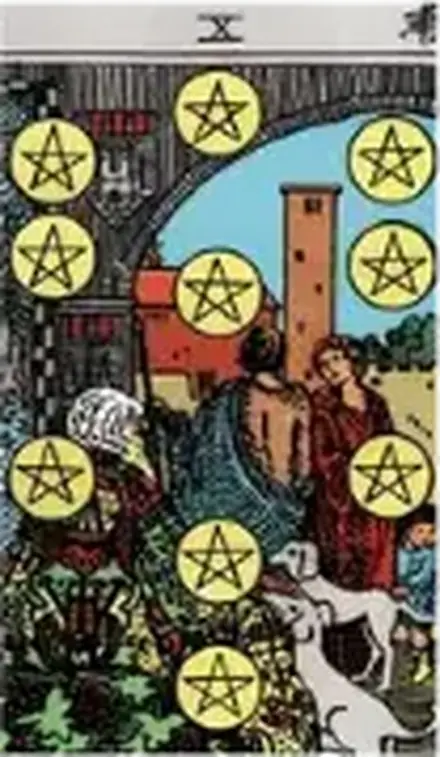
The Ten of Pentacles is wealth that lasts: the home, family and inheritance handed down through generations, giving roots to all who come.
Draw this card · Its correspondences
- Arcana: Minor, number 10
- Suit and element: Pentacles, Earth
- Golden Dawn title: Lord of Wealth
- Sephirah: Malkuth
- Decan: Virgo III, Mercury (20° to 30° Virgo)
- Keywords: Wealth, inheritance, family, establishment, the long term
- Yes or no?: Yes
- Archetype: The House and Its Line
What the card shows
In the deck Pamela Colman Smith drew for Arthur Edward Waite in 1909, the Ten of Pentacles shows the entrance to a house and its grounds. A great stone archway carved with a coat of arms opens onto a courtyard and, beyond it, the buildings of a town. Under the arch a man and a woman are talking. A child clings to her skirt and reaches toward one of two white dogs, which approach a white-bearded old man seated in the foreground in a richly embroidered cloak. The ten pentacles float above the scene.
The arrangement of the pentacles is the key to the card: they form the Kabbalistic Tree of Life, with its ten sefirot. Material wealth is drawn as a complete map of the world, from the highest to the most concrete. The three generations, grandfather, parents and child, tell the story of inheritance through time. The dogs are loyalty and the continuity of the house. The old man strokes them and so does the child, and the same gesture joins the two ends of the family. The coat of arms on the arch is lineage, the name that is handed down. The couple stand with their backs to the old man, apparently absorbed in their own affairs, a detail many readers take as the distance between the one who founded and the ones who inherit.
Waite links the card with gain and riches, family matters, archives, extraction and the family home. The Golden Dawn titled it the Lord of Wealth and placed it in Malkuth, the kingdom, the last sefirah, in the third decan of Virgo, ruled by Mercury: the trade and the word that keep a house alive.
Ten of Pentacles upright
Upright, the Ten of Pentacles reads as wealth that endures. It is the card of legacy, family and long-term stability. Tradition links it with inheritance, with the house passed from parents to children, with the family business and with everything built to outlast a single life. The suit of Pentacles ends here: the earth has yielded all its fruit, and the fruit stays.
In a spread it often points to a family or property matter: buying a home, dividing an estate, a wedding that joins two families, a tradition carried on. It can also speak of belonging, of finding a place in a community or a line. After the Nine of Pentacles, who enjoys her garden alone, the Ten opens the gate and shares it across generations.
Malkuth, the card’s sefirah, is the concrete world, where everything that came before becomes visible. That is why the Ten of Pentacles reads as material culmination: the sum of the work turned into something you can touch, live in and pass on.
As advice, the card asks you to think long-term. Today’s decisions affect those who will come after. It also invites you to value what you have received, your roots and family memory, and to care for the bonds that hold the house together as much as the money does.
Ten of Pentacles reversed
Many readers work only with upright cards and let the neighboring cards shade the meaning. Those who read reversals usually see the Ten of Pentacles reversed as trouble with an inheritance or within the family.
It can point to disputes over an estate, debts that get passed down, a family business in difficulty or the weight of inherited expectations that suffocate. It also reads as a break with the lineage: someone who leaves the house and gives up their share. Waite linked the reversed card with chance, fatality, loss and games of luck, and also with gifts, dowries and pensions: fortune that arrives or departs by unexpected roads.
The advice is to clarify family and money matters, with documents and honest conversations, before they get more tangled.
In love
In love, the Ten of Pentacles reads as a commitment with an eye on the future. For couples it speaks of starting a family, buying a home, marrying or joining two lives with long-term plans. It also points to good relations with both families and a stability that brings peace of mind.
If you are single, the card often points to the wish for a serious, lasting relationship. It can speak of meeting someone through family or community, or of getting clear about the kind of life you want to build.
Reversed, in love
Reversed in love, it points to tension with family, disagreements over money or the house, or a relationship held together by convenience. As advice, it invites you to talk frankly about expectations and assets.
Career and money
For career and money, the Ten of Pentacles reads as solid, lasting prosperity. It points to family businesses, long-term investments, property, retirement and job security. It is a favorable card for consolidating a business or planning your financial future. Tradition advises thinking about structures that will outlive the person who creates them.
Reversed, in career
Reversed, it warns of risks to your assets: doubtful investments, conflict in a family firm or inherited debts. The advice is to review contracts and get professional advice before deciding.
Health and mood
For health and wellbeing, the Ten of Pentacles is associated with family inheritance and with the value of knowing your own family history. It also reads as the support that stable relationships provide. No card can diagnose anything. For any symptom or concern, the person to see is a health professional.
Yes or no? Yes
The Ten of Pentacles reads as a firm, lasting “yes,” especially for questions about home, family, money or long-term commitments. The card favors what is built patiently and what involves several people. If the question seeks something quick and fleeting, the “yes” arrives more slowly than expected.
Ask the card: a yes or no tarot reading with one card or three.
The archetype: The House and Its Line
As an archetype, the Ten of Pentacles is less a character than a house. It embodies the family as a collective protagonist: the patriarch who founded the fortune, the children who manage it, the grandchildren who inherit without knowing what it cost. Personified, it is usually the old man in the foreground, the keeper of memory who watches his people pass beneath the arch.
In story structure, the card belongs to the saga. It is the novel of generations, the drama of inheritance, the story of a house that rises and falls over decades. Its dramatic power lies in time. The reader sees how some people’s choices weigh on others, how a name brings obligations, how the objects in a house keep secrets. It is also the image of the classic happy ending, the family gathered around the table.
The archetype’s shadow lies in a detail many people overlook: the couple turned away from the old man. Inherited wealth can divide as much as it unites. Property breeds disputes, expectations and invisible debts. In fiction, the Ten of Pentacles works best when the house is both refuge and burden, and when each generation understands differently what it means to belong to it.
In literature
- One Hundred Years of Solitude (Gabriel García Márquez, 1967). The Buendía house grows with each generation and repeats names, obsessions and fates. Úrsula holds the family together for more than a century, like the old man on the card. The novel shows the whole Ten of Pentacles, glory and shadow alike: a lineage that seems eternal and carries its own ending written inside it.
- Buddenbrooks (Thomas Mann, 1901). A prosperous merchant family of Lübeck slowly loses its fortune and its vigor over four generations. Mann narrates the house, the firm and the family name as a single organism. It is the Ten of Pentacles read in decline, with the weight of inheritance resting on every son.
- The Leopard (Giuseppe Tomasi di Lampedusa, 1958). The Prince of Salina watches his aristocratic world change with the unification of Italy and agrees to marry his nephew to the daughter of a newly rich man. Everything changes so that the house can stay standing. The novel portrays inherited wealth as a long-term family strategy.
For writers
The conflict
The Ten of Pentacles sets up a conflict between inheritance and personal desire. The character receives a house, a business or a family name, and with it an obligation they may never have chosen. It works well with several generations on stage, each with its own idea of what is owed to the family. To set up the card, show the objects in the house: a portrait, a piece of furniture, a stored document someone will one day have to read.
The twist
As a plot twist, the Ten of Pentacles is the inheritance that changes everything. An unexpected will, an unknown child, a debt hidden in the family archives. The twist can run in either direction: someone receives a fortune they never expected, or discovers that their family’s wealth was built on something they would rather not know.
Prompts
- Write the reading of a will from the point of view of the family dog, who knows everyone in the room better than they know themselves.
- Tell the story of an object that passes through four generations of the same house, with a short scene for each owner.
- Make your protagonist return to the family home to sell it, and change their mind as they pass under the entrance arch.
Its correspondences
- Element: Earth. Source: Golden Dawn (tradition).
- Sephirah: Malkuth. Source: Golden Dawn (tradition).
- Decan: Virgo III. Source: Golden Dawn (tradition).
Combinations
Ten of Pentacles and Wheel of Fortune
With the Wheel of Fortune, luck touches the family. It reads as an inheritance, growing wealth or a turn of circumstances that affects several generations.
Ten of Pentacles and The Star
Next to the Star, hope puts down roots. It reads as a steady improvement in the family or the home, built patiently and meant to last.
Ten of Pentacles and The Empress
With the Empress, abundance becomes legacy. It reads as a family home in bloom, the arrival of a child or prosperity passed to the next generation.
Ten of Pentacles and Ace of Pentacles
With the Ace of Pentacles, the beginning and the end of the suit meet. It reads as a seed that will become a legacy: what starts small today may last for generations.
Ten of Pentacles and King of Pentacles
Next to the King of Pentacles, the wealth has a steward. It reads as inheritance, a family business or the figure who manages the estate and hands it on.
Ten of Pentacles and Queen of Pentacles
With the Queen of Pentacles, the emphasis falls on caring for the home. It reads as the person who holds the family together and turns an inheritance into a home.
Ten of Pentacles and King of Wands
With the King of Wands, the founder leaves a legacy. It reads as an entrepreneurial project that consolidates and passes to the next generation, or an inheritance that arrives by surprise.
Ten of Pentacles and Ten of Cups
Next to the Ten of Cups, material wealth and family happiness coincide. It reads as a prosperous, united home, the fullest image of wellbeing in the tarot.
Frequently asked questions
What does the Ten of Pentacles mean in tarot?
The Ten of Pentacles represents wealth that endures: family, home, inheritance and assets handed down from one generation to the next. Tradition reads it as long-term stability and as the material culmination of the suit of Pentacles.
What does the Ten of Pentacles mean in love?
In love it reads as a commitment with a future: starting a family, sharing a home or marrying. For singles, it points to the wish for a serious, lasting relationship, sometimes found through family circles.
Is the Ten of Pentacles a yes or no card?
It reads as a firm “yes,” especially for questions about home, family, money or long-term projects. It favors what is built patiently and what involves several people.
What does the Ten of Pentacles reversed mean?
Readers who use reversals often see it as disputes over an inheritance, family debts, a family business in trouble or inherited expectations that weigh heavily. The advice is to settle money and family matters in writing.
Why do the pentacles on the Ten of Pentacles form a pattern?
On Pamela Colman Smith’s card, the ten pentacles trace the Kabbalistic Tree of Life. Wealth appears as a complete map, from the highest to the most concrete, and the card stands as the close of the suit.
What decan and sefirah correspond to the Ten of Pentacles?
In the Golden Dawn system, the Ten of Pentacles is titled the Lord of Wealth. It corresponds to the third decan of Virgo, ruled by Mercury (20° to 30°), and to Malkuth, the kingdom, the tenth sefirah of the Tree of Life.
Do your readingPrevious: Nine of Pentacles · Next: Page of Pentacles
The 14 cards of Pentacles
- Ace of Pentacles
- Two of Pentacles
- Three of Pentacles
- Four of Pentacles
- Five of Pentacles
- Six of Pentacles
- Seven of Pentacles
- Eight of Pentacles
- Nine of Pentacles
- Ten of Pentacles
- Page of Pentacles
- Knight of Pentacles
- Queen of Pentacles
- King of Pentacles
By Style Optimizer · published November 22, 2026.