Tarot / The 78 cards / Swords / Eight of Swords
Eight of Swords (8 of Swords): tarot card meaning, upright and reversed
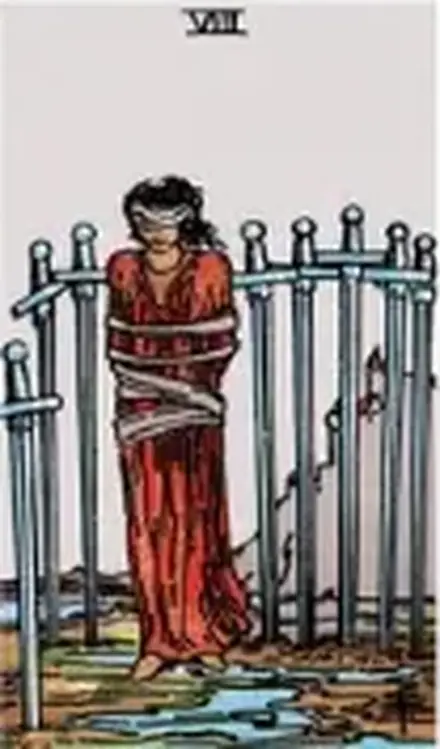
The Eight of Swords is the feeling of being trapped: a blindfold, loose bonds and a ring of swords with a gap wide enough to walk through.
Draw this card · Its correspondences
- Arcana: Minor, number 8
- Suit and element: Swords, Air
- Golden Dawn title: Lord of Shortened Force
- Sephirah: Hod
- Decan: Gemini I, Jupiter (0° to 10° Gemini)
- Keywords: Restriction, victimhood, confinement, fear
- Yes or no?: Yes, with conditions
- Archetype: The Prisoner of Herself
What the card shows
In the deck Pamela Colman Smith drew for Arthur Edward Waite in 1909, the Eight of Swords shows a woman standing blindfolded, her upper body and arms bound with cloth. She is dressed in red. The ground is waterlogged, with puddles at her feet, and eight swords stand planted around her on both sides and behind, like an unfinished fence. In front of her the way is open. In the background, a castle sits on a crag.
The image is read through its contradictions. The blindfold stops her seeing, so she cannot know the circle is open. The bindings hold her arms while her feet stay free, and she could walk. The swords surround her without touching her. They are the ideas, rules and fears that mark out her path. The water at her feet is stagnant emotion turning the ground to mud. The distant castle can be read two ways: the place she came from, with its authority and its rules, or the place she could return to if she dared to move.
In The Pictorial Key to the Tarot (1910), Waite describes a woman bound and hoodwinked, and notes that the card speaks of temporary durance rather than irretrievable bondage. The Golden Dawn called it the Lord of Shortened Force, placed it in Hod, the sephirah of intellect and words, and gave it the first decan of Gemini, ruled by Jupiter: great force that cannot find a way out.
Eight of Swords upright
Upright, the Eight of Swords reads as the feeling of being stuck, out of options and unable to move. Its keywords are restriction, victimhood, confinement and fear. The card describes someone who feels trapped by circumstances, by other people or by their own thoughts, and who cannot see the way out.
The meaning of the Eight of Swords lies in a detail of the image: the circle is open and the feet are free. The tradition reads it as a prison built mostly of ideas. There are real limits, and there are also beliefs that make them look bigger: “I can’t”, “I have no right”, “it’s too late”. The Golden Dawn title, Shortened Force, sums it up well. The ability is there, and something is cutting it short.
In a spread, the card usually advises three steps. Take off the blindfold, which means looking at the situation with facts and without drama. Move your feet, even a little, because the first step proves that moving is possible. Ask someone outside for help, someone who can see the gap in the fence. The card can also point to control imposed by another person. In that case the advice is to seek support and to avoid facing it alone.
Eight of Swords reversed
Many readers never read reversals and let the surrounding cards supply the nuance instead. Those who do usually read the Eight of Swords reversed as the moment of release.
The blindfold falls, the bindings loosen and the person discovers they could have walked out all along. It reads as regaining confidence, making a decision long put off or leaving a limiting situation behind. For the reversed card Waite gives disquiet, difficulty, opposition and the unforeseen, which suggests that stepping out of the circle brings its own vertigo.
There is another possible reading: the confinement has grown so comfortable that you no longer want to leave. Then the reversed card asks you to look at what you gain by staying tied up.
In love
In love, the Eight of Swords is about feeling trapped. In a relationship it can point to a bond you do not know how to leave, fear of saying what you think or a pattern of control. It can also speak of jealousy and insecurity that hem both partners in. The card advises looking at the situation clearly and seeking support if you need it.
If you are single, it usually speaks of limiting beliefs, such as thinking your moment has passed or that nobody will love you, and of the need to take that blindfold off.
Reversed, in love
Reversed in love, it reads as release: leaving a relationship that was suffocating you, finding your voice again or losing the fear of starting over. The advice is to take the step calmly and with support.
Career and money
For career and money, the Eight of Swords reads as being tied to a job, a debt or a contract, or as the paralysis of someone who dares not ask for a change. The tradition advises reviewing your real options, which are usually more than they seem, and taking one small first step.
Reversed, in career
Reversed, it shows a way out appearing: a new offer, a negotiation that gets unstuck or the decision to change direction. Allow for the surprises Waite links with the card.
Health and mood
For health and mood, the Eight of Swords is linked with feeling stuck, with anxiety and with thoughts that circle without finding a way out. It reads as an invitation to ask for help and to avoid isolating yourself. No card can diagnose anything: for any symptom or distress, emotional distress included, the right person to see is a health professional.
Yes or no? Yes, with conditions
The Eight of Swords reads as a conditional yes. What you are asking about is possible, provided you move: take off the blindfold, look at the fears holding you back and take the first step. As long as you stay still inside the circle, the answer drifts towards no.
Ask the card: a yes or no tarot reading with one card or three.
The archetype: The Prisoner of Herself
As an archetype, the Eight of Swords is the character who believes she is a prisoner while the door stands open. She is the daughter who dares not leave home, the employee who puts up with what nobody should, the wife who lives by rules nobody ever explained to her and that she never questions. When the card is personified, it often brings a second figure who is absent from the image: whoever tied her up, who may be long gone.
In the structure of a story, the Eight of Swords holds the stagnation before the decision. The character knows something is wrong and does nothing, believing they cannot. It is the first act of many liberation stories and the heart of many tragedies. Its dramatic power lies in irony. The reader sees the gap in the fence before the character does, and that distance creates tension.
The risk of this archetype in fiction is prolonged passivity, which wears readers out. It works better with small signs: a foot that shifts, a knot that gives, a witness who asks why she stays. Then, when the character finally pulls off the blindfold, the gesture feels inevitable. It also works in its tragic version, when the blindfold never falls and the reader watches the chance slip away.
In literature
- A Doll’s House (Henrik Ibsen, 1879). Nora lives in a comfortable home where she is treated like a child, and keeps a secret that binds her. When the truth explodes, she understands that her prison was built from ideas about what a wife should be. The door slamming at the end is the Eight of Swords at the moment the blindfold drops.
- The Yellow Wallpaper (Charlotte Perkins Gilman, 1892). Confined to a nursery room by her physician husband for a “rest cure”, the narrator is forbidden to write and starts to see a woman trapped behind the wallpaper. Gilman gives the card’s tragic version: bonds made of kindly rules, a cage nobody calls a cage, and a release that comes as madness.
- The Exterminating Angel (Luis Buñuel, 1962). Shot in Mexico, the film shuts a group of dinner guests inside a drawing room they cannot leave, though nothing stops them. It is the exact image of the Eight of Swords: a confinement without walls, held in place by habit and fear, broken when someone repeats the gesture from the beginning.
For writers
The conflict
The Eight of Swords sets up a conflict between the freedom available and the freedom a character allows themselves. It works best when the bonds have two layers: a real one, imposed by someone or by circumstance, and an inner one made of beliefs. To set it up, show the circle and show the gap too, so the reader spots it before the character and wants to shout at them to move.
The twist
As a plot twist, the Eight of Swords is the discovery that the way out was there all along. It can arrive with an outside witness, an accident that breaks the routine or a small act of disobedience that works. The richest moment is what follows: guilt at having waited so long, the vertigo of freedom and the question of who tied the blindfold, and why.
Prompts
- Write a scene where your character is bound by a rule nobody has ever said out loud, and have an outsider ask why they obey it.
- Tell the first ten steps of someone leaving years of confinement, one per paragraph, without yet explaining why they stayed.
- Narrate the same situation from the blindfolded woman and from someone watching the scene from the castle on the crag.
Its correspondences
- Element: Air. Source: Golden Dawn (tradition).
- Sephirah: Hod. Source: Golden Dawn (tradition).
- Decan: Gemini I. Source: Golden Dawn (tradition).
Combinations
Eight of Swords and The Fool
With The Fool, the Eight of Swords reads as freezing before a change. The urge to leap meets fears that, seen up close, are weaker than they look; the advice is to look for the way out and take the step.
Eight of Swords and The Devil
The Devil beside the Eight of Swords tightens the mental bonds. Blindfolds and chains add up: the person feels more trapped than they are, and the way out starts with naming what holds them.
Eight of Swords and The Chariot
With The Chariot, the Eight of Swords puts the brakes on. Together they read as the will to move colliding with an inner block; the way out lies in taking charge of yourself before you take the reins.
Eight of Swords and Nine of Swords
The Eight and Nine of Swords together read as thoughts that imprison and keep you awake at night. Fear feeds on itself, and the pair advises testing it against the facts and against someone you trust.
Eight of Swords and Two of Swords
With the Two of Swords, the two blindfolds add up. Together they read as a decision avoided for fear of seeing, which keeps the person standing still in the same spot.
Eight of Swords and The Hanged Man
The Hanged Man beside the Eight of Swords separates two kinds of waiting. The Hanged Man accepts the pause and learns from it; the Eight suffers it. Together they invite you to turn the block into a time for reflection.
Eight of Swords and Strength
With Strength, the way out of the circle comes into view. Together they read as the quiet courage to remove the blindfold and find you had more power than you thought.
Eight of Swords and Knight of Wands
The Knight of Wands beside the Eight of Swords breaks the stillness. Together they read as a surge of action, your own or that of someone arriving, that pulls the person out of confinement.
Frequently asked questions
What does the Eight of Swords mean in tarot?
The Eight of Swords stands for the feeling of being trapped, out of options and unable to move. In the image the circle is open and the feet are free, so the tradition reads it as a prison built mostly of fears and beliefs.
What does the Eight of Swords mean in love?
In love it reads as feeling trapped in a relationship, fear of speaking up or a pattern of control. If you are single, it speaks of limiting beliefs. The card advises looking at the situation clearly and looking for support.
Is the Eight of Swords a yes or no card?
It reads as a conditional yes: what you ask about is possible if you move, take off the blindfold and take the first step. As long as you stay still, the answer drifts towards no.
What does the Eight of Swords mean reversed?
Readers who use reversals usually see it as release: the blindfold falls and you discover you could have walked out. Waite also links it with disquiet and the unforeseen, the vertigo that comes with any exit.
What is the decan and Golden Dawn title of the Eight of Swords?
In the Golden Dawn system, the Eight of Swords is the Lord of Shortened Force. It corresponds to the first decan of Gemini, 0° to 10°, ruled by Jupiter, and to the sephirah Hod, the eighth on the Tree of Life.
Do your readingPrevious: Seven of Swords · Next: Nine of Swords
The 14 cards of Swords
- Ace of Swords
- Two of Swords
- Three of Swords
- Four of Swords
- Five of Swords
- Six of Swords
- Seven of Swords
- Eight of Swords
- Nine of Swords
- Ten of Swords
- Page of Swords
- Knight of Swords
- Queen of Swords
- King of Swords
By Style Optimizer · published November 22, 2026.