Tarot / The 78 cards / Cups / Seven of Cups
Seven of Cups (7 of Cups): tarot card meaning, upright and reversed
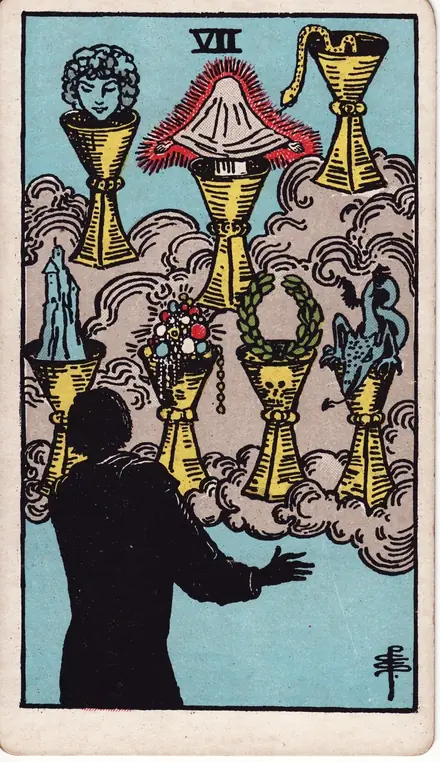
The Seven of Cups is a sky full of dreams: many dazzling options, an imagination on fire and the task of choosing just one of them.
Draw this card · Its correspondences
- Arcana: Minor, number 7
- Suit and element: Cups, Water
- Golden Dawn title: Lord of Illusionary Success
- Sephirah: Netzach
- Decan: Scorpio III, Venus (20° to 30° Scorpio)
- Keywords: Opportunities, choices, desire, illusion
- Yes or no?: It depends
- Archetype: The Dreamer Among Mirages
What the card shows
In the deck Pamela Colman Smith drew for Arthur Edward Waite in 1909, the Seven of Cups shows a dark figure, seen from behind and almost in silhouette, facing a cloud from which seven cups emerge. Each cup holds a different vision. In the top row are a human head with gentle features, a veiled figure glowing with its own light, and a snake. In the bottom row, a castle on a rock, a heap of jewels spilling over the rim, a laurel wreath and a small dragon.
Each image has its reading in the tradition. The head is linked with love or a longed-for partner, and also with the vanity of seeing yourself in someone else. The veiled figure is mystery, the true self, or an illumination that has not yet revealed itself. The snake speaks of wisdom and of temptation. The castle is security, home or power; the jewels, wealth; the laurel, victory and fame, and in some readings the cup that holds it bears a faint skull, a reminder of what glory costs. The dragon is desire, fear, or the force hidden inside fantasy. The faceless figure in shadow could be anyone, which turns the card into a mirror for whoever looks at it.
Waite spoke of strange chalices of vision and images of the fantastic spirit: sentiment, imagination, things seen in the glass of contemplation, with nothing permanent or solid about them. The Golden Dawn called it the Lord of Illusionary Success and gave it the third decan of Scorpio, ruled by Venus, in the sefirah Netzach, victory and the emotions.
Seven of Cups upright
Upright, the Seven of Cups reads as the moment of many options and waking dreams. Several possibilities open up before the person, all of them attractive: a love, a house, money, recognition, a spiritual path, an adventure. As with anything in the clouds, none of them has solid ground beneath it yet. The card portrays imagination in full flight and the difficulty of telling what is real from what is wished for.
In a spread it usually points to a choice still to be made. There are too many options and too little information, or the information is coloured by longing. The Seven of Cups means illusion in both senses: the dream that inspires and the one that deceives. Its Golden Dawn title, Lord of Illusionary Success, puts it precisely: successes that can be seen and do not yet exist.
The card also has a very valuable creative side. It belongs to dreamers, artists and inventors. The visions in the cups are the raw material of any project. What the tradition warns against is staying to stare at them: losing time in fantasy, scattering yourself across a thousand plans, or falling for the brightest option instead of the soundest one.
As advice, the Seven of Cups asks you to come down from the clouds and choose. Look at each cup calmly, ask what truly lies behind each image, and keep one. Choosing hurts a little, because it means letting the others go, and it is the only way for any dream to touch the ground.
Seven of Cups reversed
Many readers never use reversals. They read every card upright and let the neighbouring cards shade the meaning. Those who do read reversed cards tend to see the Seven of Cups reversed as a return to clarity.
Waite summed up the reversed card in four words: desire, will, determination, project. The clouds part, the person sees more sharply what they truly want, and they decide. Read this way, the reversal is a card of focus: scattered energy gathers and turns into action.
Some readings add a harder edge. The reversed card can point to disillusionment, the moment one of the cups proves empty or a promise turns out to be false. It hurts, and at the same time it frees energy for what has real foundations.
Either way, the advice is to use that clarity to commit to a single path.
In love
In love, the Seven of Cups reads as fantasy and doubt. For a couple, it can point to idealised expectations, the temptation to imagine other lives, or difficulty seeing your partner as they really are. The meaning of the Seven of Cups in love asks you to separate the real person from the image projected onto them.
For someone single, the card often speaks of many options at once, of dream lovers, or of someone who excites you a great deal and whom you barely know. Give it time to see what lies behind the first impression.
Reversed, in love
Reversed, in love, it speaks of clarity: you finally know what you want from a relationship and stop chasing an ideal. It can also mark the end of an infatuation built on fantasy. The advice is to choose with your eyes open.
Career and money
For career and money, the Seven of Cups reads as plenty of ideas and offers with little substance. It can point to several proposals at once, projects that sound good and have no plan, or deals that promise too much. The tradition advises checking the facts, getting the terms in writing and distrusting whatever looks easy. It is a very good card for creative work, as long as something gets finished.
Reversed, in career
Reversed, it marks the move from idea to plan: a project is chosen, priorities are set and distractions are dropped. The advice is to keep your focus even while other cups are still shining.
Health and mood
For health and mood, the Seven of Cups is linked with a scattered mind, daydreaming and difficulty concentrating. It reads as an invitation to put your thoughts in order and rest with simple routines. A tarot card cannot diagnose anything: for any symptom or worry, the person to see is a qualified health professional.
Yes or no? It depends
The Seven of Cups reads as an “it depends”. The question has several possible answers and none is clear yet, because the situation is wrapped in wishes and assumptions. The outcome depends on choosing well and checking what lies behind appearances. If the question is whether something is as good as it looks, the card advises caution.
Ask the card: a yes or no tarot reading with one card or three.
The archetype: The Dreamer Among Mirages
As an archetype, the Seven of Cups is the character who lives in their imagination. The dreamer who plans a hundred lives and starts none of them, the reader who mistakes novels for the world, the ambitious soul chasing wealth, fame or ideal love without watching the ground underfoot. Their defining trait is the dazzled gaze. They see so many possibilities that they lose sight of the one right in front of them.
In the structure of a story, the card holds the moment of temptation and choice: the crossroads, the antagonist’s offer, the scene where the protagonist must decide between several promises. It is also useful for dream sequences, visions and hallucinations, and for revealing a character’s inner world once desire starts to warp reality.
The dramatic power of the Seven of Cups lies in irony. The reader usually sees before the character which cup is empty, which hides a snake and which holds what they truly need. That distance creates suspense and, often, compassion.
For the archetype to work, the illusions must seduce the reader too. If the cups shine only for the character, the fall does not hurt. Make the wrong option the most beautiful one, and keep the right one almost hidden, like the veiled figure at the centre of the card.
In literature
- Madame Bovary (Gustave Flaubert, 1857). Emma Bovary learned about love from novels and expects life to deliver what their pages promised. Every lover, every purchase and every ball is a cup shining in the clouds. Flaubert shows with cool precision the price of illusionary success: debts, disenchantment and a fall that no one around her knows how to stop.
- Life Is a Dream (Pedro Calderón de la Barca, 1635). Segismundo, locked in a tower since childhood, wakes one day as a prince and is then returned to his prison, unsure of what was real. The play turns the doubt of the Seven of Cups into a philosophical question. Its answer is moral: if everything may be a dream, at least act well.
- Death of a Salesman (Arthur Miller, 1949). Willy Loman, an ageing travelling salesman, lives on promises of success: the deal that will come, the son who will triumph, the respect everyone owes him. The play shows how illusions hold a man up and destroy him at the same time, while his family tries in vain to make him face reality.
For writers
The conflict
The Seven of Cups sets up a conflict between desire and reality, and also between rival promises. The character faces too many options, or a single option that dazzles, and their mistake is usually failing to check what is inside. It works best when each cup answers a concrete need: the love they lack, the money that would save them, the recognition they never had. That way the temptation is legitimate and the choice carries weight.
The twist
As a plot twist, the card suggests the revelation that one of the cups was empty: the inheritance does not exist, the suitor was lying, the business was a swindle. It also allows the opposite twist: the humblest option, the one nobody wanted, turns out to be the valuable one. The veiled figure at the centre is a good clue: what truly matters often appears covered and without glitter.
Prompts
- Write a scene in which your character receives three offers on the same day, and describe how they imagine each of those lives before choosing.
- Tell the story of a dream that comes true and turns out very different from what the character had imagined for years.
- Have your protagonist describe someone they are in love with and, in the next scene, show that person as they really are.
Its correspondences
- Element: Water. Source: Golden Dawn (tradition).
- Sephirah: Netzach. Source: Golden Dawn (tradition).
- Decan: Scorpio III. Source: Golden Dawn (tradition).
Combinations
Seven of Cups and Knight of Cups
With the Knight of Cups, the Seven heightens romance and fantasy. It reads as a proposal that excites much and offers little, or as a surplus of dreamed-of options that calls for slow, careful choosing.
Seven of Cups and The Devil
Beside The Devil, the Seven of Cups speaks of temptation and dangerous illusions. It reads as a desire that confuses what attracts with what is good for you, and that can bind you to a false promise.
Seven of Cups and The Moon
With The Moon, fantasies grow even murkier. It reads as a risk of deception, your own or someone else’s, and as the need to wait for daylight to show things as they are.
Seven of Cups and The High Priestess
The High Priestess with the Seven of Cups floods the imagination. The pairing asks you to tell true intuition from fantasy and to decide with a cool head between dazzling options.
Seven of Cups and Ace of Wands
With the Ace of Wands, the Seven of Cups warns of scattering yourself across too many ideas and desires. It reads as advice to pick a single fire and leave the rest for later.
Seven of Cups and The Chariot
The Chariot beside the Seven of Cups reads as the decision that ends the doubt. Having looked at every cup, the person chooses a direction and moves firmly towards it.
Seven of Cups and Two of Swords
With the Two of Swords, indecision doubles. It reads as a stalemate between options that seem equally good, and as the need to gather information before choosing.
Seven of Cups and The Lovers
The Lovers with the Seven of Cups speak of a choice in love, or of values, among several possibilities. It reads as the moment to decide with heart and head at once.
Frequently asked questions
What does the Seven of Cups mean in tarot?
The Seven of Cups stands for options, dreams, desire and illusion. The figure on the card gazes at seven cups in the clouds, each holding a different vision. In the tradition it reads as an overflowing imagination and the need to choose realistically.
What does the Seven of Cups mean in love?
In love it reads as fantasy, idealisation or many options at once. For a couple, it asks you to see your partner as they are. For someone single, it advises getting to know the person who excites you before committing.
Is the Seven of Cups a yes or no?
It reads as an “it depends”. There are several possibilities and none is clear yet. The outcome depends on choosing well and checking what lies behind appearances before you commit.
What does the Seven of Cups reversed mean?
Readers who use reversals usually see it as clarity and decision: the clouds part and a path is chosen. Waite summed it up as desire, will, determination and project. It can also point to disillusionment with a dream.
What is the Seven of Cups decan and Golden Dawn title?
In the Golden Dawn system, the Seven of Cups is the Lord of Illusionary Success. It corresponds to the third decan of Scorpio, from 20° to 30°, ruled by Venus, and to the sefirah Netzach, victory, in the element of water.
What is in the seven cups on the card?
In the Rider–Waite–Smith deck, the cups hold a head, a veiled glowing figure, a snake, a castle, jewels, a laurel wreath and a dragon. They are read as love, mystery, temptation, security, wealth, victory and desire.
Do your readingPrevious: Six of Cups · Next: Eight of Cups
The 14 cards of Cups
- Ace of Cups
- Two of Cups
- Three of Cups
- Four of Cups
- Five of Cups
- Six of Cups
- Seven of Cups
- Eight of Cups
- Nine of Cups
- Ten of Cups
- Page of Cups
- Knight of Cups
- Queen of Cups
- King of Cups
By Style Optimizer · published November 22, 2026.