Tarot / The 78 cards / Wands / Six of Wands
Six of Wands (6 of Wands): tarot card meaning, upright and reversed
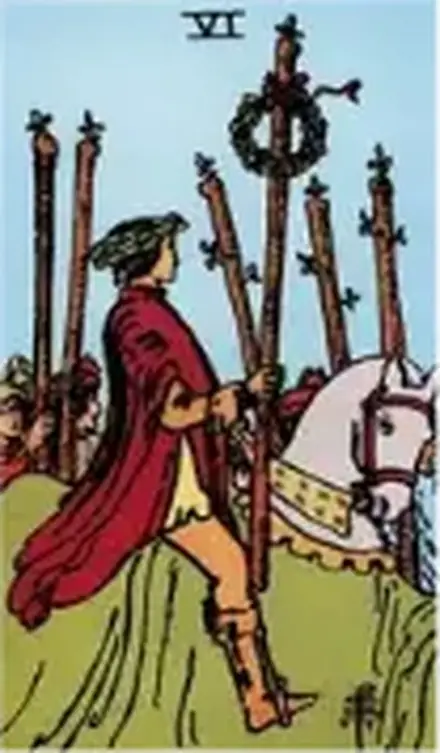
The Six of Wands is victory in plain sight: the winner’s return, public applause and the confidence that comes when hard work is rewarded.
Draw this card · Its correspondences
- Arcana: Minor, number 6
- Suit and element: Wands, Fire
- Golden Dawn title: Lord of Victory
- Sephirah: Tiphareth
- Decan: Leo II, Jupiter (10° to 20° Leo)
- Keywords: Success, public recognition, progress, confidence
- Yes or no?: Yes
- Archetype: The Returning Victor
What the card shows
In the deck Pamela Colman Smith drew for Arthur Edward Waite in 1909, the Six of Wands shows a rider moving forward on a white horse. He wears a laurel wreath on his head and holds up a wand with a second laurel wreath tied to it with ribbons. The horse is covered by a green caparison that reaches almost to its hooves. Around him walk several men on foot, raising their own wands, so that together they make up the six of the number. The sky is blue and the scene has the air of a parade.
Each element has a reading. Laurel has crowned victors since antiquity, and here it appears twice, on the rider’s head and at the top of his wand, so that everyone can see it. The white horse is linked with nobility and a clean victory. The green cloth recalls that triumph brings growth. The men on foot matter as much as the rider. Without them there would be no recognition, and their presence suggests the victory belongs to the group as well. Waite speaks of a victor triumphant and of great news, of expectation crowned by its own desire.
The Golden Dawn called this card the Lord of Victory and placed it in Tiphareth, the sefirah of the centre, harmony and beauty. Its decan is the second of Leo, ruled by Jupiter: fire that shines before others, enlarged by the planet of abundance and good fortune. After the scuffle of the Five, the suit finds its balance.
Six of Wands upright
Upright, the Six of Wands reads as success that gets recognised. The effort has paid off and people can see it: applause, good news, an award, a promotion, a favourable review, a project that succeeds in full view. Tradition stresses the public side of the triumph. Winning in private brings satisfaction. Winning in front of others brings prestige, and this card speaks of the second.
In a spread it usually marks a moment of confidence. You feel sure of yourself, you know you are on the right track and you notice other people starting to follow or support you. It comes after a struggle, which is why the Six is best understood beside the Five that precedes it. The contest between equals ends with someone on horseback and the others walking alongside. There is leadership here, and it is leadership people accept.
The card has its shadow too, and it pays to look at it calmly. The rider sits higher than everyone else, and that height can turn into pride. Applause depends on whoever is clapping. Tradition reminds us that public victory brings visibility, and visibility brings envy and new expectations.
As advice, the Six of Wands invites you to enjoy recognition openly and share it with those who walked beside you. It also reminds you that the parade lasts a day. The next stage begins when you climb down from the horse.
Six of Wands reversed
Not every school reads reversals. Many readers use only upright cards and let the neighbouring cards add nuance. Those who do read the Six of Wands reversed tend to take it in one of two ways.
The first is recognition that never arrives. The work is done and nobody sees it, someone else takes the credit, or the good news is delayed again and again. Waite lists apprehension and indefinite delay among the reversed meanings, and that uneasy waiting fits here.
The second is victory going to your head. The triumph is real, and it is lived with arrogance or a constant hunger for approval, which drives away the people who were walking alongside.
In both cases the advice is to separate the worth of your work from other people’s applause, and to look after those who helped you win.
In love
In love, the Six of Wands reads as a season of shared pride. For couples it can point to a relationship that grows stronger in full view: meeting the family, announcing a commitment, getting through a hard patch together and coming out stronger. There is mutual admiration and a wish to be seen together.
If you are single, the card speaks of confidence and appeal: a time when you feel good about yourself and it shows. It can also suggest that someone is noticing you for your achievements or your self-assurance. The Six of Wands as feelings is admiring and proud of the other person.
Reversed, in love
Reversed in love, the Six of Wands points to a lack of recognition within the couple, competition over who shines brighter, or a relationship more concerned with appearances than with what it actually lives. The advice is to value your partner in private as much as in public.
Career and money
For career and money, the Six of Wands reads as a visible achievement: a promotion, an applauded project, a major sale, a strong review or an offer that confirms the worth of your work. It is a favourable card for presenting work, negotiating from strength and asking for what you deserve. Use the good impression to take the next step.
Reversed, in career
Reversed, it points to merit that goes unrecognised, a reward that is delayed, or a success that stirs resentment in the team. The advice is to document your achievements and rely on more than applause.
Health and mood
For health and mood, the Six of Wands is linked with regained confidence and the satisfaction of having come through a difficult stretch. It reads as a good moment to acknowledge progress, however small. No card can diagnose anything. For any symptom or worry, speak to a health professional.
Yes or no? Yes
The Six of Wands reads as a clear yes. Tradition counts it among the most favourable cards in the suit: it says effort will bring results and that those results will be visible. If you are asking whether something will go well, whether good news is coming or whether you will win a competition, the card points to victory.
Ask the card: a yes or no tarot reading with one card or three.
The archetype: The Returning Victor
As an archetype, the Six of Wands is the hero coming home after a win. It embodies the champion, the acclaimed general, the athlete on a lap of honour, the writer accepting a prize before a full hall. Its essential trait is that the triumph is seen. The Six’s character exists through the eyes of others: those walking beside them, those waiting in the square, those watching with envy from a window.
In story structure, the card fits two very different places. It can be the happy ending of an underdog story, the scene of recognition the reader has been waiting for over hundreds of pages. It can also be the start of a fall. Many tragedies open with a parade. The hero returns victorious, the crowd cheers, and in that very moment the plots begin to form. The laurel crown draws looks, and not all of them are kind.
The archetype’s dramatic interest lies in that double face. The victor of the Six of Wands has to decide what to do with victory: share it with those who walked on foot, or climb higher still. A writer can play with the distance between the hero on horseback and the people around him, because that distance has room for loyalty, admiration, resentment and betrayal.
In literature
- Julius Caesar (William Shakespeare, 1599). The play opens with the people of Rome celebrating Caesar’s triumphant return. Soon after, Antony offers him a crown three times, and he refuses it before the crowd. Shakespeare shows the unsettling side of the Six of Wands: the higher the victor rises, the faster those who fear his glory begin to organise.
- Bel-Ami (Guy de Maupassant, 1885). Georges Duroy arrives in Paris with nothing and climbs through journalism and the salons on charm and calculated alliances. The novel ends with a lavish wedding in front of all Paris, which looks on him as a winner. It is the Six of Wands seen with irony: public success, and the price nobody applauds.
- The Hunger Games (Suzanne Collins, 2008). Katniss survives the arena and comes home a victor, with parades, interviews and cameras trailing her. Collins shows that public triumph is also a stage. The victor’s image belongs to whoever is watching, and Katniss will have to learn how to turn it to her own advantage.
For writers
The conflict
The Six of Wands sets up a conflict between victory and what people expect from the victor. The character has won, and now everyone is watching: supporters want their share, rivals look for the weak spot and the public demands that they keep shining. It works best when the triumph is deserved and still complicates the protagonist’s life. To build it, think about who walks beside the horse on foot and what they want in return.
The twist
As a plot twist, the card serves recognition that arrives at the worst moment, or a parade that hides a threat. One effective variation shows the victory through the eyes of one of the men on foot: the friend who fought as hard as the hero and watches someone else take the crown. That viewpoint turns a scene of celebration into the origin of a rivalry.
Prompts
- Write a scene of public triumph narrated by someone in the crowd who knows the victor’s secret.
- Give your protagonist the recognition they have always wanted, and let them discover in that same scene that it no longer matters to them.
- Tell the day after a great victory, when the applause has faded and someone knocks at the door to collect on a favour.
Its correspondences
- Element: Fire. Source: Golden Dawn (tradition).
- Sephirah: Tiphareth. Source: Golden Dawn (tradition).
- Decan: Leo II. Source: Golden Dawn (tradition).
Combinations
Six of Wands and The Sun
The Six of Wands with The Sun reads as public, well-earned triumph. There is recognition, joy and the satisfaction of seeing your effort valued in broad daylight; it is one of the most favourable pairs in tarot.
Six of Wands and The Chariot
The Six of Wands beside The Chariot strengthens success and recognition. The pair reads as a visible victory, celebrated by others, after sustained effort steered with a firm hand.
Six of Wands and Five of Wands
Preceded by the Five of Wands, the Six closes the sequence of struggle: competition between equals ends with a clear winner and the support of those who were rivals just before.
Six of Wands and Seven of Wands
The Six followed by the Seven of Wands warns that victory has to be defended. After recognition come those who want the same position, so prepare to hold your ground.
Six of Wands and Judgement
With Judgement, recognition arrives like a summons: old work is finally valued, a forgotten merit is acknowledged, or a whole chapter of life receives its favourable verdict at last.
Six of Wands and Nine of Cups
The Nine of Cups beside the Six of Wands reads as a wish come true that is also celebrated in public: personal satisfaction and prestige at the same time.
Six of Wands and The Devil
The Devil beside the Six of Wands points to the dark side of triumph: dependence on applause, vanity, or success won at the cost of something you would rather not look at.
Frequently asked questions
What does the Six of Wands mean in tarot?
The Six of Wands stands for victory recognised in public: success after effort, the applause of others and the confidence that comes from seeing your work rewarded. Tradition counts it among the most favourable cards in the suit of Wands, with a warning to keep triumph from turning into pride.
What does the Six of Wands mean in love?
In love it reads as shared pride: a relationship that strengthens in full view, mutual admiration and a wish to be seen together. For singles, it speaks of self-assurance and appeal. Reversed, it points to competing to shine or a lack of recognition.
Is the Six of Wands a yes or no card?
It reads as a clear yes. The card says effort will bring results and that the results will be visible. It is especially favourable for questions about competitions, exams, presentations or good news you are waiting for.
What does the Six of Wands reversed mean?
Readers who use reversals usually see it as delayed recognition, credit taken by someone else, or a victory lived with arrogance. The advice is to separate the value of your work from other people’s applause and to look after those who helped.
What are the Six of Wands’ decan and Golden Dawn title?
In the Golden Dawn system, the Six of Wands is called the Lord of Victory. It corresponds to the second decan of Leo, 10° to 20°, ruled by Jupiter, and to Tiphareth, the sefirah of harmony at the centre of the Tree of Life.
What does the laurel wreath in the Six of Wands mean?
Laurel has been the classic symbol of the victor since antiquity. On the card it appears twice, on the rider’s head and at the top of his wand, to stress that the triumph is public and that everyone can see it.
Do your readingPrevious: Five of Wands · Next: Seven of Wands
The 14 cards of Wands
- Ace of Wands
- Two of Wands
- Three of Wands
- Four of Wands
- Five of Wands
- Six of Wands
- Seven of Wands
- Eight of Wands
- Nine of Wands
- Ten of Wands
- Page of Wands
- Knight of Wands
- Queen of Wands
- King of Wands
By Style Optimizer · published November 22, 2026.