Tarot / The 78 cards / Wands / Knight of Wands
Knight of Wands: tarot card meaning, upright and reversed
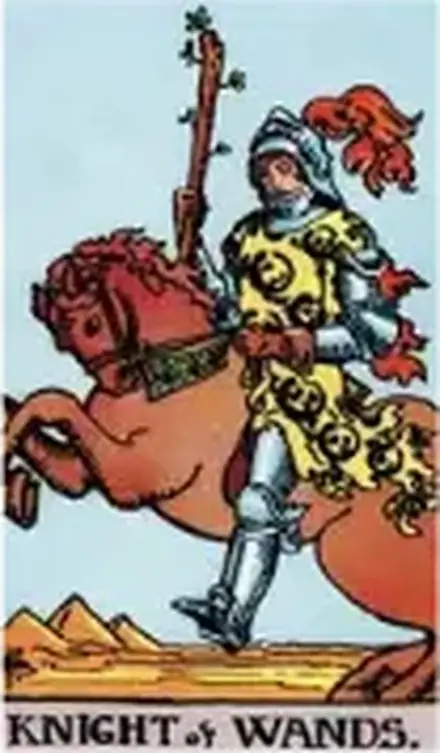
The Knight of Wands is passion in motion: the urge to set off, swift action and energy that leaps before it has a chance to think twice.
Draw this card · Its correspondences
- Arcana: Minor, court card (Knight)
- Suit and element: Wands, Fire
- Golden Dawn title: Lord of the Flame and the Lightning
- Nature: Fire of Fire
- Sephirah: Chokmah
- Signs: Scorpio, Sagittarius
- Keywords: Energy, passion, impulsiveness, action, adventure
- Yes or no?: Yes
- Archetype: The Headlong Adventurer
What the card shows
In the deck Pamela Colman Smith drew for Arthur Edward Waite in 1909, the Knight of Wands rides a horse that rears or leaps toward the left of the card. The rider wears armour with a yellow tunic over it, printed with black salamanders. Red plumes stream back from his helmet like flames. In his hand he carries a short wand with green shoots. In the background, in a desert landscape, rise three pyramids or mounds, the same ones that stand behind the Page of the suit.
Each element carries a traditional reading. The horse in full spring is the key to the character: Waite writes that the motion of the animal reveals the nature of its rider. The salamanders, spirits of fire for the alchemists, show that the knight lives in his element; some readers note that their tails do not quite close into a circle, like a cycle not yet complete. The blazing plumes are visible passion. The short wand suggests he is armed and travelling at the same time, with no appetite for war. The pyramids speak of distant lands and of a journey.
In The Pictorial Key to the Tarot (1910), Waite links the card with departure, absence, flight, emigration and change of residence. The Golden Dawn swaps King and Knight: its Knight is the fire of the suit and its King is the air. That is why this card there is the Lord of the Flame and the Lightning, fire of fire, placed in Chokmah and ruling the degrees that run from Scorpio into Sagittarius.
Knight of Wands upright
Upright, the Knight of Wands reads as energy on the move. It is passion setting off, the quick decision, the trip, the house move, the project launched before every detail is nailed down. The modern reading of the court cards gives the Knights action and movement, and in Wands that action has the intensity of fire: fast, brave and sometimes rash.
In a spread it often marks a change of scene. Waite stresses departure and emigration, and later tradition widens this to any kind of leaving: quitting a job, starting over in another city, setting out on an adventure. It can also point to a very busy stretch, with plans moving fast and little patience for paperwork.
The Knight of Wands as a person reads as someone passionate, charismatic, self-assured and in a hurry. They love a challenge, get bored with routine and bring energy wherever they go. They are generous and brave, and impulsive too: they promise a lot, start with a bang and sometimes leave before the job is done. Waite describes him as a friendly young man. In a story, he would be the friend who suggests a midnight road trip or the colleague who talks everyone into launching the project.
Next to calm cards, such as Temperance, the knight’s fire finds its measure. Next to fast cards, such as the Eight of Wands, everything speeds up even more.
As advice, the card asks you to seize the momentum and get moving. It also reminds you to look at the ground before you jump.
Knight of Wands reversed
Not every school reads reversals. Many readers use only upright cards and let the neighbouring cards add nuance. Those who do read the Knight of Wands reversed tend to take it in one of two ways.
The first is an impulse that runs out of control. Haste, recklessness, decisions made in the heat of the moment that cost dearly later, quarrels born of impatience. For the reversed card Waite speaks of rupture, division, interruption and discord, and modern readers take it as fire burning whatever it touches.
The second is the thwarted journey: plans delayed, a move that falls through, energy with no outlet that turns into frustration.
Either way, the advice points to the same place. Stop for a moment, choose your direction and pace your strength so you reach the end of the road.
In love
In love, the Knight of Wands reads as passion, pursuit and a relationship that moves fast. For couples it can point to an intense season, a trip together or a shared change of life, such as moving somewhere new. Tradition gives the card a seductive, adventurous air.
If you are single, the Knight of Wands often describes someone who arrives full of energy, sweeps you off your feet and lives in the moment. The Knight of Wands as feelings is ardent, impatient and very much in the present. The card carries one warning in love: the flame is strong, and stability still has to prove itself.
Reversed, in love
Reversed in love, the Knight of Wands speaks of inconstancy, jealousy, quarrels sparked by impulse, or someone who vanishes as quickly as they arrived. As advice, it invites you to ask for actions as well as promises.
Career and money
For career and money, the Knight of Wands reads as initiative, ambition and projects that move quickly. It favours business travel, changing employers, sales and any task that calls for boldness. It can also point to an opportunity in another city. Financially it advises riding the momentum without risking more than you need to.
Reversed, in career
Reversed, it points to hasty decisions, clashes with colleagues or projects abandoned halfway. The advice is to check the numbers before you charge ahead.
Health and mood
For health and mood, the Knight of Wands is linked with abundant physical energy and the risk of overdoing it: doing too much, sleeping too little, getting injured by rushing. It reads as a call to move wisely and respect your rest. No card can diagnose anything. For any symptom or worry, speak to a health professional.
Yes or no? Yes
The Knight of Wands reads as a quick yes, especially for questions about travel, moving house, changing jobs or decisions that take courage. The card pushes you to move now. The nuance is its impulsiveness: the yes comes fast, so make sure the road is the right one before you set off at a gallop.
Ask the card: a yes or no tarot reading with one card or three.
The archetype: The Headlong Adventurer
As an archetype, the Knight of Wands is the character who leaps. They live in motion, chase adventure and turn every desire into immediate action. They may be the wandering hero, the reckless friend, the lover who comes and goes, the rebel who pulls everyone else along on a wave of enthusiasm. Wherever they appear, the story speeds up.
In story structure, the Knight of Wands usually drives the plot forward. This is the one who breaks the first act’s stagnation, who proposes the journey or commits the rash act that unleashes the conflict. As a protagonist, the classic arc is learning moderation. The impulse that makes them dazzling at first ends up putting them in danger, and they have to learn when to stop.
Its dramatic force lies in charisma. The reader enjoys the knight’s courage and dreads their mistakes in the same breath. That double reaction sustains many adventure novels and many love stories with uncertain endings. The Knight of Wands also lives in an intriguing tension with more cautious characters, since each needs something from the other.
For it to work in fiction, the haste has to have consequences. When the reader watches the character’s fire burn something precious and still loves them, the archetype comes alive.
In literature
- Don Quixote (Miguel de Cervantes, 1605). Alonso Quijano reads so many books of chivalry that one day he arms himself, mounts Rocinante and takes to the road. His habit of charging at windmills and flocks of sheep is the Knight of Wands pushed to the limit: pure passion, instant action and an idea that brooks no delay. Cervantes laughs at him and loves him.
- The Three Musketeers (Alexandre Dumas, 1844). D’Artagnan reaches Paris on a ridiculous horse with an enormous pride, and in a single day commits to fighting three musketeers. He is the young Knight of Wands: brave, impulsive, quick to fall in love. Dumas harnesses that energy to send the novel galloping from one adventure to the next.
- On the Road (Jack Kerouac, 1957). Dean Moriarty crosses America again and again without settling anywhere. He embodies the modern Knight of Wands: charisma, speed, hunger for life and an almost total inability to stay put. The narrator follows him, spellbound, and discovers along the way what all that hurry leaves behind.
For writers
The conflict
The Knight of Wands sets up a conflict between impulse and consequences. It works best when the character has a cause they burn for and surroundings that ask them to slow down: a family, a cautious partner in business, a lover who wants to stay. To prepare the card, let the reader feel the appeal of that energy first, so the price of the haste hurts when it comes due.
The twist
As a plot twist, the Knight of Wands is the sudden departure: someone who leaves without warning, a midnight flight, a journey that changes everything. It also works as the arrival of a stranger who sets everything in motion. The most interesting moment comes afterwards, when those left behind must decide whether to follow or rebuild their lives without the knight.
Prompts
- Write the night your character decides to leave town, and have them settle everything in under an hour.
- Tell the arrival of a rider or a stranger brimming with energy in a place that has not changed in years.
- Let one brave impulse of your protagonist save one situation and ruin another in the same scene.
Its correspondences
- Element: Fire. Source: Golden Dawn (tradition).
- Sephirah: Chokmah. Source: Golden Dawn (tradition).
- Sign: Scorpio. Source: Golden Dawn (tradition).
- Sign: Sagittarius. Source: Golden Dawn (tradition).
- Hexagram: 51 · The Arousing (Thunder). Source: Crowley, The Book of Thoth (modern system).
In the Golden Dawn the Knight is the fire of the suit and the King its air. Many modern readings of the Rider deck swap the two.
Combinations
Knight of Wands and The Chariot
The Chariot with the Knight of Wands speeds the movement up: travel, moves, quick decisions and clear progress. It is a pairing of victory through sheer drive that asks for a little caution so you keep control.
Knight of Wands and Eight of Wands
With the Eight of Wands, everything goes faster still. The pair reads as news arriving quickly, imminent journeys and projects moving forward without pause.
Knight of Wands and Temperance
Temperance beside the Knight of Wands gives measure to the fire. The pair reads as decisive action that is well paced, with energy to advance and patience to avoid burning out.
Knight of Wands and Page of Wands
With the Page of Wands, curiosity turns into adventure. The pair reads as learning that leads to travel, or a young idea that someone with drive decides to carry forward.
Knight of Wands and Knight of Cups
The Knights of Wands and Cups together speak of passion and romance, of someone who arrives with both force and feeling, or of a choice between impulse and the heart.
Knight of Wands and Five of Swords
Next to the Five of Swords, impulsiveness ends in conflict. The pair reads as an argument won at other people’s expense and warns against words spoken in anger.
Knight of Wands and The Fool
With The Fool, the journey is certain and the destination unknown. The pair reads as an adventure begun with great enthusiasm and almost no plan.
Frequently asked questions
What does the Knight of Wands mean in tarot?
The Knight of Wands stands for passion in motion: the urge to set off, swift action and energy that leaps without waiting. Tradition links it with travel, house moves and change. It belongs to the suit of Wands, which corresponds to fire.
What does the Knight of Wands mean in love?
In love it reads as passion, pursuit and a relationship that moves fast. For couples it speaks of intensity or a shared change of life; for singles, of someone who sweeps you off your feet. The warning is consistency: the flame is strong and stability remains to be seen.
What is the Knight of Wands like as a person?
It reads as someone passionate, charismatic and brave, with lots of energy and little patience. They seek challenges, get bored with routine and spread enthusiasm. They are impulsive too: they start strong and sometimes leave before finishing.
Is the Knight of Wands a yes or no card?
It reads as a quick yes, especially for questions about travel, moving house or brave decisions. The nuance is haste: check the road before you set off at a gallop.
What does the Knight of Wands reversed mean?
Readers who use reversals usually see it as runaway impulsiveness, hot-headed decisions and quarrels, or as a trip or plan that falls through. Waite speaks of rupture and interruption. The advice is to pause and choose your direction.
What are the Knight of Wands’ Golden Dawn correspondences?
The Golden Dawn swaps King and Knight: its Knight is the fire of the suit and its King is the air. Here the Knight is the Lord of the Flame and the Lightning, fire of fire, in Chokmah, ruling the degrees from Scorpio into Sagittarius.
Do your readingPrevious: Page of Wands · Next: Queen of Wands
The 14 cards of Wands
- Ace of Wands
- Two of Wands
- Three of Wands
- Four of Wands
- Five of Wands
- Six of Wands
- Seven of Wands
- Eight of Wands
- Nine of Wands
- Ten of Wands
- Page of Wands
- Knight of Wands
- Queen of Wands
- King of Wands
By Style Optimizer · published November 22, 2026.