Tarot / The 78 cards / Cups / Five of Cups
Five of Cups (5 of Cups): tarot card meaning, upright and reversed
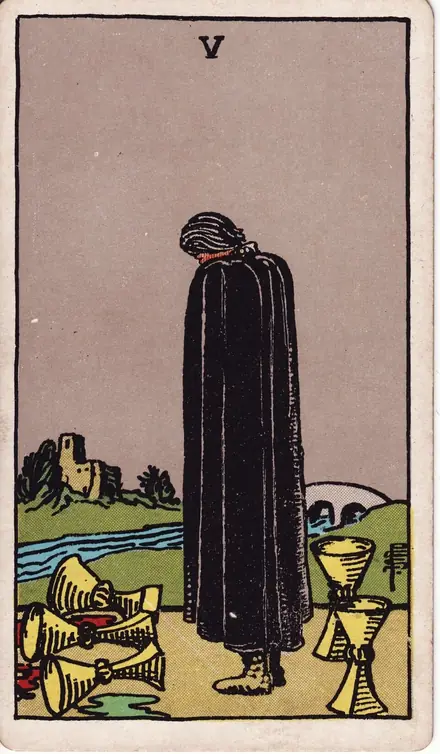
The Five of Cups is grief for what has spilled, eyes fixed on the loss, while two cups still stand upright behind the mourner, waiting.
Draw this card · Its correspondences
- Arcana: Minor, number 5
- Suit and element: Cups, Water
- Golden Dawn title: Lord of Loss in Pleasure
- Sephirah: Geburah
- Decan: Scorpio I, Mars (0° to 10° Scorpio)
- Keywords: Loss, regret, disappointment, grief
- Yes or no?: Not for now
- Archetype: The Mourner Who Faces Away
What the card shows
In the deck Pamela Colman Smith drew for Arthur Edward Waite in 1909, the Five of Cups shows a single figure wrapped in a long black cloak, standing with head bowed. In front of them lie three fallen cups, and a red and green liquid has spilled from them. Behind, out of sight, two cups remain standing. To the right runs a wide river; a stone bridge crosses it and leads to a tower or small fortified house on the far bank. The sky is a pale, even grey with no sun.
Each detail has its reading. The black cloak is mourning, and also the gesture of shutting oneself in: the figure covers themselves entirely and leaves the landscape outside. The three overturned cups are what has been lost, what can no longer be gathered up; the spilled wine, red and green, is linked with passion and with the hope that has drained away with it. The two upright cups are what survives, and the key to the card is that the figure has turned their back on them. The river is the water of the suit turned into a current of emotion that divides, and the bridge shows that a path leads back to the house and to the life that goes on.
Waite summed up the card in a simple idea: something has been lost, and something remains; three are taken and two are left. He also connected it with an inheritance that falls short of expectations. The Golden Dawn called it the Lord of Loss in Pleasure and gave it the first decan of Scorpio, ruled by Mars, in the sefirah Geburah, severity.
Five of Cups upright
Upright, the Five of Cups reads as the time of mourning. Something you loved has been lost or spoiled: a relationship, an expectation, a friendship, a project you had poured your heart into. The card portrays grief as it feels at the start, eyes fixed on what spilled and no strength to look around. In tarot, the Five of Cups and sorrow go hand in hand, and the tradition asks that this time be respected.
The detail that gives the card its meaning stands behind the figure. Two cups remain. The loss is real, and at the same time something valuable is left that cannot yet be seen, because pain fills the whole field of vision. That is why the Five of Cups means partial loss, regret and disappointment, and also the possibility of turning around when the moment comes.
In a spread it usually points to lament over something that might have gone differently. It appears when someone goes over what went wrong again and again, blames themselves or others, or sees a result fall short of what they hoped. Waite added the idea of a disappointing inheritance: what you receive comes with a bitter taste.
As advice, the card invites you to grieve what needs grieving and then take stock. What is still standing? Who is still close? The bridge in the background is a reminder that there is a way back to the house. Crossing it takes time, and no one has to hurry.
Five of Cups reversed
Many readers never use reversals. They read every card upright and let the neighbouring cards shade the meaning. Those who do read reversed cards tend to see the Five of Cups reversed as the end of mourning.
The figure begins to turn. The loss is accepted, forgiveness is given or asked for, and attention returns to the two cups still standing. Among the reversed meanings, Waite listed news, alliances, kinship, ancestry and return: someone or something comes back, or a bond with one’s family and past is restored.
There is also a less gentle reading. Reversed, the card can point to grief that is denied: you say everything is fine and carry on without having wept, or the lament drags on so long it becomes a habit. Waite also mentioned false projects. In that case the advice is to give sadness its proper place so that it can come to an end.
In love
In love, the Five of Cups reads as disappointment or heartbreak. For a couple, it can point to a fresh wound, a broken promise, or the sadness of seeing the relationship change from what it was. It speaks of mourning what has been damaged; the two upright cups remind you that part of the bond is still alive and the conversation is still possible.
For someone single, the card often appears after a breakup, when you keep looking back and find it hard to open up to someone new. The meaning of the Five of Cups in love asks you to give grief its time while keeping a window open.
Reversed, in love
Reversed, in love, it speaks of turning the page: forgiving, reconciling, or finally accepting that a story is over. It can also signal an ex coming back. The advice is to look calmly at whether that return brings something new or repeats what came before.
Career and money
For career and money, the Five of Cups reads as a setback that hurts more for what was hoped than for what is lost: a promotion that never comes, a rejected project, an investment gone wrong, a partner who leaves. The tradition advises separating the sorrow from the balance sheet. There are almost always resources, contacts or lessons left over that will serve the next step.
Reversed, in career
Reversed, it points to recovery: you learn from the mistake, revive an old contact or win back part of what was lost. The advice is to get moving again without carrying the guilt of the earlier failure.
Health and mood
For health and mood, the Five of Cups is linked with sadness, grief and the exhaustion a loss leaves behind. It reads as an invitation to look after yourself and lean on the people close to you. A tarot card cannot diagnose anything: if sorrow lingers or weighs too heavily, talk to a qualified health professional.
Yes or no? Not for now
The Five of Cups reads as a “not for now”. The question arrives at a time of loss or disappointment, and what you want is not turning out as you imagined. The two upright cups leave the door open: once the loss is accepted and you look at what remains, the situation can change. If the question is whether something deserves more mourning, the card invites you to turn around.
Ask the card: a yes or no tarot reading with one card or three.
The archetype: The Mourner Who Faces Away
As an archetype, the Five of Cups is the character who stays staring at what they lost. The widow who never leaves the house, the abandoned lover rereading old letters, the son who returns to an empty village, the man who replays every night the decision that changed everything. Their defining trait is the fixed gaze. Grief lends them enormous dignity and, at the same time, keeps them from seeing what stands behind them.
In the structure of a story, the card occupies the stretch that follows a fall: the dark valley after the loss, the scene where the protagonist hits bottom before deciding what to do with what is left. Its dramatic interest lies in the tension between two forces: grief, which asks you to stay, and life, which waits on the other side of the bridge. When the character turns around, the story starts moving again.
The Five of Cups is also a fine tool for building unforgettable secondary characters, the ones who never turn around and become monuments to their own wound. They work beautifully as mirrors for the protagonist, showing the fate that awaits if the bridge is never crossed.
For the archetype to move the reader, the loss has to matter to them. Show first what the three cups held, give it weight and colour, and let the reader spot the two upright cups before the character does. That small advantage creates the emotion of waiting: the reader longs for the character to turn.
In literature
- Great Expectations (Charles Dickens, 1861). Miss Havisham is the Five of Cups taken to its extreme. Jilted on her wedding day, she stops the clocks, keeps wearing the dress and leaves the cake to rot on the table. Her whole life revolves around the spilled cups, and her house becomes a monument to a loss she never stops staring at.
- The Remains of the Day (Kazuo Ishiguro, 1989). Stevens, an ageing butler, drives across England and slowly admits what his loyalty cost him: a misplaced devotion and a love he let pass. On a pier at dusk he weeps for the spilled cups. A stranger tells him the evening is the best part of the day, and he begins to turn around.
- The Year of Magical Thinking (Joan Didion, 2005). Didion writes the year that followed her husband’s sudden death, while their daughter lay seriously ill in hospital. She records how the mind refuses to accept the loss, how she keeps his shoes in case he comes back. It is a clear-eyed portrait of grief and of the slow turn towards what remains.
For writers
The conflict
The Five of Cups sets up a conflict between loyalty to what was lost and the need to go on living. The character feels that to stop mourning would be to betray the one who left, or what once was. It works best when what still stands is concrete and close at hand: a child, a friend, a trade, an unopened letter. The more visible it is to the reader, the more it shows that the character has turned their back on it.
The twist
As a plot twist, the card suggests the instant the character turns and discovers the two cups. It might be an object that turns up, a visit, a remark made in passing. It also allows a more bitter turn: someone reveals that the spilled cups were never full, and the grief changes its meaning. The bridge in the background makes a good closing image: a path that exists and has yet to be crossed.
Prompts
- Write a scene in which your character describes in detail what they lost, while the reader glimpses, at the edges of the scene, everything they still have.
- Tell the story of a disappointing inheritance: someone opens a will expecting one thing and receives another that, over the years, proves more valuable.
- Have your protagonist cross a real bridge to visit someone they have not seen in years, and let the conversation never name the loss that divided them.
Its correspondences
- Element: Water. Source: Golden Dawn (tradition).
- Sephirah: Geburah. Source: Golden Dawn (tradition).
- Decan: Scorpio I. Source: Golden Dawn (tradition).
Combinations
Five of Cups and Death
The Five of Cups with Death reads as deep mourning for something that has ended completely. Death confirms the ending; the Five recalls that two cups still stand and that, once grief has had its time, there is life on the other side.
Five of Cups and Judgement
Beside Judgement, the Five of Cups speaks of waking up after a long sorrow. It reads as the moment to turn around, to hear the call to begin again, and to leave behind a lament that has lasted too long.
Five of Cups and The Star
With The Star, loss finds consolation. It reads as a slow and serene healing: the person begins to look ahead and regains hope in what may still come.
Five of Cups and Three of Swords
The Three of Swords beside the Five of Cups deepens the emotional wound. It reads as a painful disappointment, often through betrayal or a breakup, that needs time and company to close.
Five of Cups and Six of Cups
With the Six of Cups, grief looks to the past. It reads as nostalgia for a happy time now gone, and also as the comfort that comes from remembering the people who were always close.
Five of Cups and The Hermit
The Hermit with the Five of Cups points to grief lived in solitude. The pairing asks you to balance withdrawal, which helps you understand, with the support of others, which helps you stand up again.
Five of Cups and Ace of Cups
With the Ace of Cups, what was lost makes room for a new affection. It reads as a heart filling again after sorrow, sometimes thanks to an unexpected person or feeling.
Frequently asked questions
What does the Five of Cups mean in tarot?
The Five of Cups stands for loss, regret and grief. The figure on the card gazes at three spilled cups and fails to see the two still standing behind them. In the tradition it reads as real sorrow that still leaves something valuable to recover.
What does the Five of Cups mean in love?
In love it reads as disappointment or heartbreak: a breakup, a broken promise, or the sadness of seeing a relationship change. The two upright cups suggest that part of the bond is still alive and there is room to heal or begin again.
Is the Five of Cups a yes or no?
It reads as a “not for now”. The situation is marked by loss, and what you want is not turning out as expected. The answer can change once you accept what happened and look at what is still there.
What does the Five of Cups reversed mean?
Readers who use reversals usually see it as the end of mourning: acceptance, forgiveness, reconciliation or someone’s return. It can also point to grief that is denied or drawn out too long, and that needs its own space before it can end.
What is the Five of Cups decan and Golden Dawn title?
In the Golden Dawn system, the Five of Cups is the Lord of Loss in Pleasure. It corresponds to the first decan of Scorpio, from 0° to 10°, ruled by Mars, and to the sefirah Geburah, severity, in the element of water.
Is the Five of Cups a negative card?
It is a sad card, and the tradition reads it with nuance. It speaks of partial loss: three cups fall, two remain. Its central message is that grief has an end, and that what still stands deserves your attention.
Do your readingPrevious: Four of Cups · Next: Six of Cups
The 14 cards of Cups
- Ace of Cups
- Two of Cups
- Three of Cups
- Four of Cups
- Five of Cups
- Six of Cups
- Seven of Cups
- Eight of Cups
- Nine of Cups
- Ten of Cups
- Page of Cups
- Knight of Cups
- Queen of Cups
- King of Cups
By Style Optimizer · published November 22, 2026.