Tarot / The 78 cards / Swords / Ten of Swords
Ten of Swords (10 of Swords): tarot card meaning, upright and reversed
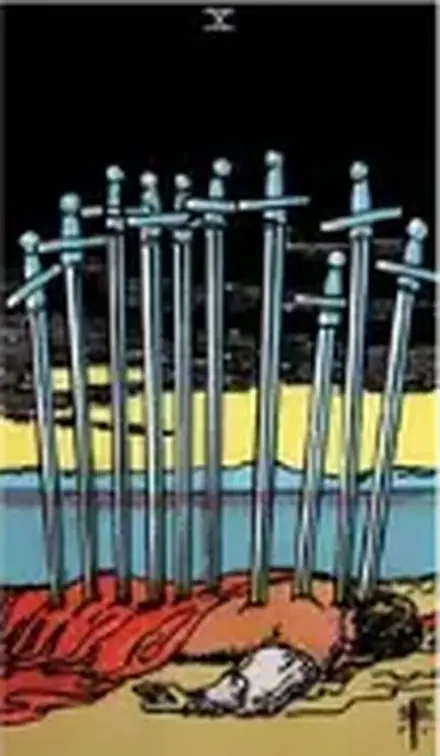
The Ten of Swords is rock bottom: a betrayal or defeat that ends a whole chapter, with the first light of day already on the horizon.
Draw this card · Its correspondences
- Arcana: Minor, number 10
- Suit and element: Swords, Air
- Golden Dawn title: Lord of Ruin
- Sephirah: Malkuth
- Decan: Gemini III, Sun (20° to 30° Gemini)
- Keywords: Betrayal, a painful ending, crisis, collapse
- Yes or no?: No
- Archetype: The Fallen at Dawn
What the card shows
In the deck Pamela Colman Smith drew for Arthur Edward Waite in 1909, the Ten of Swords shows a man lying face down on a shore, ten swords driven in a row along his back, from the nape of his neck to his waist. A red cloth covers part of his body. The upper half of the sky is black, without a single star. Below, above still water and bluish mountains, a band of yellow announces the dawn.
Each detail has its reading. Ten swords are more than enough to bring anyone down. The card exaggerates on purpose, and the tradition reads it as excess, the ending that comes when there is nothing left to wound. The black sky is the worst moment. The golden band is the other half of the card, the half many people overlook: the night is ending. The calm water says the storm has passed. The red cloth is the life and passion that remain beneath the defeat. The man’s right hand curls its fingers in a gesture close to the blessing of The Hierophant, as if even here some dignity or meaning survived.
In The Pictorial Key to the Tarot (1910), Waite describes it soberly and notes that the card does not especially signify violent death. He gives it pain, affliction, tears, sadness and desolation. The Golden Dawn called it the Lord of Ruin, placed it in Malkuth, the last sephirah, and gave it the third decan of Gemini, ruled by the Sun. That Sun of the decan seems to be drawn on the horizon.
Ten of Swords upright
Upright, the Ten of Swords reads as the lowest point of a situation. Something ends, and ends completely: a project, a relationship, a struggle that has dragged on too long, an idea about yourself that no longer holds. The tradition links it with betrayal, the stab in the back and the sense of having taken more damage than you deserved. The card’s keywords are betrayal, painful ending, crisis and collapse.
The key nuance lies in the number. Ten closes the suit’s series and, on the Tree of Life, corresponds to Malkuth, the concrete world where everything finally takes form. So the meaning of the Ten of Swords is often summed up this way: the mind has reached the end of its road. The worries, conflicts and sharp words of the earlier cards have become facts. There is nothing left to fear, because the feared thing has happened.
That is why many readers consider it, for all its harshness, a card of relief. After the Nine, which is the anguish of imagining the worst, the Ten is the worst already done, and with it the waiting ends. In a spread it usually advises giving up a lost battle, accepting the ending and resisting the urge to get up too soon. First the swords have to come out, one by one.
Ten of Swords reversed
Many readers never read reversals and let the surrounding cards supply the nuance instead. Those who do usually read the Ten of Swords reversed as the start of recovery.
The image helps: turned upside down, the swords seem to fall from the man’s back. It reads as the moment you start to breathe again, to ask for help, to tell what happened and to understand it. Waite gives the reversed card advantage, profit, success, favour, power and authority, adding that none of it is permanent: a real improvement that needs looking after.
There is a second, less gentle reading. The Ten reversed can point to an ending that resists: someone who refuses to accept that something is over and keeps returning to the same wound. In that case the advice is the upright card’s, stated more clearly still: acknowledge the ending so you can walk out of it.
In love
In love, the Ten of Swords reads as the end of a relationship or of a chapter within it. With a partner it can point to a betrayal discovered, a break-up with no way back or the exhaustion of having the same fight forever. It is a harsh card, and the tradition also reads it as release: the uncertainty ends and healing can begin.
If you are single, it usually speaks of truly closing an old story, of no longer rereading old messages and of accepting that what hurt can no longer be fixed. The dawn in the background invites you to look ahead calmly.
Reversed, in love
Reversed in love, the card speaks of recovery after a break-up or disappointment: sleep returns, trust comes back, you understand what happened. It can also point to returning to a relationship that already did harm. The advice is to tell healing apart from going back to the wound.
Career and money
For career and money, the Ten of Swords reads as the end of a project, a dismissal, unfair competition or a deal that collapses. It can also show the exhaustion of someone who has carried everything for too long. The tradition advises accepting the loss, reviewing what was learned and holding off on big decisions while it still hurts.
Reversed, in career
Reversed, it shows improvement after a bad run: an offer arrives, part of what was lost comes back, a conflict closes. Waite warns that such gains are passing, so the advice is to use them to build something more stable.
Health and mood
For health and mood, the Ten of Swords is linked with the exhaustion that follows a long stretch of strain, and with the feeling of having nothing left. It reads as an invitation to stop, rest and ask for support. No card can diagnose anything: for any symptom or distress, emotional distress included, the right person to see is a health professional.
Yes or no? No
The Ten of Swords reads as a clear no. What you are asking about has ended or is about to, and the card asks you to accept it instead of pressing on. It is a no that brings some rest: the waiting is over and recovery begins. If the question is whether the worst is behind you, the card usually reads as yes.
Ask the card: a yes or no tarot reading with one card or three.
The archetype: The Fallen at Dawn
As an archetype, the Ten of Swords is the character who has lost everything and lies on the ground as the day begins. He is the one betrayed by his own people, the hero brought down by conspiracy, the one who trusted too much. When personified, the card usually has two faces: the victim who receives the swords, and the unseen hand that drove them in, which never appears in the picture.
In the structure of a story, the Ten of Swords holds the lowest point, the moment when all is lost. In many novels and screenplays it falls at the end of the second act: the plan has failed, the ally has become an enemy, the protagonist hits bottom. Its dramatic power lies in the contradiction the card shows: a defeated body beneath a sky that is starting to lighten. The reader feels the blow and, at the same time, senses that the story goes on.
The risk of this archetype in fiction is gratuitous cruelty, piling on misfortunes until the reader stops feeling them. The ten swords work when each one has a name: a friend who stayed silent, a letter that never came, the character’s own decision that also wounded. Then the fall reads as the sum of many small blows, and the dawn in the background is earned page by page.
In literature
- Julius Caesar (William Shakespeare, 1599). The assassination at the Capitol is the Ten of Swords made theatre: many conspirators, many daggers, and one that hurts more than all the rest, Brutus’s. The play goes on after the death, and in that second half the card’s dawn appears as the blow turns against those who struck it.
- Chronicle of a Death Foretold (Gabriel García Márquez, 1981). The whole town knows Santiago Nasar is going to be killed, and nobody stops it. The novel reconstructs the fall towards the morning of the crime, knife by knife, in full view of everyone. It is the card at its most collective: the betrayal also lies with those who kept quiet.
- The Count of Monte Cristo (Alexandre Dumas, 1844). Edmond Dantès is betrayed by his friend, his rival and an ambitious prosecutor on his wedding day, and ends up buried alive in the Château d’If. It is the Ten of Swords at the start of the story, and from that rock bottom the novel builds a long dawn.
For writers
The conflict
The Ten of Swords sets up a conflict between trust and betrayal, between what the character believed they had and what they actually had. It works best when the fall is the sum of many blows and at least one comes from the least expected person. To set it up, scatter the ten swords through the story: favours never returned, silences, a loyalty everyone takes for granted and nobody checks.
The twist
As a plot twist, the Ten of Swords is the total defeat that, from outside, looks like the end of the story. The richest moment comes just after: the first morning, when the character has nothing left to lose and can finally do what they never dared. The yellow band on the horizon is the clue. After rock bottom, the novel changes its light.
Prompts
- Write the morning after a betrayal from the ground, literal or figurative, with the light changing little by little across the scene.
- Name the ten swords: list ten blows your protagonist has taken and write only the smallest, the one nobody else would notice.
- Tell a character’s fall from the point of view of the person who drove in the last sword and is convinced they did the right thing.
Its correspondences
- Element: Air. Source: Golden Dawn (tradition).
- Sephirah: Malkuth. Source: Golden Dawn (tradition).
- Decan: Gemini III. Source: Golden Dawn (tradition).
Combinations
Ten of Swords and Wheel of Fortune
With Wheel of Fortune, the Ten of Swords marks the lowest point of a cycle. Together they read as the worst moment of a run of bad luck, from which the wheel can only rise. The advice is to wait for the turn without forcing it.
Ten of Swords and Death
With Death, the ending is clear and complete. Together they read as a chapter closing for good: Death brings the transformation and the Ten brings the pain of the last day, with the sky lightening behind.
Ten of Swords and Ace of Swords
The Ace and the Ten of Swords are the beginning and the end of the suit of air. Together they read as one way of thinking running out and another, sharper one born from what was learned in the fall.
Ten of Swords and The Tower
The Tower beside the Ten of Swords is one of the hardest pairs in tarot. The Tower brings the sudden collapse and the Ten the defeat it leaves; together they read as a crisis that forces you to start from scratch.
Ten of Swords and The Star
The Star after the Ten of Swords is the night ending. Together they read as healing and hope after a great loss: the thin band of dawn widens into a whole sky of light.
Ten of Swords and Judgement
With Judgement, the fallen one rises. The pair reads as a rebirth after hitting bottom, and as the moment you finally understand what happened and why.
Ten of Swords and Nine of Swords
The Nine and Ten of Swords together speak of anguish that comes true. They read as the passage from fearing the worst to living it, and so also as the end of an exhausting wait.
Ten of Swords and Three of Swords
With the Three of Swords, betrayal reaches the heart. Together they read as a romantic or family disillusionment that hurts deeply and needs time, words and company to heal.
Frequently asked questions
What does the Ten of Swords mean in tarot?
The Ten of Swords stands for a painful ending, betrayal and the lowest point of a situation. The tradition also reads it as the close of a chapter: the worst has already happened, and dawn is breaking on the card’s horizon.
What does the Ten of Swords mean in love?
In love it reads as a break-up, a betrayal discovered or the weariness of a relationship that has nothing left to give. It is a harsh card that also sets you free: the uncertainty ends and healing can begin.
Is the Ten of Swords a yes or no card?
It reads as a clear no: what you are asking about has ended or is about to end. If your question is whether the worst is over, the card usually reads as yes.
What does the Ten of Swords mean reversed?
Readers who use reversals usually see it as the start of recovery: the swords fall away and you can breathe again. Waite gives it a sense of advantage and success that does not last. It can also show a return to the same wound again and again.
Does the Ten of Swords mean death?
Waite notes that the card does not especially signify violent death. The tradition reads it as the end of a situation, a defeat or a betrayal, and never as a literal forecast about anyone’s life.
What is the decan and Golden Dawn title of the Ten of Swords?
In the Golden Dawn system, the Ten of Swords is the Lord of Ruin. It corresponds to the third decan of Gemini, 20° to 30°, ruled by the Sun, and to the sephirah Malkuth, the tenth on the Tree of Life.
Do your readingPrevious: Nine of Swords · Next: Page of Swords
The 14 cards of Swords
- Ace of Swords
- Two of Swords
- Three of Swords
- Four of Swords
- Five of Swords
- Six of Swords
- Seven of Swords
- Eight of Swords
- Nine of Swords
- Ten of Swords
- Page of Swords
- Knight of Swords
- Queen of Swords
- King of Swords
By Style Optimizer · published November 22, 2026.