Tarot / The 78 cards / Swords / Nine of Swords
Nine of Swords (9 of Swords): tarot card meaning, upright and reversed
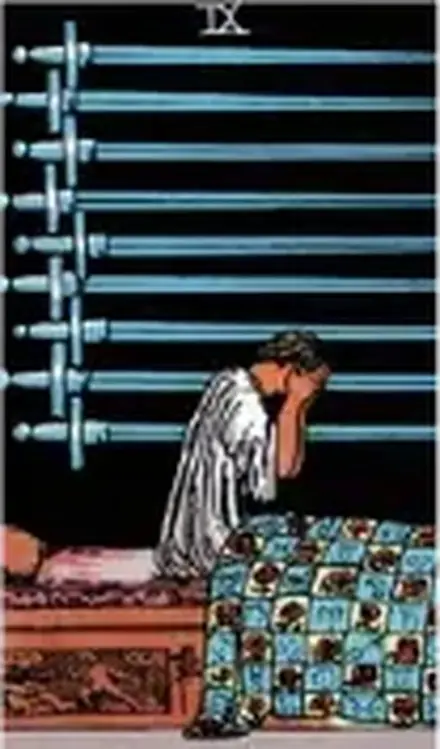
The Nine of Swords is the anguish of 3 a.m.: fears that grow in a dark bedroom until they weigh far more than reality itself.
Draw this card · Its correspondences
- Arcana: Minor, number 9
- Suit and element: Swords, Air
- Golden Dawn title: Lord of Despair and Cruelty
- Sephirah: Yesod
- Decan: Gemini II, Mars (10° to 20° Gemini)
- Keywords: Anxiety, worry, fear, nightmares
- Yes or no?: Not for now
- Archetype: The Sleepless One
What the card shows
In the deck Pamela Colman Smith drew for Arthur Edward Waite in 1909, the Nine of Swords shows a woman who has sat bolt upright in bed in the middle of the night. She wears a white nightgown and covers her face with both hands. Behind her, against a completely black background, nine swords hang horizontally one above another, like the bars of a window. None of them touches her. Her quilt is decorated with red roses and with the signs of the zodiac and the planets, and the side of the bed carries a carved panel in which one figure strikes down another.
The reading of the image rests on that contrast. The swords are on the wall, away from her body: the harm is happening inside the head of someone who cannot sleep. The black background is the small hours, the time when everything looks worse. The white nightgown suggests innocence or vulnerability. The roses and signs on the quilt are a reminder that, beneath the anguish, the world is still in order: the heavens turn, the seasons pass. The carved fight shows the nightmare, the scene the mind replays without rest.
In The Pictorial Key to the Tarot (1910), Waite presents it as a card of utter desolation and links it with failure, deception, disappointment and despair. The Golden Dawn called it the Lord of Despair and Cruelty, placed it in Yesod, the sephirah of the Moon and of images, and gave it the second decan of Gemini, ruled by Mars: a divided mind that war will not let rest.
Nine of Swords upright
Upright, the Nine of Swords reads as the anxiety, worry and fear that keep you awake. Its keywords are anxiety, worry, fear and nightmares. The card describes a very specific situation: someone awake at three in the morning, going over the same thing again and again, imagining the worst and feeling alone with it.
The meaning of the Nine of Swords carries a nuance the image makes very clear: the swords wound nobody. The threat lives mostly in the mind. That is why the tradition reads it as a card of real suffering whose cause is often exaggerated. Guilt, remorse over something said or done, dread of what tomorrow may bring: all of it swells in the dark and shrinks in daylight.
In a spread it usually asks for two things. The first is to test your fears against the facts, because this card tends to magnify problems. The second is to talk. Telling someone you trust what is worrying you breaks the loneliness the image shows. The Nine stands one step from the Ten, the end of the series, and if the anguish is tended to in time, that step may never be taken.
Nine of Swords reversed
Many readers never read reversals and let the surrounding cards supply the nuance instead. Those who do usually read the Nine of Swords reversed in one of two ways.
The first is relief. The night ends, sleep improves and you discover the fear was bigger than the problem. Waite gives the reversed card suspicion, doubt, reasonable fear and shame, which are emotions with names, easier to face directly.
The second reading is more serious: the anguish has become so habitual that it hides and goes unspoken. In that case the card invites you, more urgently, to seek help and to stop carrying the weight on your own.
In love
In love, the Nine of Swords is about jealousy, insecurity and sleepless nights of doubt. In a relationship it can point to fear of an affair that may exist only in your imagination, guilt over something hidden or an argument that keeps you awake. The card advises talking before you jump to conclusions.
If you are single, it usually speaks of the fear of being hurt again, of replaying an old break-up over and over, or of a loneliness that feels sharper at night.
Reversed, in love
Reversed in love, the card speaks of doubts beginning to clear: a conversation calms the jealousy, or you finally understand what happened. It can also point to unhappiness kept quiet. The advice is to put what troubles you into words.
Career and money
For career and money, the Nine of Swords reads as stress, fear of failure or worry about the bills. It can describe someone who takes work to bed and goes over it in the small hours. The tradition advises writing problems down, separating them and dealing with them one at a time in daylight.
Reversed, in career
Reversed, it shows pressure starting to ease: a problem turns out smaller than expected, or help arrives. It can also warn of exhaustion being disguised.
Health and mood
For health and mood, the Nine of Swords is linked with insomnia, anxiety and the fatigue of never resting. It reads as a call to protect your sleep and to avoid being alone with your worries. No card can diagnose anything: for any symptom, including anxiety or persistent sadness, the right person to see is a health professional.
Yes or no? Not for now
The Nine of Swords reads as “not yet”. The question comes from fear, and the card suggests that right now worry weighs more than the facts. It is wiser to wait until you can see things more calmly, test what you fear against reality and ask again once the night has passed.
Ask the card: a yes or no tarot reading with one card or three.
The archetype: The Sleepless One
As an archetype, the Nine of Swords is the character who cannot sleep. She is the figure who wakes with a start, who hears footsteps in the corridor, who replays a conversation until it becomes an accusation. She may be guilty or innocent. What defines her is that her own mind has turned against her. When personified, she is part sentinel and part prisoner, surrounded by bars she forged herself.
In the structure of a story, the card holds the dark night, the stretch where the character carries what they did or what they fear and has yet to act. It is the vigil before battle, the remorse after the crime, the wait for a diagnosis or a letter. Its dramatic power lies in the tension between what happens inside and what happens outside. Nothing occurs in the room, and still the reader senses enormous danger.
The risk of this archetype in fiction is getting stuck in complaint. A night of anguish told without variation tires the reader fast. It works better when the character’s mind produces concrete images, like the carving on the bed: a scene that keeps coming back, an object they cannot stop seeing, a sentence someone once said. It also gains force when the reader, like the character, is unsure whether the swords are real.
In literature
- Macbeth (William Shakespeare, 1606). After the king’s murder, Macbeth hears a voice cry that he shall sleep no more, and Lady Macbeth ends up sleepwalking, scrubbing hands that only she can see are stained. The play is a study of the Nine of Swords: guilt turned into insomnia and visions.
- The Tell-Tale Heart (Edgar Allan Poe, 1843). The narrator has killed an old man and hidden the body under the floorboards. When the police arrive, he begins to hear the dead heart beating, louder and louder, until he confesses. Poe draws the card exactly: a threat that lives inside the head and ends up becoming real.
- Crime and Punishment (Fyodor Dostoevsky, 1866). Raskolnikov spends much of the novel in a tiny room, feverish, plagued by terrible dreams and the constant suspicion that everyone knows what he did. Anguish is the real punishment before the punishment, and it only eases when he finally talks to Sonya.
For writers
The conflict
The Nine of Swords sets up an inner conflict between what the character fears and what is actually happening. It works best when the reader cannot be sure how much of the danger is real. To set it up, give the character something concrete to worry about, a guilt, a secret or a warning, and let the night enlarge it: the noises, the hours, the memory that replays the same scene.
The twist
As a plot twist, the Nine of Swords can go two ways. In one, the fear proves groundless and the character discovers they tortured themselves for nothing, which changes how they see the people around them. In the other, more unsettling, the anguish was an accurate hunch, and the next scene brings the Ten. Playing with that doubt keeps the reader awake, just like the woman on the card.
Prompts
- Write a single hour of your character’s insomnia, from three to four in the morning, with nothing happening outside their head.
- Have your protagonist carve, draw or describe the scene that haunts them, like the panel on the bed, and discover in doing so a detail they had forgotten.
- Tell the same night from the woman who cannot sleep and from the person sleeping beside her who knows nothing.
Its correspondences
- Element: Air. Source: Golden Dawn (tradition).
- Sephirah: Yesod. Source: Golden Dawn (tradition).
- Decan: Gemini II. Source: Golden Dawn (tradition).
Combinations
Nine of Swords and The Moon
The Moon beside the Nine of Swords speaks of sleepless nights and fears that grow in the dark. Together they read as anxiety fed by imagination, best shared with someone and tested against the facts.
Nine of Swords and Ten of Swords
The Nine and Ten of Swords together read as the passage from fearing the worst to living through it. It is a hard pair that also signals the end of an exhausting wait.
Nine of Swords and Eight of Swords
With the Eight of Swords, the anguish comes from feeling trapped. Together they read as a loop of thoughts that feed themselves; the way out starts with removing the blindfold and looking at what is really there.
Nine of Swords and The Star
The Star after the Nine of Swords is rest after a bad night. Together they read as calm, hope and a steadier view of whatever was causing so much worry.
Nine of Swords and The Devil
With The Devil, worry turns into obsession. The pair reads as a thought that chains you, often tied to guilt or a dependency, and advises asking for help.
Nine of Swords and The Sun
The Sun beside the Nine of Swords chases the night away. Together they read as the moment when, in full daylight, fears are seen for what they were and lose their power.
Nine of Swords and Queen of Cups
With the Queen of Cups, anguish finds comfort. Together they read as someone who listens without judging, or as your own ability to treat yourself gently through a hard time.
Frequently asked questions
What does the Nine of Swords mean in tarot?
The Nine of Swords stands for anxiety, worry and the fears that keep you awake. In the image the swords hang on the wall without touching the woman, so the tradition reads it as real suffering that the mind enlarges in the dark.
What does the Nine of Swords mean in love?
In love it reads as jealousy, insecurity, guilt or the fear of being hurt again. It often points to doubts that grow in the imagination more than in reality, and advises talking to your partner before jumping to conclusions.
Is the Nine of Swords a yes or no card?
It reads as “not yet”. The question springs from fear, and the card advises waiting until you can see things calmly, testing what you fear against the facts and asking again afterwards.
What does the Nine of Swords mean reversed?
Readers who use reversals usually see it as relief: the night ends and the fear proves bigger than the problem. Waite links it with doubt, suspicion and reasonable fear. It can also point to anguish that is being kept quiet.
What is the decan and Golden Dawn title of the Nine of Swords?
In the Golden Dawn system, the Nine of Swords is the Lord of Despair and Cruelty. It corresponds to the second decan of Gemini, 10° to 20°, ruled by Mars, and to the sephirah Yesod, the ninth on the Tree of Life.
Do your readingPrevious: Eight of Swords · Next: Ten of Swords
The 14 cards of Swords
- Ace of Swords
- Two of Swords
- Three of Swords
- Four of Swords
- Five of Swords
- Six of Swords
- Seven of Swords
- Eight of Swords
- Nine of Swords
- Ten of Swords
- Page of Swords
- Knight of Swords
- Queen of Swords
- King of Swords
By Style Optimizer · published November 22, 2026.