Tarot / The 78 cards / Swords / Two of Swords
Two of Swords (2 of Swords): tarot card meaning, upright and reversed
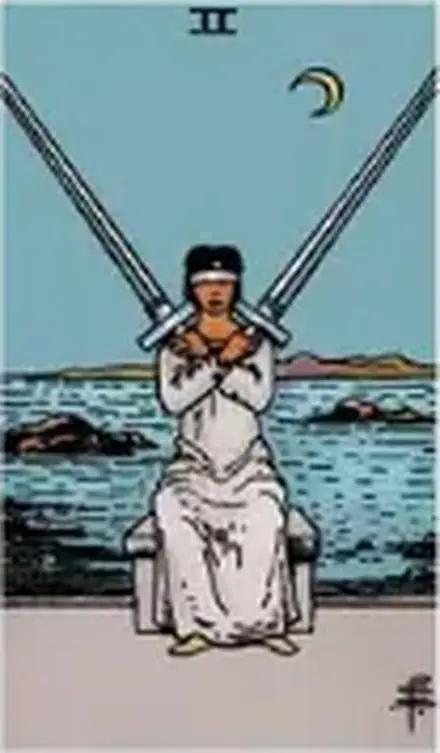
The Two of Swords is the decision on hold: two options in perfect balance, a blindfold, and a calm that lasts only while nobody moves.
Draw this card · Its correspondences
- Arcana: Minor, number 2
- Suit and element: Swords, Air
- Golden Dawn title: Lord of Peace Restored
- Sephirah: Chokmah
- Decan: Libra I, Moon (0° to 10° Libra)
- Keywords: Difficult decisions, weight, stalemate, denial
- Yes or no?: It depends
- Archetype: The Keeper of the Stalemate
What the card shows
In the deck Pamela Colman Smith drew for Arthur Edward Waite in 1909, the Two of Swords shows a woman seated on a grey stone bench at night, on the shore of the sea. She wears a pale robe and a white blindfold covers her eyes. Her arms are crossed over her chest and each hand holds a long sword. The two blades rise above her shoulders and open into an X. Behind her the water is still, broken only by a few rocks and small islands. High on the right shines a crescent moon.
Each detail has its reading. The blindfold says the decision is being made, or avoided, without looking: she is shielding herself from what she would see with open eyes. Crossed arms are a gesture of defence and also of balance, since if one hand gives way the whole pose collapses. The swords belong to the suit of air, so they are ideas and arguments of equal weight. The sea at her back holds the feelings she would rather not attend to, and the rocks are obstacles just below the surface. The crescent moon adds a note of something still taking shape.
In The Pictorial Key to the Tarot (1910), Waite describes a hoodwinked female figure balancing two swords upon her shoulders, and gives as meanings concord in a state of arms, equipoise, and also affection and intimacy. The Golden Dawn titled the card Lord of Peace Restored, placed it in Chokmah and gave it the first decan of Libra, ruled by the Moon, from 0° to 10° of the sign: the scales just brought to rest, with the Moon setting them gently swaying.
Two of Swords upright
Upright, the Two of Swords reads as a fragile truce. There are two paths, two arguments or two people, and you have reached a stalemate where any move seems to cost too much. The card shows the moment you choose not to choose. The arms cross, the eyes close and a calm holds for as long as nobody pushes.
The tradition gives it two faces. The first is peace achieved through balance, the peace the Golden Dawn calls restored: two forces cancelling each other out, a conflict brought to a halt, an agreement that holds. The second is deadlock: indecision that drags on, information avoided so you never have to act, denial of something you already know. In a spread, the neighbouring cards usually show which face weighs more.
The Two of Swords also speaks of defence. The figure is protecting herself from pain, from an uncomfortable truth or from outside pressure. For a while that can be healthy, a breathing space before you decide. Trouble starts when the pause becomes a habit and the blindfold becomes a way of life.
As advice, the card invites you to take the blindfold off gently. Gather the facts you are missing, notice what your body is telling you, name both options and accept that choosing one means letting go of the other. Often the simple act of looking is enough for the decision to become clear.
Two of Swords reversed
Many readers never read reversals and let the surrounding cards supply the nuance instead. Those who do usually read the Two of Swords reversed in one of two ways.
The first is balance breaking down. Built-up pressure overwhelms the figure, the blindfold slips and the decision arrives all at once, sometimes forced by circumstances. It can feel like relief or like disorientation, depending on how ready the person was to look.
The second follows Waite, who gives the reversed card imposture, falsehood, duplicity and disloyalty. Read this way, the Two of Swords reversed points to an agreement resting on a lie, a pretended neutrality or someone playing both sides. It can also show an overload of information that paralyses: so many opinions that your own voice gets lost.
Either way, the advice is to recover your own judgement and decide with what you already know.
In love
In love, the Two of Swords reads as a relationship on pause. With a partner it can point to a conversation you keep avoiding, a subject you both circle without touching, or a truce after a fight. It also appears when someone is torn between two people, or between staying and leaving, and would rather not face what they feel. There is peace, as long as nobody moves.
If you are single, the card describes a guarded heart. You cross your arms when someone approaches, afraid of repeating an old hurt, or you hover between two possibilities without stepping towards either. The Two of Swords in love invites you to lower your guard a little and listen to what you actually want.
Reversed, in love
Reversed in love, the card says the postponed decision can wait no longer: a truth comes out, a choice is forced or a deception is discovered. The advice is to be honest with yourself before you demand honesty from the other person.
Career and money
For career and money, the Two of Swords reads as a stalled decision: two offers, two projects or two partners you cannot choose between, or a negotiation stuck in stalemate. It can also show a workplace conflict that has frozen without being resolved. The tradition advises gathering the missing information, writing out both options with their costs and setting a date to decide.
Reversed, in career
Reversed, it points to a decision imposed from outside or an agreement that breaks down through disloyalty. Review contracts, verbal promises and whatever each side is taking for granted.
Health and mood
For health and mood, the Two of Swords is linked with the tension that builds when something important is put off: tight shoulders, light sleep, mental fatigue. It reads as an invitation to stop carrying the doubt in silence and to talk about it. No card can diagnose anything: for any symptom or worry, the right person to see is a health professional.
Yes or no? It depends
The Two of Swords reads as “it depends”. The card shows scales at rest: the answer exists, but you have yet to look at it or to act on it. While the situation stays in deadlock, nothing moves. If the question hinges on your own decision, the card hands it back to you. Yes or no will come once the blindfold is off.
Ask the card: a yes or no tarot reading with one card or three.
The archetype: The Keeper of the Stalemate
As an archetype, the Two of Swords is the character who plants herself between two forces and refuses to move. She can be the mediator who keeps peace between two camps by never taking sides, the judge who defers the sentence, the daughter who will not choose between her father and her mother, or the lover who has lived between two lives for years. Her strength is restraint. Her weakness is wilful blindness.
In the structure of a story, the card holds the moment just before the central decision. It is the threshold of the second act, when the protagonist already knows the dilemma and still resists owning it, or the waiting scene where two characters size each other up without striking. The dramatic tension comes from stillness. The reader sees the sea behind her, the rocks breaking the surface, the changing moon, and knows the balance cannot last.
As a person, the Two of Swords is calm on the outside and taut within, very able to reason and reluctant to feel. Usually loyal, discreet and a good negotiator, this character finds it hard to ask for help. The natural arc is learning to look, and the scene where the blindfold comes off is the one the reader is waiting for.
For the archetype to work, both swords have to carry real weight. If one option is plainly better, the deadlock looks like a whim. When both sides are right, every day of indecision has a price, and that price holds the story up.
In literature
- Hamlet (William Shakespeare, 1600). The prince knows what the ghost has asked of him and spends five acts weighing it: duty against doubt, revenge against conscience. Every argument he builds has a counterweight. Shakespeare turns the Two of Swords into the most famous stalemate in drama, and the price of the long pause is paid in bodies.
- Bartleby, the Scrivener (Herman Melville, 1853). Bartleby answers every request with “I would prefer not to” and stays motionless in his corner of the office. His polite refusal paralyses everyone around him, starting with the lawyer who tells the story. It is the Two of Swords pushed to the limit: a balance so closed that nothing can get in or out.
- The Age of Innocence (Edith Wharton, 1920). Newland Archer spends the novel between two women, May and Ellen, and between two ways of living. Each time he could decide, he crosses his arms and lets society choose for him. Wharton turns indecision into fate: the peace he preserves costs him the life he wanted.
For writers
The conflict
The Two of Swords sets up a conflict between two options of equal weight and a character who refuses to pick one. It works best when each option has someone behind it applying pressure: a business partner and a brother, a spouse and a lover, a duty and a desire. Seed the tension with the small costs of waiting: unanswered calls, deadlines passing, someone growing tired of standing by.
The twist
As a plot twist, the Two of Swords can reveal that the indecision was a decision all along. The character who seemed frozen had been choosing one sword by omission for months. Or the reverse: the balance everyone thought was solid rested on a lie, and once somebody takes off the blindfold the truce shatters in a single scene.
Prompts
- Write a scene where your protagonist holds the letter, message or evidence that would settle everything, and finds one excuse after another to leave it unopened.
- Tell a truce between two enemies through the eyes of the person holding it together in the middle, who knows the peace depends on staying perfectly still.
- Narrate the night someone takes off the blindfold, and make the first thing they see the thing that was behind them from the start.
Its correspondences
- Element: Air. Source: Golden Dawn (tradition).
- Sephirah: Chokmah. Source: Golden Dawn (tradition).
- Decan: Libra I. Source: Golden Dawn (tradition).
Combinations
Two of Swords and Ace of Swords
The Ace of Swords brings the clean cut the Two will not make. Together they read as the end of indecision thanks to a clear fact, a frank conversation or an idea that finally puts things in order.
Two of Swords and Justice
With Justice, the scales of the Two find their verdict. The pair reads as a postponed decision that can wait no longer: Justice asks you to remove the blindfold, weigh the facts and accept the consequences of choosing.
Two of Swords and The High Priestess
Beside The High Priestess, the deadlock reads as knowledge you already have and refuse to look at. The pair invites you to trust your intuition and listen to what you know in silence to break the stalemate.
Two of Swords and The Lovers
With The Lovers, a choice of the heart hangs in suspense. The pair reads as a decision between two people or two paths, put off for fear of losing one of them, that asks you to listen to your own desire.
Two of Swords and King of Swords
The King of Swords beside the Two reads as the firm judgement that breaks the deadlock. Sometimes it is you deciding with a cool head; sometimes it is a third party with authority who helps cut the knot.
Two of Swords and The Chariot
With The Chariot, the stillness of the Two breaks into motion. Together they read as a decision finally made and put into action, leaving doubt behind with willpower and a clear direction.
Two of Swords and Two of Cups
The Two of Cups beside the Two of Swords points to a bond at a standstill. Together they read as a possible reconciliation, or an agreement between two people that asks them to swap defence for trust.
Frequently asked questions
What does the Two of Swords mean in tarot?
The Two of Swords stands for the decision on hold: two options in balance and a person who covers her eyes to avoid choosing. The tradition reads it as a fragile truce and as deadlock, and advises gathering the missing information and making the call.
What does the Two of Swords mean in love?
In love it reads as a relationship on pause: an avoided conversation, a choice between two people or a heart guarding itself after a hurt. The Two of Swords in love invites you to lower your defences and listen to what you truly feel.
Is the Two of Swords a yes or no card?
It reads as “it depends”. The scales are at rest, and the answer will come once you stop putting off the decision. While the situation stays in stalemate, nothing moves in either direction.
What does the Two of Swords mean reversed?
Readers who use reversals see it as balance breaking and a decision arriving all at once, or, following Waite, as falsehood and disloyalty: an agreement resting on a lie. The advice is to recover your own judgement and decide.
What is the decan and Golden Dawn title of the Two of Swords?
In the Golden Dawn’s Book T, the Two of Swords is titled Lord of Peace Restored. It corresponds to the first decan of Libra, 0° to 10°, ruled by the Moon, and to the sephirah Chokmah. Its element is air, like the rest of the suit of Swords.
What does the blindfold on the Two of Swords mean?
The blindfold stands for a decision made, or dodged, without looking. The figure shields herself from what she would see with open eyes. The tradition reads it both as a defence that helps for a while and as denial once the pause drags on.
Do your readingPrevious: Ace of Swords · Next: Three of Swords
The 14 cards of Swords
- Ace of Swords
- Two of Swords
- Three of Swords
- Four of Swords
- Five of Swords
- Six of Swords
- Seven of Swords
- Eight of Swords
- Nine of Swords
- Ten of Swords
- Page of Swords
- Knight of Swords
- Queen of Swords
- King of Swords
By Style Optimizer · published November 22, 2026.