Tarot / The 78 cards / Cups / Two of Cups
Two of Cups (2 of Cups): tarot card meaning, upright and reversed
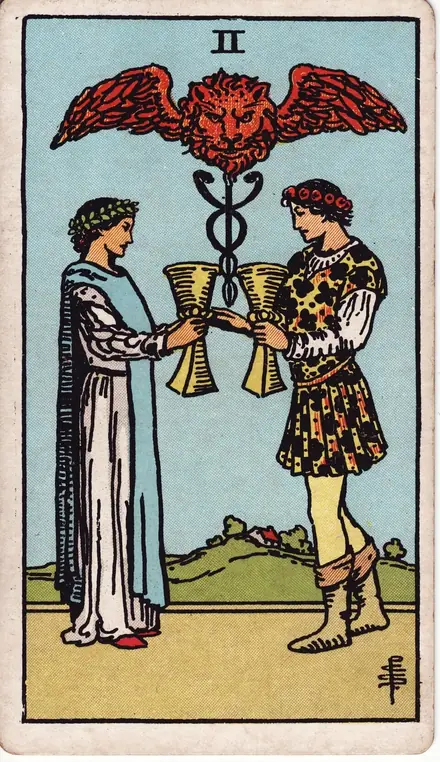
The Two of Cups is love returned in kind: two people who recognise each other, make a promise and seal a bond as equals.
Draw this card · Its correspondences
- Arcana: Minor, number 2
- Suit and element: Cups, Water
- Golden Dawn title: Lord of Love
- Sephirah: Chokmah
- Decan: Cancer I, Venus (0° to 10° Cancer)
- Keywords: Union, attraction, connection, close partnerships
- Yes or no?: Yes
- Archetype: The Ones Who Make a Promise
What the card shows
In the deck Pamela Colman Smith drew for Arthur Edward Waite in 1909, a young man and a young woman stand face to face, each holding a cup. Both wear wreaths of leaves and flowers. He steps towards her and reaches out with his free hand, as if about to touch her cup; she looks him in the eye and holds her own at the same height. Between the two cups rises a caduceus, the staff of Hermes with two twining serpents, and at its top appears a lion’s head with two great red wings. Behind them lies a calm green landscape with a house on a hill.
Each detail has its reading in the tradition. The two figures stand at the same height and wear the same crown, which speaks of a bond between equals, both standing tall and meeting each other’s gaze. The cups are their hearts, and offering them is a pledge. The caduceus, with its two serpents crossing and balancing each other, is linked with the reconciliation of opposites and with healing. The winged lion’s head is often read as passion, the animal fire of desire, raised up and placed in the service of the bond. The house in the background hints at the home that may grow from this pact.
In The Pictorial Key to the Tarot (1910), Waite describes a youth and a maiden pledging one another, and notes that the lion above the caduceus is a variant of a sign found in some older decks. The Golden Dawn called this card the Lord of Love, placed it in the sefirah Chokmah and gave it the first decan of Cancer, ruled by Venus.
Two of Cups upright
Upright, the Two of Cups reads as the union of two people who choose each other. It is the tarot’s card of mutual love above all others, and also of deep friendship, reconciliation and partnerships in which each side gives and receives in equal measure. Its defining quality is reciprocity. The Ace of Cups was a feeling that arrived; the Two is that feeling once it finds an answer in someone else.
In a spread it usually marks a meeting that matters. It can be the start of a relationship, an engagement, a conversation in which two people finally understand each other, or the end of a quarrel. The tradition links it with attraction, sympathy and harmony, with that sense of having found someone who sees the world the way you do. Waite adds a loftier note: the desire that sanctifies nature, love as something that raises up those who live it.
The Two of Cups also speaks of agreements outside romance. A business partnership, a creative collaboration or a pact between families all suit the card, as long as respect and trust are present. Beside Pentacles, the emphasis falls on practical matters; beside Wands, on a shared passion for a project.
As advice, the card invites you to take the first step with your cup held out: say what you feel, offer your hand, propose the agreement. What it asks in return is that you listen to the other person with the same attention you give to speaking.
Two of Cups reversed
Many tarot readers work with upright cards only and let the surrounding cards shade the meaning. Those who do read reversals tend to see the Two of Cups reversed as a bond that has lost its balance.
The most common reading is a mismatch. One person gives more than the other, the cups no longer sit at the same height, a promise is broken or a conversation turns sour. It can also point to a breakup, a cooling between friends, or a partnership that dissolves for lack of trust.
There is a second, more inward reading. The reversed card can speak of the relationship with oneself: someone who looks to others for the approval they will not give themselves, or who stays in a story out of fear of being alone. In that case the advice is to find your own centre again before you offer your cup once more.
Either way, the tradition asks for plain speaking and an honest look at what you expect from the other person and what you are willing to give.
In love
In love, the meaning of the Two of Cups comes down to one word: reciprocity. For a couple, it reads as a time of harmony, renewed closeness or commitment, sometimes a formal step such as moving in together or marrying. If there has been conflict, the card speaks of reconciliation and of looking each other in the eye again.
For someone single, it is one of the most hoped-for cards. Tradition reads it as a meeting with someone who returns your interest in equal measure. It can also signal a friendship that turns into something more.
Reversed, in love
Reversed, in love, the Two of Cups speaks of imbalance: one gives while the other takes, there is jealousy or misunderstanding, or the attraction is one-sided. As advice, it invites an honest talk about what each of you expects, and patience with an answer that has yet to come.
Career and money
For career and money, the Two of Cups reads as a partnership that works: a trusted associate, a collaboration with good chemistry, a deal sealed with a handshake that both sides honour. It favours negotiations aimed at mutual benefit and small teams where personal rapport counts as much as talent.
Reversed, in career
Reversed, it points to tension with a partner or colleague, agreements one side fails to keep, or a collaboration that has become lopsided. Put what was agreed in writing and make clear who contributes what.
Health and mood
For health and mood, the Two of Cups is linked with the wellbeing that comes from feeling accompanied and with recovery after a period of conflict. It reads as an invitation to lean on the people close to you. A tarot card cannot diagnose anything: for any symptom or worry, the person to see is a qualified health professional.
Yes or no? Yes
The Two of Cups reads as a “yes”, especially for questions about love, friendship or agreements. It suggests the other side is willing and the interest is mutual. This “yes” rests on reciprocity: it holds when both people want the same thing and say so. If the question concerns something you are doing alone, the card advises finding an ally.
Ask the card: a yes or no tarot reading with one card or three.
The archetype: The Ones Who Make a Promise
As an archetype, the Two of Cups is the couple at the moment of the vow. When it takes human form, it is two figures who recognise each other: lovers swearing fidelity, friends sealing a blood pact, rivals who decide to make peace. Its power lies in the gaze. Each sees in the other something no one else had noticed.
In the structure of a story, the card holds the place of the decisive meeting. In a romance, it is the scene where the two leads declare themselves; in an adventure, the moment the hero finds a travelling companion; in a family drama, the reconciliation that closes an old wound. It usually comes after a long misunderstanding, which is why readers greet it with relief.
The caduceus rising between the cups offers a valuable narrative clue. The promise joins two forces that remain distinct: two serpents that cross without merging. The best couples in fiction keep their differences, and those differences fuel the conflict of what comes next. The lion’s head reminds us that desire is at stake, and desire complicates any pact.
The risk of this archetype is sweetness without weight. A mutual meeting moves the reader when it has been hard to reach, or when the reader knows something that threatens the promise. A cup offered in the shadow of danger is worth more on the page than a thousand scenes of calm happiness.
In literature
- Romeo and Juliet (William Shakespeare, 1597). The balcony scene is the Two of Cups in its purest form: two young people who recognise each other at first sight and pledge themselves in secret. Shakespeare sets that vow between two feuding houses, so every word of love carries weight. The cup they offer each other ends up holding poison.
- Pride and Prejudice (Jane Austen, 1813). Elizabeth Bennet and Mr Darcy spend most of the novel learning to stand at the same height. First they misjudge each other, then they correct themselves. When they finally understand each other, the bond is one between equals, exactly what the card shows: both yield and both change.
- Love in the Time of Cholera (Gabriel García Márquez, 1985). Florentino Ariza waits more than half a century for Fermina Daza to return his gaze. The novel is the long wait for a Two of Cups, and the ending aboard the riverboat, flying the cholera flag, shows the promise kept when no one expected it any longer.
For writers
The conflict
The Two of Cups sets up a conflict between the promise and everything that threatens it. The bond sits at the centre, and the drama comes from what surrounds the two characters: a disapproving family, a difference in class, an old secret, a war. It also works inside the couple, with two people who love each other and expect different things from the vow they have made. For the card to carry weight, the reader needs to know what each of them risks in offering their cup.
The twist
As a plot twist, the Two of Cups is the meeting that changes course: the enemy who becomes an ally, the stranger who turns out to be the person everyone was looking for, the reconciliation no one saw coming. It works especially well midway through a story, when the protagonist has lost their support and finds someone who restores their trust. That new bond then becomes exactly what the antagonist can take away.
Prompts
- Write a promise between two characters in which each understands something different by the same words.
- Tell the first meeting of two friends who will become inseparable, and let the reader sense from the opening line how their friendship will end.
- Have two enemies drink a toast to a common cause, and let the toast hide a condition neither of them says out loud.
Its correspondences
- Element: Water. Source: Golden Dawn (tradition).
- Sephirah: Chokmah. Source: Golden Dawn (tradition).
- Decan: Cancer I. Source: Golden Dawn (tradition).
Combinations
Two of Cups and Ace of Cups
With the Ace of Cups, the Two shows the whole journey of a feeling: what was born in one person finds an answer in another. It reads as a love that begins and is returned from the very first moment.
Two of Cups and Knight of Cups
Beside the Knight of Cups, the declaration arrives and is warmly received. It reads as a romantic proposal that finds an echo, a date that goes well, or the start of a relationship that excites both people.
Two of Cups and Queen of Cups
With the Queen of Cups, the bond rests on tenderness and mutual care. It is one of the most favourable pairings in a love spread: two people who listen to each other and hold each other up in equal measure.
Two of Cups and The Lovers
With The Lovers, the romantic meaning grows stronger. The pair reads as a mutual connection and a conscious choice: two people who love each other and decide to walk the road together.
Two of Cups and Temperance
Beside Temperance, the Two of Cups speaks of reconciliation and balance between two people. It reads as a bond mended with patience, or an agreement built on equal terms.
Two of Cups and Three of Swords
With the Three of Swords, the bond crosses paths with pain: a third person, a betrayal or an old wound. The pairing asks you to protect the promise and to talk about what hurts.
Two of Cups and Ten of Cups
With the Ten of Cups, the union looks towards home and family. It reads as a relationship that settles and bears fruit, the house in the background of the card made real.
Frequently asked questions
What does the Two of Cups mean in tarot?
The Two of Cups stands for a mutual union between two people: shared love, deep friendship, reconciliation or an agreement between equals. In the tradition it is the card of reciprocity, the feeling of the Ace of Cups once it finds an answer in someone else.
What does the Two of Cups mean in love?
In love it is one of the most favourable cards: closeness, commitment or reconciliation for a couple, and a meeting with mutual interest for someone single. Its key is that the feeling runs in both directions.
Is the Two of Cups a yes or no?
It reads as a yes, especially for questions about love and agreements, because it suggests the other side is willing. It is a yes that depends on reciprocity: both people need to want the same thing.
What does the Two of Cups reversed mean?
Readers who use reversals usually see it as an unbalanced bond: one side giving more than the other, a broken promise, a growing distance or a breakup. It can also speak of seeking from others the approval you withhold from yourself.
What does the Two of Cups mean as feelings?
When you ask how someone feels about you, the Two of Cups reads as attraction and affection that are returned. Tradition links it with a person who sees you as an equal and wants to build something together.
What is the Two of Cups decan and Golden Dawn title?
In the Golden Dawn system, the Two of Cups is called the Lord of Love and corresponds to the first decan of Cancer, ruled by Venus, from 0° to 10° of the sign. On the Tree of Life it sits in Chokmah, wisdom.
Do your readingPrevious: Ace of Cups · Next: Three of Cups
The 14 cards of Cups
- Ace of Cups
- Two of Cups
- Three of Cups
- Four of Cups
- Five of Cups
- Six of Cups
- Seven of Cups
- Eight of Cups
- Nine of Cups
- Ten of Cups
- Page of Cups
- Knight of Cups
- Queen of Cups
- King of Cups
By Style Optimizer · published November 22, 2026.