Tarot / The 78 cards / Cups / Eight of Cups
Eight of Cups (8 of Cups): tarot card meaning, upright and reversed
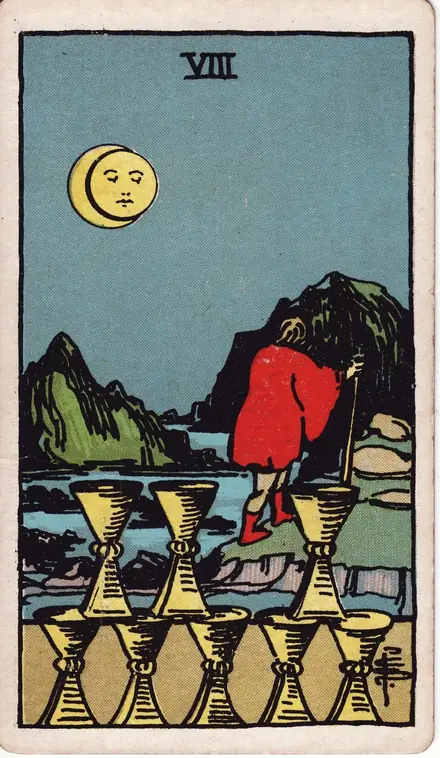
The Eight of Cups is the night departure of someone who leaves what they built because it no longer fills them, in search of something deeper.
Draw this card · Its correspondences
- Arcana: Minor, number 8
- Suit and element: Cups, Water
- Golden Dawn title: Lord of Abandoned Success
- Sephirah: Hod
- Decan: Pisces I, Saturn (0° to 10° Pisces)
- Keywords: Disappointment, walking away, withdrawal, the search for truth
- Yes or no?: No
- Archetype: The Traveller Who Leaves by Night
What the card shows
In the deck Pamela Colman Smith drew for Arthur Edward Waite in 1909, the Eight of Cups shows a man walking away with his back to us. He wears a red cloak and red boots and leans on a traveller’s staff. In the foreground stand eight cups stacked in two rows, five below and three above, with a visible gap in the upper row, as if one were missing. A strip of water runs between the cups and the traveller, and beyond it rise dark rocks and mountains. It is night. In the sky, the moon has a face and appears both full and waning at once, with the crescent drawn inside the disc.
Each detail has its reading in the tradition. The neatly arranged cups are what has been achieved through effort: a relationship, a trade, a life that works on the outside. The gap above is the lack no one else sees and the character feels. The staff and boots speak of a long journey on foot, unhurried. The mountains are linked with spiritual seeking and a hard climb. The double moon, halfway between full and waning, marks a threshold: something reaches its peak and begins to decline on the same night.
In The Pictorial Key to the Tarot (1910), Waite describes a man of dejected aspect abandoning the cups of his felicity, enterprise or former concern, and gives the card the meaning of a matter in decline, or the discovery that what seemed important carries little weight. The Golden Dawn titled it the Lord of Abandoned Success and gave it the first decan of Pisces, ruled by Saturn, in the sefirah Hod.
Eight of Cups upright
Upright, the Eight of Cups reads as a voluntary departure. The character has what they wanted, or something very like it, and still they leave. They go by their own choice, having realised that their surroundings no longer nourish them, and they decide to look elsewhere. That is why the card belongs to Cups, the suit of feeling. What runs dry is the meaning of the achievement more than the achievement itself.
In a spread it usually signals weariness with a stage of life: a stable job that bores, a decent relationship where the conversation has stopped, a city that has grown too small, a project kept alive by inertia. The card shows the exact instant of turning your back on all that. The destination is still to be discovered; what is clear is what you are leaving.
The Golden Dawn title, Lord of Abandoned Success, captures its double edge. There is real success, and there is renunciation. Saturn in Pisces, the card’s decan, reads as seriousness and limits entering the waters of emotion: the maturity of someone who understands it is time to let go. The sefirah Hod, the sphere of intellect and form, adds that the decision has been thought through; the character has counted their cups before leaving.
As advice, the card invites you to listen to that quiet unease that has no obvious cause. It asks for courage to leave what is comfortable and patience for the road ahead, which the card draws at night and uphill.
Eight of Cups reversed
Many readers never use reversals. They read every card upright and let the neighbouring cards shade the meaning. Those who do read reversed cards tend to see the Eight of Cups reversed in one of two ways.
The first is the departure that never happens. You know something no longer fulfils you, and you stay out of fear, habit or concern for what people will say. The reversed card then speaks of stagnation and dissatisfaction that drags on.
The second is the return. Waite, curiously, gives the reversed card a sense of great joy, happiness and feasting. Read this way, the traveller retraces his steps and finds the cups were worth more than he thought, or celebrates having settled his doubt. In both cases the advice is the same: tell passing tiredness apart from a lack that runs deep.
In love
In love, the Eight of Cups reads as withdrawal. For a couple, it can mean one partner feels the relationship has lost its depth and begins to pull away, sometimes in silence, sometimes through a calm conversation. It can also ask for a journey, time alone or a search that later enriches the bond, so it need not mean a breakup. What the card makes plain is that carrying on as before is no longer enough.
For someone single, it speaks of leaving behind a story that still took up space, closing an emotional chapter, or giving up a pattern of relationships that kept repeating. It is a farewell card that clears the ground.
Reversed, in love
Reversed, in love, the Eight of Cups speaks of staying in a relationship out of fear of leaving, or of going back to someone you had left. The advice is to ask yourself honestly whether you return out of desire or out of fear of being alone.
Career and money
For career and money, the Eight of Cups reads as walking away from a job or project that worked on the outside and hollowed you out inside. It can point to a career change, a sabbatical, selling a business or leaving one field to study another. The tradition advises planning the exit: the card travels on foot and by night, and the journey will be long.
Reversed, in career
Reversed, it points to someone staying in a job they have lost interest in for the sake of security, or going back to a former role. Weigh up what you gain and what you lose by staying.
Health and mood
For health and mood, the Eight of Cups is linked with emotional fatigue and the emptiness that can follow a goal achieved. It reads as an invitation to rest, to get a change of scene and to look after your spirits. A tarot card cannot diagnose anything: for persistent sadness or any symptom, the person to see is a qualified health professional.
Yes or no? No
The Eight of Cups reads as a “no” to keeping or gaining something in the form you have in mind, because the card shows someone walking away from what they had. If the question is whether to leave, change course or seek something different, the card leans towards “yes”.
Ask the card: a yes or no tarot reading with one card or three.
The archetype: The Traveller Who Leaves by Night
As an archetype, the Eight of Cups is the character whose life is in perfect order and who stands up from the table. They embody a very particular kind of courage: giving something up when no one forces them to, when staying would be easy. The pilgrim, the deserter from comfortable life, the daughter who leaves the family home, the professional who hangs up the suit. Their gesture holds a mystery for those around them, because from the outside they lack nothing.
In the structure of a story, the Eight of Cups holds the place of the call accepted, the moment the protagonist crosses the threshold and leaves the known world. It can also appear at the end, as an open close: the character walks away and the reader is left looking at the empty cups. Its dramatic force lies in the contrast between the visible and the private. The cups are neatly arranged; only the one who leaves sees the gap.
This archetype needs careful motivation. If the reader does not understand what is missing, the departure looks like a whim. It works when the story has shown the absent cup in small details: conversations that lead nowhere, empty rituals, a nostalgia without an object. Then the night departure feels inevitable, and the reader walks with the character towards the mountains.
In literature
- A Doll’s House (Henrik Ibsen, 1879). Nora has a husband, children, a pretty home and a life everyone envies. In the final scene she realises none of it is truly hers, and she leaves. The door slamming at the end is the Eight of Cups brought to the stage: a woman turning her back on her well-ordered cups to find herself.
- Siddhartha (Hermann Hesse, 1922). Siddhartha leaves his father’s house, then the ascetics, and later the wealth and the love of Kamala in the city. Each stage gives him something and each one runs dry. Hesse builds the novel as a series of departures, and the most painful is that of the prosperous man who flees his garden by night.
- The Ones Who Walk Away from Omelas (Ursula K. Le Guin, 1973). Omelas is a happy city whose joy depends on the suffering of a child locked in a cellar. Most citizens accept the bargain. A few leave the city alone, on foot, heading for the mountains, and never come back. Le Guin draws almost exactly the card: happiness left behind for a nameless search.
For writers
The conflict
The Eight of Cups sets up a conflict between visible satisfaction and private dissatisfaction. The character has achieved what they were after and finds it is not enough. The drama deepens if the people around them depend on their staying: a family, a business partner, a community. To prepare the card, let the reader see the neatly arranged cups and, in small scenes, the gap that only the protagonist notices.
The twist
As a plot twist, the Eight of Cups is the unexpected renunciation: the character who, at the moment of triumph, leaves it all behind. It works very well in the middle of a novel, when the reader believed the story had reached safe harbour. The richest moment is the night of the departure: what they take, whom they tell, which cup they look at one last time before crossing the water.
Prompts
- Write the scene in which your protagonist quietly packs a bag while the rest of the house sleeps, and let the reader understand why they are leaving without it ever being said.
- Tell a departure from the point of view of the one left with the eight cups, who discovers on counting them that one was always missing.
- Describe the traveller’s first dawn in the mountains: what they miss, and what, for the first time in years, feels truly their own.
Its correspondences
- Element: Water. Source: Golden Dawn (tradition).
- Sephirah: Hod. Source: Golden Dawn (tradition).
- Decan: Pisces I. Source: Golden Dawn (tradition).
Combinations
Eight of Cups and The Hermit
With The Hermit, the Eight of Cups speaks of withdrawing to seek a deeper meaning. Both cards show someone walking by night, and together they read as a chosen retreat, a season of fertile solitude and study.
Eight of Cups and The Moon
The Moon beside the Eight of Cups deepens the night of the journey. It reads as a departure guided by intuition more than by a plan, full of doubts and dreams, with the whole road still out of sight.
Eight of Cups and Seven of Cups
With the Seven of Cups, the leaving follows disillusionment with fantasy. It reads as leaving illusory options behind to choose a single direction, humbler and truer.
Eight of Cups and Four of Cups
The Four of Cups before the Eight traces an apathy that ripens into decision. First the offer is refused; then comes the courage to leave in search of something else.
Eight of Cups and Death
With Death, the departure is final. It reads as the complete close of an emotional or life chapter, with no way back, and as the condition for another to begin.
Eight of Cups and Six of Swords
The Six of Swords beside the Eight of Cups underlines the journey. It reads as a move or relocation that carries you away from a painful situation towards calmer waters.
Eight of Cups and Ten of Pentacles
With the Ten of Pentacles, the Eight of Cups speaks of leaving behind an inheritance, a family business or material security to follow your own calling, whatever the cost.
Frequently asked questions
What does the Eight of Cups mean in tarot?
The Eight of Cups stands for the decision to leave behind something achieved through effort because it no longer fulfils you. In the tradition it reads as withdrawal, disillusionment and the search for deeper meaning: the traveller walking away by night from his well-ordered cups.
What does the Eight of Cups mean in love?
In love it reads as withdrawal: a relationship that has lost depth, a need for time alone, or the close of a story that still took up space. It may or may not mean a breakup; it does say that carrying on as before is no longer enough for either person.
Is the Eight of Cups a yes or no?
It reads as a no to keeping things exactly as they are, because the card shows someone walking away. If the question is whether to leave, change direction or look for something different, the answer leans towards yes.
What does the Eight of Cups reversed mean?
Readers who use reversals usually see it as a departure that never happens because of fear or habit, or as a return. Waite gave the reversal a sense of joy and feasting. The advice is to tell passing tiredness from a deeper lack.
What is the Eight of Cups decan and sefirah?
In the Golden Dawn’s Book T, the Eight of Cups is titled the Lord of Abandoned Success. It corresponds to the first decan of Pisces, from 0° to 10°, ruled by Saturn, and sits in Hod, the eighth sefirah of the Tree of Life.
Why is the moon on the Eight of Cups both full and waning?
In Pamela Colman Smith’s drawing, the moon shows a full disc with the crescent drawn inside it. It reads as a threshold: something reaches its fullness and starts to wane on the same night, just as the traveller decides to leave.
Do your readingPrevious: Seven of Cups · Next: Nine of Cups
The 14 cards of Cups
- Ace of Cups
- Two of Cups
- Three of Cups
- Four of Cups
- Five of Cups
- Six of Cups
- Seven of Cups
- Eight of Cups
- Nine of Cups
- Ten of Cups
- Page of Cups
- Knight of Cups
- Queen of Cups
- King of Cups
By Style Optimizer · published November 22, 2026.