Tarot / The 78 cards / Cups / Three of Cups
Three of Cups (3 of Cups): tarot card meaning, upright and reversed
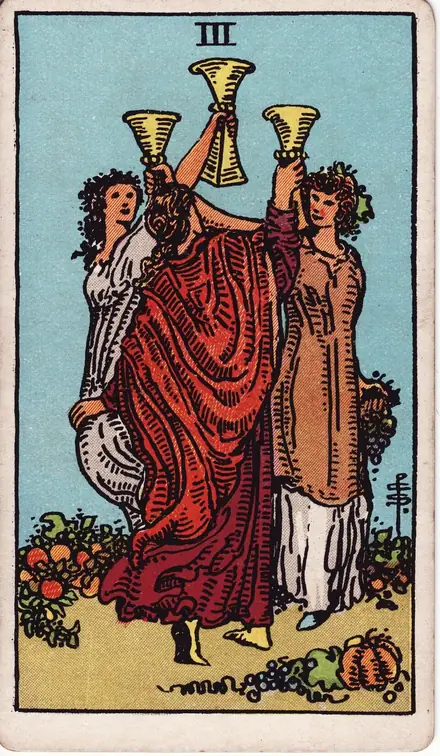
The Three of Cups is joy shared: friends raising a toast, a harvest celebrated together and an achievement that means more in good company.
Draw this card · Its correspondences
- Arcana: Minor, number 3
- Suit and element: Cups, Water
- Golden Dawn title: Lord of Abundance
- Sephirah: Binah
- Decan: Cancer II, Mercury (10° to 20° Cancer)
- Keywords: Celebration, friendship, creativity, collaboration
- Yes or no?: Yes
- Archetype: The Circle of Friends
What the card shows
In the deck Pamela Colman Smith drew for Arthur Edward Waite in 1909, three young women stand together in a garden, in a circle, raising their cups high as if toasting one another. Their bodies turn and their long dresses swing: they seem to be dancing. They wear garlands of flowers and leaves in their hair. At their feet, on the grass, lie the fruits of the harvest, pumpkins and bunches of grapes, and the sky behind them is clear.
Each detail has its reading in the tradition. Three is the number of the first fruit: after the union of the Two, something is born and multiplies, so the card speaks of abundance. The three figures joined in a circle are linked with friendship, community and a group sharing the same moment. The raised cups are the gesture of the toast, joy made public. The harvest at their feet shows that something has been achieved: a piece of work finished, a season closing with a good yield. Some readers see in the three women an echo of the Graces of classical myth, who handed out joy and beauty.
In The Pictorial Key to the Tarot (1910), Waite describes maidens in a garden lifting their cups as if pledging one another, and links the card with the happy conclusion of a matter, plenty, solace and healing. The Golden Dawn called it the Lord of Abundance, placed it in the sefirah Binah and gave it the second decan of Cancer, ruled by Mercury.
Three of Cups upright
Upright, the Three of Cups reads as celebration. It is the card of the party, the gathering of friends, the wedding, the birthday, the reunion and any moment when joy is shared. Few cards in tarot speak so clearly of community: good things happen to the group, and the group multiplies them.
In a spread it usually signals a happy ending. Something long awaited comes to a good conclusion, a piece of work bears fruit, a hard stretch ends and it is time to celebrate. The tradition associates the card with abundance, friendship, cooperation and the support of the people around you. It is linked with healing too, in the sense of finding relief in company: some sorrows are easier to carry around a table.
The Three of Cups also speaks of shared creativity. A workshop, a writing group, a choir or a theatre company all fit the card. The bond between two people in the Two opens here to several, and from that opening come projects no one would have made alone. Beside Wands, the emphasis falls on the energy of the group; beside Pentacles, on a material harvest that is shared out.
As advice, the card invites you to celebrate what you have achieved and to do it with others. It also asks you to thank the people who helped. The toast is for everyone in the circle.
Three of Cups reversed
Many tarot readers work with upright cards only and let the surrounding cards shade the meaning. Those who do read reversals tend to read the Three of Cups reversed in two directions.
The first is excess. Waite already pointed towards the side of sensual pleasure taken too far: the party that never ends, reckless spending, fun used to cover up a problem. The reversed card then speaks of knowing when to stop.
The second is a group that falls apart. A friendship that cools, gossip, a third person who comes between friends, a celebration someone is left out of. It can also point to isolation: feeling outside the circle while everyone else raises a glass.
Waite also gives the reversed card a more neutral sense: expedition, dispatch, a matter brought quickly to a close. In every case, the advice is to look at the bonds within the group and the place each person holds in it.
In love
In love, the meaning of the Three of Cups comes down to shared joy. For a couple, it speaks of good times, celebrations together, a relationship that blends well with friends and family, and sometimes an engagement worth toasting.
For someone single, the card suggests meetings at parties, gatherings or among friends. Tradition also links it with enjoying single life and the company of the people you love.
Reversed, in love
Reversed, in love, the Three of Cups can point to a third person coming between a couple, gossip that affects the relationship, or a connection that stays on the surface. As advice, it invites you to protect your privacy and keep outsiders from making decisions for the two of you.
Career and money
For career and money, the Three of Cups reads as a team success: a project that goes well thanks to cooperation, a launch worth celebrating, a workplace where colleagues get along. It favours creative group work and professional networks.
Reversed, in career
Reversed, it points to rivalry within the team, office gossip or overspending on celebrations. It can also show a shared project where some people do the work while others raise the glasses. Divide the tasks fairly.
Health and mood
For health and mood, the Three of Cups is linked with the relief that company brings and with recovery after a bad patch. The tradition also remembers its reversed side, the excesses of food and drink. A tarot card cannot diagnose anything: for any symptom or worry, the person to see is a qualified health professional.
Yes or no? Yes
The Three of Cups reads as a cheerful “yes”. It suggests the matter can end well and give you something to celebrate, especially if other people lend a hand. This “yes” grows in company: if the question concerns something you are taking on alone, the card advises looking for support.
Ask the card: a yes or no tarot reading with one card or three.
The archetype: The Circle of Friends
As an archetype, the Three of Cups is the group bound together by joy. When it takes human form, it is the inseparable friends, the sisters, the summer gang, the companions celebrating a victory together. No single character stands out from the others: what matters is the circle, and what happens inside it.
In the structure of a story, the card holds two places. The first is the feast: the wedding at the end of a comedy, the banquet that closes an adventure, the ball where every character meets. Shakespeare ends many of his comedies this way, with the whole cast celebrating. The second place is subtler: the scene of shared happiness placed just before a loss, so the reader knows exactly what is about to be lost. A toast in the first act can become the measure of everything that breaks later.
The three raised cups also hint at group dynamics. Three is the smallest number that makes a society, and also the one that allows alliances and exclusions: two against one, the newcomer, the friend left out. Fiction about groups of friends thrives on those tensions running beneath the joy.
The risk of this archetype is a party without consequences. A celebration works on the page when it means something: the achievement being toasted was hard won, or the glasses are raised while something threatens the group. The grapes on the card are a reminder that every harvest comes at the end of a season, and winter follows.
In literature
- Little Women (Louisa May Alcott, 1868). The four March sisters form the circle of the card: they play, write a homemade newspaper, stage plays and hold one another up while their father is away at war. The novel celebrates shared joy and measures its worth by what it costs to keep.
- The Three Musketeers (Alexandre Dumas, 1844). Athos, Porthos and Aramis, joined by d’Artagnan, are the group who drink together at the inn and fight side by side. Their motto, all for one and one for all, sums up the card: the strength of the circle outweighs that of any single member.
- The Sun Also Rises (Ernest Hemingway, 1926). A group of friends travels to the fiesta of San Fermín in Pamplona and drinks without pause. Hemingway paints the Three of Cups reversed: an endless celebration covering the wounds of war, jealousy and emptiness. The party rolls on while the circle cracks from within.
For writers
The conflict
The Three of Cups sets up a conflict inside the group. Shared joy is the starting point, and the drama arrives when something threatens the circle: a rivalry no one admits to, a secret between two of the friends, a fourth person who wants in, a success that reaches only one of them. It works well in stories about friendship, family or teams. For the card to carry weight, the reader has to love the group before seeing it in danger.
The twist
As a plot twist, the Three of Cups is the celebration where everything changes. In the middle of the party news arrives, someone makes an announcement, a couple forms or breaks up, or a toast reveals an alliance no one knew about. The scene brings every character together, which makes it the perfect place to rearrange their relationships in a single stroke.
Prompts
- Write a toast between three friends in which each drinks to something different and only one of them knows why.
- Tell the story of a harvest festival from the point of view of the person who organised it and whom nobody has thanked.
- Describe a group of friends meeting again twenty years later, and let a single empty glass reveal who is missing.
Its correspondences
- Element: Water. Source: Golden Dawn (tradition).
- Sephirah: Binah. Source: Golden Dawn (tradition).
- Decan: Cancer II. Source: Golden Dawn (tradition).
Combinations
Three of Cups and The Empress
Beside The Empress, the Three of Cups speaks of abundance and family celebration: a birth, a wedding or a harvest feast with loved ones. It is shared joy in its most fertile form.
Three of Cups and Four of Wands
With the Four of Wands, the celebration becomes a home or a ceremony. It reads as a wedding, a housewarming or a party marking a stable and happy stage of life.
Three of Cups and Nine of Cups
With the Nine of Cups, a wish come true is shared. It reads as a personal achievement celebrated with friends and deep emotional satisfaction.
Three of Cups and The Devil
The Devil beside the Three of Cups points to the side of excess: the party that turns into dependence, the fun that binds. The pairing asks you to keep an eye on the group’s habits.
Three of Cups and The Sun
With The Sun, joy multiplies. It is one of the brightest pairings in tarot: success, celebration in the open air, sincere friendship and good spirits for everyone.
Three of Cups and Three of Swords
With the Three of Swords, the circle breaks because of a third person, a betrayal between friends or sad news arriving in the middle of the party.
Three of Cups and Ten of Pentacles
With the Ten of Pentacles, the celebration is familial and lasting: inheritances, traditions, gatherings across several generations. It reads as a shared harvest handed down from one generation to the next.
Frequently asked questions
What does the Three of Cups mean in tarot?
The Three of Cups stands for shared joy: celebration, friendship, cooperation and abundance that is passed around. In the tradition it reads as the happy conclusion of a matter and the support of a group, and it is also linked with creativity born in good company.
What does the Three of Cups mean in love?
In love it reads as good times together, a relationship that fits well with friends and family, or an engagement worth celebrating. For someone single, it suggests meetings at parties or in groups. Reversed, it can point to a third person.
Is the Three of Cups a yes or no?
It reads as a cheerful yes: the matter can end well and give you cause to celebrate. It is a yes that grows with other people’s help, so the card advises leaning on the group.
What does the Three of Cups reversed mean?
Readers who use reversals usually see it as excess, the party that never ends and pleasure taken too far, or as a group falling apart through gossip or rivalry. Waite also gives it a neutral sense: a matter quickly brought to a close.
Does the Three of Cups mean a third party?
Upright, it reads mainly as friendship and celebration. The reading of a third person in a relationship appears more often when the card is reversed or sits beside cards such as the Three of Swords. The spread as a whole decides.
What is the Three of Cups decan and Golden Dawn title?
In the Golden Dawn system, the Three of Cups is called the Lord of Abundance and corresponds to the second decan of Cancer, ruled by Mercury, from 10° to 20° of the sign. On the Tree of Life it sits in Binah, understanding.
Do your readingPrevious: Two of Cups · Next: Four of Cups
The 14 cards of Cups
- Ace of Cups
- Two of Cups
- Three of Cups
- Four of Cups
- Five of Cups
- Six of Cups
- Seven of Cups
- Eight of Cups
- Nine of Cups
- Ten of Cups
- Page of Cups
- Knight of Cups
- Queen of Cups
- King of Cups
By Style Optimizer · published November 22, 2026.