Tarot / The 78 cards / Wands / King of Wands
King of Wands: tarot card meaning, upright and reversed
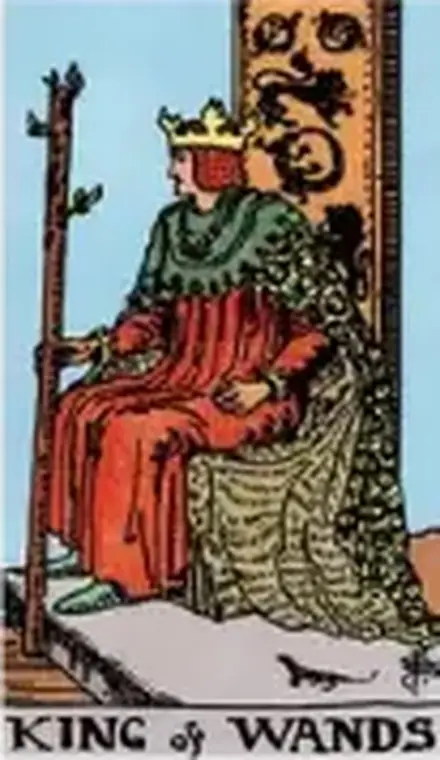
The King of Wands is fire turned into leadership: vision, natural authority and the nerve to set in motion what others only imagine.
Draw this card · Its correspondences
- Arcana: Minor, court card (King)
- Suit and element: Wands, Fire
- Golden Dawn title: Prince of the Chariot of Fire
- Nature: Air of Fire
- Sephirah: Tiphareth
- Signs: Cancer, Leo
- Keywords: Natural leadership, vision, entrepreneurship, honor
- Yes or no?: Yes
- Archetype: The Visionary Founder
What the card shows
In the deck Pamela Colman Smith drew for Arthur Edward Waite in 1909, the King of Wands sits on a throne, turned in profile, as if watching something that has not yet arrived. He holds up a long wand with green shoots. He wears an orange and yellow robe embroidered with salamanders biting their own tails, and beneath a crown shaped like flames he wears a red cap. The back of the throne shows lions and more salamanders. On the ground beside his feet sits a living salamander, small and alert. The background is a clear sky with no landscape.
Each piece carries a traditional reading. The salamander is fire’s elemental creature: according to old belief it lives among the flames without burning, so it stands for someone who has mastered their element. When it bites its tail it forms a circle, an image of continuity and of energy that renews itself. The lions return to Leo and to courage. The leafing wand is the life of the suit. The profile gaze reads as vision: the King is watching the horizon and the next step. The cap beneath the crown is what Waite calls the cap of maintenance, the cap of dignity worn by all four Kings in his deck.
In The Pictorial Key to the Tarot (1910), Waite describes an ardent nature, lithe, animated, impassioned and noble, and says the card always signifies honesty. In the Golden Dawn, Waite’s King corresponds to the Prince of the Chariot of Fire, Air of Fire, in the sefirah Tiphareth, ruling from the last degrees of Cancer to the first of Leo. The Golden Dawn swaps King and Knight: its Knight is the fire of the suit and its King is the air.
King of Wands upright
Upright, the King of Wands reads as outer mastery of fire. In the modern Rider reading, the Kings represent the maturity of their element put at the service of the world: authority, responsibility and the capacity to decide. In the suit of Wands, that means leadership, vision and an entrepreneurial spirit. The King sees what does not yet exist, describes it so that others want to join in and takes on the risk of beginning.
In a spread it often marks a moment to take charge. It is a good time to lead a project, found something of your own, negotiate with poise or defend an idea before the people who decide. When it describes a situation, it says someone needs to set the course, and that someone may well be you.
The King of Wands as a person is a natural leader. He has charisma, initiative and a self-assurance that inspires trust. He is honest and frank, sometimes too frank, and prefers action to waiting. He is driven by challenges, by projects with a horizon and by people with drive. He protects his own generously and expects the same push from them in return. Waite describes him as a friendly countryman, generally married, honest and conscientious, and adds that the card may bring news of an unexpected inheritance. He can represent the querent or someone else, of any gender, who embodies that warm authority.
As advice, the card asks you to step into the role in front of you and decide with your head held high, without waiting until everything is certain.
King of Wands reversed
Not every school reads reversals. Many readers use only upright cards and let the neighbouring cards add nuance. Those who do read the King of Wands reversed tend to take it in one of two ways.
The first is authority hardening. The leader grows impatient, imposes instead of persuading and confuses firmness with arrogance. Waite sums up the reversed card as good but severe, austere yet tolerant: the fire is still noble, and it has lost its warmth.
The second is fire that never takes shape. There are grand plans, speeches and promises, and little staying power to carry them out. The vision hangs in the air, and those who trusted it begin to tire.
In both cases the advice is to listen before deciding and to choose a single goal that can actually be reached.
In love
In love, the King of Wands reads as a relationship with passion and purpose. For couples it points to a season of initiative: travelling, moving, building something together. If he stands for the partner, he describes someone protective, loyal and enthusiastic, who shows love through action.
If you are single, the card speaks of taking the initiative and of attraction to confident people with real character. It can herald someone charismatic and direct who makes no secret of their feelings. The King of Wands as feelings is bold and generous: when he wants someone, he says so and acts on it.
Reversed, in love
Reversed in love, it points to pride, impatience or a partner who wants to decide for both of you. It can also describe big promises that go unkept. The advice is to share the lead and judge words by deeds.
Career and money
For career and money, the King of Wands reads as leadership and enterprise. It favours starting a business, leading teams, closing deals and applying for positions of responsibility. It speaks of authority earned through vision and honesty. Financially, it points to bold decisions that are best backed by a solid plan.
Reversed, in career
Reversed, it warns of hasty decisions, clashes with superiors or a project losing focus. Delegate and check the figures before going further.
Health and mood
For health and mood, the King of Wands is linked with high energy and a tendency to demand too much of yourself. It reads as an invitation to channel that force through sport and respect your rest so you do not burn out. No card can diagnose anything. For any symptom or worry, speak to a health professional.
Yes or no? Yes
The King of Wands reads as a decisive yes, especially if the question is about starting a venture, leading or making a major decision. The card says the vision and strength to carry it through are present, provided you take responsibility. Reversed, the yes first asks for patience and a plan.
Ask the card: a yes or no tarot reading with one card or three.
The archetype: The Visionary Founder
As an archetype, the King of Wands is the character who founds: the city, the company, the movement, the family that will give its name to a saga. He sees what others cannot and has the charisma to make them follow. His authority springs from vision and example, which is why he is forgiven almost anything as long as he stays out in front.
In a story, this character often opens the tale or gives it its engine. He is the king rallying his troops before battle, the captain who persuades the crew to cross an unknown sea, the patriarch who raises a town from nothing. He can be the protagonist of a rise-to-power story and also a reference figure for a young hero, who learns from him and will end up surpassing him or rebelling against him.
His shadow is just as rich. The founder can become a tyrant, mistake his vision for the truth and crush anyone who thinks differently. He can also be consumed by his own fire: so many projects, so many promises, that in the end nothing gets finished. The salamander biting its tail is a fine image for writers, a circle of energy that either renews itself or devours itself.
As a plot moment, the King of Wands marks the instant someone takes command. It usually comes after a crisis, when the group needs direction, and it opens a stretch of action. The interesting part comes afterwards: what price the leader pays for that authority, and who begins to doubt him.
In literature
- Henry V (William Shakespeare, 1599). The young king who was once a carousing prince becomes a leader able to set an exhausted army on fire. His St Crispin’s Day speech is the King of Wands’ fire turned into words: a shared vision that transforms a handful of men into a band of brothers.
- Citizen Kane (Orson Welles, 1941). Charles Foster Kane takes over a newspaper with crusading energy, publishes a declaration of principles and builds an empire on sheer charisma. The film shows both faces of the card: the founder who carries a whole city with him and the fire that, with nothing to feed it, ends alone among the treasures of Xanadu.
- Pedro Páramo (Juan Rulfo, 1955). Pedro Páramo owns Comala and everything in it. He is the King of Wands reversed: a will that accepts no limits and an authority imposed by force. When his desire is thwarted, he lets the whole town die, and the novel is heard among its ruins, in the murmurs of the dead.
For writers
The conflict
The King of Wands sets up a conflict between the leader’s vision and the cost paid by those who follow. The character believes in the project and pulls others along. It works best when the reader sees the cracks in the plan, or the sacrifice of those around him, before the King does. To prepare the card, let his enthusiasm be infectious at first, so the reader wants to follow him too.
The twist
As a plot twist, the King of Wands is the moment a character unexpectedly takes command and changes the story’s course. The reverse twist works as well: the admired leader reveals that his vision was mostly personal ambition, and his followers must decide whether to carry on, rebel or look for a new fire.
Prompts
- Write the speech your character uses to win over a sceptical group, then what the one holdout is silently thinking.
- Have your protagonist found something, a town, a company or a band, and tell the first day the project asks more than they want to give.
- Narrate the fall of a charismatic leader through the eyes of the small salamander that was always at his feet.
Its correspondences
- Element: Fire. Source: Golden Dawn (tradition).
- Sephirah: Tiphareth. Source: Golden Dawn (tradition).
- Sign: Cancer. Source: Golden Dawn (tradition).
- Sign: Leo. Source: Golden Dawn (tradition).
- Hexagram: 42 · Increase. Source: Crowley, The Book of Thoth (modern system).
In the Golden Dawn the Knight is the fire of the suit and the King its air. Many modern readings of the Rider deck swap the two.
Combinations
King of Wands and The Emperor
The Emperor beside the King of Wands reinforces authority. Fire brings vision and charisma; the Major Arcana card brings structure and order. Together they read as leadership able to carry an ambitious project all the way.
King of Wands and Strength
With Strength, the King’s leadership gains composure. The pair reads as charisma that persuades through calm and patience, so others follow out of trust and with no need for force.
King of Wands and Queen of Wands
The King and Queen of Wands form the complete fire couple. They read as a passionate relationship between equals, or a project that joins the King’s outward direction with the Queen’s warmth.
King of Wands and The Chariot
With The Chariot, the Golden Dawn’s Prince of the Chariot of Fire comes to mind. The pair reads as determined progress, a victory won through willpower and clear direction.
King of Wands and Three of Wands
The Three of Wands beside the King reads as long-range vision: someone who looks far ahead, plans an expansion and waits to see the fruit of what they set in motion.
King of Wands and The Magician
With The Magician, vision finds its tools. The pair reads as the perfect moment to launch an initiative of your own, with talent, resources and the confidence to do it.
King of Wands and King of Swords
Two Kings, fire and air. Together they read as leadership that joins enthusiasm with logic, or as a clash between the King of Wands’ intuition and the King of Swords’ cool detachment.
King of Wands and Ten of Pentacles
With the Ten of Pentacles, the founder leaves a legacy. The pair reads as a project that becomes established and passes to the next generation, echoing the unexpected inheritance Waite links with this card.
Frequently asked questions
What does the King of Wands mean in tarot?
The King of Wands stands for outer mastery of fire: leadership, vision, initiative and honesty. Tradition reads him as someone who can see what does not yet exist and persuade others to build it. Waite notes that the card always signifies honesty.
What is the King of Wands like as a person?
As a person, the King of Wands describes a natural leader: charismatic, enterprising, frank and generous with his own. He prefers action to waiting and thrives on challenges. His shadow is impatience and pride. He can stand for anyone, of any gender, with that warm authority.
What does the King of Wands mean in love?
In love he reads as passion with purpose: a couple that makes plans and looks after each other. If he stands for the partner, he describes someone loyal and enthusiastic. For singles, he invites you to take the initiative. Reversed, he warns of pride, impatience or unkept promises.
Is the King of Wands a yes or no card?
He reads as a decisive yes, especially for starting a venture or taking the lead. The card says the vision and strength are there once you accept responsibility. Reversed, the yes first asks for patience and a concrete plan.
What does the King of Wands reversed mean?
Readers who use reversals usually see him as authority grown hard and impatient, or as fire that never takes shape: big plans and little follow-through. Waite sums him up as good but severe. The advice is to listen and choose a single goal.
Why does the Golden Dawn swap the King and Knight of Wands?
In Book T, Waite’s King corresponds to the Prince of the Chariot of Fire, Air of Fire, in Tiphareth, ruling from the last degrees of Cancer to the first of Leo. The suit’s pure fire belongs to the Knight. Crowley linked the card with hexagram 42, Increase.
Do your readingPrevious: Queen of Wands · Next: Ace of Cups
The 14 cards of Wands
- Ace of Wands
- Two of Wands
- Three of Wands
- Four of Wands
- Five of Wands
- Six of Wands
- Seven of Wands
- Eight of Wands
- Nine of Wands
- Ten of Wands
- Page of Wands
- Knight of Wands
- Queen of Wands
- King of Wands
By Style Optimizer · published November 22, 2026.