Tarot / The 78 cards / Swords / Five of Swords
Five of Swords (5 of Swords): tarot card meaning, upright and reversed
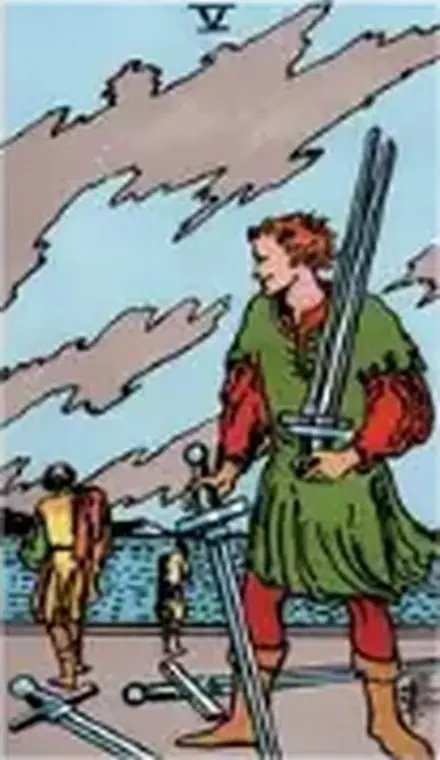
The Five of Swords is the fight you win only to find the field empty: a bitter victory, wounded pride and the price of being right.
Draw this card · Its correspondences
- Arcana: Minor, number 5
- Suit and element: Swords, Air
- Golden Dawn title: Lord of Defeat
- Sephirah: Geburah
- Decan: Aquarius I, Venus (0° to 10° Aquarius)
- Keywords: Conflict, tension, loss, defeat, a hollow victory
- Yes or no?: No
- Archetype: The Lonely Victor
What the card shows
In the deck Pamela Colman Smith drew for Arthur Edward Waite in 1909, the Five of Swords shows the end of a fight. In the foreground a red-haired young man looks over his shoulder at his rivals with a sneer. Two swords rest against his left shoulder and he holds a third in his right hand, point down. Two more lie abandoned on the ground. Behind him, two figures walk away towards the shore of a sea or lake. One trudges along hunched over. The other covers his face with his hands. The sky is slashed with jagged, broken clouds driven by the wind.
Each element has its reading. The victor has every weapon and is still alone, with nobody to celebrate alongside him. His smile reads as the satisfaction of someone who has won the argument without noticing what he has lost. The swords on the ground are the others’ defeat, abandoning even the chance to defend themselves. The weeping figure is humiliation. The torn clouds are the suit of air in turmoil: harsh words, stirred-up feelings, a storm that has yet to pass.
In The Pictorial Key to the Tarot (1910), Waite describes the man as master in possession of the field and gives the card meanings of degradation, destruction, revocation, dishonour and loss. Reversed, he gives the same, with a note of burial and obsequies. The Golden Dawn named it the Lord of Defeat, placed it in Geburah, the sephirah of severity, and gave it the first decan of Aquarius, ruled by Venus, from 0° to 10°.
Five of Swords upright
Upright, the Five of Swords reads as a conflict that leaves casualties on both sides. There is a fight, an argument or a contest, and someone comes out on top. The tradition stresses the cost of that win. The victor keeps the field, the weapons and the last word, and loses the people. That is why it is known as the card of the Pyrrhic victory.
In a reading it can describe three positions, depending on where you stand. If you recognise yourself in the man with three swords, the card asks whether it is worth winning arguments that damage a relationship, a team or a friendship. If you recognise yourself in the figures walking away, it speaks of defeat, humiliation and the need to retreat and recover. And if you are watching the scene from outside, it warns of a tense atmosphere, rivalries and foul play around you.
The Golden Dawn title, Lord of Defeat, is blunt, and Geburah, the sephirah of severity and of the force that cuts, explains the card’s harshness. The decan, Venus in Aquarius, adds an interesting shade: affection cools and the head overrules the heart. This is the card of someone who defends an idea so coldly that they forget the people in front of them.
As advice, the Five of Swords invites you to pick your battles. Sometimes the wise move is to withdraw in time, accept a small defeat or give up the last word. Other times it asks you to admit you won the wrong way and repair the damage while you still can.
Five of Swords reversed
Many readers never read reversals and let the surrounding cards supply the nuance instead. Those who do usually see the Five of Swords reversed as the end of the conflict.
It can be a reconciliation after a fight, a truce, or the moment someone decides to stop fighting because it is no longer worth it. It also reads as defeat accepted with dignity: you lose, you admit it and you move on without bitterness. Waite barely changes the meaning in reverse and adds the idea of burial, which can be read as burying the hatchet or laying a matter fully to rest.
In its harder reading, the reversed card speaks of resentment that lives on after the fight is over, or of a conflict that flares up again because it was never properly settled. The advice is to talk through what happened calmly and decide what you want to keep.
In love
In love, the Five of Swords reads as a fight won at the relationship’s expense. With a partner it can point to arguments where being right matters more than understanding each other, words meant to wound, silence used as punishment or a power struggle. The card asks what you gain by imposing your view and what breaks along the way.
If you are single, it can describe a recent break-up that left scars and hurt pride, or a defensive attitude that makes it hard to get close to anyone. It can also show rivalry, such as competing for the same person.
Reversed, in love
Reversed in love, it reads as the wish to make peace: apologising, lowering the tone, owning your share of the blame. It can also show a couple deciding to part without hurting each other further, which is another way of ending the fight.
Career and money
For career and money, the Five of Swords reads as cut-throat competition: colleagues treading on each other, a boss who wins at the team’s expense, a negotiation where someone walks away humiliated. If you are the one winning, the card warns that success gained this way tends to make enemies. Financially, beware lawsuits and money disputes that cost more than they are worth.
Reversed, in career
Reversed, it says a workplace dispute is calming down, an agreement is within reach or it is a good moment to leave a toxic environment. It also invites you to settle a conflict before it festers.
Health and mood
For health and mood, the Five of Swords is linked with the strain conflict leaves behind: frayed nerves, poor sleep and the sense of always being on the defensive. It reads as an invitation to step back from the fighting and to seek support. No card can diagnose anything: for any symptom or discomfort, the right person to see is a health professional.
Yes or no? No
The Five of Swords reads as a no. Even if you get what you are after, the card warns the price will be high and the result will leave you dissatisfied. If the question is whether to keep fighting for something, the answer is clearer still: withdrawing in time is usually the wiser choice.
Ask the card: a yes or no tarot reading with one card or three.
The archetype: The Lonely Victor
As an archetype, the Five of Swords is the character who wins and ends up alone. It can be the household tyrant who lays down the law at home, the rival who humiliates the hero, or the hero himself when ambition makes him forget the people around him. His dramatic trait is blindness. He is so busy counting the swords he has won that he never sees the people drifting off towards the shore.
In the structure of a story, the card marks the poisoned victory. It often appears in the second act, when the character gets what they wanted by the worst route, or at the close of a tragedy, when the victor surveys an empty field. It also works from the other side, as the humiliating defeat that sets the loser’s story in motion. Many revenge plots begin with those two figures walking away, faces in their hands.
The most interesting thing about the archetype is that nobody in the scene is entirely well. The victor wins and is isolated. The defeated lose and keep the chance to rebuild. That ambiguity allows for very rich scenes: arguments where the reader understands both sides, triumphs that taste of ash, characters who learn too late that being right never makes up for what they broke to prove it. A writer who uses this card holds the most uncomfortable question in drama: what is winning for?
In literature
- Wuthering Heights (Emily Brontë, 1847). Heathcliff spends half his life taking revenge on those who humiliated him, and he succeeds: he ends up with both houses, the land and the heirs. At the end, master of everything, he is lonelier than ever. He is the man with three swords, gazing at a field that gives him nothing.
- The House of Bernarda Alba (Federico García Lorca, 1936). Bernarda wins every battle inside her house, imposing mourning, silence and obedience on her daughters. Her final victory is the most terrible, because it comes with Adela’s death. Lorca writes a Five of Swords in which ruling harder means losing everything.
- Lord of the Flies (William Golding, 1954). On an island without adults, Jack seizes power from Ralph through fear and violence. The other boys join his side or fall along the way. His victory leaves the island in flames, and Golding shows starkly what is left of a group once winning becomes the only thing that matters.
For writers
The conflict
The Five of Swords sets up a conflict where winning costs more than losing. It works best when both sides are partly right and the reader can understand them. For the card to land, the victor has to want something badly, such as respect, redress or power, and get it by sacrificing a relationship that also mattered. The price must be visible in the scene.
The twist
As a plot twist, the card offers the triumph that turns into defeat. The protagonist gets what they wanted and, in the same chapter, discovers what they have lost: an ally who walks out, a child who stops speaking to them, a team that falls apart. The twist can also run the other way, if the one who lost the fight becomes the character the reader follows from then on.
Prompts
- Write an argument in which your protagonist wins with a flawless point and, in the last line, realises the other person has already gone.
- Tell the same fight from the point of view of one of the figures walking towards the shore, without ever naming the victor.
- Have a character celebrate a victory in an empty room, where every object reminds them of someone who did not come.
Its correspondences
- Element: Air. Source: Golden Dawn (tradition).
- Sephirah: Geburah. Source: Golden Dawn (tradition).
- Decan: Aquarius I. Source: Golden Dawn (tradition).
Combinations
Five of Swords and Strength
The Five of Swords beside Strength advises leaving a fight that only produces losers. The pair reads as the victory of someone who masters the impulse, refuses the bait and keeps their dignity.
Five of Swords and Knight of Swords
With the Knight of Swords, the argument is won at a gallop and the people are lost. The tradition reads the pair as a warning against needless fights and words hurled without thought.
Five of Swords and Knight of Wands
Beside the Knight of Wands, impulsiveness ends in conflict. The pair reads as an outburst that wins the argument at others’ expense, a warning about what gets said in the heat of the moment.
Five of Swords and Seven of Swords
With the Seven of Swords, victory comes through cheating. Together they read as an advantage gained by underhand means that breeds resentment and isolates whoever takes it.
Five of Swords and The Tower
The Tower beside the Five of Swords speaks of a conflict that explodes all at once and brings a whole situation down. Together they read as a fight that changes things for good.
Five of Swords and Ten of Swords
With the Ten of Swords, defeat reaches its final point. Together they read as the exhaustion of a conflict that has nothing left to give, and that at last makes way for a new beginning.
Five of Swords and Five of Cups
The Five of Cups beside the Five of Swords puts the emphasis on grieving after a fight: sorrow for what was lost, and the temptation to look only at what broke.
Five of Swords and Temperance
With Temperance, the card asks for mediation and balance. Together they read as the chance to de-escalate, find middle ground and patiently mend what was damaged.
Frequently asked questions
What does the Five of Swords mean in tarot?
The Five of Swords stands for a conflict won at too high a price: the Pyrrhic victory, pride, humiliation and defeat. The tradition reads it as a warning about fights that leave casualties on both sides, and as an invitation to pick your battles.
What does the Five of Swords mean in love?
In love it reads as arguments where being right matters more than understanding, power struggles and wounding words. If you are single, it can point to the scars of a recent break-up. The card asks what breaks when you impose your own view.
Is the Five of Swords a yes or no card?
It reads as a no. Even if you get what you want, the cost will be high and the outcome will leave you dissatisfied. If you are asking whether to keep fighting for something, the card advises withdrawing in time.
What does the Five of Swords mean reversed?
Readers who use reversals usually see it as the end of a fight: reconciliation, a truce or defeat accepted with dignity. In its harder reading, it speaks of resentment that lingers after the conflict seemed closed.
Is the Five of Swords a bad card?
It is one of the toughest cards in the suit, and the tradition reads it as a useful warning. It shows where you may be winning the wrong way or where it is wiser to step back. Its meaning depends on which figure you recognise yourself in.
What decan corresponds to the Five of Swords?
In the Golden Dawn system, the Five of Swords is the Lord of Defeat. It corresponds to the first decan of Aquarius, ruled by Venus, 0° to 10°, and sits in Geburah, the sephirah of severity on the Tree of Life.
Do your readingPrevious: Four of Swords · Next: Six of Swords
The 14 cards of Swords
- Ace of Swords
- Two of Swords
- Three of Swords
- Four of Swords
- Five of Swords
- Six of Swords
- Seven of Swords
- Eight of Swords
- Nine of Swords
- Ten of Swords
- Page of Swords
- Knight of Swords
- Queen of Swords
- King of Swords
By Style Optimizer · published November 22, 2026.