Tarot / The 78 cards / Cups / Six of Cups
Six of Cups (6 of Cups): tarot card meaning, upright and reversed
The Six of Cups is childhood memory and the gift that returns from the past: a simple joy that is remembered or found once again.
Draw this card · Its correspondences
- Arcana: Minor, number 6
- Suit and element: Cups, Water
- Golden Dawn title: Lord of Pleasure
- Sephirah: Tiphareth
- Decan: Scorpio II, Sun (10° to 20° Scorpio)
- Keywords: Revisiting the past, childhood memories, innocence, joy
- Yes or no?: Yes
- Archetype: The Child Who Gives Flowers
What the card shows
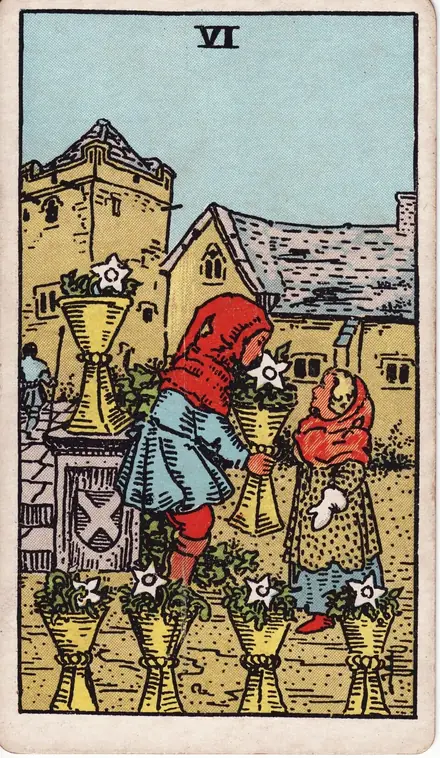
In the deck Pamela Colman Smith drew for Arthur Edward Waite in 1909, the Six of Cups takes place in the courtyard of an old house or walled village. A boy in a red hood bends towards a smaller girl and offers her a cup full of white, five-petalled flowers. There are six cups in the scene, all holding the same flowers; four rest on the ground, one is in the boy’s hands, and the last stands on a stone pedestal carved with a shield bearing a saltire cross. In the background, a guard with a spear walks away towards a tower. The sky is a bright, luminous yellow.
Each detail has its reading. The children are childhood, innocence and trust without calculation. The gesture of the gift sets the tone for the whole card: affection is given and received with nothing expected in return. The white flowers are linked with purity and memory, and their five petals recall a small star. The enclosed courtyard and the old house speak of home and of the place you come from. The departing guard is the grown-up who leaves the children to play in safety; he can also be read as time that has already passed.
Waite called it the card of the past and of memories: happiness drawn from what has already been lived, such as childhood. He also proposed a reversed reading of new relationships and new surroundings. The Golden Dawn titled it the Lord of Pleasure and gave it the second decan of Scorpio, ruled by the Sun, in the sefirah Tiphareth, beauty and balance.
Six of Cups upright
Upright, the Six of Cups reads as the return of happy memory. It speaks of childhood, of the places where you grew up, of lifelong friends, of simple gestures that did good without anyone asking for them. It is one of the tenderest cards in the deck, and the tradition associates it with nostalgia in its sweetest form.
In a spread it usually marks something coming back from the past: a person who reappears, a family reunion, a visit to a hometown or a grandparents’ house, a keepsake that stirs old memories. It can also point to a gift or a selfless favour, an act of kindness that reminds you how easy it was to love as a child.
The Six of Cups also means innocence and play. Sometimes the card invites you to take up a forgotten hobby, to laugh for no reason, to treat others with the frankness you would show a childhood friend. Its Golden Dawn title, Lord of Pleasure, points to a harmonious pleasure at the centre of the Tree of Life, where emotions find their balance.
The card has a shadow too. Nostalgia can become a hiding place and make the past seem better than it was. Beside cards such as the Five of Cups or The Moon, the emphasis falls on idealisation. As advice, the Six of Cups asks you to visit the past and bring back what was good in it: trust, tenderness and uncalculated joy. Then return to the present with those gifts in hand.
Six of Cups reversed
Many readers never use reversals. They read every card upright and let the neighbouring cards shade the meaning. Those who do read reversed cards tend to see the Six of Cups reversed in one of two ways.
The first comes from Waite, for whom the reversed card pointed to the future: renewal, things soon to come. Read this way, the card asks you to stop looking back and prepare for what lies ahead. The memories have already given all they had to give.
The second is nostalgia that traps you. You live in the past, idealise a stage of life or a person, and measure everything against a before that no longer exists. It can also point to childhood wounds asking for attention, or to difficulty growing up in some area of life.
In both cases the advice is the same: be grateful for what you have lived, look at the present with open eyes, and choose which memories deserve to travel with you.
In love
In love, the Six of Cups reads as tenderness, closeness and simple affection. For a couple, it speaks of remembering what first brought you together, returning to the places where it began, and treating each other with the ease of old friends. The meaning of the Six of Cups in love is full of play and sweetness.
For someone single, the card is often linked with the return of someone from the past: a first love, an ex, a childhood friend with whom things take on a new tone. It can also point to a relationship that grows naturally, with no pretence.
Reversed, in love
Reversed, in love, it speaks of being stuck in a past story, or of comparing every new person with an idealised memory. The advice is to leave that memory where it belongs and open yourself to what the present offers.
Career and money
For career and money, the Six of Cups reads as the value of the familiar: returning to a trade learned when young, going back to a company where you were happy, getting help from an old contact. It also favours work with children, teaching, crafts, memory and anything to do with heritage. Financially, it can point to a gift or help from family.
Reversed, in career
Reversed, it points to resistance to new methods simply because the old ones once worked. The advice is to keep the experience and open the door to new ways of working.
Health and mood
For health and mood, the Six of Cups is linked with the wellbeing that close affection, rest and simple routines bring. It reads as an invitation to look after yourself patiently and to surround yourself with people you love. A tarot card cannot diagnose anything: for any symptom or doubt, the person to see is a qualified health professional.
Yes or no? Yes
The Six of Cups reads as a gentle “yes”. Circumstances are favourable and the answer comes easily, often thanks to someone you know or something you have lived before. If the question is about the return of a person or a past situation, the card points that way. It helps if what you ask for looks forward.
Ask the card: a yes or no tarot reading with one card or three.
The archetype: The Child Who Gives Flowers
As an archetype, the Six of Cups is the character who keeps part of their childhood intact. It can be an actual child, with their direct way of seeing the world, or an adult who still knows how to give without calculating. It is the old friend who reappears, the protective older brother, the grandfather who tells stories, the stranger who does a favour and vanishes. Their defining trait is simple generosity.
In the structure of a story, the card holds the moments of memory: the flashback, the return to the place of origin, the reunion that reopens an old story. It is very useful for giving the reader a breath of light before a hard scene, or for showing where a character comes from and what they lost along the way. Used well, the card explains the present through the past.
The archetype also has an unsettling face, one literature has often explored: the character who refuses to grow up, who tries to return to a past that no longer exists, who mistakes memory for life. That tension between the sweetness of remembering and the impossibility of going back gives the Six of Cups a melancholy depth.
For it to work in fiction, the memory has to be concrete: a smell, a song, a game with its own rules. Generic nostalgia leaves the reader cold. The exact detail, like the white flower on the card, moves them.
In literature
- Swann’s Way (Marcel Proust, 1913). The narrator dips a madeleine in his tea and, all at once, his whole childhood in Combray comes back: the house, Aunt Léonie, the Sunday walks. It is the Six of Cups turned into a literary method. The past returns through the senses and becomes the material of an immense work.
- Peter Pan (J. M. Barrie, 1904). Peter leads Wendy and her brothers to Neverland, where no one ever has to grow up. Barrie gives the card both its faces: the joy of play and adventure, and the boy left outside the nursery window while the others go home and grow older. Childhood here is a gift and a trap.
- The Great Gatsby (F. Scott Fitzgerald, 1925). Gatsby builds a fortune and a mansion to win back Daisy and the summer they fell in love. He believes the past can be repeated. The novel shows the shadow of the Six of Cups: nostalgia turned into obsession, driving a man against a door that has already closed.
For writers
The conflict
The Six of Cups sets up a conflict between the remembered past and the real present. The character returns to a place or a person expecting to find what they left behind, and discovers that everything has changed, starting with themselves. It works best when the memory is very bright and the reader can feel the gap between what was hoped for and what is found. The card allows gentler conflicts too, such as someone deciding whether to open a box of keepsakes.
The twist
As a plot twist, the card suggests someone from childhood reappearing with a forgotten truth, an object or a secret. It can also be a memory that changes meaning: what the character believed was an innocent gift turns out to have another story behind it. The guard walking away in the background offers a useful clue: in childhood memories there are always grown-ups who knew something the children did not.
Prompts
- Write your protagonist’s return to the house where they grew up, told through a single object that is still in the same place.
- Tell a scene in which two adults who were friends as children meet again and discover they remember the same day differently.
- Describe a gift one child gives another and, on the same page, what that gift means to both of them thirty years later.
Its correspondences
- Element: Water. Source: Golden Dawn (tradition).
- Sephirah: Tiphareth. Source: Golden Dawn (tradition).
- Decan: Scorpio II. Source: Golden Dawn (tradition).
Combinations
Six of Cups and Judgement
With Judgement, the Six of Cups speaks of a reunion with someone or something from the past that allows a chapter to close. It reads as a return that calls you to wake up and make peace with your own history.
Six of Cups and Five of Cups
Beside the Five of Cups, memory is tinged with sorrow. It reads as nostalgia for a lost time and, at once, as the comfort of old bonds that are still standing.
Six of Cups and The Sun
The Sun with the Six of Cups is one of the brightest pairings in the deck. It reads as joy, innocence and happy family life, with a strong emphasis on children and play.
Six of Cups and Two of Cups
With the Two of Cups, the past returns as a bond: a first love, an old friendship that becomes something else, a reunion full of warmth and understanding.
Six of Cups and Ten of Pentacles
Beside the Ten of Pentacles, the emphasis falls on family and inheritance. It reads as the value of roots, traditions and possessions passed from one generation to the next.
Six of Cups and The Moon
The Moon with the Six of Cups warns of a nostalgia that confuses. It reads as an idealised memory, or a childhood wound still quietly at work in the present.
Six of Cups and Page of Cups
With the Page of Cups, tenderness multiplies. It reads as an affectionate message, an invitation to play or the arrival of a child, and always as a simple, sincere emotion.
Frequently asked questions
What does the Six of Cups mean in tarot?
The Six of Cups stands for happy memories, childhood, innocence and gifts given freely. In the tradition it reads as something returning from the past, a person or a place, and as an invitation to recover the simple joy of being a child.
What does the Six of Cups mean in love?
In love it reads as tenderness and closeness. For a couple, it invites you to remember what brought you together. For someone single, it is often linked with someone returning from the past or a relationship that grows naturally.
Is the Six of Cups a yes or no?
It reads as a gentle yes. Circumstances are favourable and the answer comes easily, often thanks to someone you know or a past experience that helps.
What does the Six of Cups reversed mean?
Readers who use reversals usually see it as nostalgia that traps you, an idealised past or a childhood wound. Waite also gave it a sense of the future and renewal: stop looking back and get ready for what is coming.
What is the Six of Cups decan and Golden Dawn title?
In the Golden Dawn system, the Six of Cups is the Lord of Pleasure. It corresponds to the second decan of Scorpio, from 10° to 20°, ruled by the Sun, and to the sefirah Tiphareth, beauty, in the element of water.
Does the Six of Cups mean someone from the past?
Very often. The tradition links it with reunions: childhood friends, relatives, old loves or people who reappear with a kind gesture. The surrounding cards help show whether that return brings something new.
Do your readingPrevious: Five of Cups · Next: Seven of Cups
The 14 cards of Cups
- Ace of Cups
- Two of Cups
- Three of Cups
- Four of Cups
- Five of Cups
- Six of Cups
- Seven of Cups
- Eight of Cups
- Nine of Cups
- Ten of Cups
- Page of Cups
- Knight of Cups
- Queen of Cups
- King of Cups
By Style Optimizer · published November 22, 2026.