Tarot / The 78 cards / Pentacles / Three of Pentacles
Three of Pentacles (3 of Pentacles): tarot card meaning, upright and reversed
The Three of Pentacles is good work done together: skilled craft, a shared plan and a building raised stone by stone with people who know.
Draw this card · Its correspondences
- Arcana: Minor, number 3
- Suit and element: Pentacles, Earth
- Golden Dawn title: Lord of Material Works
- Sephirah: Binah
- Decan: Capricorn II, Mars (10° to 20° Capricorn)
- Keywords: Teamwork, collaboration, learning
- Yes or no?: Yes
- Archetype: The Master Builder
What the card shows
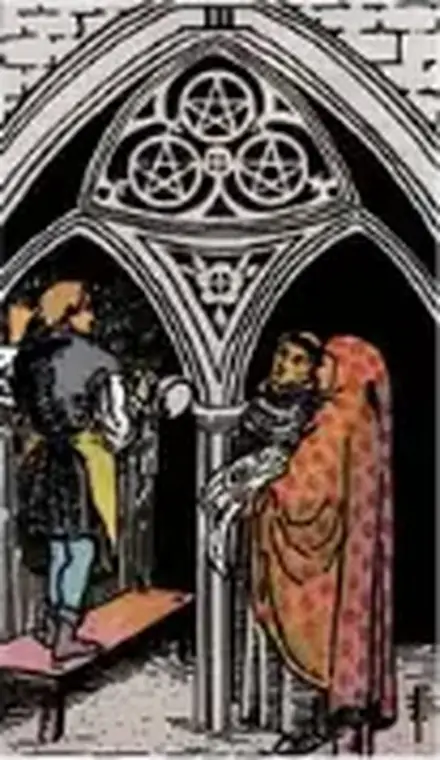
In the deck Pamela Colman Smith drew for Arthur Edward Waite in 1909, the Three of Pentacles takes place inside a stone church. A young craftsman in an apron, holding a mason’s tools, stands on a wooden bench and works high up on an arch. Below him on the left, two figures watch: a hooded monk and a person in a many-colored cloak who holds a sheet with the design of the building. In the arch, three pentacles form a triangle, with a carved flower motif beneath them.
Each detail has its reading. The three figures are the heart of the card: the one who knows how to make, the one who commissions or keeps the place, and the one who drew the plan. None of them raises the arch alone. The bench lifts the craftsman and gives him height, the height of a trade already mastered. The plan says there is a design that came first, an order worked out before anyone touched the stone. The three pentacles in a triangle, set into a sacred building, join the earth of the suit to something higher: material work placed at the service of a work that will last.
In The Pictorial Key to the Tarot (1910), Waite describes a sculptor at work in a monastery and asks us to compare the card with the Eight of Pentacles. The apprentice of that card has received his reward and is now at work in earnest. He gives the meanings of trade, skilled labor and commerce, and adds that it is often read as a card of nobility, renown and glory. The Golden Dawn called it the Lord of Material Works and placed it in the second decan of Capricorn, ruled by Mars, in the sefirah Binah, the one that gives form.
Three of Pentacles upright
Upright, the Three of Pentacles reads as work taking shape through collaboration. There is a project, a plan and people with different skills who agree to build it. It is one of the clearest cards in the tarot about craft. It speaks of competence, of accumulated practice and of the moment the effort of learning becomes a work that others can see.
In a spread it often points to a good moment for teamwork, for asking advice from someone experienced, or for showing your work to someone who can judge it. Tradition stresses recognition. The craftsman on the card works in full view, and what he does earns the others’ attention. That is why it is linked with first commissions, promotions, passed exams and a reputation earned through quality.
It also speaks of building slowly. A stone arch goes up piece by piece, and each stone holds up the next. The card values patience, detail and listening. The mason follows the plan, and the one who brought the plan listens to what the stone allows. Beside cards of momentum, such as the Three of Wands, the project grows and expands. Beside cards of study, such as the Page of Pentacles, the emphasis falls on learning.
As advice, the Three of Pentacles asks you to find the right people, share the plan and take care to do the work well, even when nobody will notice every detail.
Three of Pentacles reversed
Many readers work only with upright cards and let the neighboring cards shade the meaning. Those who read reversals usually see the Three of Pentacles reversed as a work that never quite comes together.
The first meaning is poor coordination. Everyone works alone, the plan stays in one drawer, or nobody knows who decides. The card speaks of pointless meetings, teams treading on each other’s toes and projects delayed for lack of agreement.
The second meaning concerns quality. For the reversed card Waite gives mediocrity, puerility, pettiness and weakness: work rushed or done carelessly, a craft neglected, pride that refuses to learn from others. It can also point to effort that nobody acknowledges.
The advice is to go back to the plan, clarify each person’s role and give the work the time it truly needs.
In love
In love, the Three of Pentacles reads as a relationship built together. For couples it speaks of shared projects, such as a house, a business or a family, and of a love grounded in effort and in respect for what each partner brings. This is a couple who work side by side and admire each other.
If you are single, the card can point to meeting someone at work, in a class or through a shared activity, where you first get to know them by how they do things. It also invites you to build a solid life of your own that you can later share.
Reversed, in love
Reversed in love, it speaks of a couple pulling in different directions: projects never agreed on, chores unevenly shared, a lack of mutual recognition. The advice is to sit down and talk about the shared plan and what each of you expects.
Career and money
For career and money, the Three of Pentacles is one of the most favorable cards in the suit. It points to professional competence, good collaboration and recognition: a well-received commission, a team that works, a client who values quality. It is the card of trades, of craftsmanship and of any job that demands technique. Financially, it speaks of income earned through effort and a good reputation.
Reversed, in career
Reversed, it points to team problems, poor-quality work or effort that goes unrewarded. The advice is to review your processes, ask someone experienced for feedback and refuse deadlines that force you to do the job badly.
Health and mood
For health and wellbeing, the Three of Pentacles is associated with steady care and with the value of leaning on people who know. It reads as an invitation to build habits little by little and to follow a plan. No card can diagnose anything. For any symptom or concern, the person to see is a health professional.
Yes or no? Yes
The Three of Pentacles reads as a “yes.” What you are asking about rests on good foundations and can succeed through work, preparation and the help of others. It is a “yes” that asks for effort: the building goes up if you keep working on it with steadiness and a clear plan, and it usually comes with recognition.
Ask the card: a yes or no tarot reading with one card or three.
The archetype: The Master Builder
As an archetype, the Three of Pentacles is the craftsperson who has mastered a trade and puts it at the service of something larger. The cathedral mason, the seamstress who keeps a workshop running, the village carpenter, the scientist in a small lab. Their authority comes from their hands and their years of practice, and so they earn the respect of those with power or learning, like the monk and the architect on the card.
In story structure, the Three of Pentacles appears when a group gathers to raise something: a house, a ship, a revolution, a film, a book. It is the plot of the collective work, with its tensions between whoever pays, whoever designs and whoever builds. Each sees the work differently, and the conflict springs from those three views, which must fit together like the stones of the arch.
It is also the card of an apprenticeship completed. The apprentice of the Eight of Pentacles has arrived here, and the story can center on the moment someone acknowledges their skill for the first time. That recognition changes their place in the community.
The risk with this archetype is the work that costs nothing. Construction grips the reader when it demands a price: money, years, friendships, life itself. Literature’s cathedrals stand on the sacrifices of the people who built them.
In literature
- The Pillars of the Earth (Ken Follett, 1989). Tom Builder dreams of raising a cathedral, and the novel follows masons, monks and nobles for decades as they fight over it. It is the Three of Pentacles stretched into a saga. Prior Philip provides the place, Jack the talent, and the Gothic arch rises from the clash between their interests and their faith.
- The Spire (William Golding, 1964). Dean Jocelin is determined to crown his cathedral with a great spire, though the master builder Roger Mason warns that the foundations cannot bear it. The novel shows the card’s three figures out of balance: the man of the church overrules the man of the craft, and the whole building groans under a plan that ignores the stone.
- The Hunchback of Notre-Dame (Victor Hugo, 1831). Beyond the story of Quasimodo and Esmeralda, Hugo devotes whole chapters to the cathedral as the shared work of generations of anonymous craftsmen. For him the building is a book written in stone by many hands. That idea of a shared craft outliving each builder is the Three of Pentacles in its purest form.
For writers
The conflict
The Three of Pentacles sets up a conflict inside a team that is building something. It works best when the card’s three viewpoints collide: the one who commissions wants one thing, the one who designs wants another, and the one who builds knows what the material will allow. To raise the tension, add a deadline, a thin budget or a miscalculation that forces everyone to negotiate who gives way.
The twist
As a plot twist, the Three of Pentacles is the moment someone recognizes the talent of a character who had been working in the shadows. The apprentice becomes the master, the work is finally seen complete, or an expert spots something in another’s work that nobody had noticed. The reverse twist also works: the plan was wrong, and the craftsman knew it from the start.
Prompts
- Write a scene of manual work told in the exact vocabulary of the trade, in which the character reveals who they are through the way they handle their tools.
- Put three characters in front of a half-finished building and let each describe it differently, according to what they hope it will become.
- Tell the day an apprentice realizes their master could no longer do what they have just done.
Its correspondences
- Element: Earth. Source: Golden Dawn (tradition).
- Sephirah: Binah. Source: Golden Dawn (tradition).
- Decan: Capricorn II. Source: Golden Dawn (tradition).
Combinations
Three of Pentacles and The Hierophant
With the Hierophant, the craft is learned within a tradition. Together they read as training under a master, work inside an institution and recognition from the keepers of knowledge.
Three of Pentacles and Eight of Pentacles
The Eight of Pentacles is the apprentice Waite sees arriving at the Three. Together they read as steady practice that ends in mastery and in work that others value.
Three of Pentacles and The Magician
With the Magician, technique meets ingenuity. It reads as a project with every resource at hand and a person able to turn an idea into a finished work.
Three of Pentacles and Three of Wands
Next to the Three of Wands, the project grows beyond the workshop. It reads as a collaboration that expands, with new partners or a wider market.
Three of Pentacles and Three of Cups
With the Three of Cups, the team celebrates. It reads as shared work that ends well and as professional relationships that turn into friendship.
Three of Pentacles and Ten of Pentacles
The Ten of Pentacles adds endurance. Together they speak of a work that is inherited: a family business, a house or a trade handed down from one generation to the next.
Three of Pentacles and Five of Swords
With the Five of Swords, the team breaks from within. It reads as rivalry at work, credit someone steals or a collaboration that ends in a dispute.
Frequently asked questions
What does the Three of Pentacles mean in tarot?
The Three of Pentacles represents teamwork, craft and a work built from a shared plan. Tradition reads it as competence, collaboration and recognition: the moment the effort of learning produces a result that others value.
What does the Three of Pentacles mean in love?
In love it reads as a relationship built together, with shared projects and respect for what each partner brings. For singles, it can point to meeting someone at work or in a class. Reversed, it speaks of a couple pulling in different directions.
Is the Three of Pentacles a yes or no card?
It reads as a “yes.” What you ask about rests on good foundations and can succeed through work, preparation and the help of others. It is a “yes” that asks for consistency and a clear plan.
What does the Three of Pentacles reversed mean?
Readers who use reversals often see it as a work that fails to come together: poor coordination, low-quality work or effort nobody acknowledges. Waite gives it the meanings of mediocrity and pettiness. The advice is to return to the plan and care for the craft.
What decan and Golden Dawn title belong to the Three of Pentacles?
In the Golden Dawn’s Book T, the Three of Pentacles is the Lord of Material Works. It corresponds to the second decan of Capricorn, 10° to 20°, ruled by Mars, and to the sefirah Binah on the Tree of Life.
Who are the three figures on the Three of Pentacles?
Tradition reads them as a craftsman standing on a bench, a monk and a figure holding the plans of the building. They stand for three kinds of knowledge, craft, place and design, which have to agree for the arch to rise.
Do your readingPrevious: Two of Pentacles · Next: Four of Pentacles
The 14 cards of Pentacles
- Ace of Pentacles
- Two of Pentacles
- Three of Pentacles
- Four of Pentacles
- Five of Pentacles
- Six of Pentacles
- Seven of Pentacles
- Eight of Pentacles
- Nine of Pentacles
- Ten of Pentacles
- Page of Pentacles
- Knight of Pentacles
- Queen of Pentacles
- King of Pentacles
By Style Optimizer · published November 22, 2026.