Tarot / The 78 cards / Cups / Nine of Cups
Nine of Cups (9 of Cups): tarot card meaning, upright and reversed
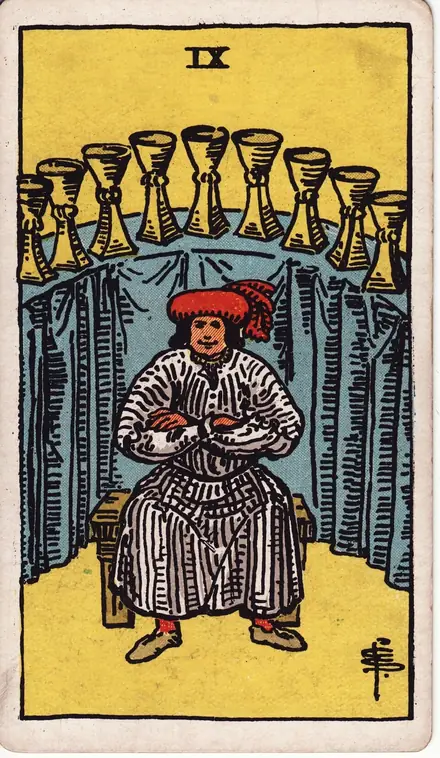
The Nine of Cups is a wish fulfilled and the pleasure of enjoying it: someone who has filled their table and at last sits down to admire it.
Draw this card · Its correspondences
- Arcana: Minor, number 9
- Suit and element: Cups, Water
- Golden Dawn title: Lord of Material Happiness
- Sephirah: Yesod
- Decan: Pisces II, Jupiter (10° to 20° Pisces)
- Keywords: Satisfaction, gratitude, a wish fulfilled
- Yes or no?: Yes
- Archetype: The Contented Host
What the card shows
In the deck Pamela Colman Smith drew for Arthur Edward Waite in 1909, the Nine of Cups shows a stout man seated on a wooden bench, facing us, arms folded across his chest and wearing a calm smile. He has a red cap, a pale tunic and red stockings. Behind him curves a crescent-shaped table or counter, draped to the floor in blue cloth, and on it rest nine golden cups set out in an arc. The background is a plain yellow, with no landscape.
Each detail has its reading in the tradition. The nine cups in a row are abundance gathered and on display, the fruit of everything that has filled up along the suit. The arc they form recalls a stage or an altar: satisfaction is shown off with pride. The folded arms can be read two ways: as the gesture of someone content who needs nothing more, and as the gesture of someone guarding what is theirs and letting no one near the table. The blue cloth is the water of the suit, still and well contained. The red cap adds a taste for pleasure and for life in the body. The yellow background, with no horizon, is the light of a good day.
In The Pictorial Key to the Tarot (1910), Waite describes a figure who has feasted to his heart’s content, with abundant wine behind him, as if the future were secured as well. He adds that the picture shows only the material side of things. The Golden Dawn titled it the Lord of Material Happiness and gave it the second decan of Pisces, ruled by Jupiter, in the sefirah Yesod.
Nine of Cups upright
Upright, the Nine of Cups reads as satisfaction. What you wished for has arrived, or is so close that you are already enjoying it. Modern readers often call it the wish card, and in a spread it usually brings good news: a goal reached, a celebration, a season of wellbeing and appetite for life. Waite gave it the meanings of concord, contentment, physical bien-être, victory and advantage.
The card puts the emphasis on enjoyment. The man is seated, resting, looking back at whoever looks at him. He has stopped working for a moment to savour what he has won. That is why it also speaks of shared meals, good health, small luxuries and the right to feel good about what you have.
Its Golden Dawn decan, Jupiter in Pisces, reads as expansion and generosity in the waters of feeling. Jupiter is the planet of abundance, and in a water sign it multiplies emotional pleasure. The sefirah Yesod, the foundation, home of imagination and dreams, adds a nuance: the happiness of the Nine leans heavily on one’s self-image. The title, Lord of Material Happiness, makes clear that this is a concrete, earthly wellbeing.
As advice, the card invites you to acknowledge what you have achieved and enjoy it without guilt. With Waite’s caution, it also reminds you that happiness has other dimensions beyond a full table. The next step, the Ten, is to share it.
Nine of Cups reversed
Many readers never use reversals. They read every card upright and let the neighbouring cards shade the meaning. Those who do read reversed cards tend to see the Nine of Cups reversed in one of two ways.
The first is excess. The table is full and enjoyment turns into complacency: eating too much, spending too much, showing off, mistaking wellbeing for accumulation. For the reversed card, Waite lists mistakes and imperfections.
The second is a wish only half fulfilled, or one that satisfies less than expected once it arrives. Yet Waite also gives the reversal the meanings of truth, loyalty and liberty. Read this way, the reversed card reveals what remains once the table is cleared away.
In love
In love, the Nine of Cups is one of the most favourable cards in the suit. For a couple, it reads as a time of wellbeing, shared pleasure and closeness, often tied to a celebration, a trip or good news you share. For someone single, it speaks of feeling good in your own skin, enjoying your social life and being in a fine frame of mind for a meeting that fits what you want.
The card has one nuance worth noticing: the man sits alone on his bench. It can point to a very personal happiness that is not yet fully shared.
Reversed, in love
Reversed, in love, the Nine of Cups speaks of looking to a partner to confirm your self-image, of vanity, or of a comfortable relationship lived with little real commitment. The advice is to make room at the table for the other person.
Career and money
For career and money, the Nine of Cups reads as success and recognition: a project that goes well, a pay rise, a sale, a season of comfortable income. It is a good card for hospitality, leisure and anything that gives pleasure to others. The tradition advises enjoying the moment and managing what comes in with a clear head.
Reversed, in career
Reversed, it points to impulsive spending, complacency that lets work slide, or a smaller success than hoped. Check the accounts before you celebrate.
Health and mood
For health and mood, the Nine of Cups is linked with wellbeing, good humour and a zest for life. It also calls for moderation with food and drink, as the image itself suggests. A tarot card cannot diagnose anything: for any symptom or doubt, the person to see is a qualified health professional.
Yes or no? Yes
The Nine of Cups reads as a clear “yes”. It is the wish card, and in yes or no questions the tradition counts it among the most favourable in the deck. The nuance lies in the kind of wish: if it is sincere and well considered, the card backs it; if it springs from vanity, the satisfaction may be short-lived.
Ask the card: a yes or no tarot reading with one card or three.
The archetype: The Contented Host
As an archetype, the Nine of Cups is the character who has arrived where they wanted to be and enjoys it in full view of everyone. The host of the party, the prosperous merchant, the genial bon vivant, the burgher showing off his house. There is something endearing about them and something comic: we love them for their joy and smile at their pride. The folded arms sum up the type’s ambiguity, because they can mean contentment and also a lock on the door.
In the structure of a story, the Nine of Cups holds the place of the happy plateau, the moment the protagonist gets what they were after and the story allows itself to celebrate. It is a delicate point. In comedy, the card closes the tale with a banquet. In more complex stories, that moment of fullness sets up the next question: what to do with what has been won, and whom to share it with.
The literary interest of the archetype lies in Waite’s caution: the picture shows only the material side. A writer can play with the distance between what the character believes makes them happy and what the reader senses. The self-satisfied figure gazing at their cups becomes a great character when the reader sees, behind the golden arc, the gap the character has yet to notice.
In literature
- The Wind in the Willows (Kenneth Grahame, 1908). Mr Toad of Toad Hall has money, a fine house and a boundless appetite for the latest pleasure, from boats to motor cars. He boasts, sings his own praises and lands in trouble again and again. The novel ends with a banquet at Toad Hall, where a humbler Toad finally lets others take the credit.
- Henry IV, Part 1 (William Shakespeare, 1597). Falstaff is the great lord of enjoyment in English drama: he drinks, eats, brags and turns every tavern into his kingdom. He embodies the bright side of the card, the joy of the body and of humour, and its shadow too, a contentment that lives only for the present and for his own pleasure.
- The Pickwick Papers (Charles Dickens, 1836). Samuel Pickwick, wealthy, retired and fond of his dinner, travels England with his friends through inns, feasts and Christmas parties. Dickens makes his wellbeing a comic engine and, little by little, a generous one: the novel shows personal contentment opening out to others.
For writers
The conflict
The Nine of Cups sets up a quiet conflict: someone has got what they wished for and must decide what to do with it. It can be a comic conflict of pride and excess, or an intimate one, between the satisfaction of the self-image and a need that a full table cannot meet. To prepare it, show the character truly enjoying themselves: the reader has to believe in their joy before doubting it.
The twist
As a plot twist, the Nine of Cups is the wish granted. The prize, the promotion, the inheritance or the longed-for love arrives, and the story changes its question. The most fertile twist comes when the fulfilled wish brings consequences no one foresaw, or when someone approaches the table and the character must choose between folding their arms and making room.
Prompts
- Write a banquet scene narrated by the host, so pleased with himself that the reader discovers what he misses through his guests’ gestures.
- Have your character get exactly what they asked for in the first chapter, and devote the next scene to what they do the morning after.
- Tell the story of one of the nine cups: who filled it, when, and what it cost someone who never appears at the table.
Its correspondences
- Element: Water. Source: Golden Dawn (tradition).
- Sephirah: Yesod. Source: Golden Dawn (tradition).
- Decan: Pisces II. Source: Golden Dawn (tradition).
Combinations
Nine of Cups and King of Cups
The Nine of Cups with the King speaks of emotional satisfaction and generosity: a mature person who enjoys what they have and shares it. It reads as stable, well-managed wellbeing, favourable for sincere wishes.
Nine of Cups and The Sun
With The Sun, the Nine of Cups shines at full strength. It reads as success, joy and health, one of the brightest pairings in the deck for any question about wishes and celebrations.
Nine of Cups and The Empress
The Empress beside the Nine of Cups underlines abundance and the pleasures of the senses. It reads as fertility, good food and a season of comfortable, generous growth.
Nine of Cups and The Devil
With The Devil, satisfaction turns into excess. It reads as a warning about dependence on pleasure, spending or vanity: enjoy yourself without being bound by what you enjoy.
Nine of Cups and Ten of Cups
The Nine and Ten of Cups together trace the move from personal happiness to shared happiness. Your own wish comes true and opens out to family or group.
Nine of Cups and Nine of Pentacles
With the Nine of Pentacles, the wellbeing is also material and self-made. It reads as financial independence, a well-kept home and the pleasure of enjoying what you have grown yourself.
Nine of Cups and Seven of Cups
The Seven of Cups beside the Nine asks you to tell real wishes from fantasies. It reads as the right choice among many temptations, or as a warning against wanting what merely glitters.
Nine of Cups and The Star
The Star with the Nine of Cups reads as a wish come true after a hard time. Hope finds its reward, and the satisfaction rests on a deep sense of calm and meaning.
Frequently asked questions
What does the Nine of Cups mean in tarot?
The Nine of Cups stands for a wish fulfilled and the enjoyment of what you have achieved. In the tradition it reads as satisfaction, wellbeing, success and good humour; modern readers call it the wish card. Waite noted that the picture shows mainly the material side of happiness.
What does the Nine of Cups mean in love?
In love it reads as wellbeing, shared pleasure and closeness, often tied to a celebration. For singles, it speaks of feeling good about yourself and open to a meeting. Its nuance is that the man on the card sits alone: the joy may still be very personal.
Is the Nine of Cups a yes or no?
It reads as a clear yes, and the tradition counts it among the most favourable cards for yes or no questions. The nuance lies in the wish: if it is sincere, the card backs it; if it springs from vanity, the satisfaction may not last.
What does the Nine of Cups reversed mean?
Readers who use reversals usually see it as excess and complacency, or as a wish only half fulfilled. Waite gave the reversal mixed meanings: mistakes and imperfections, and also truth, loyalty and liberty. The advice is to see what remains once the table is cleared.
What is the Nine of Cups decan and sefirah?
In the Golden Dawn’s Book T, the Nine of Cups is titled the Lord of Material Happiness. It corresponds to the second decan of Pisces, from 10° to 20°, ruled by Jupiter, and sits in Yesod, the foundation, the ninth sefirah of the Tree of Life.
Why does the man on the Nine of Cups have his arms folded?
In Pamela Colman Smith’s drawing, the folded arms can be read two ways: as the gesture of someone satisfied who needs nothing more, and as that of someone keeping the table to himself. That double reading gives the card its note of pride.
Do your readingPrevious: Eight of Cups · Next: Ten of Cups
The 14 cards of Cups
- Ace of Cups
- Two of Cups
- Three of Cups
- Four of Cups
- Five of Cups
- Six of Cups
- Seven of Cups
- Eight of Cups
- Nine of Cups
- Ten of Cups
- Page of Cups
- Knight of Cups
- Queen of Cups
- King of Cups
By Style Optimizer · published November 22, 2026.