Tarot / The 78 cards / Cups / Queen of Cups
Queen of Cups: tarot card meaning, upright and reversed
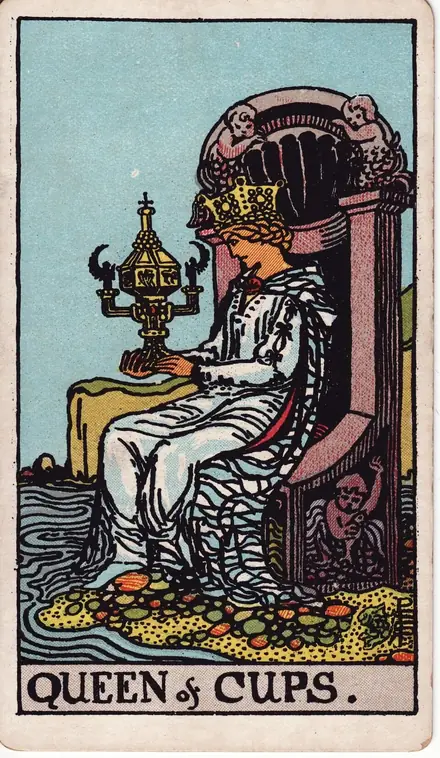
The Queen of Cups is deep feeling that knows how to listen: intuition, compassion and a calm that welcomes others without drowning in emotion.
Draw this card · Its correspondences
- Arcana: Minor, court card (Queen)
- Suit and element: Cups, Water
- Golden Dawn title: Queen of the Thrones of the Waters
- Nature: Water of Water
- Sephirah: Binah
- Signs: Gemini, Cancer
- Keywords: Compassion, calm, comfort, support
- Yes or no?: Yes
- Archetype: The One Who Listens and Sees
What the card shows
In the deck Pamela Colman Smith drew for Arthur Edward Waite in 1909, the Queen of Cups sits on a stone throne exactly where the land ends. The water reaches her feet, which rest on coloured pebbles. The throne is carved with small water babies, half undine and half cherub, and crowned with a shell. She is dressed in white and blue, and her mantle falls to the ground as if melting into the shore.
In her hands she holds a cup quite unlike the others in the suit: golden, worked like an altar vessel, with two angel-shaped handles and, above all, closed with a lid. It is the only covered cup in the whole series. The Queen gazes at it intently, absorbed. The tradition reads that lid as the secret of the inner life: what is truly felt is kept, protected and opened only to those who know how to look. The water babies on the throne speak of imagination and tenderness; the shell, of the sea as origin; the border between land and water, of a woman who belongs to both worlds and drowns in neither.
In The Pictorial Key to the Tarot (1910), Waite describes her as a dreamer who sees visions in her cup, and adds at once that she also acts, and that her activity feeds her dream. The Golden Dawn called her the Queen of the Thrones of the Waters, water of water, and placed her in Binah, between Gemini and Cancer. The same system swaps King and Knight: its Knight is the fire of the suit and its King the air.
Queen of Cups upright
Upright, the Queen of Cups reads as inner mastery of water: the ability to feel deeply without letting emotion take the reins. She speaks of intuition, listening and care. In a spread she usually marks a moment to attend to what you feel before deciding, to trust first impressions and to give others room to tell their side. Her calm welcomes: it makes a place where others can weep, confess or rest.
The tradition also links her with creation. The closed cup holds visions, and the Queen knows how to wait for them to ripen. That is why she appears when an idea, an artistic project or an affection needs to incubate in silence before it is shown.
The Queen of Cups as a person reads as someone sensitive, empathetic and rich in inner life, of any age or gender, though the tradition pictures a mature woman. She is the friend everyone calls in a crisis, the therapist, the nurse, the mother who reads what is happening in a single look, the artist who works from intuition. She listens more than she speaks. She remembers the details of every person. She has a fine moral sense and a deep loyalty. Her weak point is porousness: she absorbs other people’s moods and can carry their sorrows until she is exhausted. Waite describes a good, fair woman, honest and devoted, with a loving intelligence that gives her the gift of vision. As advice, the card asks for that same balance: feel fully, and keep the lid on the cup so that what is yours does not spill away.
Queen of Cups reversed
Many tarot readers work with upright cards only and let the surrounding cards shade the meaning. Those who do read reversals tend to see the Queen of Cups reversed as water that floods or stagnates.
Flooding, she is emotion that swamps everything: touchiness, mood swings, emotional dependence, the person who gets lost in everyone else’s problems and no longer knows what she herself feels. Stagnant, she is sensitivity closed off: the covered cup no one can open any more, resentment stored away, fantasy taking the place of life.
Among the reversed meanings, Waite lists a distinguished woman who is not to be trusted. As a character, she is emotional manipulation: someone who uses tenderness and guilt to get what she wants. The advice of the reversed card is to return to the shore, set boundaries and look after yourself before you go on looking after others.
In love
In love, the Queen of Cups is one of the tenderest cards in the tarot. For a couple, she reads as devotion, understanding and deep emotional intimacy: two people who listen to each other, care for each other and can talk about their feelings without fear. She can also point to a partner who brings calm and support.
For someone single, the card speaks of opening up through sensitivity, recognising what you truly want and drawing bonds deeper than before. As a person in a love reading, she usually represents someone gentle, intuitive and faithful.
Reversed, in love
Reversed, in love, the Queen of Cups points to emotion poorly shared: jealousy, a need for approval, giving everything and expecting the same in return, or an idealisation that hides who the other person really is. She asks you to restore your boundaries and listen to yourself before pouring yourself out.
Career and money
For career, the Queen of Cups favours the caring and creative professions: health, teaching, psychology, support work, art and writing. She reads as a good moment to trust your intuition, mediate in conflicts and tend the mood of the team. With money, she advises emotional prudence: spend on what brings real wellbeing, without being swept along by impulse.
Reversed, in career
Reversed, she warns of burnout from carrying everyone’s problems, of decisions driven by mood, and of being won over by emotional arguments in money matters.
Health and mood
For health and mood, the Queen of Cups is linked with emotional sensitivity and the need for rest, sleep and quiet spaces. She invites you to keep a balance between giving and receiving. A tarot card cannot diagnose anything: for any symptom or worry, the person to see is a qualified health professional.
Yes or no? Yes
The Queen of Cups reads as a serene “yes”, especially for questions about love, friendship, family and creative work. The card favours what grows from sincere affection and intuition. Her “yes” asks you to listen to what you truly feel: if the question rests on an honest wish, the answer is favourable; if it rests on a fantasy, look inside the cup before you leap.
Ask the card: a yes or no tarot reading with one card or three.
The archetype: The One Who Listens and Sees
As an archetype, the Queen of Cups is the character who holds the emotional life of a story. The confidante, the mother, the healer, the lover who understands before anyone explains, the neighbour who knows what goes on in every house. Around her, others lower their guard and tell the truth. Her power is the power of listening, which in fiction is worth as much as a sword: whoever listens to everyone ends up knowing more than anyone.
In the structure of a story, the Queen of Cups usually holds one of two places. She can be the refuge, the house the protagonist returns to between blows to put themselves back together. Or she can be the protagonist of an inward story, where the action happens inside: a woman who sees more than she says, who senses disaster before the others and decides when to open the cup.
The richest plot for this archetype springs from her weakness. A Queen of Cups who absorbs everything is left with no space of her own; the story comes alive on the day she must choose between caring for others and attending to what she keeps. The covered cup on the card is a direct invitation to the writer: what is inside, who has seen it open, and what would happen if someone forced the lid?
She also works as a mirror for other characters. Facing her, the impulsive one sees their own impulsiveness and the liar feels found out. The Queen of Cups only has to look and stay silent for the temperature of a scene to change.
In literature
- The House of the Spirits (Isabel Allende, 1982). Clara del Valle is an almost literal Queen of Cups: a woman who sees what is coming, lives attuned to her inner world and holds the family together with a calm that can look like absence. Her notebooks keep everyone’s memory, like the closed cup on the card.
- To the Lighthouse (Virginia Woolf, 1927). Mrs Ramsay holds the people of the summer house together through her attention, her silences and her sense of what each guest needs. Woolf narrates from inside her characters’ minds, and the Queen of Cups reigns there, in everything felt and left unsaid.
- Little Women (Louisa May Alcott, 1868). Marmee, mother of the March sisters, holds the family together while their father is away, with tenderness, moral firmness and a listening ear that never judges. Each daughter brings her sorrow to her, and she answers with advice that teaches them to govern what they feel.
For writers
The conflict
The Queen of Cups sets up a conflict between caring for others and caring for yourself. The character feels what everyone else feels, so everyone leans on her, until her own inner life demands room. To make it work, show the price of that devotion first in small details: calls answered at all hours, a piece of work endlessly postponed, a wish of her own she never mentions.
The twist
As a plot twist, the Queen of Cups is the intuition that proves right. The quiet character nobody took seriously knew from the start what was happening and kept it in her cup. The moment she opens it, when she finally says what she has seen, can turn the whole story around and change who holds power in the scene.
Prompts
- Write a scene in which one character comforts another and, as she does, the reader realises she is the one who most needs comfort.
- Imagine what your protagonist keeps in a closed cup, and write the day someone opens it without permission.
- Tell a conversation by the sea in which what matters happens in what one of the two people senses and keeps to herself.
Its correspondences
- Element: Water. Source: Golden Dawn (tradition).
- Sephirah: Binah. Source: Golden Dawn (tradition).
- Sign: Gemini. Source: Golden Dawn (tradition).
- Sign: Cancer. Source: Golden Dawn (tradition).
- Hexagram: 58 · The Joyous (Lake). Source: Crowley, The Book of Thoth (modern system).
In the Golden Dawn the Knight is the fire of the suit and the King its air. Many modern readings of the Rider deck swap the two.
Combinations
Queen of Cups and King of Cups
The Queen and King of Cups together form the emotional couple of the suit: she feels inwardly, he governs outwardly. They read as a mature relationship of mutual understanding, or as one person who unites intuition and composure.
Queen of Cups and The High Priestess
With The High Priestess, intuition doubles. It reads as very reliable inner knowledge, a secret best kept a little longer, or a season of fertile silence before speaking.
Queen of Cups and The Moon
The Moon beside the Queen of Cups asks you to tell intuition from imagination. Emotions run deep and dreams are vivid; the tradition advises checking before believing everything you feel.
Queen of Cups and Two of Cups
With the Two of Cups, tenderness finds an answer: a loving bond or a friendship in which both people care for each other equally. It is a very favourable pairing in love readings.
Queen of Cups and The Empress
The Empress and the Queen of Cups speak of abundant care: motherhood, home, artistic work born from affection. The emphasis falls on what grows when it is given warmth.
Queen of Cups and Queen of Swords
With the Queen of Swords, heart and head meet. It reads as the need to put clear words to what you feel, or as two women of different temperaments who complement each other.
Queen of Cups and Queen of Pentacles
With the Queen of Pentacles, care becomes complete: one tends the spirit and the other the practical side. They read as someone both empathetic and practical, or as two close figures of support.
Queen of Cups and Queen of Wands
The Queen of Wands beside the Queen of Cups joins fire and water. They read as passion and sensitivity in the same person, or as two women of opposite temperaments who complete each other.
Frequently asked questions
What does the Queen of Cups mean in tarot?
The Queen of Cups stands for inner mastery of water: intuition, compassion, listening and a welcoming calm. In the tradition she reads as the ability to feel deeply without getting lost in emotion, and she is linked with care and with creative work that ripens in silence.
What does the Queen of Cups mean in love?
In love she is one of the tenderest cards: devotion, understanding and emotional intimacy. For a couple, she speaks of caring for and listening to each other; for someone single, of opening up through sensitivity. As a person, she usually describes someone gentle, intuitive and faithful.
What does the Queen of Cups mean as a person or as feelings?
She reads as someone empathetic, intuitive and rich in inner life: the confidante, the carer, the artist who works from feeling. As someone’s feelings, she points to deep, protective tenderness. Her challenge is to set limits so she does not carry everyone’s sorrows.
Is the Queen of Cups a yes or no?
She reads as a serene yes, especially in love, family and creative work, as long as the question springs from a sincere wish. If it rests on a fantasy, the card asks you to look inside yourself before deciding.
What does the Queen of Cups reversed mean?
Readers who use reversals see her as water that floods or stagnates: emotions that swamp everything, emotional dependence, stored-up resentment or manipulation through guilt. The advice is to restore your boundaries and look after yourself.
What are the signs and sefirah of the Queen of Cups?
In the Golden Dawn she is the Queen of the Thrones of the Waters, water of water, in the sefirah Binah, ruling from the last degrees of Gemini to the first of Cancer. In *The Book of Thoth*, Crowley links her with hexagram 58, The Joyous (Lake).
Do your readingPrevious: Knight of Cups · Next: King of Cups
The 14 cards of Cups
- Ace of Cups
- Two of Cups
- Three of Cups
- Four of Cups
- Five of Cups
- Six of Cups
- Seven of Cups
- Eight of Cups
- Nine of Cups
- Ten of Cups
- Page of Cups
- Knight of Cups
- Queen of Cups
- King of Cups
By Style Optimizer · published November 22, 2026.